10 Red Flags to Avoid When Hiring Local Groomers
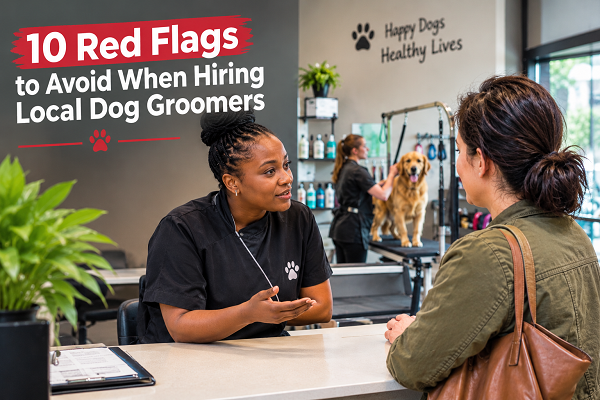
What are the biggest red flags when hiring a dog groomer? The biggest warning signs are a groomer who won’t let you see where your dog will be handled, uses heated cage dryers or leaves dogs unwatched, skips questions about health and vaccines, or offers sedation. Others include no proof of training or insurance, rough handling, a rushed or smelly salon, shaving double coats without a conversation, and vague pricing. If you spot one, walk out. Finding another groomer is easy. Undoing an injury isn’t.
Table of Contents
- Introduction
- Why Trust This Guide?
- Why Red Flags Matter: Dog Grooming Is Mostly Unregulated
- The 10 Red Flags of a Bad Dog Groomer
- Quick Red Flag Cheat Sheet
- 12 Questions to Ask Before You Book
- Your 15-Minute Vetting Plan
- Special Cases: Red Flags That Change by Dog
- What to Do If You Spot a Red Flag (or Something Goes Wrong)
- Frequently Asked Questions
- Conclusion
- Sources
Introduction
You hand over the leash, wave goodbye, and go and run errands. A few hours later, your dog comes back clean, fluffy and happy. That’s how most grooming visits go, and that’s the problem. Because they usually go well, we rarely stop to ask what could go wrong.
Here’s the thing. The red flags when hiring a dog groomer are easy to miss if you don’t know what to look for. Dog grooming is mostly unregulated in many countries, so anyone can open a salon, buy clippers and call themselves a pro. Some are excellent. Some have never had proper training. You can’t tell the difference from a pretty Instagram page.
In this guide, you’ll learn the 10 biggest warning signs of a bad groomer, the exact questions to ask, how to check credentials, and which red flags matter most for double-coated, flat-faced, nervous and working dogs. You’ll also learn what to do if something feels off. This guide is written for a global audience, so the advice works whether you’re in London, Lagos or Los Angeles.
Why Trust This Guide?
I’m Cpl. Rofiat Muritala, a Nigerian Army military working dog instructor and handler with more than 14 years of experience at the Nigerian Army Dog Centre. Working dogs get examined, handled and checked constantly, so we treat tolerance for touch as a core skill. That gives me a trained eye for how a dog looks when handling is calm and when it isn’t.
I’ve also raised my own puppy, a German Shepherd mix named Bruno, and I made plenty of grooming mistakes with him, from bathing him too often to cleaning his ears too deep. I know how easy it is to get this wrong at home, so I know why picking the right professional matters.
I built this guide from veterinary advice, animal welfare organisations, industry guidelines, and real cases reported in the news. Sources are listed at the end. This is general education, not veterinary advice, so ask your own vet about anything that worries you.
Why Red Flags Matter: Dog Grooming Is Mostly Unregulated
Most people assume groomers are licensed, the way human hairdressers are. In many places, they aren’t.
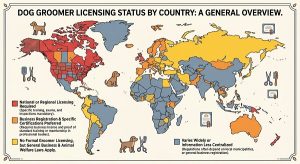
Do dog groomers need a licence? In most places, no. The UK doesn’t require a specific licence for dog groomers, although they must follow the Animal Welfare Act 2006. In the US, the sources I checked say no state licenses individual groomers. Rules change, so check your local council or state website.
What the Rules Look Like in Different Countries
- United Kingdom: No licence is needed for a grooming business. In mid-2025, the Canine and Feline Sector Group (CFSG), the Pet Industry Federation and the British Isles Grooming Association published best-practice guidelines to set a national baseline. They cover qualifications, insurance, emergency procedures, hygiene, and handling anxious pets. They’re guidelines, not law.
- Scotland: The Scottish government has consulted on licensing groomers, with checks and a public register. Today, no qualifications are required to become a groomer there.
- United States: No state licenses individual groomers, according to the sources I reviewed. Connecticut is reported to regulate grooming facilities. Bills like New Jersey’s “Bijou’s Law” were proposed after dogs died following grooming, but licensing proposals have largely stalled.
- Everywhere else: Rules are patchy. Ask local vets and your national kennel club.
Linda Law, a master groomer with the National Dog Groomers Association of America, put the risk bluntly. She said that anyone can “hang up your sign and say you’re a dog groomer” without ever having picked up clippers. That’s why the checking falls on you.
The 10 Red Flags of a Bad Dog Groomer
Not every red flag means the groomer is dangerous. A few mean “ask more questions.” Others mean “pick up your dog and leave.” I’ve marked which is which.
Red Flag 1: They Won’t Let You See Where Your Dog Will Be Groomed
Severity: high. A groomer who refuses a tour, keeps the back room hidden, or gets defensive when you ask to look around has something to hide, or hasn’t thought about transparency.
Veterinarian Debra Eldredge advises owners to visit and confirm that someone is with each pet at all times. Many salons don’t let owners stay for the whole groom, and that’s fine. Dogs can act up when their owner hangs around, and busy salons have safety rules. But a good groomer will still show you the space, explain each step, and offer a window, a camera or photo updates.
What to do: Ask to see the grooming area, the drying area, and where dogs wait. A confident groomer says yes.
Red Flag 2: Heated Cage Dryers or “Set It and Walk Away” Drying
Severity: very high. Heat kills quietly. A dog sits in an enclosed kennel, hot air blows in, and nobody’s watching the clock.
In 2008, a Lhasa Apso named Sadie died after being placed in a cage dryer at a US pet store salon. Her vet reported internal burns and bleeding caused by heat. Her owner sued, demanding that cage dryers be banned. In 2015, a two-year-old golden retriever named Colby died after a grooming visit at another store in Virginia. The company said no heat was used on Colby, but it removed that type of kennel dryer from all its stores and said the staff involved had been dismissed. Reports from that time also mentioned a toy poodle in California and an Airedale terrier in New Jersey.
A 2012 UK petition described a 12-year-old dog named Dusty who suffered severe burns after being left in a crate with an industrial dryer pointed at him. The petitioner claimed it was the fourth such case in two years. I can’t verify every detail of petition claims, but the pattern is consistent across countries.
Linda Law said her salons stopped cage drying decades ago because groomers got busy and forgot about dogs. Dr. Eldredge adds that flat-faced breeds can struggle to breathe in dryer cages, and older or overweight dogs are especially vulnerable to heat stroke.
What to do: Ask, “Do you use cage dryers? Do they use heat? Who watches the dog while it dries?” A safe answer is “We hand-dry or use a force dryer, and a person stays with your dog.” Want to know how heat affects dogs in general? Read our guide to dog cooling vests and the warning signs of overheating.
Red Flag 3: Nobody Watches Your Dog on the Table or in the Tub
Severity: very high. Dogs jump. Wet tables are slippery. A leash or collar left hanging can turn a short jump into a strangled neck.
Dr. Eldredge warns that pets sometimes leap from grooming tables while wearing a hanging collar, with injuries that include a snapped neck or strangulation. Her advice is simple: ask for the policy on monitoring dogs on tables, and expect an unequivocal answer. Someone should be with your dog the entire time it’s on the table.
What to do: Ask, “Is a person with my dog every second it’s on the table or in the tub?” If the answer is “mostly” or “we pop in and out,” that’s your answer.
Red Flag 4: No Questions About Health, Vaccines or Behaviour
Severity: high. A good groomer interviews you before touching your dog. A bad one just takes the leash.
A vet who wrote a guide on choosing groomers calls it a problem when a groomer doesn’t ask about health concerns, or when a salon doesn’t ask about vaccination status. The CFSG guidelines go further. They expect groomers to assess each pet’s temperament, health, age and medical history before starting.
Why does it matter? A dog with a heart condition, skin infection, arthritis or seizure history needs different handling. An unvaccinated dog can pick up or spread illness in a shared space. Groomers also spot things owners miss, like lumps, ticks and skin changes. If you’re in a tick-heavy area, our K9 tick care guide explains what to know before your groomer finds one.
Your part: Be honest. Tell the groomer about bite history, fear of clippers, past injuries and medications. Hiding a problem doesn’t protect you. It puts the groomer and your dog at risk.
Red Flag 5: They Suggest Sedation (or Ask You to Bring Something)
Severity: very high. Sedation is a medical decision. Groomers aren’t vets.
Dr. Eldredge’s advice is blunt: never use a groomer who sedates animals. If your dog is so anxious that sedation seems necessary, she suggests asking your vet about grooming at the clinic, where medical staff are on hand. One vet-written guide lists a groomer who asks whether you’ll bring a sedative next time as a red flag.
There’s one fair exception. Severely matted dogs may need a full clip, and the ASPCA notes that this can require sedation. In that case, a vet clinic should lead, not a salon.
What to do: Ask, “Do you ever sedate or give calming medication?” The only good answer is “No, we refer that to a vet.”
Red Flag 6: They Can’t Prove Training, Insurance or an Emergency Plan
Severity: high. Because licences are rare, other proof matters more.
Ask three things:
- How did you train? Look for a course, an apprenticeship, or years working under a senior groomer. In the UK, National Careers lists Level 2, 3 and 4 dog grooming qualifications. In the US, look for credentials like Certified Professional Groomer (CPG), National Certified Master Groomer (NCMG) or International Certified Professional Groomer (ICPG). Eldredge also points to groups like the National Dog Groomers Association of America and International Professional Groomers.
- Are you insured? The UK pet insurer ManyPets says a good groomer should carry insurance. Ask to see proof.
- What happens in an emergency? They should name a nearby vet, say who pays, and tell you how they’d contact you.
One trap to know about: a certificate isn’t always a credential. Groomer to Groomer magazine points out that many certificate courses cover foundations and typically don’t require testing, while credentials like CPG and NCMG involve exams. Experience counts too. A groomer with 25 years of clean work and glowing vet referrals can beat a new graduate. Ask for references.
Red Flag 7: A Rushed Schedule, High Staff Turnover, or a Dirty, Smelly Salon
Severity: medium to high. Rushed grooming is where mistakes happen.
A veteran groomer with over 40 years in the trade told a local news outlet that employee turnover is her biggest red flag, because good groomers stay where the work environment is good. She also likes dogs to stay with one groomer for consistency. She named constant foul odours and consistently cranky staff as warning signs too, while noting that a one-off mess is normal.
Time matters as well. PetMD figures suggest a bath alone takes 30 to 40 minutes, and a full appointment can run three to four hours. If someone promises a full groom of a big double-coated dog in an hour, ask how. A properly dried dog also takes time. Rushing the dry often means rushing the dog.
What to do: Ask how many dogs one groomer handles per day and where dogs wait between steps. If the salon’s book looks like a conveyor belt, it probably is.
Red Flag 8: Rough Handling or a Fear-Based Approach
Severity: very high. Watch the groomer’s body language with your dog during drop-off. It tells you almost everything.
Good handling looks calm, slow and predictable. Bad handling looks like yanking, shouting, tight restraint, or a groomer who seems afraid of dogs. PETA’s advice on this one is hard to argue with: if the groomer seems afraid of or impatient with animals, turn around and leave.
On the training field, we say that a dog learns from every touch. A rough groom doesn’t only hurt that day. It teaches fear, and next time your dog may refuse to walk through the door. The CFSG guidelines include specific handling techniques for anxious pets, and the Fear Free programme offers a groomer seminar series. Ask whether your groomer has done either.
What to do: Watch your dog’s reaction at pick-up. A relaxed, wiggly dog is a good sign. A dog that’s shaking, hiding or refusing to re-enter the building next time is telling you something.
Red Flag 9: They Shave First and Explain Later
Severity: medium to high. Coats are not all alike, and a good groomer talks before cutting.
Double-coated dogs like German Shepherds, Huskies and many working breeds have an insulating undercoat and a protective top coat. Groomer to Groomer magazine notes that shaving can change texture and thickness permanently, and some areas never grow back. ManyPets says regrowth can be patchy, uneven or slow, and that Nordic breeds are said to be more at risk. Dogster adds that a shaved double coat can leave a dog hotter and more prone to sunburn. A groomer who shaves a Husky “because it’s hot” without explaining those risks hasn’t done the job.
Matting is different. The ASPCA says severe mats can cut into the skin or cut off blood supply to a limb, sometimes leading to amputation. Sometimes a short clip is the kind choice. But a good groomer explains why, shows you the mats, and gets your consent first. Some grooming schools even use signed release forms for these “humane shave-downs.” The red flag is a groomer who does it without a word.
What to do: Say what you want and ask for their honest opinion. A good groomer will tell you if your request is risky and offer an alternative, like a deshedding treatment or a trim.
Red Flag 10: Vague Pricing, Poor Communication, or Too-Good-to-Be-True Reviews
Severity: medium. Money and messages tell you how a business treats you when something goes wrong.
- Vague quotes. Ask for a price range up front, and ask about extra fees for dematting, long nails or a large coat. PetMD’s figures show a full-service groom commonly costs $40 to $75 in the US. Prices vary by country and city, so compare quotes locally.
- A price far below the local norm. This is my own reasoning, not a statistic. When the price is much lower than everyone else’s, the salon often makes it up by handling more dogs per hour.
- No updates. You should hear when your dog is ready, and you should hear right away if anything unexpected happens.
- Suspicious reviews. Check more than one platform. Be wary of many near-identical five-star reviews posted in a short window, reviews with no detail, and outlandish claims. Read how the owner replies to bad reviews. A defensive or abusive reply tells you plenty.
Quick Red Flag Cheat Sheet
| # | Red flag | What you’ll see or hear | What to do |
|---|---|---|---|
| 1 | Hidden grooming area | “We don’t allow visitors.” | Ask for a tour or choose another salon |
| 2 | Heated cage dryers | “He’ll dry in the kennel while we work.” | Ask about heat and supervision; leave if unsure |
| 3 | Unwatched dog | Dog alone on table, tub or in a loop | Ask for the monitoring policy |
| 4 | No health questions | No form, no vaccine check | Offer the info yourself; judge their reaction |
| 5 | Sedation talk | “Bring something to calm him.” | Refuse; go to a vet clinic if needed |
| 6 | No proof of training | “I’ve just always done it.” | Ask for credentials, insurance, references |
| 7 | Rushed, dirty, high turnover | Strong smells, rotating staff | Visit at a busy time and look closely |
| 8 | Rough handling | Yelling, yanking, fearful groomer | Take your dog and leave |
| 9 | Shaving without a talk | Coat gone, no explanation | Agree the style and risks beforehand |
| 10 | Vague pricing and reviews | No quote, copy-paste praise | Get a written range; read reviews widely |
12 Questions to Ask Before You Book
What should I ask a dog groomer before booking? Ask about training, insurance, drying methods, supervision, sedation, emergency plans and pricing. A good groomer answers calmly and in detail. If they dodge or sound annoyed, that’s a red flag in itself.
- How did you train, and do you hold any credentials?
- Are you insured? Can I see proof?
- Have you groomed my dog’s breed and coat type before?
- Do you use cage dryers, and do any of them use heat?
- Is someone with my dog at all times, including on the table and in the tub?
- Do you ever sedate dogs or give calming medication?
- What happens if my dog is injured or becomes ill during the groom?
- Which vet do you use in an emergency?
- How many dogs do you groom per day?
- Where do dogs wait between steps?
- What will it cost, including extras?
- Will you update me during the groom, and can I see photos?
Your 15-Minute Vetting Plan
You don’t need a long investigation. This takes about 15 minutes and saves a lot of worry.
- Read reviews (5 minutes). Check at least two platforms. Look for details, not just stars.
- Phone with three questions (3 minutes). Ask about drying, supervision and sedation. Their tone matters as much as their answers.
- Visit in person (5 minutes). Look at cleanliness, smell, noise, and how staff speak to dogs. ManyPets suggests bringing your dog along to meet the groomer and reward calm behaviour.
- Book a short first appointment (2 minutes). Start with a bath, brush and nail trim only, not a full haircut. For puppies, the first visit usually works best at 12 to 14 weeks once vaccines are up to date. Our guide to dog grooming tips for a healthy puppy walks through that first visit and the handling practice that helps.
Afterward, watch your dog. Relaxed body, normal appetite, happy greeting next time? Keep this groomer.
Special Cases: Red Flags That Change by Dog
Double-Coated and Working Breeds
If you own a German Shepherd, Belgian Malinois, Husky, Rottweiler or similar, your coat questions matter more than most. Ask, “Will you brush out the undercoat instead of shaving?” A proper deshedding treatment opens airflow without destroying coat structure, and that’s a safer way to help a dog stay cool. Be careful with any groomer who calls shaving the default answer.
Flat-Faced Dogs and Senior Dogs
Bulldogs, Pugs, Boxers and other flat-faced breeds can struggle to breathe under heat and stress. Older and overweight dogs are also more vulnerable to heat stroke. Ask about breaks, cool drying, and shorter sessions. A groomer who has handled these dogs will know exactly what you mean.
Nervous, Reactive and Protection-Trained Dogs
Honesty is your best tool here. Tell the groomer about bite history, reactivity and any protection training before the appointment. A skilled groomer may use a muzzle or extra handling steps, and that’s not a red flag. It’s professionalism. The red flag is a groomer who says they’ll “handle anything” without asking questions, or who treats your dog roughly because it’s tense.
For protection or K9 dogs, handlers usually do the drop-off themselves and brief the groomer on how to approach the dog. If your dog does scent work, tell the groomer, and ask for unscented products without perfume sprays. Strong fragrance isn’t helpful for a dog whose job is to use its nose.
Mobile Groomers
Mobile vans can be a great low-stress option, but ask the same questions. Is the van ventilated and cooled? Does it use heated dryers? Is your dog ever left alone inside? Can you watch? Hot vans are a heat risk, so the drying and ventilation questions matter even more.
What to Do If You Spot a Red Flag (or Something Goes Wrong)
Before the groom: Say no politely and take your dog home. You don’t owe anyone an explanation.
During the groom: Ask to collect your dog now. If a groomer refuses, stay calm and firm.
After the groom, check your dog for:
- Heavy panting, weakness, vomiting or collapse (possible heat stress, which is an emergency)
- Cuts, razor burn, bleeding nails or red patches
- Limping or crying when touched
- Ear scratching, head shaking or eye irritation
- New fear of the groomer’s name or the car ride there
If anything looks wrong, call your vet the same day. Take photos, write down what happened with times, and keep any receipts. Then report it. In the UK, the council guidance I found points to the RSPCA for welfare complaints. In other countries, try local animal control or consumer protection authorities. A calm, factual written report helps other owners.
Want to Raise a Calm, Confident Dog From Day One?
A dog that’s used to handling is easier to groom, easier to examine, and safer for everyone. My ebook, Beyond the Bark: Inside a Pro Handler’s Playbook for Raising the Ideal Dog, shares the routines professional handlers use, from early handling to confidence building.
Get a new guide every week. Join our weekly articles roundup at arfsk9team.com.ng/newsletter for training tips, health advice and handler insights in your inbox.
Frequently Asked Questions
1. How do I know if a dog groomer is good?
A good groomer asks about your dog’s health and temperament, explains each step, shows you the space, and has training and insurance to back it up. They handle dogs calmly, never rush, and never suggest sedation. Your dog should leave relaxed and return willingly.
2. Is it normal for a groomer to sedate a dog?
No. Sedation is a veterinary decision, and a vet should do it in a clinic. Dr. Debra Eldredge advises never using a groomer who sedates animals. If your dog is too anxious for a normal groom, ask your vet about options.
3. Are cage dryers safe for dogs?
They can be dangerous, especially with heat and no supervision. Cases of dogs dying from heat in cage dryers have been reported in several countries, and some salons no longer use them. Flat-faced, older and overweight dogs face the highest risk. Always ask whether a groomer uses cage dryers and who watches the dog.
4. Do dog groomers need a licence or qualification?
In most places, no. The UK has no specific groomer licence, and the US sources I checked report no state licences for individual groomers. Scotland has consulted on licensing. Because rules are weak, check credentials, insurance and references yourself.
5. How much should dog grooming cost and how long should it take?
It depends on your country, breed and coat. PetMD figures put a full-service groom at roughly $40 to $75 in the US. A bath alone can take 30 to 40 minutes, and a full appointment three to four hours. A quote far below local prices, or a promise to finish in under an hour for a big coat, deserves questions.
Conclusion
Grooming should feel like care, not a gamble. Most groomers are skilled and kind, but because rules are thin, you’re the inspector. Remember the main signs: a hidden salon, heated cage dryers, an unwatched dog, no health questions, sedation talk, no proof of training or insurance, rough handling, a rushed or dirty space, shaving without a conversation, and vague pricing.
Here’s what to do this week:
- Pick your top three local dog groomers and read their reviews on two platforms.
- Call each one and ask about drying, supervision and sedation.
- Visit your favourite and look at the space.
- Book a short first appointment, then watch how your dog acts afterwards.
- Save this list for next time.
Trust what you see, and trust your dog’s reaction. If you want more handler-tested tips, subscribe to our weekly newsletter at arfsk9team.com.ng/newsletter.
Sources
- Canine and Feline Sector Group, Pet Industry Federation and British Isles Grooming Association, Guidelines for Dog and Cat Groomers (2025), as reported by Pet Business World, Total Grooming Magazine and Global Pet Industry
- Gravesham Borough Council, Dog and Cat Grooming Businesses guidance
- LegalVision UK, Legal Considerations for Dog Grooming Businesses
- MRCVSonline, Scotland considers licensing dog groomers
- Debra Eldredge, DVM, grooming dangers guidance (Bottom Line)
- Embrace Pet Insurance, Grooming 101: Finding the Right Groomer
- ManyPets, How to Choose a Dog Groomer and Should I Shave My Dog?
- ASPCA, Preventing Your Pet’s Coat from Matting
- Groomer to Groomer magazine, The Double Coated Debate; Certification, Certificates and Licensing; PPGSA Standards of Care
- Dogster, Don’t Shave That Dog
- PETA, grooming safety tips
- NBC TODAY, WRIC/WSLS, CBS News, Fox News and KFSN-TV coverage of cage dryer deaths
- UK Parliament petitions archive, Regulate and License the Dog and Cat Grooming Industry
- Academy of Pet Careers and Legal Clarity, US grooming licensing overviews
- NJBIZ and Daily Signal, coverage of New Jersey’s Bijou’s Law
- PetMD, puppy grooming guidance (as cited in our puppy grooming guide)

Her work centres on obedience, detection, protection and operational readiness. She favours proven methods built on repetition, consistency and real-world conditioning, so that both dogs and handlers are prepared for high-pressure tasks.
Rofiat represented the Nigerian Army Dog Centre at the Nigerian Army Day Celebration (NADCEL) 2026, where she led demonstrations in obedience, explosive detection, agility and tactical movement. Through articles, training content and documentaries, she shares field-based insight into how structured training, clear communication and trust between handler and dog affect performance and reliability.
She is the author of Beyond the Bark: Inside a Pro Handler's Playbook for Raising the Ideal Dog, a practical guide that helps dog owners and handlers apply professional training principles in everyday situations.
- Food Aggression Dog Training: Pro K9 Guide - November 21, 2026
- DIY Dog Scent Training: Easy 4-Week Home Guide - November 20, 2026
- Buckeye Puppies Review: 5 Red Flags to Check - November 19, 2026