Dog During a Home Invasion: A K9 Handler’s Survival Plan
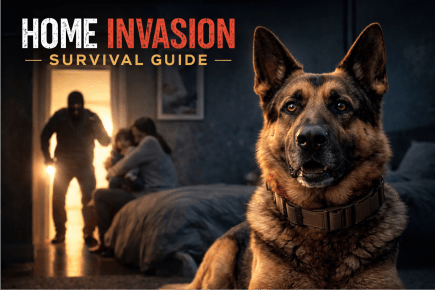
During a home invasion, your job is to control your dog, not to send her after the intruder. Get your family and your dog into a lockable room with a command she already knows, lock the door, call emergency services, and keep her calm beside you. A barking dog behind a locked door still scares most intruders away, and it keeps her out of a fight she could lose.
Table of Contents
- How Often Do Home Invasions Happen While You’re Home?
- Will Your Dog Actually Protect You? Three Real Cases
- The 5-C Plan: Your Dog in the First 60 Seconds
- Why Your Voice Matters More Than Your Command
- Your Safe Room, Dog Edition
- The Commands to Train (and a 12-Week Plan)
- Should Your Dog Confront the Intruder?
- When the Police Arrive: Protect Your Dog
- After the Event: Helping a Shaken Dog Recover
- Prevention: Making Your Home a Harder Target
- 8 Mistakes That Get Dogs and Families Hurt
- Special Situations: Small Dogs, Puppies, Apartments and More
- Trainer’s Note: Why You Can Trust This Guide
- FAQs
- Conclusion
Introduction
It’s 2 a.m. Glass breaks downstairs. Your dog is on her feet before you’re fully awake, hackles up, a low growl rolling out of her chest. You have maybe thirty seconds to decide what happens next.
Here’s the problem. Most advice about a dog during a home invasion falls into two camps. One camp says your dog will save the day. The other camp forgets the dog exists. Both leave you unprepared, because a dog is neither a bodyguard nor a bystander. She’s a fast, frightened, unpredictable animal who takes her cues from you.
I’m a military K9 handler with more than 14 years of experience teaching dogs to stay under control when everything around them is chaos. In this guide, you’ll learn:
- What home invasions really look like, based on U.S. Department of Justice numbers
- A simple five-step plan for handling your dog the moment you hear a break-in
- How to set up a safe room that works for a dog, not just for people
- Which commands to train and a 12-week schedule to make them hold up under stress
- Whether your dog should ever confront an intruder, plus the legal picture in the U.S. and UK
- How to keep police from mistaking your dog for a threat
- How to help your dog recover afterward
Let’s get into it.

How Often Do Home Invasions Happen While You’re Home?
Quick note on words first. “Home invasion” is mostly a media term. Researchers usually call these events household burglaries, and they count them as violent crime only when someone at home is attacked or threatened. That matters, because the real numbers are less scary and more useful than the headlines.
The U.S. Bureau of Justice Statistics (BJS) published the most detailed report on this, covering 2003 to 2007. Here’s what it found:
- A household member was home in about 28% of burglaries, roughly 1 million incidents.
- About 7% of all household burglaries involved violence against someone at home, around 266,560 incidents a year.
- Offenders were unarmed in 61% of those violent burglaries and had a firearm in 12%.
- Victims knew the offender in 65% of violent burglaries. Strangers made up 28%.
That last number catches people off guard. If the person in your hallway isn’t always a stranger, “my dog hates strangers” is not a complete plan.
Now the deterrence side. Researchers at UNC Charlotte, led by Joseph Kuhns, surveyed 422 incarcerated burglars. Most said they weighed signs of extra security when choosing a target, including alarms, dogs inside the house, and outdoor cameras. Only about one in eight picked locks or used a key. Most forced a door or window, or just walked through one that was open. (One fair caveat: an alarm-industry foundation funded the study.) A former police officer turned security expert told ABC13 in Houston that most intruders hunt for an empty home and want to be gone within three to five minutes.
Here’s one more number I like because it’s honest. In a Charlotte survey of burglary victims, 29.4% said they had a dog at home when it happened. So dogs deter many burglars. They don’t stop all of them.
What does all that tell us? Intruders want speed and silence. Noise, delay and uncertainty cost them both. That’s exactly what your dog and a good plan give you.
Will Your Dog Actually Protect You? Three Real Cases
Let’s look at what really happens when family dogs meet intruders.
Redford Township, Michigan. A woman woke around 5 a.m. to find a masked man climbing through her bedroom window. He hit her with a gun. She called for her rescue pit bull, Monkey. The moment the intruder heard the dog coming down the hallway, he ran back out the window. Notice something? The dog never touched him. The sound and the threat of an approaching dog did the work.
Oklahoma City. Security footage showed a man walk into a home and pet the Great Dane in the hallway. The dog only turned on him after the owner screamed. Then the man ran. That’s how most family dogs work. They watch you first, then decide if a stranger is a threat.
Houston, Texas. Four armed men came through an unlocked back door around 1 a.m. The family dog tried to attack them and got shot in the paw. The family’s 17-year-old slipped out a window and ran for help, and the intruders fled. The dog recovered. Change where that bullet landed and this story ends very differently.
Three dogs, three outcomes: scared off by noise, triggered by the owner, and wounded. So which kind of dog do you have?
| Dog type | How she behaves | What you can count on |
|---|---|---|
| Alert or alarm dog (most family dogs) | Barks, wakes the house, may follow your lead | Early warning and noise. Needs commands to stay safe. |
| Fearful or reactive dog | Lunges, snaps or hides out of fear | Unpredictable. She may bite a family member or an officer. Contain her. |
| Trained protection dog | Bites and releases on command | Reliable only with a skilled handler beside her. Rare. |
A home-defense instructor writing for Personal Defense Network makes the same point: a dog that bites out of fear is not a bite-trained protection dog, and owners who say “my dog will attack” should talk to a dog-training expert. I agree completely. If you’ve never tested your dog’s reactions, you don’t know which dog you have.
The 5-C Plan: Your Dog in the First 60 Seconds
I built this plan around five verbs because panic erases long instructions. You can remember five words.
How to manage your dog during a home invasion
- Collect: Gather your family and your dog, using a cue she already knows.
- Close: Move to a lockable room, shut the door and lock or brace it.
- Call: Phone emergency services and tell them you have a dog with you.
- Control: Keep your dog on her mat, calm and close, with your hand on her.
- Communicate: Stay put until police identify themselves, then hand over control of the dog safely.
1. Collect
Take one second to ask: where is the sound, and where is my dog? Then use a short cue like “WITH ME” or “COME” in a low, steady voice. Guide her with a hand on her collar or harness. Don’t yank. A sudden grab can spike a dog’s fear and trigger a bolt or a bite.
Don’t teach a new word right now. Use the one she’s heard a thousand times.
2. Close
A solid-core door beats a hollow one. A deadbolt or door security bar beats a flimsy knob lock. If the lock is weak, brace the door with furniture. Put your dog on her mat inside, away from the door, so she isn’t standing in the line of the door when it opens.
If you can get out safely and the exit is away from the intruder, leaving can beat hiding. Never run past the intruder to get there.
3. Call
Dial your local emergency number: 911 in the U.S. and Canada, 999 in the UK, 112 in the EU and many other countries. Give your address first. Then say how many people are with you and add a line most owners forget: “I have a dog with me in this room.” You’ll see why in the police section below.
4. Control
Keep your voice low and slow. Give your dog something to do: a long-lasting chew or a lick mat works well. Keep a hand on her.
Should she bark? Here’s my rule. If the intruder already knows you’re home, let her bark. A bark from behind a locked door is a deterrent and a siren for your neighbors. If you’re hiding and the intruder doesn’t know where you are, ask for quiet with your QUIET cue and reward her for it.
5. Communicate
Stay in the room until the dispatcher says officers are at your door or officers identify themselves. Keep your dog leashed and beside you before you open anything. Don’t open the door and let her out, even if she’s whining.
Where is your dog? What to do
| Where your dog is | What to do |
|---|---|
| Right beside you | Collect her, move together, lock the door. |
| Elsewhere upstairs, short and safe path | Call her once, softly. Don’t search the house. |
| Downstairs, near or past the intruder | Leave her. Don’t walk toward danger to fetch a dog. Lock yourself in and call. Your family comes first. |
| Crated | Leave her crated. A crate keeps her out of harm’s way and she’ll still bark. |
| Outside in the yard | Don’t open the door to bring her in. Tell the dispatcher. |
| More than one dog | Collect the ones that respond. Don’t chase the rest. Train “all dogs to PLACE” in your drills. |
The hardest line in that table is the third one. I know it feels wrong to leave your dog. But I’ve seen what happens when handlers walk toward a threat to retrieve an animal. You lose control of two situations at once. Get safe, then get help.
Why Your Voice Matters More Than Your Command
Ever notice how your dog goes quiet when you’re sad or wired when you’re angry? That’s not magic.
A 2019 study from Linköping University in Sweden measured cortisol, a stress hormone, in the hair of dogs and their owners over several months. The stress levels were synchronized. Owners with high cortisol had dogs with high cortisol. The researchers suggest the dog mirrors its owner’s stress, not the other way around. Their study measured long-term stress rather than one scary night, but the pattern fits what I see with working dogs: your dog reads your state before she reads your words.
Remember the Great Dane in Oklahoma? He didn’t react until his owner screamed. Your voice is a trigger.
So decide your emergency voice now:
- Low pitch, slow pace, one word at a time.
- Say each cue once. Repeating it tells your dog you’re unsure.
- Practice it during drills until it feels normal in your mouth.
Your Safe Room, Dog Edition
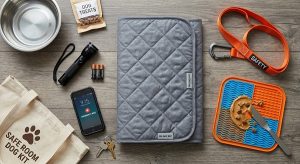
Most safe room checklists forget the dog. Stock this before you need it:
- Solid door and strong lock. A deadbolt or door security bar helps a lot.
- Phone and charger. An old phone kept plugged in can still call emergency services.
- Flashlight with fresh batteries.
- Leash and harness hung on the inside of the door. A dog you can clip in two seconds is a dog you control.
- A mat or bed that stays in the room. This is her PLACE. Familiar smell is calming.
- A lick mat or long-lasting chew. It keeps her mouth busy and her stress lower.
- Water and a non-spill bowl.
- A basket muzzle, if your dog is reactive, already conditioned so she accepts it calmly. A muzzle protects her and the officers.
- Copies of vaccination records, especially rabies, and your vet’s number.
- Pet first-aid basics next to your family first-aid kit.
Also check her ID. She should wear a collar tag with your phone number and have a microchip. Broken doors and panic mean dogs bolt. A chipped, tagged dog comes home.
The Commands to Train (and a 12-Week Plan)
You don’t need a protection dog. You need six behaviors your dog does reliably when things get noisy. Here’s the toolkit I’d drill with any family:
| Command | What it does | Why it matters in a break-in |
|---|---|---|
| WITH ME (or HEEL) | Keeps her glued to your side | Moves you to safety together without a struggle |
| COME | Fast recall | Pulls her away from a threat and toward you |
| PLACE | Sends her to a mat and holds her there | Contains her when you’re on the phone |
| QUIET | Stops barking on cue | Keeps a tense moment from escalating |
| LEAVE IT | Breaks her focus on a person or door | Stops charging and lunging |
| SAFE ROOM (your cue) | Sends her into your chosen room | Gets her moving to safety on one word |
If you want the full walk-through of how I teach these, see my guide on basic protection commands for the family pet.
How to teach QUIET
Teach SPEAK first. Wait for a bark, mark it with a word like “yes,” and reward. Once she barks on cue, add the word QUIET the instant she pauses, and reward the silence. Build from 2 seconds to 10, then 30, then a full minute. Then practice with a doorbell sound.
How to teach SAFE ROOM
This one is my favorite because almost nobody teaches it. For two weeks, feed her dinner in the safe room. Say your cue cheerfully as you walk in. Reward on her mat. Over time, say it from different rooms and let her run in on her own. In the end, one word sends her toward the one place you want her.
Teach “no food from strangers”
Security advice from South African insurers to U.S. trainers all points the same way: don’t let your dog take food from strangers. Teach a simple refusal. Have a friend offer a treat and reward your dog for ignoring it. A dog that won’t take a bribe is harder to distract and harder to poison.
The 12-week plan
| Weeks | Focus | Pass mark |
|---|---|---|
| 1 to 4 | Foundations in a quiet room: WITH ME, COME, PLACE, LEAVE IT, SPEAK and QUIET, plus safe room dinners | 9 out of 10 correct |
| 5 to 8 | Add distractions: doorbell, knocking, a dropped pan, family members moving fast, different people giving cues | 9 out of 10 with moderate noise |
| 9 to 12 | Stress-proof: lights off, night drills, surprise timing, low-volume recorded glass-break sounds, a familiar person in the hallway | 8 out of 10 under noise |
| Ongoing | A 30-second drill monthly and a full night drill twice a year | Under 30 seconds from bed to locked room |
I use a simple 10-for-10 rule. Ask for a behavior ten times in ten different spots. Don’t move to the next stage until she nails at least nine. If your dog is sound-sensitive, build the recorded noises up very slowly and stop if she panics.
Here’s what I’ve noticed again and again with working dogs: a dog who’s perfect on the living room rug gets sloppy the first time real noise shows up. That gap is what proofing closes. If you want my full method for building obedience that survives pressure, it’s in my e-book, Beyond the Bark: Inside a Pro Handler’s Playbook for Raising the Ideal Dog.
Want to go further into protective training? Start with how to train your dog for family protection.
Should Your Dog Confront the Intruder?
I get asked this constantly. For nearly every family dog, my answer is no. Here’s why.
1. Your dog can get badly hurt. The Houston dog was shot in the paw. Your dog can’t tell a burglar with a weapon from one without. The BJS data says most violent burglars were unarmed, but 12% had a firearm. That’s a risk no dog understands.
2. A fight ends your control. Once your dog is in a physical struggle, you’re managing two crises instead of one.
3. Dogs make mistakes in the dark. A teenager sneaking in late, a relative with a key, or a police officer entering your home can look like a threat to an adrenaline-flooded dog. If you want to read your dog’s stress cues before they turn into bites, see my guide on warning signs before a dog bites.
4. The law is not as simple as the internet says. Let’s look at it honestly.
The legal picture (and a reminder that I’m not a lawyer)
- United States. “Castle doctrine” laws mostly cover people using force in their homes, not dogs. Dog-bite laws vary by state. Many protect owners when the person bitten was trespassing or committing a crime, but not all, and some states apply other rules like negligence. Check your state’s statute.
- England and Wales. The 2014 changes to the Dangerous Dogs Act 1991 made “dangerously out of control” offences apply on private property too. They also added a householder exemption: no offence where the dog is dangerously out of control around a trespasser who is in, or entering, your home. Welfare groups note it covers the dwelling itself, not gardens, driveways or outbuildings. Sources differ on whether you need to be home, so ask a solicitor if it matters to you.
- Everywhere else. Rules vary widely. Ask a local lawyer or your police dog unit.
The one narrow exception
If you own a professionally trained protection dog, you play by different rules. That dog should bite only on command and release on command, and her trainer should write your home plan with you. Don’t try to turn a family pet into that dog by yourself in a few weeks. It goes wrong fast.
When the Police Arrive: Protect Your Dog
This is the part almost every guide skips, and it’s where dogs get hurt.
Officers walking into an unfamiliar home, possibly after an armed intruder, see a barking dog and make a split-second choice. The U.S. Department of Justice’s COPS Office published a guide in 2011 called The Problem of Dog-Related Incidents and Encounters because police-dog encounters had become a serious issue. Many departments now train on dog body language. Don’t rely on that. Protect your dog yourself.
- Tell the dispatcher about your dog at the start of the call. Give size, breed and whether she’s friendly.
- Keep her leashed and on her mat, or crated, with your hand on her.
- Never open the door and let her out. She may run toward the officers out of relief or fear.
- If officers must clear the house, shut her in a room or crate first if you can do it safely.
- Wait for an officer to say it’s safe before you release her.
A pet alert sticker near your front door is also worth having. It’s cheap and it can matter if you’re not home.
After the Event: Helping a Shaken Dog Recover
The emergency isn’t over when the police leave. For your dog, it may just be starting.
Check her body first. Adrenaline hides pain. Look for cuts, limping, swelling or sore spots. Sweep up broken glass before she walks around, because shards cut paws. Call your vet if anything looks off. If she bit someone, expect animal control paperwork and, in many places, an observation period, so have her vaccination records ready.
Watch her behavior. Common signs of stress include clinginess, pacing, hiding, poor sleep, changes in appetite and jumpiness at everyday sounds. Many dogs settle within a couple of weeks when their routine stays calm and predictable. If the signs last longer than about two weeks or get worse, call your vet or a qualified behavior professional.
Take care of yourself too. Remember the Linköping study? Your stress feeds hers. If you’re shaking and sleepless, she’s likely to be as well. Talk to someone, keep routines steady, and give her extra quiet walks and predictable meals.
Rebuild confidence slowly. If doorbells and knocks now set her off, go back to the distraction stage of your training plan and rebuild at low volume.
Prevention: Making Your Home a Harder Target
The best break-in plan is the one you never use. Burglars say noise and uncertainty turn them away, so lean into both.
- Let your dog be heard. A dog that barks at the doorbell is doing free security work.
- Stack layers. Dogs plus locks, lighting, cameras and an alarm outperform any single tool. The dog makes noise, the camera records, and the lock stays locked when the dog gets distracted.
- Lock everything. Most intruders walk through open doors and windows or force them. Locking them costs nothing.
- Watch your dog door. Security experts call pet doors a point of entry, especially on a back door next to the lock. Lock or remove it at night.
- Sleep the dog near you. Collecting her takes seconds when she’s in your bedroom.
- Teach the family. Kids, partners and house guests should know the plan and the cue words.
- Run a drill twice a year, once in daylight and once at night.
8 Mistakes That Get Dogs and Families Hurt
- Teaching a family pet to “attack” with no professional help.
- Walking toward the noise to find the dog.
- Screaming. Your dog mirrors your panic.
- Using a brand-new command in the middle of a crisis.
- Opening the safe room door to let the dog out.
- Releasing the dog when police arrive.
- Drilling alone. Everyone in the house needs practice giving the cues.
- Skipping the vet check afterward because she “seems fine.”
Special Situations: Small Dogs, Puppies, Apartments and More
| Situation | What to adjust |
|---|---|
| Small or toy dog | Scoop her up or keep a carrier near the safe room. Her bark still works as an alarm. |
| Puppy under six months | Don’t expect reliable commands. Carry her and crate her in the safe room. |
| Senior or limited mobility | Keep a non-slip mat in the safe room and clear the path. |
| Reactive or fearful dog | Condition a basket muzzle, plan to contain her, and work with a qualified behaviorist. |
| Protection-trained dog | Follow your trainer’s written plan. Control and release on command come first. |
| Several dogs | Teach “all dogs PLACE” and practice group recalls. |
| Apartment or thin doors | Pick the room farthest from the entrance, phone first, and let her bark. Neighbors hear it through the walls. |
Trainer’s Note: Why You Can Trust This Guide
I’m Cpl. Rofiat Muritala, a Nigerian Army military working dog instructor and handler with more than 14 years of experience at the Nigerian Army Dog Centre. I’ve completed advanced obedience, K9 patrol and advanced explosive detection courses, and in 2026 I represented the Dog Centre at the Nigerian Army Day Celebration (NADCEL), leading demonstrations in obedience, explosive detection, agility and tactical movement.
My work is about reliability under pressure. That’s the same standard I apply here. I’m a trainer, not a lawyer or a police tactical officer, so I’ve sourced the numbers above from the U.S. Bureau of Justice Statistics, UNC Charlotte, Linköping University, and UK legislation, and I’ve told you where the law varies. Always follow the instructions of your local emergency services.
FAQs
1. What should I do with my dog during a home invasion?
Get your dog and family into a lockable room with a command she already knows, like “WITH ME” or “COME.” Lock the door, call emergency services, tell the dispatcher you have a dog, and keep her calm on a mat beside you.
2. Should I let my dog attack an intruder?
In most cases, no. Your dog can be injured or killed, and legal protection varies by place. A contained, barking dog behind a locked door gives you most of the deterrent value with far less risk.
3. Will my dog protect me if someone breaks in?
Maybe, but you can’t count on it. Many family dogs bark and some defend, while others hide or take cues from their owner. A trained protection dog is different, but that takes professional training and a skilled handler.
4. Can I get in trouble if my dog bites an intruder?
It depends on where you live. Many U.S. states protect owners when the person bitten was trespassing or committing a crime, but not all do. In England and Wales, a householder exemption covers a dog that is dangerously out of control around a trespasser inside your home, but not in your garden or driveway. Ask a local lawyer.
5. How do I help my dog after a break-in?
Check her for hidden injuries, keep her routine calm and predictable, and watch for stress signs like clinginess, hiding and poor sleep. If the signs last more than about two weeks, talk to your vet or a qualified behavior professional.
Conclusion
A home invasion is one of the few moments in life where a plan you made weeks ago beats anything you can think up on the spot. Your dog can be a real asset: a deterrent before anyone gets in, and a calm, contained presence once they do. But she only helps if you’ve done the quiet work of training her to listen under stress.
Here’s your 20-minute action list for tonight:
- Pick your safe room and check the door and lock.
- Stock the dog kit: leash, mat, lick mat, ID, vaccination records.
- Choose your six cue words and write them on the fridge.
- Run your first 30-second drill, with the whole family.
- Add “no food from strangers” to this week’s training.
Want a new K9 article in your inbox every week? Subscribe to the ARFS K9 Team weekly roundup newsletter.
And if you want the deeper, step-by-step system pro handlers use to build rock-solid obedience, grab my e-book, Beyond the Bark: Inside a Pro Handler’s Playbook for Raising the Ideal Dog.
Sources
- U.S. Bureau of Justice Statistics, Victimization During Household Burglary (2010): https://bjs.ojp.gov/content/pub/ascii/vdhb.txt
- UNC Charlotte, Through the eyes of a burglar: https://inside.charlotte.edu/news-features/2013-05-15/through-eyes-burglar-study-provides-insights-habits-and-motivations
- Charlotte Residential Burglary Victimization Survey (Kuhns, Blevins and Turner), via SDM: https://sdmmag.com/articles/95025-how-effective-were-anti-burglary-efforts
- ABC13 Houston, Do you know what to do during a home invasion?: https://abc13.com/news/do-you-know-what-to-do-during-a-home-invasion/381992/
- Fox 2 Detroit, Family dog scares away intruder in Redford Twp.: https://fox2detroit.com/news/family-dog-scares-away-intruder-in-redford-twp
- KJRH, Great Dane bites burglar during home invasion: https://www.kjrh.com/news/local-news/great-dane-bites-burglar-during-home-invasion
- Dayton Daily News, Dog shot while rescuing family during home invasion: https://daytondailynews.com/news/national/dog-shot-while-rescuing-family-during-home-invasion-police-say/1srpm3se0qepoGTkTJp1RL
- Personal Defense Network, Are Your Dogs Part of Your Home-Defense Plan?: https://www.personaldefensenetwork.com/article/dogs-home-defense-plan/
- Linköping University, Dogs mirror their owner’s stress: https://liu.se/en/news-item/hunden-speglar-agarens-stress
- UK Anti-social Behaviour, Crime and Policing Act 2014, explanatory notes: https://www.legislation.gov.uk/ukpga/2014/12/section/106/notes?view=plain
- UK Government, Dangerous dogs law changes cover attacks on private property: https://www.gov.uk/government/news/dangerous-dogs-law-changes-cover-attacks-on-private-property
- NAWT, Changes to the Dangerous Dogs Act: https://www.nawt.org.uk/news/changes-to-the-dangerous-dog-act-advice-for-owners/
- U.S. DOJ COPS Office, The Problem of Dog-Related Incidents and Encounters: https://post.nv.gov/uploadedFiles/postnvgov/content/Training/Dog-Related_Incidents_and_Encounters_USDOJ-COPS.pdf
- MiWay, Being prepared for a home invasion: https://www.miway.co.za/blog/being-prepared-for-a-home-invasion

Her work centres on obedience, detection, protection and operational readiness. She favours proven methods built on repetition, consistency and real-world conditioning, so that both dogs and handlers are prepared for high-pressure tasks.
Rofiat represented the Nigerian Army Dog Centre at the Nigerian Army Day Celebration (NADCEL) 2026, where she led demonstrations in obedience, explosive detection, agility and tactical movement. Through articles, training content and documentaries, she shares field-based insight into how structured training, clear communication and trust between handler and dog affect performance and reliability.
She is the author of Beyond the Bark: Inside a Pro Handler's Playbook for Raising the Ideal Dog, a practical guide that helps dog owners and handlers apply professional training principles in everyday situations.
- Dog Hotel Prep: 7 Must-Haves Before Boarding - October 21, 2026
- How to Enter the COBA National Dog Championship - October 20, 2026
- K9 Advantix Dosage Chart & Safety Guide for Dogs - October 19, 2026