How To Bond With Your Puppy At Every Stage (Guide)
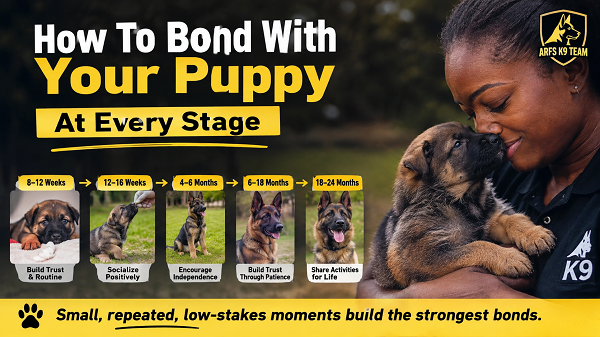
How do you bond with a puppy? You bond with a puppy by matching what you do to their age. Keep things calm and predictable from 8 to 12 weeks, expose them to the world safely from 12 to 16 weeks, reward check-ins at 4 to 6 months, stay patient through the teenage months (6 to 18 months), and share activities that suit their personality as they mature. Most puppies show clear trust within 3 to 4 weeks, but a deep bond keeps growing for two years.
- 8-12 weeks: safe space, routine, gentle handling
- 12-16 weeks: safe socialization, short training games
- 4-6 months: reward check-ins, manage teething
- 6-18 months: stay consistent, keep one-on-one time
- 18-24 months: teamwork, dog sports, cooperative care
Table of Contents
- Introduction
- How Long Does It Take to Bond With a Puppy?
- What Bonding Really Is (and What Science Says)
- Stage 1: Safe Haven Weeks (8 to 12 Weeks)
- Stage 2: The Socialization Window (12 to 16 Weeks)
- Stage 3: The Wandering Phase (4 to 6 Months)
- Stage 4: The Teenage Test (6 to 18 Months)
- Stage 5: Teamwork (18 to 24 Months)
- Signs Your Puppy Is Bonding With You
- 7 Mistakes That Quietly Damage the Bond
- Special Situations (Shy Puppies, Rescues, Busy Owners, Working Breeds)
- A Simple 30-Minute Daily Bonding Plan
- Why You Can Trust This Advice
- FAQs
- Final Thoughts
Introduction
You brought your puppy home expecting an instant best friend. Instead, your puppy cries at night, ignores you outside, and chews your phone charger. So you start wondering: Is something wrong with me? Why isn’t the bond happening?
Nothing is wrong. Here’s the thing most puppy bonding tips online skip: a puppy’s brain changes every few weeks. What builds trust at 9 weeks can feel pushy at 8 months. Most articles hand you a list of ten tricks and call it a day. They don’t tell you when each trick works.
I’ve spent over 14 years as a military working dog instructor and handler. I’ve watched dogs carry out high-pressure work for handlers they trust, and I’ve watched talented dogs struggle with handlers they didn’t. The difference almost always started in puppyhood.
In this guide, you’ll learn how to bond with your puppy at every stage, what’s happening in their head, the signs your puppy trusts you, the mistakes that quietly hurt the bond, and a simple daily plan you can start tonight.
How Long Does It Take to Bond With a Puppy?
Most puppies start showing real trust within 3 to 4 weeks of coming home. They follow you, relax near you, and check in with you. A deep, reliable bond, the kind that holds up around distractions and stress, keeps growing until your dog is fully mature at around 12 months for small breeds and 18 to 24 months for large and giant breeds.
Some puppies warm up in days. Others need weeks. Breed, early experiences, and personality all play a part. If you adopted a puppy who had a rough start, give yourself even more time. For a week-by-week view of how newly homed dogs settle in, read our guide to the 3-3-3 rule for dogs.
What Bonding Really Is (and What Science Says)
Bonding isn’t cuddling. It’s trust plus predictability plus positive history. Your puppy bonds with you when they learn that you’re safe, fair, and fun, and that good things happen when you’re around.
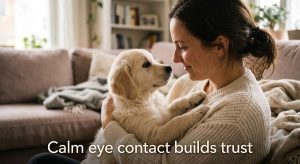
There’s real biology behind this. A well-known 2015 study by Miho Nagasawa and colleagues, published in Science, found that when dogs and owners gaze at each other, both sides get a rise in oxytocin, the hormone linked to bonding in human parent-child relationships. In plain words, those quiet eye-contact moments really do build a chemical connection.
The timing matters too. Researchers J.P. Scott and John Fuller, working in the mid-1900s, mapped out critical windows in puppy development. Today, the American Veterinary Society of Animal Behavior (AVSAB) says the first three months of life are the most important time for socialization. That’s the stretch when puppies are naturally more curious than scared.
So the timing of your effort matters as much as the effort itself.
Stage 1: Safe Haven Weeks (8 to 12 Weeks)
What’s happening: Your puppy just lost their mom and littermates. Everything, your smell, your voice, your floors, is new. Many puppies also go through a first fear period around 8 to 11 weeks (the exact ages vary by dog), so loud or scary experiences can leave a bigger mark.
Your goal: Make your puppy feel safe. Nothing else matters yet.
Build a safe space first
Give your puppy a crate, pen, or quiet corner that is only theirs. Add a soft bed and one or two calm toys (skip noisy squeakers here).
- Let your puppy retreat there anytime. Never drag them out.
- Sit near it sometimes and ask for nothing.
- Let your puppy choose to come to you. Puppies who get that choice trust faster than puppies who feel cornered by affection.
I learned this early with a German Shepherd candidate. I kept pulling him out of his crate for “bonding time” because I was excited. It backfired. He started avoiding the crate area. Once I let him set the pace, he was sleeping against my boots within a week. Need help with night crying? Our guide on how to crate train a puppy walks you through it step by step.
Lock in a routine
A steady schedule builds more trust than any “bonding activity.” Aim for:
- Meals: same times, same place, usually 3 to 4 small meals a day at this age
- Potty breaks: every 2 to 3 hours for an 8-week-old, plus after waking, eating and play
- Play: several short bursts of 5 to 10 minutes
- Sleep: lots of it, around 18 to 20 hours a day is normal for young puppies
- Bedtime: the same calm wind-down every night
Predictability isn’t boring for a puppy. It’s relief. When your puppy knows what’s coming, their body stops scanning for danger.
Start gentle handling
Spend two or three minutes a day touching paws, ears, tail and mouth. Pair every touch with a soft word and a tiny treat. You’re teaching your puppy that your hands mean good things. That pays off at every vet visit for the next 15 years.
What to do when your puppy cries at night
Place the crate or pen near your bed for the first few weeks. Your puppy can hear and smell you, which settles them. A quiet hand through the crate door works better than taking them into bed every time. Move the crate farther away gradually as your puppy gets confident.
Stage 2: The Socialization Window (12 to 16 Weeks)
What’s happening: This is the stretch when your puppy’s experiences get wired in for life. Puppies handled positively now usually grow into confident adults. Puppies who miss this window often show fear or reactivity later.
Your goal: Show your puppy that the world is safe and that you’re their anchor in it.
The vaccine problem (and the smart answer)
Here’s the tension every owner faces. Full vaccine protection often isn’t complete until around 16 weeks. That’s right when the socialization window is closing. Waiting until your puppy is fully vaccinated can mean waiting too long.
The AVSAB position is clear: puppies can start socialization classes as early as 7 to 8 weeks, after at least one set of vaccines given 7 or more days before the first class, plus a first deworming. Talk to your vet about your area’s disease risk, and see our puppy vaccine schedule so you know what’s covered at each age.
Safe socialization (no dog parks yet)
- Carry your puppy through pet-friendly shops and let them watch the world from your arms.
- Invite calm, vaccinated adult dogs you know to visit.
- Let people of different ages, hats, beards and uniforms approach calmly, with a treat.
- Introduce new floors, stairs, car rides, vacuum sounds and umbrellas, one at a time.
- Avoid dog parks and public grass where unvaccinated dogs go until your vet says it’s safe.
My rule of thumb with clients: aim for 100 different positive experiences by 14 weeks. That sounds like a lot, but a new surface, sound, person or object each counts. Keep a quick tally on your phone.
Read the body language
A tucked tail, flat ears, yawning, lip licking, or freezing means “too much.” Give distance, don’t push. A puppy who learns you’ll stop when they’re scared learns you can be trusted. That is bonding in action.
Join a puppy class
A good puppy kindergarten has a certified instructor, small class sizes, and puppies grouped by size and play style. Group classes typically run about $150 to $300 for a 4 to 6 week course in the US and UK, though prices vary a lot by region. Ask to watch a class first. A good trainer won’t mind.
Start tiny training games
Five minutes, a few times a day. Teach name response, sit, come and “leave it.” Keep it light and quit while your puppy is still keen.
Stage 3: The Wandering Phase (4 to 6 Months)
What’s happening: Your puppy was glued to your ankles. Now they wander off to sniff things. New owners panic and think the bond is slipping. It isn’t. Your puppy feels secure enough to explore. That’s a good sign. Teething also kicks in around now as adult teeth arrive.
Your goal: Make you the most interesting thing in the neighborhood.
Reward the check-in
On walks (using a long line outdoors), reward your puppy whenever they look back at you. Even a glance earns a treat or a happy word. This single habit is the backbone of reliable recall later. Your puppy learns: checking in with my person pays.
Survive the teething storm
- Keep a rotation of safe chew toys, including frozen ones for sore gums.
- Redirect instead of scolding.
- Play trade games: offer a treat for whatever your puppy grabbed. Giving things up becomes a good habit, not a fight.
Add structured activity
Check with your vet first, then add longer walks and sniff-based games. Let your puppy sniff. A slow “sniffari” tires the brain more than a fast walk. For working breeds like Malinois, German Shepherds and Dutch Shepherds, see our guide on how much exercise a working dog needs.
Stage 4: The Teenage Test (6 to 18 Months)
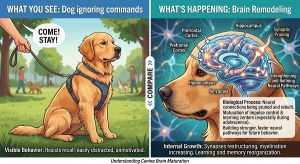
What’s happening: Hormones surge, the brain rewires, and a second fear period may appear anywhere between about 6 and 14 months. Your dog suddenly ignores commands they’ve known for months. That’s not defiance. It’s biology. Puberty usually starts around 6 to 9 months in males and can come later in females, depending on breed size.
Your goal: Protect the relationship. Don’t win every battle.
Stay calm and consistent
The dogs I’ve seen come out of adolescence with the strongest bonds all had handlers who stayed steady. Shouting and heavy corrections build avoidance, not respect. Research on aversive training methods, such as a 2020 study by de Castro and colleagues, links them to higher stress in dogs. Reward what you want and manage what you don’t.
Go back to easy wins
When recall falls apart, shorten your distance, raise your treat value, and practice at home first. Rebuild with success, not frustration.
Give their brain a job
Bored teenagers get into trouble. Try scent games (hide treats around the house), beginner agility, trick training, new walking routes, and puzzle feeders. If you’re building a backyard course, our post on a DIY dog agility course layout is a good start.
Protect one-on-one time
It’s tempting to let training slide once your dog “mostly knows it.” Don’t. Fifteen focused minutes a day, a game, a short session, or quiet time on the floor, keeps the connection alive through the chaos.
Stage 5: Teamwork (18 to 24 Months)
What’s happening: Most dogs reach social maturity around now, though giant breeds can take longer. Small breeds are often adults by 12 months, while giant breeds can need 18 to 24 months. What you built stops being “training” and becomes teamwork.
Your goal: Turn trust into a partnership.
- Learn who your dog really is. Some dogs live for sprints and fetch. Others would rather solve a puzzle beside you. Match activities to the dog you have, not the dog you imagined.
- Try a dog sport. Agility, rally, scent work, nose work and obedience trials all deepen the bond.
- Build cooperative care. A dog who trusts you stands still for nail trims, leans into brushing, and stays calm at the vet. That calm comes from years of tiny positive moments.
Want a structured system for every stage? My book, Beyond the Bark: Inside a Pro Handler’s Playbook for Raising the Ideal Dog, walks through the same framework I use with clients, from foundation obedience to advanced trust-building.
Quick Reference: Puppy Bonding by Age
| Age | Brain focus | Best bonding move | Avoid |
|---|---|---|---|
| 8-12 weeks | Safety, routine | Safe space, handling, routine | Forced cuddling, loud scares |
| 12-16 weeks | Socialization | Positive new experiences, class | Overwhelming crowds |
| 4-6 months | Independence, teething | Reward check-ins, trade games | Scolding for chewing |
| 6-18 months | Hormones, fear period | Consistency, scent games | Harsh corrections |
| 18-24 months | Social maturity | Dog sports, shared jobs | Dropping training |
Signs Your Puppy Is Bonding With You
Not sure it’s working? Look for these:
- Checks in with you during walks or play
- Follows you from room to room
- Seeks calm contact, like leaning on your leg or napping on your feet
- Offers soft eye contact and relaxed, wiggly greetings
- Looks to you when startled instead of running away
- Relaxes with you around, with a loose body and floppy ears
- Brings you toys or invites play
- Settles after you leave and return, rather than panicking for long
You don’t need all eight. Two or three, repeated daily, tell you the bond is growing.
7 Mistakes That Quietly Damage the Bond
- Forcing affection. Hugging a puppy who stiffens teaches them to avoid you. Let them choose.
- Punishing accidents. Your puppy can’t link the scolding to the puddle you found later. They just learn you’re unpredictable.
- Skipping socialization until all vaccines are done. The window closes while you wait.
- Being inconsistent. If the couch is allowed on Monday and banned on Tuesday, your puppy can’t trust the rules.
- Too much excitement, not enough calm. Constant wrestling can build a wild puppy, not a connected one. Teach settling too.
- Letting the phone win. Distracted walks are missed bonding. Put it away for ten minutes.
- Quitting in adolescence. Many owners think the training is done at 6 months. It’s just getting started.
Special Situations
A shy or fearful puppy
Go slower than feels natural. Sit on the floor, look away, and toss treats behind them so approaching doesn’t feel like pressure. Keep sessions short and end on a calm note. If fear stays strong after a few weeks, ask your vet and a certified behavior professional for help.
A rescue or adopted puppy
Background matters. Rescue puppies often need more decompression time, so lean on the 3-3-3 pattern (three days, three weeks, three months) as a rough guide. Keep your world small at first and add experiences gradually.
You work full time
Quality beats quantity. Give your puppy a proper meal routine, a morning walk with sniffing, and 15 to 20 focused minutes after work. Arrange midday potty breaks and enrichment, such as a puzzle feeder or a chew, so your puppy isn’t left in boredom or distress.
Kids and other pets
Supervise every interaction. Teach children to pet gently under the chin or chest, not hug or grab. Let your puppy leave when they want. A puppy who can say “no thanks” safely trusts everyone more.
Working breeds and protection-line puppies
Malinois, German Shepherds, Dutch Shepherds and similar breeds bond fast but need purpose. Build the relationship with play, obedience games and scent work before anything advanced. In professional programs, handlers don’t start with aggression. They start with trust, because a dog who trusts the handler is a dog the handler can control. Our team’s view is simple: no strong bond, no reliable working dog. Wondering whether you’ve picked the right pup? See our list of mistakes to avoid when choosing a puppy.
A Simple 30-Minute Daily Bonding Plan
You don’t need hours. You need consistency. Try this split:
- 10 minutes: calm connection. Sit on the floor, gentle touch, soft eye contact. No demands.
- 10 minutes: training game. Name, sit, hand touch, “leave it.” End while your puppy still wants more.
- 10 minutes: play or sniff walk. Tug with a clear “drop it,” a flirt pole, or a slow sniff session.
On top of that, include your puppy in normal life: let them nap near you while you work, and bring them along on safe errands. That time counts too.
Why You Can Trust This Advice
I’m not pulling this from a listicle. I’m a Nigerian Army Military Working Dog instructor and handler with more than 14 years of hands-on experience at the Nigerian Army Dog Centre. I’ve completed advanced obedience, K9 patrol and explosive detection courses, and I represented the Centre at the Nigerian Army Day Celebration (NADCEL) 2026, where I led obedience, explosive detection, agility and tactical movement demonstrations.
In work like that, a weak bond isn’t a small problem. It’s an operational risk. The same principles that build trust in a working dog candidate build trust in a family pet. The stakes are just different. Where I cite research (Nagasawa et al. 2015, AVSAB’s puppy socialization position statement, and de Castro et al. 2020), I’ve listed it by name so you can look it up yourself.
Not a vet note: always check with your vet about vaccines, exercise limits and any sudden change in behavior. Pain often hides behind “attitude” in dogs.
FAQs
1. How do I bond with my puppy in the first week?
Keep things calm and predictable. Set up a safe space, feed at the same times, take regular potty breaks, and let your puppy come to you. Add two or three minutes of gentle handling with treats each day. Don’t overwhelm your puppy with visitors or outings in week one.
2. What if my puppy doesn’t seem to like me?
That’s very common. Many puppies need two to four weeks to relax. Slow down, stop forcing contact, and use food and play to build good feelings. Rule out medical causes if your puppy avoids touch or seems unusually irritable. If nothing improves after a few weeks, a certified trainer can spot patterns you may miss.
3. Should my puppy sleep in my bed or my room?
Sleeping in your room, in a crate or pen near your bed, is a great way to build trust in the early weeks. Sharing your bed is a personal choice. If you do, make sure your puppy is safe from falls and potty accidents, and be consistent so the rules don’t confuse them.
4. Can you bond too much with a puppy?
You can’t love a puppy too much, but you can accidentally build separation anxiety if your puppy never learns to settle alone. Mix connection time with short, calm periods of independence, like time in the crate or pen with a chew.
5. Do I need to bond again during adolescence?
Yes. The bond doesn’t disappear in the teenage months, but it gets tested. Keep daily one-on-one time, stay consistent, use scent games and easy wins, and skip harsh corrections. Most dogs come out of this stage closer to their owners if the owners stay steady.
Final Thoughts
Bonding with a puppy isn’t one perfect moment. It’s built in the boring, repeated stuff: the same breakfast time, five quiet minutes on the floor after work, staying calm when your shoe gets chewed.
Here’s what to remember:
- Match your effort to the stage. Safety first, then socialization, then independence, then patience, then teamwork.
- Let your puppy choose contact. Trust grows faster when they aren’t cornered.
- Reward check-ins and keep your training positive.
- Stay steady in adolescence. That’s where most bonds are won or lost.
- Start small tonight. Ten minutes of calm connection beats a weekend of forced cuddling.
Want more tips like these in your inbox? Subscribe to our weekly articles roundup newsletter and get fresh K9 training advice every week.

Her work centres on obedience, detection, protection and operational readiness. She favours proven methods built on repetition, consistency and real-world conditioning, so that both dogs and handlers are prepared for high-pressure tasks.
Rofiat represented the Nigerian Army Dog Centre at the Nigerian Army Day Celebration (NADCEL) 2026, where she led demonstrations in obedience, explosive detection, agility and tactical movement. Through articles, training content and documentaries, she shares field-based insight into how structured training, clear communication and trust between handler and dog affect performance and reliability.
She is the author of Beyond the Bark: Inside a Pro Handler's Playbook for Raising the Ideal Dog, a practical guide that helps dog owners and handlers apply professional training principles in everyday situations.
- Dog Hotel Prep: 7 Must-Haves Before Boarding - October 21, 2026
- How to Enter the COBA National Dog Championship - October 20, 2026
- K9 Advantix Dosage Chart & Safety Guide for Dogs - October 19, 2026