Can Dogs Smell Explosives Through Water or Metal?
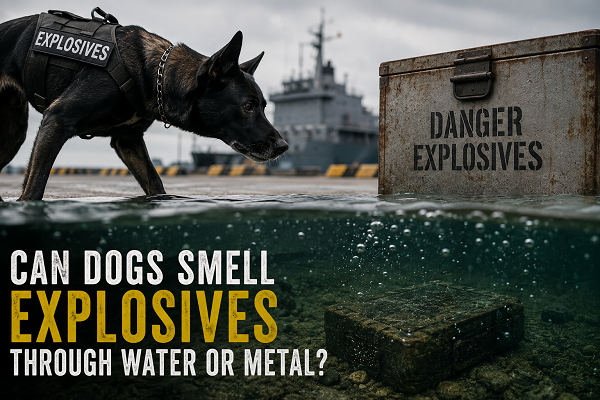
Can dogs smell explosives through water or metal? Not through them like X-ray vision, no. Dogs smell vapor, which means tiny scent molecules in the air. Solid metal and deep water can block or trap those molecules, so a perfectly sealed, clean container gives a dog almost nothing to smell. But real-world containers almost always leak a little through seams, seals, vents and dirty outer surfaces, and water carries scent to the surface in many cases. That’s why trained explosive detection dogs often succeed where people expect them to fail, and why they still miss things when the odor has nowhere to go.
Table of Contents
- Introduction: The Question Every Handler Hears
- What a Detection Dog Actually Smells
- Can Dogs Smell Explosives Through Metal?
- Can Dogs Smell Explosives Through Water?
- What About Plastic, Glass, Bags and Soil?
- What the Research and Field Numbers Show
- Why Dogs Miss: The Real Limits
- How Handlers Work Around These Barriers
- Dogs vs. Machines: Who Wins?
- Myths vs. Facts
- Trainer’s Notes
- Try This at Home: A Safe Scent Game
- FAQs
- The Bottom Line
Introduction: The Question Every Handler Hears
Ever watch a dog circle a locked metal box or sniff along a boat dock and wonder, “Can it really smell anything in there?”
I hear this question at almost every demonstration I give. People picture a bomb inside a steel case, or at the bottom of a lake, and they assume the dog either smells everything or nothing. The truth sits in the middle, and it’s more interesting than either answer.
In this guide, you’ll learn:
- What odor molecules a detection dog actually follows
- Why metal and water change the scent picture instead of simply blocking it
- What real research and field results say (with numbers)
- Where dogs fail, and how handlers cover those gaps
- A simple scent game you can try with your own dog
This guide covers the science of canine scent detection. It doesn’t cover how explosives are made, hidden or disguised, and we’ll keep it that way.
What a Detection Dog Actually Smells
Here’s the first thing I tell every new handler: a dog doesn’t smell “a bomb.” A dog smells chemicals.
Dogs are commonly said to have up to 300 million scent receptors, compared with roughly 6 million in people. They also have a second scent system, the vomeronasal organ, and a nose built to pull air in short, rapid sniffs while keeping scent inside the nasal passages. Dogs pick up certain odors at parts-per-trillion levels. An American Chemical Society classroom guide on landmine detection puts it this way: dogs can detect some substances at concentrations far, far below what people can notice.
But here’s the part most articles skip. Dogs often don’t key on the explosive itself. They key on the vapors that leak off it.
- With TNT, dogs mainly pick up DNT, an impurity that evaporates much more easily. The ACS guide notes that vapor coming off TNT can be about 35% DNT, while the solid itself holds only about 0.08%.
- With plastic explosives, research teams have found that dogs often respond to additives and by-products that carry more odor than the main ingredient.
Why does this matter for our question? Because the real question isn’t “can a dog smell through metal?” It’s “can enough of those vapor molecules reach the dog’s nose?”
I call this the “no vapor, no alert” rule. Think of scent like water leaking from a pipe. Dogs find the drip, not the pipe.
Can Dogs Smell Explosives Through Metal?
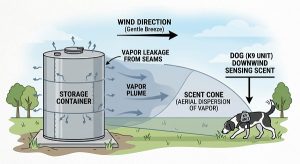
Direct answer: A dog can’t smell through solid, sealed metal. But a dog can often smell the odor that escapes around it, and that’s enough most days.
Why a sealed steel box isn’t as sealed as it looks
Real objects have weak points. Handlers learn to think about these first:
- Seams and welds. Few containers are truly airtight.
- Lids, hinges and latches. Metal-on-metal contact leaves microscopic gaps.
- Rubber seals and gaskets. Here’s the irony: rubber seals made to keep water out still let odor molecules creep out. One UK canine security professional who has screened shipping containers with search dogs makes this exact point. His dogs concentrate on doors, rubber seals and hinges because that’s where scent escapes.
- Vents, drain holes, screw threads and cable entries.
- Surface contamination. Anyone who handled the item may have left trace residue on the outside. A dog can alert to that residue even when the inside is tight.
What changes the odds
Several factors decide how much vapor reaches the outside:
| Factor | Helps detection | Hurts detection |
|---|---|---|
| Container design | Seams, vents, gaskets | Welded, vacuum-tight, thick, clean exterior |
| Temperature | Warm metal pushes vapor out faster | Cold slows vapor release |
| Time | Hours or days of leaking builds a scent field | A fresh, just-sealed item has little outside odor |
| Airflow | Gentle steady wind carries scent | Strong gusts scatter it; dead air traps it |
| Surroundings | Clean background | Strong competing smells (fuel, food, cleaning chemicals) |
A real-world example
That same container screening report described roughly 25,000 containers checked over ten years, with 129 dog alerts. Of those, 111 held the target odor, about 86%. Six of the 18 “empty” alerts came from containers that had once carried tobacco. Two dogs checked 500 containers in about 90 minutes.
A caution: those figures come from one operator’s own records and weren’t independently audited, and the target was contraband, not explosives. I include them because they show something real. Dogs do find hidden items in metal boxes because odor leaks, and old odor can linger and create “false” alerts that are actually the dog being right about a past smell.
Bottom line for metal: Metal slows scent. It rarely stops it completely. A very clean, tight container with nothing on the outside is the hardest case, and that’s where handlers add other tools (more on that below).
Can Dogs Smell Explosives Through Water?
This is the harder question, and honesty matters here. Published, hard data on dogs detecting explosives underwater is thin. Anyone who gives you a confident number is guessing.
What we do know comes from a close cousin: water search dogs that locate drowning victims. That work has been studied far longer, and it shows how scent behaves around water.
How scent gets out of water
A review of search-dog use described in Fire Engineering magazine collected results from 130 drowning cases handled by 26 U.S. units and one Canadian unit:
- Dogs found 84 of the victims.
- 24 victims were recovered outside the search area.
- 22 were not found.
- Find rates were 100% in tidal areas and 82% in normal river, creek and stream flow.
- Victims were found at depths from 10 to 150 feet.
The same source explains the mechanism. Material shed by the submerged body rises and spreads to the surface, evaporates, and forms a cone-shaped scent plume that the dog works from a boat. In still water the dog usually alerts within about 10 feet of the target. Accuracy gets worse with depth, colder water, and stronger or shifting currents.
The figures trace back to a 1992 lecture and a 2013 article, so treat them as a picture of how it works, not a modern guarantee. A UK university team (Wrexham University, working with UK-K9) is also studying cadaver dogs and submerged remains, and its early notes say success may depend heavily on the water type and conditions. In other words, researchers are still learning.
What this means for explosives
Remains and explosives behave differently. Human odor is rich, constantly shed and easy for water to carry. Many explosives give off very little vapor to begin with. So I’d treat the water results as a hint, not proof.
Here’s how I explain it to students:
- Item on the surface, floating, or partly out of water: Good chance of detection. Vapor goes straight to air.
- Item in shallow, calm water, leaking or contaminated: Detection is possible, especially from a boat or the shoreline downwind.
- Item sealed and deep, in moving water: Poor odds. Water dilutes scent and currents carry it away from the source, so any alert can sit far from the item.
- Wet or rain-soaked ground: Water can wash trace residue away or mask it, so handlers expect lower odds right after heavy rain.
Water is also a search tool
Handlers often work along banks, bridges and docks, because plumes from submerged items can surface downwind. Flowing water also moves scent. In flood conditions, victims have been found more than 40 miles from where they were last seen, which shows how far water can carry things.
Bottom line for water: Dogs can follow scent that reaches the surface, but they can’t smell a sealed item sitting deep in the water. For underwater searches, teams combine dogs with sonar, divers and other sensors.
What About Plastic, Glass, Bags and Soil?
Most people only ask about metal and water. Handlers think about every barrier. Here’s a quick comparison.
| Barrier | How much odor gets through | Notes from the field |
|---|---|---|
| Sealed steel or aluminum | Very little through the metal itself | Odor escapes at seams, seals and vents |
| Welded, thick, clean metal | Minimal | Hardest case; surface residue may still help |
| Plastic bags and wrap | Often a lot | Many plastics, including common polyethylene bags, are slowly permeable to odor molecules. Wrapping doesn’t hide scent from a dog |
| Glass jar with metal lid | Little until the lid seal leaks | Glass blocks odor well; the lid is the weak spot |
| Foil layers | Low | Foil slows odor, but folds and tears leak |
| Soil and sand | Moderate | Buried items release vapor slowly into the soil, then to the air. Dogs have been used in landmine work for decades |
| Water (deep) | Low | Dilution and current reduce odor at the surface |
| Water (shallow, calm) | Moderate | Vapor can reach the surface |
| Fabric, cardboard, wood | High | Porous materials let odor pass easily |
The surprise for most people is plastic. Layering bags, wrap or tape often feels secure, but odor molecules are tiny. Researchers have even used this idea on purpose: teams at Florida International University and elsewhere have developed odor-permeable membrane devices that let explosive odor out slowly and safely for canine training.
What the Research and Field Numbers Show
Let’s look at what’s actually documented.
- Dogs vs. machines. In a 2001-era test at Auburn University, the top landmine-detecting dogs were about 10 times more sensitive than a machine. In 2010, a U.S. report said sensors typically found about half of roadside bombs before they went off, while dog teams found 80%.
- Machines are catching up on sensitivity. NIST scientist Matthew Staymates notes that the newest artificial detectors can sense smaller traces than dogs. But they’re big, need power and gas, and often need a sample brought to them.
- Dogs help science. In 2017, MIT Lincoln Laboratory built a dresser-sized mass spectrometer that matched dog sensitivity and gave answers in about a second. It showed that some “dog mistakes” were actually cross-contaminated containers. The dog was right and the training aid was dirty. That’s a lesson every handler remembers.
- The size of the working force. The U.S. military counted more than 1,740 working dogs in 2016.
- Training time. The ACS guide cites about four to six months of training. Many agencies run detection courses of 24 to 32 weeks when you count handler pairing and certification.
- Cost. Estimates for fully trained working dogs often fall around $50,000 for a military working dog. Specialized detection dogs can run far higher.

Why Dogs Miss: The Real Limits
I’ve seen great dogs have bad days. Being honest about limits makes a team safer.
- No vapor reaches the outside. The sealed-and-clean case. The dog can’t smell what isn’t there.
- Wind and weather. A steady breeze is a gift. Swirling wind, heavy rain and extreme heat all scatter or wash away scent.
- Stacked or tall targets. The container report calls screening stacked containers “virtually impossible” for a dog team, since dogs work mostly at ground level.
- Competing odors. Coffee, bleach, fuel and cleaning chemicals add noise. (In that same report, dogs still alerted in a coffee test. Training matters.)
- Residual odor. Old odor makes empty items alert. It’s a handler headache, but it also proves how good the dog’s nose is.
- Fatigue. Focused search work often drops in accuracy after about 20 to 45 minutes, so good teams rotate dogs.
- Training gaps. A dog trained on only a few explosive types or settings will struggle in new ones.
- Handler error. A tired or distracted handler can miss a dog’s subtle change of behavior. In my experience, this one causes more misses than people like to admit.
How Handlers Work Around These Barriers
Good teams plan around the nose, not against it.
- Search downwind. Start where the wind carries scent toward the dog, then work the edges.
- Target the weak points. Seams, doors, hinges, vents and cable entries.
- Give scent time to gather. In a closed room or vehicle, a short wait can help odor build up.
- Use air sampling. Systems that pull air from a sealed area and present it to the dog help with containers, cargo and vehicles. One such approach was tested in wildlife trafficking work, where dogs were paired with an air-sampling device.
- Rotate dogs. Swap every 30 to 45 minutes so each dog stays sharp.
- Pair the dog with other tools. Sonar and divers for water, X-ray or trace detectors for cargo.
- Confirm before opening. An alert triggers a safe, layered response, not a guess.
Dogs vs. Machines: Who Wins?
Short version: neither wins everywhere.
| Detection dogs | Machines and sensors | |
|---|---|---|
| Mobility | Walk anywhere, climb, squeeze through gaps | Often large, need power, or need a sample |
| Sensitivity | Excellent; very low concentrations | Newest tools can beat dogs in labs |
| Real-time tracking | Follows a plume to the source | Usually tells you whether, not where |
| Variety | Many compounds, one nose | Often tuned to certain chemicals |
| Fatigue | Needs breaks and rotation | Doesn’t tire |
| Cost to field | High upfront and ongoing | Varies widely |
| Handling surprises | Adapts to unpredictable settings | Struggles outside its design |
Handlers I know don’t argue about this anymore. They layer both, because each covers the other’s blind spots.
Myths vs. Facts
Myth: Wrapping something in plastic or foil hides the smell from a dog. Fact: Many plastics let odor through, and folds in foil leak. Layers slow scent but rarely stop it.
Myth: Dogs can smell anything underwater, no matter how deep. Fact: Dogs smell what reaches the surface. Depth, cold and current all reduce what arrives.
Myth: If a dog alerts and nothing is found, the dog was wrong. Fact: Residual odor and cross-contamination cause many “false” alerts. The MIT work showed that some mistakes were actually correct calls on dirty training material.
Myth: Dogs are always better than machines. Fact: Machines can beat dogs on raw sensitivity in a lab. Dogs win on mobility and tracking.
Myth: More explosive means a stronger smell. Fact: Detection depends on how much vapor reaches the nose, not how much material exists.
Trainer’s Notes
Author note: add your own details here (years of service, units, certifications) and one short story from your field work. Readers and Google both reward real, specific experience. The structure below is ready for you to fill in. The first-person lines elsewhere in this article (“I hear this question at every demonstration”, “I’ve seen great dogs have bad days”) should also be checked so they match your real experience.
What I’d want you to remember:
- Experience: Handlers learn quickly that the dog isn’t the limit. The odor path is.
- Expertise: When a dog “fails” on a sealed item, ask where the vapor could have escaped before blaming the dog.
- Authority: Standards bodies such as NIST work to improve canine detection and calibration. Agencies like TSA and the U.S. Air Force’s 341st Training Squadron at Lackland train and field detection teams.
- Trust: Detection is probability, not magic. Any trainer who promises a dog will always find a sealed, hidden item is selling something.
One lesson I teach every new handler: read the dog’s change of behavior (faster breathing, a sharper head turn, a tighter tail) before it gives its final response. That early change often points to the plume edge, and a good handler follows it.
For deeper background, see our guide on how military working dogs are trained. To see how reliable these dogs really are, read how accurate military dogs are at detecting explosives. For the biology behind the nose, try the science behind why explosive detection dogs are often successful.
Try This at Home: A Safe Scent Game
You can show your own dog how barriers affect smell, with no explosives or hazardous materials involved. Use treats only.
What you need: A few smelly treats, a metal tin with a loose lid, a plastic bag, a small glass jar, and a shallow bowl of water.
- Put a treat in the tin with the lid slightly open. Let your dog find it. Praise and reward.
- Close the lid fully. Watch where your dog sniffs (usually the seam).
- Wrap another treat in a plastic bag and place it under a cloth. Notice how fast your dog finds it.
- Drop a treat into the shallow bowl and see how your dog responds at the surface.
- End on an easy win, and keep sessions to 5 to 10 minutes.
You’ll see the “no vapor, no alert” idea in action. Your dog goes straight to the leak point. If you want to go further into scent training and working-dog thinking, my book Beyond the Bark covers practical handling ideas you can use with your own dog.
FAQs
1. Can dogs smell through metal?
Not through solid, sealed metal. They smell odor molecules that leak from seams, vents, seals and from residue on the outside. Because real containers rarely seal perfectly, dogs often detect items in metal boxes.
2. Can dogs smell explosives underwater?
Dogs can’t smell a sealed item deep underwater. They can work from boats and shorelines to find scent that rises to the surface. Hard published data for explosives underwater is limited, so teams combine dogs with sonar and divers.
3. Can bomb sniffing dogs smell through plastic or vacuum-sealed bags?
Often yes for ordinary plastic, because many plastics let odor molecules slowly pass. A truly vacuum-sealed, clean package is harder, but handlers still look for leaks and surface residue.
4. How far away can a detection dog smell explosives?
It depends on wind, temperature and how much vapor escapes. There’s no single distance. A steady breeze with a downwind dog can carry scent much farther than still air, which is why handlers always check the wind first.
5. Are dogs better than machines at finding explosives?
Dogs usually win on mobility and tracking a plume to its source. Some machines now match or beat dogs on lab sensitivity. Most professional teams use both.
The Bottom Line
So, can dogs smell explosives through water or metal? They smell what escapes, not what hides. Metal slows scent, and water dilutes and moves it, but neither one is a perfect wall in the real world. A clean, sealed, deep target is the hard case, and that’s when smart teams add air sampling, sonar and other tools.
What to do with this:
- If you’re a dog owner, try the treat-tin game to see scent leaks in action.
- If you’re a handler, plan every search around wind, seams and time, not just the dog.
- If you’re a student, remember “no vapor, no alert.”
Want more K9 insight like this every week? Subscribe to our weekly articles roundup newsletter and get new guides straight to your inbox.
Sources
- Why dogs’ noses out-sniff the most advanced bomb detectors (MIT Technology Review)
- Screening shipping containers with search dogs, Stu Phillips (BWY Canine)
- Air-Scenting Search and Rescue Dogs for Dive Teams (Fire Engineering)
- Cadaver Water Dogs research (Wrexham University)
- Sniffing landmines (American Chemical Society, ChemMatters)

Her work centres on obedience, detection, protection and operational readiness. She favours proven methods built on repetition, consistency and real-world conditioning, so that both dogs and handlers are prepared for high-pressure tasks.
Rofiat represented the Nigerian Army Dog Centre at the Nigerian Army Day Celebration (NADCEL) 2026, where she led demonstrations in obedience, explosive detection, agility and tactical movement. Through articles, training content and documentaries, she shares field-based insight into how structured training, clear communication and trust between handler and dog affect performance and reliability.
She is the author of Beyond the Bark: Inside a Pro Handler's Playbook for Raising the Ideal Dog, a practical guide that helps dog owners and handlers apply professional training principles in everyday situations.
- How to Enter the COBA National Dog Championship - October 20, 2026
- K9 Advantix Dosage Chart & Safety Guide for Dogs - October 19, 2026
- How to Set Up & Use Bousnic Dog Training Collar - October 18, 2026