Best Dog Breeds for Kids: A K9 Trainer’s Real Guide
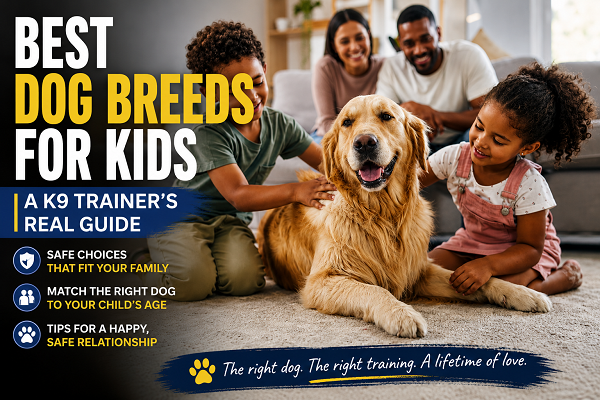
Which dog breed is best with kids? Labrador Retrievers, Golden Retrievers, Cavalier King Charles Spaniels, Collies, Standard Poodles, Beagles and Newfoundlands top most trainer lists because they tend to be tolerant, trainable and sociable. But breed is only part of the answer. Each dog’s own temperament, the child’s age, and how well adults supervise matter more. The best family dog is the one whose energy, size and health fit your home, and whose child is taught how to behave around it.
What you’ll get in this guide:
- A ten-breed comparison table with size, exercise needs, lifespan and watch-outs
- A breed-by-child-age matching chart (baby to teenager)
- The bite research most “top 10” lists leave out
- A 7-day plan for introducing a new dog to your kids
- Costs, health risks, and what to do if a bite happens
Table of Contents
- Why “Best Breed” Is the Wrong First Question
- What the Research Says About Dogs and Child Safety
- The 7 Traits a Kid-Friendly Dog Needs
- Best Dog Breeds for Kids: 10 Breeds Compared
- Match the Dog to Your Child’s Age
- Puppy, Adult or Rescue?
- Breeds That Need an Experienced Home
- The Real Cost of a Family Dog
- The Supervision Rules That Actually Work
- Introduce a New Dog to Your Kids: A 7-Day Plan
- Special Situations: Allergies, Autism, Other Pets
- If a Bite Happens
- A Note From the Trainer
- FAQs
- The Bottom Line
Why “Best Breed” Is the Wrong First Question
Ever notice how every “best dog breeds for kids” list looks the same? Golden Retriever, Labrador, Beagle, repeat. Then a family follows the list, brings home a lovely dog, and six months later calls a trainer because the dog snapped at a toddler.
Here’s the problem. Those lists answer which dog. They skip how. They don’t tell you that a four-year-old and a calm dog still need a plan. They don’t tell you that most bites to young children come from a dog the child already knows.
I’ve handled working dogs for years, and the pattern is always the same. The dog isn’t “bad.” The setup was. A tired dog with no escape route, a child who hugs, and an adult who’s looking at their phone. That’s how most incidents start.
So in this guide, you’ll get both halves. First, the honest breed list, with numbers. Then the part other guides leave out: matching a dog to your child’s age, the supervision rules we use with handlers, a step-by-step introduction plan, and what it really costs.
What the Research Says About Dogs and Child Safety
Let’s start with the facts, because they change how you choose.
The numbers parents should know
- About 4.5 million dog bites happen in the U.S. each year, and roughly 885,000 need medical care (Gilchrist et al., Injury Prevention, 2008). The AVMA notes that about half of bite victims are children.
- In a study of 537 children with facial dog bites, 68% were age 5 or younger, and age 3 was the peak. 89.8% of the dogs were known to the child, and 51.2% were the family pet. Over a fifth (22.5%) needed hospital admission (Chen et al., 2013).
- In the same study, 53.2% of bites with a recorded cause were provoked. That usually meant rough petting, startling the dog, or falling on it. The child wasn’t being “bad.” Toddlers just don’t know better.
- A Philadelphia trauma-center study found 72% of injured children knew the dog. Among children under 7, 70% were bitten on the face, most during friendly, child-initiated contact (Reisner et al., 2011).
Resource guarding is a bigger deal than breed
Researchers at a veterinary hospital reviewed bites to children and found that children under six were most often bitten during resource guarding, meaning the dog was protecting food, a toy or a resting spot. That was 44% of cases in that group (Reisner et al., 2007). Two-thirds of those dogs (66%) had never bitten a child before.
Think about what that means. These weren’t “dangerous dogs.” They were normal dogs, pushed past their limit in their own home.
Neutering and obedience classes aren’t magic
In that same study, 93% of the dogs were neutered and 66% of the owners had attended obedience classes. The authors concluded that those common measures weren’t reliable bite deterrents. Training helps, but it doesn’t replace supervision.
What about breed?
The AVMA states that a dog’s breed doesn’t reliably predict whether it’ll bite. Here’s why that makes sense:
- In a review of fatal dog attacks from 2000 to 2009, valid breed identification was possible in only 17.6% of cases. Media reports and animal-control records disagreed on the breed in 40.2% (Patronek et al., JAVMA, 2013).
- Visual breed guesses are shaky. In one shelter study, staff’s main breed label matched the DNA result just 57% of the time, and 33% of labels didn’t show up in the dog’s DNA at all (Gunter et al., PLOS One, 2018).
- That same fatality review found that 87.1% of deaths had no able-bodied person present to step in, and 80.5% involved four or more risk factors piling up.
My take as a trainer: Breed gives you tendencies. It doesn’t give you guarantees. A calm, well-bred Lab from a good line can still bite a toddler who pulls its tail. And a “scary” breed raised well, supervised well, can be gentle. Choose on tendencies, then manage the rest.
Disclaimer: I’m sharing research, not medical or legal advice. If your child has been bitten, see a doctor.
The 7 Traits a Kid-Friendly Dog Needs
When I assess a dog for a family, I don’t start with the breed name. I check these seven things.
- Bite inhibition. Does the dog use a soft mouth when excited? Retrievers were bred to carry game without damage, which often helps here.
- Frustration tolerance. What does the dog do when it can’t get what it wants? Pushy dogs struggle with grabby toddlers.
- Recovery speed. After a loud noise or a stumble, how fast does the dog settle? A dog that shakes it off in seconds copes better with a busy home.
- Size versus child. A 130-lb dog can knock over a toddler by accident. A 6-lb dog can be hurt by a hug. Both need management.
- Energy level. An under-exercised dog invents its own games, and those games often involve kids and chewing.
- Handling comfort. Does the dog calmly allow paws, ears and collar to be touched? Kids touch everything.
- Health. A dog in pain bites. The AVMA says pain can make dogs more likely to bite. Joint trouble, ear infections and heart disease all change behavior.
If you want a quick refresher on how breeds are grouped before you shortlist, my guide to the 7 types of dogs explains why a herding dog and a gundog behave so differently at home.
Best Dog Breeds for Kids: 10 Breeds Compared
Most lists give you a photo and a paragraph. Here’s the side-by-side view I wish every family had. Weights and lifespans are typical adult ranges from major breed clubs and veterinary sources. Exercise times are my handler estimates for a healthy adult dog.
| Breed | Adult weight | Typical lifespan | Daily exercise | Best child age | Main watch-out |
|---|---|---|---|---|---|
| Labrador Retriever | 55–80 lb | 10–13 yrs | 60–90 min | 5+ (with supervision for younger) | Boisterous, chews, can knock over toddlers |
| Golden Retriever | 55–75 lb | 10–12 yrs | 60–90 min | 5+ | High cancer risk, heavy shedding |
| Cavalier King Charles Spaniel | 13–18 lb | 12–15 yrs | 30–45 min | 4+ | Heart disease (mitral valve) very common |
| Beagle | 20–30 lb | 10–15 yrs | 45–60 min | 5+ | Howling, scent-driven, escapes |
| Collie | 50–75 lb | 12–14 yrs | 45–60 min | 5+ | Herding nips at running kids |
| Standard Poodle | 40–70 lb | 10–18 yrs | 60 min | 5+ | Needs grooming and mental work |
| Newfoundland | 100–150 lb | 9–10 yrs | 30–60 min | 6+ | Size, drool, short lifespan |
| Bernese Mountain Dog | 80–115 lb | 7–10 yrs | 30–60 min | 6+ | Short lifespan, high vet bills |
| Staffordshire Bull Terrier | 28–34 lb | 12–14 yrs | 60 min | 6+ | Strong and exuberant, breed rules in some countries |
| Retired Greyhound | 60–70 lb | 10–13 yrs | 30–45 min | 6+ | High prey drive, not always safe with small pets |
Labrador Retriever: the all-rounder
Labs are friendly, food-motivated and easy to train, which is why they’re so common. They’re also strong and bouncy until about age three. If your child is small, you’ll spend those years teaching “four paws on the floor.”
Golden Retriever: the gentle gundog
Goldens are soft-mouthed and people-focused. The trade-off is health. Cancer is the leading cause of death in the breed, so buy only from breeders who share health testing for hips, elbows, eyes and heart, and plan on pet insurance.
Cavalier King Charles Spaniel: the small lap dog with a big risk
Cavaliers are gentle and small enough for a family flat. But research summarized by Science for Animal Welfare shows about half of Cavaliers have a heart murmur by age 5 and nearly all surviving dogs have at least a low-grade murmur by age 10. Mitral valve disease accounts for 42.8% of deaths in the breed. Ask breeders for heart screening results on both parents. Explain to your kids, honestly, that this breed may have a shorter, medically busier life.
Beagle: the happy scent hound
Beagles are sturdy, cheerful and good with kids. They’re also nose-driven. Leave a gate open and a Beagle will be three streets away following a smell. Good fencing and recall training are non-negotiable.
Collie: the sensitive herder
Collies are famously devoted and gentle with families. But herding dogs may nip at running children’s heels. That’s instinct, not aggression. Teach kids to walk, not run and scream, around the dog, and give the Collie a job.
Standard Poodle: the clever one
Poodles are smart, athletic and sociable. They shed less, but no dog is truly allergy-proof (more on that below). Expect regular grooming costs.
Newfoundland and Bernese Mountain Dog: the gentle giants
Both are calm, patient and famously good with children. Both are also big, droolly, and short-lived (the Bernese often lives only 7–10 years). Think hard about whether your family can handle losing a beloved dog when your child is still young.
Staffordshire Bull Terrier: loving, but not a “nanny”
You’ll hear “nanny dog” a lot. It’s a myth. No dog is a babysitter. Staffies can be loving and affectionate with children when raised well, but they’re strong, and some countries and insurers have breed-related rules. Check yours before you commit.
Retired Greyhound: the couch potato sprinter
Ex-racers are quiet and gentle indoors. Many have never lived in a house, so they need patience. Check with the adoption group about cat and small-pet safety, because prey drive can be high.
Don’t overlook mixed breeds
In the Gunter shelter study above, a third of breed labels didn’t match the dog’s DNA. So a dog labeled “Lab mix” might be anything. Don’t judge a shelter dog by its label. Judge it by behavior: how it handles noise, handling and a calm child’s presence over several visits.
Match the Dog to Your Child’s Age
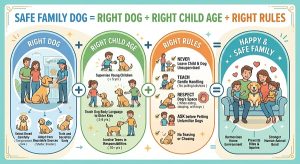
This is the part nearly every ranking article skips, and it’s the part that matters most. The age of your child decides how much management you’ll need.
| Child’s age | Risk picture | What to prioritize |
|---|---|---|
| Baby (0–1) | Can’t move or signal; adults control everything | Calm adult dog already used to babies; physical barriers (gates, closed doors) |
| Toddler (1–3) | Grabs, falls, crawls into the dog’s space; the peak age for facial bites in the Denver study | Very tolerant medium or large adult; constant adult supervision; dog safe zone |
| Young child (4–7) | Highest-risk window for face bites (70% of under-7 bites were to the face in the Philadelphia study) | Active supervision; teach “hands off when the dog is eating or resting” |
| Child (8–12) | Can help with feeding, walks, basic cues | Medium or large energetic dog; your child can join training classes |
| Teen (13+) | Can handle most breeds with adult backup | Teen as main handler for walks and training, adult as final responsible person |
The AVMA suggests considering waiting until your children are older than 4 before adopting a new dog. I agree for most families, because the toddler years are when you’ll be least able to watch the dog and child every second.
My honest advice by age
- New baby on the way? Adopt an adult dog with a known history, and start routine changes months before the baby arrives.
- Toddlers at home? A calm adult dog beats an energetic puppy. Puppies mouth, jump and nip, and they’ll hurt a toddler without meaning to.
- School-age kids? This is the sweet spot for most active, trainable breeds.
Puppy, Adult or Rescue?
A puppy gives you the chance to shape the dog. It also gives you sharp teeth, sleepless nights and a heavy socialization workload in the first 16 weeks.
An adult dog (2+ years) lets you see the temperament you’re getting. A good rescue will have fostered the dog around children and can tell you what the dog does at the food bowl, when picked up, or when startled.
| Puppy | Adult/rescue | |
|---|---|---|
| Temperament | Predictable only by parents | Observable now |
| Time demands | Very high | Moderate |
| Mouthing/nipping | Yes | Rare |
| Cost up front | Higher (breeder) | Lower (adoption fee) |
| Best for | Families with older kids and time | Families with toddlers or limited time |
If you do buy a puppy, check the breeder’s health tests and meet the mother before you pay. Once the puppy comes home, a crate is your best tool for giving the dog a safe space away from kids. My guide on how to crate train a puppy walks you through it.
A practical adult-dog check before you adopt
Ask the shelter or foster these questions:
- Has the dog lived with children? What ages?
- Does it guard food, toys or bones? How do you know?
- How does it react to being startled, touched while sleeping, or hugged?
- Can I meet it at least three times, on different days?
- Is there a trial period or return policy?
Never test a dog’s reactions by putting your child in an uncertain situation. Let the professionals run those tests.
Breeds That Need an Experienced Home
Some dogs can live happily with kids, but they need an owner who already knows what they’re doing. These aren’t “bad” breeds. They need more skill.
- Toy breeds (Chihuahua, Yorkshire Terrier): A child can seriously hurt one by dropping or squeezing it, and fearful small dogs may snap when scared.
- Akita and Chow Chow: Independent and protective. They don’t enjoy rough handling or visiting children.
- Siberian Husky and Alaskan Malamute: High prey drive, escape artists, and very high exercise needs.
- Australian Cattle Dog: Strong herding instinct, often nips at heels.
- Working-line German Shepherds, Belgian Malinois, Cane Corsos: Fantastic dogs, but they need serious training, structure and a job. Working-line dogs are bred for drive, not for sitting beside a toddler.
Notice that I’m not saying “never.” I’m saying be honest about your experience, time and household before you choose.
The Real Cost of a Family Dog
Nobody budgets this properly, and it ends up being a reason dogs are rehomed.
Based on 2026 figures from Rover:
- Yearly cost for an adult dog: about $1,930 to $5,305
- First-year upfront costs: roughly $1,195 to $4,650
- Lifetime cost: around $19,840 for a small dog, $35,415 to $43,285 for a medium dog, and $58,875 for a large dog
Large and giant breeds cost more because of food, medication doses, boarding and bigger vet bills. And breeds with known health problems (Cavaliers’ hearts, Goldens and cancer, Berners and a shorter life) can mean higher veterinary spending.
What to budget for:
- Food and treats
- Vaccines, flea/tick and worm treatment
- Pet insurance (compare policies early; some limit coverage for known breed conditions)
- Training classes (aim for at least one 6-week family course)
- Grooming, if you pick a Poodle or Collie
- A secure fence, baby gates and a crate
Also check home insurance and local laws. Some insurers restrict cover for certain breeds. Some countries restrict or ban certain breed types. Call before you buy, not after.
The Supervision Rules That Actually Work
Supervision means watching with your eyes, not being in the same room scrolling a phone. Here’s the system I give families.
Rule 1: Always have a “dog-free zone”
The UK Kennel Club recommends a quiet place the dog can retreat to. Give the dog a bed or crate no child may enter. Use baby gates so the dog can still see the family but can’t be grabbed.
Rule 2: No unsupervised time for babies and toddlers
The AVMA says never leave a baby or small child alone with a dog. Not for “just a second.” When you can’t watch, separate them with a gate or a closed door.
Rule 3: Teach kids the five do’s and don’ts
- Do ask an adult before approaching any dog.
- Do stay calm and keep your hands low.
- Do let the dog come to you.
- Don’t hug, kiss or climb on a dog.
- Don’t touch a dog that’s eating, sleeping or chewing a bone.
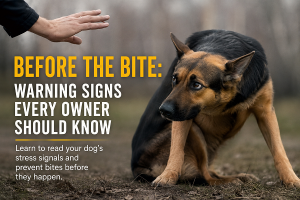
Rule 4: Learn the stress signals
Teach every adult in the house to spot these early signs:
- Lip licking, yawning when not tired
- Turning the head away
- “Whale eye” (white of the eye showing)
- Stiff body, tail held stiff or tucked
- Freezing or moving away
A growl is information. Never punish it. A dog told off for growling may skip the warning next time and go straight to a bite.
Rule 5: Prevent resource guarding
Because food and toy guarding showed up as the leading trigger for young children’s bites in the research above:
- Feed the dog in a quiet spot, away from kids
- Pick up bones, chews and toys when the dog is done
- Never let a child take something from the dog’s mouth
- Teach the dog “drop it” and “leave it” early. The same commands I teach for protection dogs work beautifully in a family home.
Rule 6: Teach kids to “be a tree”
If a dog approaches or jumps up, a child should stand still, fold their arms, look at their feet and stay silent until the dog loses interest. The UK Kennel Club teaches a similar freeze response, and it works because running triggers chasing.
Rule 7: Dogs get tired, so watch for it
Tired, hungry or sore dogs have shorter fuses. Make sure your dog sleeps 12 to 14 hours (puppies more), gets regular vet checks and has quiet time each day.
Introduce a New Dog to Your Kids: A 7-Day Plan
Most guides stop at “pick a dog.” Here’s what to do after you bring it home.
Day 1: Quiet arrival. Let the dog explore the house on leash with adults only. Show it the bed or crate. Keep visitors away. Kids stay calm and watch.
Day 2: Short, calm meetings. Have the child sit on the floor while an adult holds the leash. The child offers a treat from a flat hand. No petting yet. Keep it under five minutes.
Day 3: Gentle petting. One child at a time, one gentle stroke on the chest or shoulder, then stop. Watch whether the dog comes back for more. If it moves away, respect that.
Day 4: Feeding rules. Teach the household feeding routine. Dog eats alone, bowl goes away when done. Kids stay out of the dog’s space during meals.
Day 5: Walks together. An adult holds the leash. The older child walks beside, carrying treats. Practice “sit” and “wait” at doors.
Day 6: Short play. Gentle fetch or hide-and-seek with treats. No wrestling, no chasing, no tug-of-war.
Day 7: Review. Check what worked. Adjust the gates, schedule and rules. Book a family training class.
Keep up the structure for months, not days. A new dog might also change behavior after the first few weeks, when it feels more settled and shows its true personality.
Special Situations: Allergies, Autism, Other Pets
Allergies
There’s no 100% hypoallergenic dog. Poodles and other low-shedding breeds may cause fewer symptoms for some people, but dander and saliva still cause reactions. Spend time with the specific dog before you commit, and talk to your doctor.
Children with autism or sensory needs
Some children with autism find calm dogs soothing, and others find barking, licking or sudden movement overwhelming. Pick a quiet, predictable adult dog, introduce sounds and touch slowly, and look into properly trained assistance or therapy dogs if you need that level of support.
Children with mobility needs
A steady, sturdy dog can be a lovely companion, but a dog that jumps or pulls can knock a child with limited balance. Choose a calm, well-trained dog, and train loose-leash walking before the child ever holds the lead.
Other pets
Cats, rabbits and small animals need careful introductions. Breeds with high prey drive (Greyhounds, terriers, some herders) may not be safe with small pets. Ask for a “cat test” with rescue dogs.
Older dogs and growing kids
Dogs change as they age. Arthritis, hearing loss and poor eyesight make older dogs grumpier and easily startled. When your children get more active, an older dog may need more retreat time. Vet checks twice a year for seniors help catch pain early.
If a Bite Happens
Stay calm, and act in this order. This follows AVMA guidance.
- Separate the dog and child safely.
- Wash the wound with soap and warm running water for several minutes.
- Apply pressure with a clean cloth if it’s bleeding.
- See a doctor promptly. Bites can get infected, and facial bites in children often need specialist care.
- Get vaccination information if the dog belongs to someone else, including proof of rabies vaccination and the owner’s contact details.
- Contact your vet and consider a behavior consult before the dog is around the child again.
- Report it if your local rules require it. These differ by country and state.
A bite doesn’t always mean the dog has to go. But it always means something needs to change, and a qualified trainer or behaviorist should help you work out what.
A Note From the Trainer
I’m Rofiat Muritala, a K9 handler and trainer with 14 years’ experience working with military and working dogs. I wrote this guide to cut through the clutter. Where I share statistics, I’ve cited the original studies and organizations so you can verify them yourself, including the CDC-linked research, the AVMA, the UK Kennel Club, and published veterinary journals. Where I share my own view, I’ve said so.
I’m a trainer, not a vet or a doctor, so for medical, legal or behavioral problems, speak to a qualified professional.
FAQs
1. What is the safest dog breed for toddlers?
No breed is “safe” on its own. That said, calm, medium-to-large, sturdy adult dogs such as Labradors, Goldens and Newfoundlands tend to tolerate toddlers well. The child’s age matters more than the breed, so plan on gates and constant supervision.
2. Are small dogs better for kids than big dogs?
Not necessarily. Small dogs are easier to manage physically, but they’re easier for a child to injure, and fearful small dogs may snap. Big dogs can knock a toddler down by accident. Pick on temperament and fit, not size alone.
3. What age should a child be before getting a dog?
The AVMA suggests considering waiting until children are older than 4. Many trainers, me included, find families do best when the youngest child is at least 5 or 6, because they can follow rules more reliably.
4. Should I get a puppy or an adult dog for my family?
If you have a baby or toddler, an adult dog with a known history is usually the better choice. Puppies need heavy socialization in their first 16 weeks, and their mouthing and jumping are hard on small children. Older kids and families with time can do well with a puppy.
5. What dog breeds should I avoid with kids?
I wouldn’t say “avoid,” but some breeds need experienced owners: toy breeds, Akitas, Chow Chows, Huskies, Cattle Dogs and working-line protection breeds. Check your local laws and your insurer too, since some countries restrict certain breeds.
The Bottom Line
Choosing from the best dog breeds for kids is a good start, but it’s only about 20% of the job. The rest is matching the dog to your child’s age, picking a dog with a healthy body and a steady temperament, and setting up rules everyone follows.
Your action list:
- Shortlist 3 breeds (or mixed-breed adults) from the table above.
- Check health testing, lifespan and total cost.
- Visit the dog three times before you commit.
- Set up a dog-free zone, gates and feeding rules before day one.
- Teach your kids the five do’s and don’ts.
- Book a family training class in the first month.
- Never leave a baby or small child alone with any dog.
If you want to understand how working dogs think and learn, so you can apply that structure at home, my e-book Beyond the Bark is the next step.
And if you’d like weekly dog-training articles in your inbox, subscribe to our weekly roundup newsletter.
Sources: Gilchrist et al., Injury Prevention (2008); Chen et al., Craniomaxillofacial Trauma & Reconstruction (2013); Reisner et al., Injury Prevention (2007, 2011); Patronek et al., JAVMA (2013); Gunter et al., PLOS One (2018); AVMA dog bite prevention guidance; The Kennel Club (UK), dogs and children guidance; Science for Animal Welfare, Cavalier mitral valve disease; Rover, cost of owning a dog (2026).

Her work centres on obedience, detection, protection and operational readiness. She favours proven methods built on repetition, consistency and real-world conditioning, so that both dogs and handlers are prepared for high-pressure tasks.
Rofiat represented the Nigerian Army Dog Centre at the Nigerian Army Day Celebration (NADCEL) 2026, where she led demonstrations in obedience, explosive detection, agility and tactical movement. Through articles, training content and documentaries, she shares field-based insight into how structured training, clear communication and trust between handler and dog affect performance and reliability.
She is the author of Beyond the Bark: Inside a Pro Handler's Playbook for Raising the Ideal Dog, a practical guide that helps dog owners and handlers apply professional training principles in everyday situations.
- Dog Hotel Prep: 7 Must-Haves Before Boarding - October 21, 2026
- How to Enter the COBA National Dog Championship - October 20, 2026
- K9 Advantix Dosage Chart & Safety Guide for Dogs - October 19, 2026