Pitbull Dog Breed: Facts, Myths & What Owners Don’t Tell You
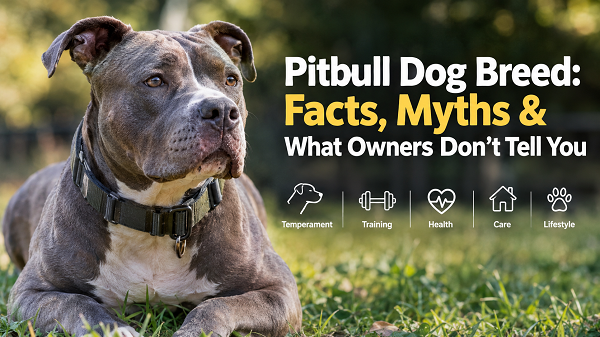
“Pitbull” isn’t one breed. It’s a label for a group of related dogs, mainly the American Pit Bull Terrier, American Staffordshire Terrier and Staffordshire Bull Terrier. Pitbulls don’t have locking jaws, and they aren’t born aggressive. Temperament testing puts pitbull-type breeds around 85–92%, above the 83% average across 198 breeds. But they’re also strong, energetic dogs. Many are selective with other dogs, and they need real training, exercise and supervision. Most live 12–14 years. Budget roughly $1,300–$3,700 a year to keep one. This guide gives you the myths, the numbers and the parts owners often skip.
Table of Contents
- What Is a Pitbull? (And Why Nobody Can Spot One)
- Pitbull History: From Bull-Baiting to War Hero
- Pitbull Facts at a Glance
- 6 Pitbull Myths, Debunked
- Pitbull Temperament: What the Test Data Really Shows
- Are Pitbulls Good With Kids?
- Pitbull vs. American Bully
- Where Are Pitbulls Banned?
- What Pitbull Owners Don’t Tell You
- Pitbull Lifespan and Common Health Problems
- How Much Does a Pitbull Cost?
- Training a Pitbull: A First-Year Roadmap
- Is a Pitbull Right for You?
- Handler’s Notes: Why You Can Trust This Guide
- The Bottom Line
- Frequently Asked Questions
Introduction
Ever noticed how one word can make a whole street go quiet? Say “pitbull” and people pick sides fast. Some see a family dog. Others see a threat.
Here’s the problem. Most of what people believe about pitbulls comes from headlines, not facts. And the opposite side sometimes overcorrects, claiming “there’s no such thing as a dangerous pitbull” or “it’s all how they’re raised.” Neither extreme helps you decide whether to bring one home, or how to keep the one you have safe and well trained.
So here’s what you’ll get. We’ll separate breed facts from myths, look at the actual temperament data (including its limits), and cover kids, laws, health, costs and training. I’ve also included the “what owners don’t tell you” section that most pitbull guides leave out.
What Is a Pitbull? (And Why Nobody Can Spot One)
Quick answer: A pitbull is not a single breed. It’s a catch-all term for bull-and-terrier type dogs, usually the American Pit Bull Terrier (APBT), the American Staffordshire Terrier (AmStaff) and the Staffordshire Bull Terrier. Some people also include the American Bully. Others use “pitbull” for any stocky, short-coated dog with a blocky head.
The Breeds Under the “Pitbull” Umbrella
| Breed | Registry | Typical Size | Notes |
|---|---|---|---|
| American Pit Bull Terrier | UKC (not AKC) | 30–60 lb (14–27 kg) | Athletic, driven, high energy |
| American Staffordshire Terrier | AKC | 40–70 lb (18–32 kg) | Bred for show lines; slightly heavier build |
| Staffordshire Bull Terrier | AKC, Kennel Club (UK) | 24–38 lb (11–17 kg) | Smallest of the group; legal in the UK |
| American Bully | UKC, ABKC | 40–85+ lb (18–39 kg) | Newer companion breed; often lumped in with pitbulls |
Why Nobody Can Identify a Pitbull by Sight
This matters more than most people realize. In one shelter study, professionals misidentified pit bull-type dogs about 60% of the time when checked against DNA results. Another finding says shelter staff and vets mislabeled over half of the dogs called “pitbulls.”
That means bite reports, shelter numbers and even city laws often rest on guesswork. A boxer mix, a bulldog cross or a Cane Corso puppy can all get the “pitbull” label. If you own a rescue with an unknown background, a DNA test can save you a lot of trouble with landlords and insurers.
Want a deeper look at how mixed-breed dogs really work? Read our Mixed Breed Dogs: Health, Traits & Temperament Guide.
Pitbull History: From Bull-Baiting to War Hero
The Fighting Past
Pitbull-type dogs come from bulldog and terrier crosses bred in the British Isles in the 1800s. People used them for bull-baiting and, after Britain banned that in 1835, for dog fighting. Immigrants brought them to America, where they also worked on farms, guarding livestock and homesteads.
That fighting history is real. It’s why some pitbulls show dog-to-dog intensity today. But history doesn’t decide what an individual dog does, and it’s only half the story.
The “Nanny Dog” and War Hero Side
Pitbull-type dogs were once called “nanny dogs” because of their reputation around children. In the early 1900s they were an American symbol, showing up on wartime posters.
Two well-known examples:
- Sergeant Stubby became the most decorated war dog of World War I. He’s often described as a pitbull type, though his exact breed is still debated. Some sources call him a pitbull mix.
- Wheela was a pitbull that won the Ken-L-Ration Dog Hero of the Year award in 1993 for her actions after a dam break along the Tijuana River.
The point? The same type of dog has been a fighter, a nanny, a soldier and a rescuer. What changed each time was the human on the other end of the leash.
Pitbull Facts at a Glance
| Trait | What to Expect |
|---|---|
| Size (APBT) | Males 35–60 lb, 18–21 in; females 30–50 lb, 17–20 in (UKC standard) |
| Coat | Short, smooth, low grooming |
| Energy | High, needs about 60–90 minutes of real activity daily |
| Lifespan | Most live 12–14 years, some reach 15+ |
| Trainability | High: eager to please, food and play motivated |
| Shedding | Moderate, year-round |
| Heat and cold | Short coat means they overheat in summer and get cold fast in winter |
| Best for | Active owners who train consistently |
6 Pitbull Myths, Debunked
Myth 1: Pitbulls Have Locking Jaws
False. Pit bulls have no special mechanism or enzyme that lets them lock their jaws, and their skulls look like those of other breeds. So why does it seem like they lock on? Determination. A pitbull that’s committed to a toy or a tug rope won’t let go easily, and that stubborn grip looks like locking.
Myth 2: Pitbulls Have the Strongest Bite
False. Pitbull-type dogs don’t have the strongest bite, and their jaw structure in proportion to size is no different from any other breed. Their power comes from muscle, drive and grip, not from special jaws.
Myth 3: Pitbulls Are Born Aggressive
Mostly false, but here’s the nuance. No credible study shows pitbulls are born to attack people. A 2022 study from the National Canine Research Council found breed can’t predict aggressive behavior. But genetics still influence energy, drive and how a dog reacts to other dogs. Behavior comes from genes plus environment plus training. Anyone who tells you it’s 100% one or the other is selling something.
Myth 4: Pitbulls Can’t Be Trained
False, and it’s usually backwards. Pitbulls are eager to learn and work hard for food, toys and praise. Problems show up when owners use harsh methods or skip training. Many people still believe a strong dog needs to be “dominated.” Our guide on dominance vs. discipline explains why calm structure beats force every time.
Myth 5: Most Dog Attacks Come From Pitbulls
Unproven. Bite data is messy. Most bites go unreported unless someone needs medical care, which is more likely with large dogs, and breed often can’t be confirmed. Add the misidentification problem above, and you can’t trust simple “breed X causes Y% of bites” claims.
Myth 6 (The Overcorrection): “Breed Doesn’t Matter at All”
Also false. Some advocates go too far. A dog bred for generations to be intense, athletic and dog-selective may show those traits. That doesn’t make pitbulls dangerous by default. It means they need an owner who understands the type. This is the honest middle ground most articles skip.
Pitbull Temperament: What the Test Data Really Shows
The best-known measure is the American Temperament Test Society (ATTS) test. It puts a dog through a simulated walk with sudden sounds, strangers and odd sights, then checks for panic, unprovoked aggression or shyness. The test simulates a casual walk through a park or neighborhood with visual, auditory and touch stimuli.
The Numbers
| Breed | ATTS Pass Rate (approx.) |
|---|---|
| American Pit Bull Terrier | 87.6% |
| American Staffordshire Terrier | 85.7% |
| Staffordshire Bull Terrier | 91.9% |
| Average across 198 breeds | 83.0% |
These figures come from ATTS data through January 2023, and they put the pitbull-type group in roughly the top 20% of breeds tested. An earlier 2016 ATTS sheet lists 913 American Pit Bull Terriers tested, with 798 passing (87.4%).
What Those Numbers Don’t Tell You
Be careful here. Golden Retrievers also score in the mid-80s, so the fair takeaway is “as stable as the family favorites,” not “better than everything.” And ATTS is a voluntary test. Owners choose to enter, so tested dogs tend to come from committed homes. It’s useful evidence, not a guarantee for every dog.
The Dog-Selectivity Truth
This is the one trait I wish more guides admitted. Dog-aggression and people-aggression are two separate traits, and dog-intolerance may not appear until a dog is fully mature. Many pitbull-type dogs can be dog-selective, but that’s unrelated to how they treat people.
In plain words: your pitbull may love every human on earth and still not want to share a dog park. Plan for that from day one.
Are Pitbulls Good With Kids?
Quick answer: Many pitbulls are gentle, tolerant family dogs, but no dog of any breed should be left alone with a young child. Good outcomes come from early socialization, training and adult supervision, not from breed alone.
Why Many Pitbulls Do Well With Children
- They’re people-focused. Most pitbulls crave human contact.
- They’re sturdy. They handle the clumsy hugging and tail-grabbing of toddlers better than fragile small breeds (though kids still shouldn’t do this).
- They love play. They match a child’s energy.
- They’re loyal. They bond hard with their family.
What the Fatality Research Really Says
The best study we have looked at 256 dog-bite deaths in the U.S. from 2000 to 2009 and used investigation records instead of media stories. It found that most cases involved a mix of preventable factors: no capable adult around (87.1%), a victim with no familiar relationship to the dog (85.2%), and an owner who hadn’t neutered the dog (84.4%). Four or more of these factors showed up together in 80.5% of deaths.
The authors’ conclusion: breed was not one of the preventable factors, and multi-factor approaches beat single-factor fixes like breed bans.
That’s the real lesson: risk comes from situations. Unsupervised child + unfamiliar dog + isolated, unsocialized animal = trouble, in any breed.
7 Safety Rules for Pitbulls and Kids
- Never leave a young child alone with any dog, even a calm one.
- Teach kids not to hug, ride or corner the dog.
- Give the dog a quiet safe space (crate or bed) that kids can’t enter.
- Keep the dog away from kids’ food and toys.
- Teach children to leave a dog alone while it eats or sleeps.
- Learn stress signals: lip licking, whale eye (showing the whites), yawning, stiff body.
- Train “leave it,” “drop it” and a solid recall before the baby arrives.
Pitbull vs. American Bully
People swap these names all the time, but the dogs differ.
| Feature | American Pit Bull Terrier | American Bully |
|---|---|---|
| Build | Lean, athletic | Wider, heavier, more compact |
| Weight | 30–60 lb | 40–85+ lb |
| Energy | High | Moderate |
| Purpose | Historic working/fighting dog, now versatile | Developed recently as a companion |
| Exercise need | Heavy | Moderate |
The simple rule: if you run, hike or do dog sports, an APBT fits. If you want a calmer couch companion with moderate walks, look at the Bully type, but check health, because heavier builds can strain joints.
Curious how instinct and trainability differ across breeds? See our guide to working dogs and their exercise needs.
Where Are Pitbulls Banned?
Countries and Regions With Restrictions
Rules change often, so always check current local law before you travel or move.
- United Kingdom: It’s illegal to own, breed, sell, exchange, advertise, give away or abandon Pit Bull Terrier type dogs, and the XL Bully type was added later. An unregistered banned dog can bring up to six months in prison or a fine of up to £5,000. Note that the Staffordshire Bull Terrier stays legal.
- Denmark: Completely bans 13 breeds, including the American Pit Bull Terrier.
- Germany: Restrictions apply to pit bulls, Staffordshire Bull Terriers and American Bulldogs.
- Qatar and UAE: Ban several breeds, including pit bulls.
- Australia and New Zealand: Strict import bans on the American Pit Bull Terrier.
- USA and Canada: No national ban. Rules are local: Miami-Dade County in Florida has had breed-specific laws since 1989, and Winnipeg has restrictions.
Countries That Reversed Their Bans
The Netherlands lifted its 15-year pitbull ban in 2008 after finding it hadn’t cut dog bite incidents. It now uses a behavior-based approach, where authorities can order specific dogs muzzled or leashed.
Why Breed Bans Struggle
UK enforcement relies on looks. A mixed-breed dog that resembles a pitbull can be treated as a banned type. Given the identification problem we covered earlier, you can see why owners and vets criticize these laws. The AVMA has said controlled studies haven’t identified this breed group as disproportionately dangerous.
Renting and Insurance
Even without a ban, many landlords and home insurers restrict “pitbull” dogs. Some jurisdictions are pushing back. In July 2023 Tacoma, Washington passed a rental law stopping landlords from enforcing breed restrictions. If you rent, ask about breed rules before you adopt. A DNA test result can sometimes help your case.
What Pitbull Owners Don’t Tell You
Fans of the breed (including me) love these dogs. But if you’re deciding, you deserve the full picture.
1. They Have Big Energy and Big Chewing Power
A bored pitbull destroys things: couches, doors, drywall. A short walk won’t cut it. Plan for at least 60–90 minutes of exercise daily, plus brain work like sniff games, puzzle feeders and training sessions.
2. Dog Parks May Not Be for Them
Because of dog selectivity, many owners quietly stop using off-leash parks. If your pitbull is fine with dogs at 6 months, that can change between ages 1 and 3. Keep introductions controlled and know your dog’s limits.
3. They’re Stronger Than They Look
A 55-lb pitbull pulling on a leash can drag a small adult. Loose-leash training isn’t optional. Invest in a well-fitted harness or front-clip setup, and start young.
4. Skin and Ear Problems Are Common
Chronic skin allergies may need ongoing medication and special diets. Their narrow ear canals can trap moisture and dirt, raising infection risk. Many owners quietly spend hundreds a year on allergy management.
5. They Hate Being Left Alone
These are people dogs. Long hours alone, especially without training, lead to separation anxiety, barking and destruction. Crate training early helps. See our crate training guide for a trainer-tested method.
6. You’ll Become an Ambassador Whether You Want It or Not
Expect stares, questions and the occasional rude comment. A well-behaved dog on a loose leash is the best answer you can give.
Pitbull Lifespan and Common Health Problems
Quick answer: Most pitbull-type dogs live 12 to 14 years. With good care, some reach 15 or more.
| Breed | Typical Lifespan |
|---|---|
| American Pit Bull Terrier | 12–14 years |
| American Staffordshire Terrier | 12–16 years |
| Staffordshire Bull Terrier | 12–15 years |
Common Health Problems
- Skin allergies and infections. Short coats expose skin, and allergies rank as the most common problem in this breed.
- Ear infections. Regular cleaning helps.
- Joint trouble. They’re prone to cranial cruciate ligament (CCL) tears, and hip or elbow dysplasia can still occur. Hip dysplasia treatment can cost $1,500 to $6,000.
- Heart and thyroid issues. Less common, but worth routine vet screening.
- Overheating. Short muzzles and short coats mean careful exercise in hot weather.
6 Ways to Add Years to Your Pitbull’s Life
- Keep them lean. Extra weight strains joints.
- Build muscle with controlled exercise, not just weekend sprints.
- Do yearly vet checks, and twice yearly after age 7.
- Clean ears and check skin weekly.
- Feed a balanced diet suited to their age and allergies.
- Choose a breeder who health-tests parents, or a shelter that provides medical history.
How Much Does a Pitbull Cost?
| Cost | Typical Range (USD) |
|---|---|
| Purebred APBT puppy | $500–$1,500 (higher for show lines) |
| Shelter adoption | Often $50–$400 |
| Food | $20–$60 per month |
| Routine vet visit | $75–$150 |
| Pet insurance | $30–$70 per month |
| Yearly total (excluding purchase) | About $1,260–$3,740 |
A purebred APBT puppy usually runs $500 to $1,500, with champion bloodlines costing more. Yearly ownership costs range from $1,260 to $3,740, which adds up to about $15,000 to $45,000 over a 12-year life. Some insurers charge more for pitbulls, so shop around. Prices vary by country, so treat these as a guide.
Training a Pitbull: A First-Year Roadmap
Use positive reinforcement: reward what you like, calmly block what you don’t. Pitbulls respond well to food, tug and praise.
Weeks 8–16: The Socialization Window
- Meet 100 different people (hats, uniforms, kids, elderly).
- Expose them to sounds, floors, cars and vet visits.
- Start crate training, name response and “sit.”
- Pick puppy classes over free-for-all dog-park play.
Months 4–12: Foundations
- Teach loose-leash walking, “down,” “stay,” “leave it,” “drop it” and recall.
- Keep short sessions (5–10 minutes), several times daily.
- Practice calm greetings so your dog doesn’t jump on strangers.
- Start controlled dog-to-dog meetings with well-matched, calm dogs.
Year 1–3: Maturity Check
- Expect changes around social maturity (roughly 12–36 months).
- Keep training sessions going, and watch for new dog selectivity.
- Consider dog sports like weight pulling, agility or scent work. Working dogs need a job.
Working Roles
Well-trained pitbull-type dogs work as therapy dogs, service dogs and in scent and detection roles. Bully breeds can be loving family pets, service animals, therapy dogs and K9 police dogs.
Want a full professional method? My e-book, Beyond the Bark: Inside a Pro Handler’s Playbook for Raising the Ideal Dog, walks through socialization, behavior and leadership from puppyhood to adulthood.
Is a Pitbull Right for You?
A Pitbull Fits If You
- Exercise daily, rain or shine
- Enjoy training and can stay consistent
- Have a fenced yard or can manage leash walking well
- Can handle a dog that may not enjoy other dogs
- Are ready to answer questions from strangers
Think Twice If You
- Work long hours with no dog care
- Rent in a building with breed bans
- Want a dog you can leave unsupervised with small kids
- Want an off-leash dog-park regular
- Can’t afford vet care for allergies or joint problems
Questions to Ask a Breeder or Shelter
- Can I meet the parents or see the dog’s history?
- What health tests were done?
- How does the dog behave with other dogs, kids and strangers?
- Has a behaviorist assessed the dog?
- What support do you provide after adoption?
Walk away from anyone who dodges these.
Handler’s Notes: Why You Can Trust This Guide
I’m Cpl. Rofiat Muritala, a Nigerian Army military working dog instructor and handler with more than 14 years at the Nigerian Army Dog Centre. My work covers dog selection, foundation training, obedience, detection and behavior shaping in real operations.
What I see again and again: most “problem dogs” have a problem with structure, not breed. Strong dogs with no rules, no exercise and no clear leader get into trouble fast. Give them work and consistency, and most settle beautifully.
Sources and limits: I based the statistics here on ATTS breed data, the 2013 JAVMA fatality study (Patronek et al.), AVMA statements, shelter research and UK government guidance. I’m a handler, not a vet or a lawyer. Check with your veterinarian for health concerns and local authorities for breed laws.
The Bottom Line
Pitbulls aren’t monsters, and they aren’t magic. They’re powerful, driven, people-loving dogs with a complicated past and a very human problem: they get judged before anyone meets them.
Here’s what to remember:
- “Pitbull” is a group label, and even experts misidentify these dogs.
- Locking jaws and “strongest bite” are myths.
- Temperament data is strong, but individual dogs still vary, especially with other dogs.
- Supervision, training and neutering decisions matter more than breed in bite prevention.
- Budget for exercise, training and vet bills.
- Check local laws and landlord rules before you commit.
If you already own one, train them well, keep them safe and let your dog change a few minds.
Want more trainer-tested guides like this? Subscribe to our weekly articles roundup newsletter and get practical dog tips in your inbox.
Frequently Asked Questions
1. Are pitbulls naturally aggressive?
No. Pitbulls aren’t born aggressive toward people. Temperament tests place pitbull-type breeds in roughly the top 20% of breeds tested. Some can be selective with other dogs, so early socialization and management matter.
2. Are pitbulls good family dogs?
Yes, many are, when trained, exercised and supervised. They’re loyal, playful and people-focused. Never leave any dog alone with a young child, whatever the breed.
3. What is the difference between a pitbull and an American Bully?
Pitbulls (APBTs) are leaner, more athletic and higher energy. American Bullies are heavier, stockier and usually calmer. Bullies often weigh 40–85+ lb, while APBTs usually weigh 30–60 lb.
4. How long do pitbulls live?
Most live 12 to 14 years, and some reach 15 or more. Good diet, a healthy weight, regular vet care and a safe home help them live longer.
5. Why are pitbulls banned in some places?
Bans come from the breed’s fighting history, media coverage of attacks and public safety fears. The UK bans Pit Bull Terrier type dogs under the Dangerous Dogs Act 1991. Critics point out that the Netherlands lifted its ban in 2008 after it didn’t reduce bites.

Her work centres on obedience, detection, protection and operational readiness. She favours proven methods built on repetition, consistency and real-world conditioning, so that both dogs and handlers are prepared for high-pressure tasks.
Rofiat represented the Nigerian Army Dog Centre at the Nigerian Army Day Celebration (NADCEL) 2026, where she led demonstrations in obedience, explosive detection, agility and tactical movement. Through articles, training content and documentaries, she shares field-based insight into how structured training, clear communication and trust between handler and dog affect performance and reliability.
She is the author of Beyond the Bark: Inside a Pro Handler's Playbook for Raising the Ideal Dog, a practical guide that helps dog owners and handlers apply professional training principles in everyday situations.
- Australian Cattle Dog vs Blue Heeler: Any Difference? - October 1, 2026
- Bousnic Dog Training Collar Review: Is It Safe? - September 30, 2026
- Gravy Train Dog Food Review: Ingredients & Recalls - September 30, 2026