Top 10 Healthy Training Treats For Dogs (Vet-Backed)

The healthiest training treats for dogs are small, soft, low-calorie rewards worth 2 to 5 calories per piece, like freeze-dried liver, plain boiled chicken, soft commercial training bites, green beans, carrots and blueberries. Keep all treats under 10% of your dog’s daily calories, tear them into pea-sized pieces, and never use anything with xylitol, chocolate, grapes, raisins, onion or garlic.
Table of Contents
- Introduction: The Hidden Calorie Problem
- What “Vet-Backed” Really Means (and What It Doesn’t)
- What Makes a Training Treat Healthy?
- Top 10 Healthy Training Treats for Dogs
- The Treat Value Ladder: How Pro Handlers Choose Rewards
- Portion Control: The 10% Rule With Real Numbers
- Best Treats for Puppies, Seniors, Overweight and Sensitive Dogs
- Homemade Healthy Training Treats (3 Recipes)
- Treats to Avoid
- How to Fade Treats Without Losing Your Dog’s Focus
- Why Trust This Guide (Handler Experience)
- FAQs
- Conclusion and Action Plan
Introduction: The Hidden Calorie Problem
Picture a 20-minute training session. You reward your dog 40 times. If each reward is a 20-calorie biscuit, you just fed 800 calories in treats. For a 30 lb (13.6 kg) dog, that’s roughly the whole day’s food, gone in one session.
That’s the trap most owners fall into. They do everything right: they train daily, they reward every good rep. And their dog still gains weight.
It’s a big problem worldwide. The Association for Pet Obesity Prevention (APOP) found that 59% of dogs in the US were overweight or obese in its 2022 prevalence survey. Here’s the part that surprised me: in a follow-up opinion survey, only 17% of dog owners said their own dog was overweight. Most of us just don’t see it.
So what do you do? You pick healthy training treats for dogs that are tiny, tasty and low in calories, and you count them like you’d count anything else in your dog’s diet.
In this guide, you’ll learn:
- What “vet-backed” actually means, so you can spot marketing fluff
- The 10 best healthy training treats, with realistic calorie counts per piece
- A simple 10% rule calculator for dogs from 10 lb to 90 lb
- How to choose treats for puppies, seniors, overweight dogs and dogs with sensitive stomachs
- Three safe homemade recipes, and the foods that can hurt your dog
- How to fade treats so your dog works for praise and play, not just snacks
I’ve spent more than 14 years working with military working dogs, and I’ve watched treat choice make or break a training day. Let’s get into it.
What “Vet-Backed” Really Means (and What It Doesn’t)
You’ll see “vet-approved,” “vet-recommended” and “vet-backed” on a lot of packaging. Here’s the thing: none of those phrases is a regulated safety standard. A brand can use them if a single vet likes the product.
So in this article, “vet-backed” means the treat meets the same checks veterinary nutrition guidance asks for:
- Calories are controlled. Treats make up no more than 10% of daily calories. Veterinary nutrition guidance has repeated this for years.
- Ingredients are simple. Real food comes first. No unnamed by-products, no artificial dyes, no sugar syrups.
- Nothing toxic. No xylitol, chocolate, grapes, raisins, onion, garlic or macadamia nuts.
- The label is honest. Calories are printed per treat, not just per bag. Many leading vet-nutrition brands do this. For example, Royal Canin lists its training treats at under 3 calories per piece.
- It suits your dog. A treat that’s perfect for a healthy Labrador can be wrong for a dog with pancreatitis or a chicken allergy.
A quick tip for dental treats: look for the VOHC seal (Veterinary Oral Health Council). That seal means the product has been shown to reduce plaque or tartar. But dental chews are slow to eat, so they don’t belong in a training pouch.
When in doubt, ask your own vet. They know your dog’s weight, medical history and allergies. No article can replace that.
What Makes a Training Treat Healthy?
A training treat has a different job from a snack. It has to be fast. If your dog spends ten seconds chewing a hard biscuit, your timing is gone and the lesson is lost.
Use this checklist before you buy or make anything:
- 3 to 10 calories per piece, ideally under 5. You’ll give dozens per session.
- Soft and quick to swallow. One chew, one gulp.
- Strong smell. Dogs have around 300 million scent receptors, so smell sells the treat.
- Short ingredient list. Five ingredients or fewer is a good rule.
- Easy to split. If you can break it into 3 or 4 pieces, it stretches further.
- Not crumbly. Crumbs waste treats and make a mess in your pouch.
- Safe for your dog’s age and health. Puppies need softer pieces. Seniors may need softer textures for sore teeth.
The 10-second label test: Find the calories per treat. Check the first ingredient. Look for xylitol, BHA, BHT or ethoxyquin. If you can’t find the calories per piece, weigh a treat on a kitchen scale and divide the bag’s calories by the piece count. It takes two minutes and saves you from a lot of guesswork.
Top 10 Healthy Training Treats for Dogs
Calorie numbers below are estimates for a pea-sized piece. Brands, cuts and moisture levels change them, so always check your own label.
| # | Treat | Approx. calories per piece | Value level | Best for |
|---|---|---|---|---|
| 1 | Freeze-dried liver | 2–4 | High | New skills, distractions |
| 2 | Boiled chicken breast | About 1 | High | Recall, proofing, weight control |
| 3 | Soft commercial training bites | 2–4 (check label) | Medium–High | Rapid-fire drills |
| 4 | Your dog’s own kibble | 3–4 | Low | Easy cues at home |
| 5 | Blueberries | About 1 | Medium | Light rewards |
| 6 | Carrot pieces | 1–4 | Low–Medium | Weight control, puppies |
| 7 | Green beans | 1–2 | Low–Medium | Overweight dogs |
| 8 | Plain pumpkin puree | About 5 per tablespoon | Medium | Settle work, crate training |
| 9 | Low-fat cheese | 2–3 | Very high | Hardest exercises |
| 10 | Cooked salmon bites | 2–4 | High | Chicken or beef-sensitive dogs |
1. Freeze-Dried Liver (Beef, Chicken or Lamb)
If I could only carry one treat, this would be it. Freeze-dried liver is one ingredient, it doesn’t need a fridge, and almost every dog loses their mind over it, including picky Belgian Malinois and Dutch Shepherds.
- Why it works: Strong smell, rich in iron and vitamin A, and no added oils.
- Calories: Roughly 2 to 4 per pea-sized piece.
- Handler tip: Tear one piece into 3 or 4 bits. Dogs care more about how often they get rewarded than how big the reward is.
- Watch out: Liver is very rich in vitamin A. Fed in big amounts every day for a long time, it can cause trouble. Pea-sized pieces are fine, but don’t turn it into a meal.
2. Plain Boiled Chicken Breast
Cheap, lean and loved by nearly every dog. A pea-sized cube is about 1 calorie, so you can reward generously.
- Prep: Boil or bake with no salt, oil or seasoning. Never use garlic or onion powder. Make sure there are no bones.
- Storage: Dice it, then keep it in the fridge for up to 4 days or freeze it in small bags.
- Best for: Teaching recall around distractions, because the smell cuts through a noisy park.
3. Soft Commercial Training Bites
These are made for pouches. They’re soft, small and not crumbly. Some brands list under 3 calories per piece. Pet Circle’s vet team makes the same point I do: hard or slow treats drag training down.
- Look for: Real meat as the first ingredient, calories per treat on the label, no artificial colors.
- Best for: Heel work, long sessions and group classes, where you need fast, clean delivery.
- Age note: Some products, like Royal Canin’s training treats, are labeled for dogs over 6 months. Always check the label for puppies.
4. Your Dog’s Own Kibble
Most “top treat” lists skip this one, and it’s a smart one. Purina’s own guidance suggests measuring part of the day’s ration into a pot and using it for training.
- Why it works: Zero extra calories. You’re just changing how dinner gets delivered.
- Best for: Easy cues at home, such as sit, down and name recognition.
- Tip: Use the “lunch-money” trick. Measure the kibble in the morning, and only use that kibble for rewards that day. The rest goes in the bowl.
- Limit: Plain kibble often fails outdoors or around other dogs. Save the exciting treats for those moments.
5. Blueberries
Tiny, sweet and about 1 calorie each. Many dogs happily work for them, especially dogs that aren’t super meat-driven.
- Why it works: They’re antioxidant-rich and nearly free in calories.
- Caution: Start with two or three. Too much fruit can cause loose stools.
6. Carrot Pieces
Crunchy, cheap and easy on the waistline. A baby carrot is around 3 to 4 calories, and small cut pieces are about 1.
- Handler tip: Frozen carrot sticks soothe teething puppies.
- Reality check: Carrots are medium-low value. They’re great for easy cues, but they won’t beat a squirrel.
7. Green Beans (Fresh or Steamed, No Salt)
This is the best friend of an overweight, food-driven dog. A bean has roughly 1 to 2 calories, and the fiber helps dogs feel full.
- Best for: Weight-loss plans where you still want to reward often.
- Never use: Canned beans with added salt.
8. Plain Pumpkin Puree
Plain 100% pumpkin has about 5 calories per tablespoon. Freeze it in an ice cube tray and you’ve got a slow-lick reward.
- Best for: Teaching calm, crate time and settling after hard work. It’s a lick treat, not a rapid-fire treat.
- Caution: Never use pumpkin pie filling. It has sugar and spices like nutmeg that aren’t safe.
9. Low-Fat Cheese
Cheese is a super-high-value reward. A pea-sized cube of low-fat mozzarella is about 2 to 3 calories, or you can use a small teaspoon of plain low-fat cottage cheese.
- Best for: The hardest moments, like proofing a command next to another dog.
- Caution: Some dogs struggle with lactose. Try a tiny piece first. Skip cheese if your dog has had pancreatitis, because the fat can be a trigger.
10. Cooked Salmon Bites
Fish gives you a novel protein for dogs that react to chicken or beef. Purina’s vets note that salmon is rich in omega-3 fats, but it’s also higher in fat. So keep pieces small, and don’t use it for dogs with a pancreatitis history.
- Safety rule: Cook it fully. Raw Pacific salmon can carry a parasite that causes “salmon poisoning disease” in dogs, which can be fatal.
- Commercial option: Look for single-ingredient fish treats with the calorie count printed on the pack.
Bonus: Apple Slices
Thin apple slices work as a crunchy low-value treat. Always remove the core and seeds first.
The Treat Value Ladder: How Pro Handlers Choose Rewards
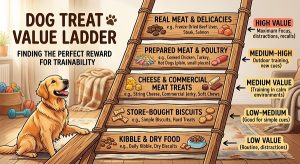
Here’s something most pet owners never hear: not every reward should carry the same weight. In professional programs, we sort rewards into a ladder.
- Low value (kibble, carrot, green bean): Behaviors your dog already knows, in quiet places.
- Medium value (blueberries, soft training bites, pumpkin): New places and mild distractions.
- High value (liver, chicken, cheese, salmon): New skills, heavy distractions, recall, and anything that matters for safety.
Why does this matter? If every treat is a jackpot, your dog has nothing bigger to work for when it counts. I’ve seen dogs that ignore cheese in the kennel yard because they’ve been fed it all week. Keep your best treats rare, and they stay powerful.
Working dog programs also lean on more than food. Many detection programs use a toy or ball as the main reward, with food mostly in the early stages. That’s a good reminder for pet owners too: tug, fetch and praise are “free” rewards with zero calories. If your dog loves a toy, use it in between food rewards.
If you’re building a full training plan, our guide to common dog training mistakes handlers must avoid shows how bad timing and rewards can slow your progress.
Portion Control: The 10% Rule With Real Numbers
The 10% rule: Treats should be no more than 10% of your dog’s daily calories. The other 90% comes from a complete, balanced diet.
Here’s a guide for a typical neutered adult dog. Your own dog’s needs depend on age, breed, activity and body condition, so check with your vet.
| Dog weight | Approx. daily calories | 10% treat budget | Number of 2-calorie treats |
|---|---|---|---|
| 10 lb (4.5 kg) | ~350 | ~35 | ~17 |
| 30 lb (13.6 kg) | ~800 | ~80 | ~40 |
| 60 lb (27 kg) | ~1,300 | ~130 | ~65 |
| 90 lb (41 kg) | ~1,800 | ~180 | ~90 |
Notice how a 20-calorie biscuit changes the picture. For the 30 lb dog, four biscuits would use the whole treat budget. Forty tiny liver pieces use the same budget and give you ten times more chances to reward.
Working dogs: Very active dogs, like those in patrol, detection or sport work, burn far more energy and often eat a performance diet. Their treat budget scales up, but the rule stays the same: treats are a small slice, and the main food does the heavy lifting. If you feed a performance diet, see our review of Purina Pro Plan Sport 30/20 for working K9s.
How to stay inside your budget:
- Weigh once. Weigh a “small piece” on a kitchen scale. Most owners guess too big.
- Swap, don’t add. If you use 80 calories of treats, take about a fifth of a cup out of dinner (for a typical kibble of around 375 calories per cup).
- Pre-portion each morning. Put the day’s treats in a small container. When it’s empty, treat time is over.
- Count every source. Dental chews, a bite of your toast and pill pockets all count.
- Check the body, not the scale. You should feel your dog’s ribs under a light layer of fat, and see a waist from above. Ask your vet to show you the body condition score.
Best Treats for Puppies, Seniors, Overweight and Sensitive Dogs
No one treat suits every dog. Here’s how I match treats to the dog in front of me.
Puppies
- Choose soft, pea-sized or smaller pieces that are easy on baby teeth. Boiled chicken, soft training bites and tiny cheese cubes are good.
- Puppies have small stomachs and need balanced food for growth, so keep treats well under 10%. Our guide to puppy nutrition from week 1 to month 12 explains what the main diet should look like.
- Check the age on the label of any commercial treat.
Senior dogs
- Pick soft treats for sore teeth: soft training bites, mashed pumpkin, tiny pieces of chicken.
- Seniors burn fewer calories, so treats count even more.
Overweight dogs
- Use green beans, carrots, blueberries and plain boiled chicken.
- Use part of their kibble as treats.
- Ask your vet for a target weight and a daily calorie goal. Only 17% of owners in the APOP survey said their dog was overweight, so a quick vet check is worth it.
Dogs with food allergies or sensitive stomachs
- Stick to one new treat at a time for a week so you can spot reactions.
- Look at novel proteins such as cooked fish, or ask your vet about a limited-ingredient treat.
- Watch for itching, ear problems, loose stools or vomiting.
Dogs with a pancreatitis history
- Avoid high-fat treats like cheese, fatty meats and salmon skin. Ask your vet for a low-fat plan.
Hot climates
- Fresh meat spoils fast in the heat. Don’t leave boiled chicken or cheese in a pouch for hours. Keep fresh treats in an insulated bag with an ice pack, or use freeze-dried and dehydrated treats for outdoor sessions.
Homemade Healthy Training Treats (3 Recipes)
Homemade treats give you full control over ingredients and size. Every recipe below skips salt, sugar, xylitol, garlic and onion.
1. Baked Sweet Potato Bites
- Slice sweet potato into thin rounds, about ¼ inch (6 mm).
- Bake at 250°F (120°C) for 2 to 3 hours until chewy but not burnt.
- Cool fully, then cut into pea-sized pieces. Store in the fridge for up to a week.
- Each tiny dried piece is roughly 2 to 3 calories.
2. Oat and Peanut Butter Bites
- Mix 1 cup oat flour, ½ cup plain peanut butter and 1 mashed banana.
- Roll into pea-sized balls and bake at 350°F (175°C) for 12 to 15 minutes.
- Store in the fridge for up to a week.
- Critical: Check the peanut butter label. Xylitol is sometimes listed as “birch sugar.” Only use peanut butter made from peanuts, or peanuts and salt.
3. Liver Cake Cubes
- Blend raw liver with 1 to 2 eggs and a scoop of oat flour until it looks like a thick batter.
- Spread it thin in a baking tray and bake at 350°F (175°C) for about 20 minutes, until firm.
- Cool, then cut into tiny cubes. Freeze most of it and take out a few days’ worth at a time.
- This is a high-value treat. Keep portions small because liver is rich.
Xylitol warning: The US Food and Drug Administration warns that xylitol can cause a rapid, severe drop in a dog’s blood sugar within 10 to 60 minutes. Some peanut butters, baked goods, gum and sugar-free products contain it. If your dog eats something that might contain xylitol, call your vet or an emergency clinic straight away. Don’t wait for symptoms.
Treats to Avoid
Not everything sold as a “dog treat” belongs in a training pouch. Skip these:
- Anything with xylitol. Check labels on peanut butter, baked goods and sugar-free products.
- Chocolate, grapes, raisins, onion, garlic and macadamia nuts. All of them can be toxic.
- Rawhide and hard chews. They’re slow to eat, and some dogs choke or break teeth.
- High-fat jerky and fatty meats. These can set off pancreatitis in sensitive dogs. They’re also often high in salt.
- Cooked bones. They splinter.
- Seasoned table scraps. Chicken is fine until you add salt, oil, garlic or onion.
- Large hard biscuits. They’re heavy on calories and slow to chew.
If you ever have a doubt, leave it out, and call your vet.
How to Fade Treats Without Losing Your Dog’s Focus
None of us want to carry a pouch for life. Here’s a simple fading plan I use. Timelines vary by dog and by skill, so treat these as a rough guide.
- Weeks 1 to 2: Reward every correct rep. Pay within 1 to 2 seconds so your dog links the treat to the exact behavior.
- Once your dog gets it right most of the time (around 8 out of 10 reps): Start rewarding every second or third rep. Mix up the pattern so your dog can’t guess.
- Add life rewards: Praise, a toy, a game, going through the door, or a sniff on the walk.
- Keep jackpots for breakthroughs. Give 3 to 5 treats at once for a great recall or a new skill.
- Raise difficulty slowly. Go back to more frequent rewards when you add new distractions, a new place or longer duration.
Fading doesn’t mean never giving food again. It means food becomes a surprise, and surprise rewards keep dogs working hard.
Five treat mistakes I see most:
- Treats that are too big
- Treats that take too long to chew
- Forgetting to count treat calories
- Using the same high-value treat for everything
- Delivering the treat late, after the moment has passed
Why Trust This Guide (Handler Experience)
Who wrote this: Cpl. Rofiat Muritala is a Nigerian Army military working dog instructor and handler with more than 14 years of experience at the Nigerian Army Dog Centre. Her work covers dog selection, foundation training, behavior shaping and performance evaluation in real operational environments. She represented the Nigerian Army Dog Centre at the Nigerian Army Day Celebration (NADCEL) 2026, leading demonstrations in obedience, explosive detection, agility and tactical movement. She is also the author of Beyond the Bark: Inside a Pro Handler’s Playbook for Raising the Ideal Dog.
How this article was built: The calorie estimates come from standard food composition values and label data, and the safety guidance follows published veterinary and FDA advice, including APOP obesity survey data and FDA xylitol warnings. Always check with your own veterinarian before changing your dog’s diet, especially if your dog has a medical condition. This article is general education, not veterinary advice.
FAQs: Healthy Training Treats for Dogs
1. How many training treats can I give my dog per day?
It depends on calories, not count. Keep treats to 10% of daily calories. For a 30 lb dog eating about 800 calories, that’s around 80 calories, or roughly 40 treats worth 2 calories each. Smaller pieces mean more rewards.
2. What is the best low-calorie training treat for dogs?
Green beans, small carrot pieces, blueberries and plain boiled chicken are the lowest-calorie options, at about 1 to 4 calories each. Pair them with a few high-value treats like liver for hard exercises.
3. Can puppies eat the same training treats as adult dogs?
Most of these foods are fine for puppies if you cut them very small and keep portions tiny. Always check the age on commercial treat labels, because some are made for dogs over 6 months. Ask your vet about your puppy’s diet.
4. Are freeze-dried treats better than fresh treats for training?
Freeze-dried treats are lighter and don’t need a fridge, so they’re easier to carry and safer in hot weather. Fresh treats like boiled chicken are often lower in calories but spoil faster. I use freeze-dried for travel and fresh for home sessions.
5. What can I use instead of treats for dog training?
Use your dog’s kibble, a toy, a quick game of tug, praise, or a favorite activity such as a sniff walk. Many working dogs are rewarded mostly with a toy. Mix these in with food and your dog stays motivated with fewer calories.
Conclusion and Action Plan
The best training treat isn’t the fanciest one. It’s small, soft, low in calories, safe, and something your dog really wants. From freeze-dried liver to plain chicken, and from green beans to your dog’s own kibble, the healthiest choices are often the simplest.
Here’s your action plan:
- Check your calories. Look at the calories per piece in your current treats and compare them with your dog’s 10% budget.
- Cut everything small. Pea-sized pieces mean more rewards for fewer calories.
- Build your ladder. Pick one low, one medium and one high-value treat.
- Swap, don’t add. Take the treat calories out of your dog’s meals.
- Check labels for toxins, especially xylitol in peanut butter.
- Fade slowly. Move from every rep to surprise rewards, and use play and praise.
- Call your vet if your dog has health issues, allergies or weight concerns.
Want more handler-tested tips each week? Subscribe to our weekly articles roundup newsletter and get new K9 training, nutrition and health guides in your inbox.
Ready for the full framework? If you want a step-by-step system for building focus, obedience and drive, the way professional handlers do, my e-book Beyond the Bark: Inside a Pro Handler’s Playbook for Raising the Ideal Dog walks you through it.

Her work centres on obedience, detection, protection and operational readiness. She favours proven methods built on repetition, consistency and real-world conditioning, so that both dogs and handlers are prepared for high-pressure tasks.
Rofiat represented the Nigerian Army Dog Centre at the Nigerian Army Day Celebration (NADCEL) 2026, where she led demonstrations in obedience, explosive detection, agility and tactical movement. Through articles, training content and documentaries, she shares field-based insight into how structured training, clear communication and trust between handler and dog affect performance and reliability.
She is the author of Beyond the Bark: Inside a Pro Handler's Playbook for Raising the Ideal Dog, a practical guide that helps dog owners and handlers apply professional training principles in everyday situations.
- Food Aggression Dog Training: Pro K9 Guide - November 21, 2026
- DIY Dog Scent Training: Easy 4-Week Home Guide - November 20, 2026
- Buckeye Puppies Review: 5 Red Flags to Check - November 19, 2026