5 Dog Trainer Secrets to Stop Excessive Barking
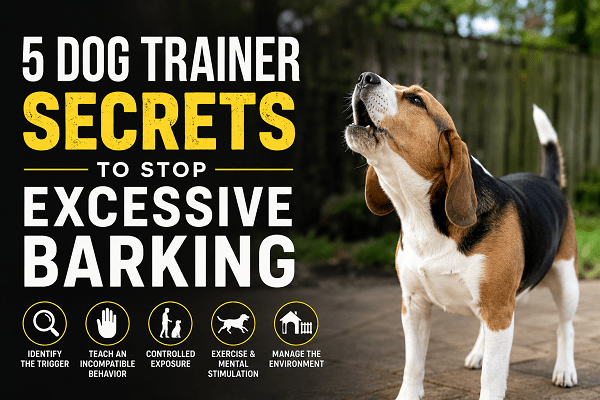
To stop excessive barking, find out why your dog barks, then fix that cause. Teach a calm replacement behavior like “go to your mat,” teach a “quiet” cue the right way, change how your dog feels about triggers with slow exposure, meet exercise and mental needs, and block rehearsal of the habit while you train. Most dogs improve in 2 to 6 weeks. Fear and separation barking can take 2 to 4 months. This guide gives you five trainer secrets, a 14-day starter plan, breed notes, and the “it gets worse before it gets better” trap most articles skip.
Table of Contents
- Introduction
- Why Dogs Bark Too Much (and Why “Quiet!” Never Works)
- Secret 1: Read the Bark, Not Just the Noise
- Secret 2: Teach a Replacement Behavior and a Real “Quiet” Cue
- Secret 3: Change How Your Dog Feels About the Trigger
- Secret 4: Fill the Tank Before You Train
- Secret 5: Manage the Environment and Survive the Extinction Burst
- Your 14-Day Barking Reset Plan
- Fixing the 6 Most Common Barking Situations
- Breed Barking Tendencies
- Mistakes That Make Barking Worse (What the Research Says)
- Neighbors, Noise Complaints and the Law
- When Barking Is a Medical or Welfare Red Flag
- When to Call a Professional
- FAQs
- Final Thoughts
Introduction
It’s 5:45 a.m. Your dog has spotted a cat, a delivery rider or just a leaf blowing past the window, and the whole house is awake. Sound familiar?
Excessive barking is one of the top reasons owners book a trainer. It ruins sleep, upsets neighbors and, honestly, makes some people dread walking through their own front door. Most owners try the same things first: shouting “quiet!”, spraying water, buying a gadget. Then they wonder why nothing sticks.
Here’s what I’ve learned working with dogs in structured training settings: barking is a symptom, not the problem. A dog that barks too much is telling you something. It’s bored, scared, frustrated, guarding, or it has learned that barking works. Fix that cause and the noise drops. Skip it and you’ll be fighting the same battle for years.
In this guide you’ll learn:
- How to tell what type of bark you’re dealing with
- Five trainer-level techniques that actually change the behavior
- A day-by-day 14-day plan you can start tonight
- Why barking often gets worse in week one (and how to push through)
- Fixes for doorbells, windows, fences, car rides and being left alone
- When barking signals pain, fear or a welfare problem
Whether you own a vocal Beagle, a watchful German Shepherd or a rescue mix with big opinions, these steps apply. If you want more weekly tips like this, subscribe to our weekly articles roundup newsletter.
Why Dogs Bark Too Much (and Why “Quiet!” Never Works)
Quick answer: Dogs bark excessively because of alarm or territorial instinct, boredom, excitement, fear or frustration, separation distress, or learned attention-seeking. Yelling “quiet!” fails because your dog hears it as you joining in.
Dogs have used barking to communicate for thousands of years. Pet dogs also hear far higher sounds than we do, so they react to things you never notice. When your dog barks “at nothing,” it almost always heard, smelled or saw something you didn’t.
Barking turns into a problem when it becomes:
- Too frequent (dozens of episodes a day)
- Too long (it won’t stop even after the trigger leaves)
- Too intense (panic, lunging, drooling, pacing)
- Too easy to trigger (every sound, every shadow)
That last one has a name: trigger stacking. Each small stress (a noise, a passing dog, a hungry stomach) adds to the last. By evening, a dog that ignored the gate at 9 a.m. now loses it at a falling twig. If your dog seems to “bark at everything” late in the day, stacking is usually the reason.
Secret 1: Read the Bark, Not Just the Noise
Trainers who get fast results never start with a generic anti-bark plan. They match the fix to the function of the bark. Most articles list the causes and move on. Here’s how to actually work it out.
Step 1: Keep a 3-Day Barking Log
Write down, for every barking episode:
- Time (morning, midday, night)
- Trigger (what happened in the 10 seconds before)
- Duration (seconds, minutes, an hour)
- Your reaction (did you shout, give attention, let the dog in, ignore it?)
- How it ended
Most owners are shocked. They think the dog barks “all day.” The log shows three real triggers and a lot of rehearsal after each one.
Step 2: Match the Bark to the Cause
| Bark type | What it sounds and looks like | Usual cause | Fix to start with |
|---|---|---|---|
| Alert/territorial | Short, sharp, repeated. Stiff body, eyes on the door or window | Strangers, vehicles, animals near home | Replacement behavior + blocking the view |
| Fear | Higher pitch, backing away, ears pinned, tail low | Unfamiliar people, dogs or noises | Distance + counterconditioning |
| Frustration | On leash or behind a fence, whining mixed with barking, pulling | Wants to reach something but can’t | Impulse control + distance |
| Demand | One or two barks at you, with eye contact | Food, play, attention, door opening | Stop rewarding it; reward quiet |
| Boredom | Repetitive, monotone, long stretches, with digging or chewing | Too little exercise or enrichment | More exercise + brain work |
| Separation distress | Starts within minutes of you leaving; howling, pacing, drooling | Anxiety about being alone | Gradual alone-time training + vet/behaviorist help |
| Social/”response” | Starts when another dog barks | Contagious barking | Reduce exposure, teach settle |
| Compulsive | Rhythmic, hard to interrupt, often with spinning or fence-running | Chronic stress or under-stimulation | Professional help |
A K9 Handler’s Tip: Count the Bark, Not the Dog
In working-dog kennels, noise is managed through routine. Dogs that know when feeding, exercise and rest happen bark far less than dogs living in a guessing game. At home, a fixed daily rhythm does the same job. Dogs relax when the day is predictable.
If you’ve just adopted a dog, some extra vocalizing is normal while it settles in. Expect it to ease over the first three days, three weeks and three months.
Secret 2: Teach a Replacement Behavior and a Real “Quiet” Cue
This is the most underused tool in a pet owner’s kit, and it’s one that working K9 handlers lean on daily. A dog can’t do two opposite things well at once. A dog lying on a mat with a chew in its mouth can’t charge a window the same way.
Part A: The Mat (“Place”) Method
- Teach “place” with no distractions. Reward your dog for stepping onto a mat or bed, then for lying down on it.
- Build value. Drop treats on the mat while your dog stays there calmly. You’re teaching: the mat is where good things happen.
- Add a tiny trigger at a distance your dog can handle. A door tap works better than a full doorbell.
- Send your dog to the mat the moment the trigger appears, before the barking starts. Timing is everything.
- Shrink the distance over days and weeks. Don’t rush this.
This same discipline is the foundation of obedience work in protection and security dogs: hold position, ignore the noise, wait for the handler. If you want to see how that discipline gets built from the ground up, read our guide on how to train your dog for security and protection.
Part B: Teaching “Quiet” the Right Way
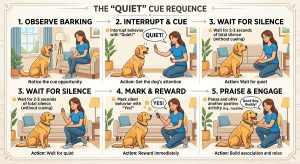
Quick answer: To teach “quiet,” wait for a natural pause in the barking, mark it with a word like “yes,” and reward right away. Once your dog stops predictably, say “quiet” just before the pause, then reward. Never shout the cue in the middle of a bark storm.
Here’s the trainer’s version, in plain steps:
- Wait for a break. Even a one-second gap to breathe counts.
- Mark and reward the instant the barking stops. Use a calm “yes” and a high-value treat (small pieces of chicken or cheese, not dry kibble).
- Stretch the pause. Each round, wait one second longer before the treat.
- Add the cue once you can predict the pause. Say “quiet” quietly, a beat before your dog stops. The word then becomes a signal for “silence earns a reward.”
- Practice at low intensity first. Use a mild trigger (a distant knock), not your dog’s worst one.
- Reward quiet when it happens on its own. Catch your dog being quiet near a trigger and pay for it. This builds the habit faster than any command.
Some trainers also teach “speak” first, so “quiet” has something to switch off. It’s a handy trick for very vocal dogs, but only if your dog is already barking on cue and won’t use it as a way to demand things.
Trainer note: Say the cue calmly and once. Repeating “quiet, quiet, QUIET!” teaches your dog that the cue means “bark louder until the human screams.”
Secret 3: Change How Your Dog Feels About the Trigger
If your dog loses it at doorbells, bikes or other dogs, you need more than commands. You need to change the emotion behind the bark. That’s what desensitization and counterconditioning do. It sounds technical, but the idea is simple: make the scary or exciting thing predict something great.
The Trainer’s Framework
- Find the threshold. This is the distance where your dog notices the trigger but doesn’t bark. If your dog barks at another dog 20 meters away, start at 40.
- Pair trigger and treat. The second your dog notices the trigger calmly, say “yes” and deliver a treat. The trigger appears, then food. Not the other way around.
- Keep sessions short. Five to ten minutes, a few times a week, beats one long frustrating walk.
- Move closer only when your dog is relaxed at the current distance. Loose body, soft eyes, eating treats happily.
- Retreat if your dog barks. That means you got too close. It’s feedback, not failure.
Try the “Look at That” Game
This simple exercise teaches dogs to notice a trigger and look back to you for the reward.
- Stand at a safe distance from a trigger.
- When your dog looks at it, say “yes” and treat.
- Soon your dog will glance at the trigger, then turn to you on its own, as if to ask, “Do I get paid for this?”
That glance is the early sign of calm control, and it’s a lot more useful than a dog that stares and then explodes.
For dogs whose barking comes with lunging, growling or snapping, work with a certified professional. Barking and reactivity often overlap, and those dogs need a careful plan.
Secret 4: Fill the Tank Before You Train
I’ve seen “barking problems” shrink dramatically after one change: the exercise routine. A short walk around the block doesn’t cut it for many dogs, especially working and herding breeds. A dog with pent-up energy goes looking for an outlet, and barking is a free one.
But here’s the part most guides miss: physical exercise alone can backfire. Endless ball-throwing builds fitness and adrenaline, which can make some dogs more reactive. The best barking-prevention plan mixes three things:
- Physical exercise matched to breed, age and health (walks, runs, swimming, fetch)
- Sniffing time. Ten minutes of slow sniffing tires a dog’s brain more than ten minutes of running. Let your dog lead on a long line or a calm “sniffari.”
- Brain work. Snuffle mats, puzzle feeders, scatter-feeding, short training sessions, scent games
A Simple Daily Template (Adult, Healthy Dog)
| Time | Activity | Why it helps |
|---|---|---|
| Morning | 20 to 45 min walk or run (breed dependent) | Burns early energy before peak trigger time |
| Mid-morning | Food puzzle or stuffed chew in the crate or mat | Teaches calm alone-time |
| Afternoon | 10 min training + 10 min sniffing | Mental work, not just physical |
| Evening | Second walk or play session | Prevents evening trigger stacking |
| Night | Chew, then rest | Winds the dog down |
These are starting points, not rules. A Border Collie or Belgian Malinois needs far more than a Cavalier King Charles Spaniel. Our guide on how often to exercise a working dog covers realistic benchmarks by breed and energy level.
Don’t forget sleep. Adult dogs generally need 12 to 14 hours of rest a day, puppies even more. An overtired dog is a reactive dog.
Secret 5: Manage the Environment and Survive the Extinction Burst
Management Isn’t Cheating
While you’re training, stop your dog from practicing the barking. Every rehearsal makes the habit stronger. A dog that barks at the window 40 times a day is basically doing 40 practice sessions.
Practical management tools:
- Frosted window film or furniture moved away from the window
- White noise or calm music to soften outside sounds
- A crate or pen away from the front door as a calm space, never as punishment
- Baby gates to block access to rooms with a view of the street
- No unsupervised garden time for dogs that bark at passersby
- Pre-emptive chews during known trigger times (school run, mail delivery)
If separation barking is part of the picture, a properly introduced crate can help a lot. Our step-by-step guide on how to crate train a puppy shows how to build a calm space your dog actually likes.
The Extinction Burst: Why It Gets Worse Before It Gets Better
This is the part almost every top-ranking article leaves out, and it’s the reason so many owners quit in week one.
Say your dog barks for attention, and you start ignoring it. Your dog has always been paid for barking, so what does it do? It barks louder and longer. It tries harder, because the old strategy always worked. Trainers call this an extinction burst.
How to survive it:
- Expect it. A rough few days is a sign the old habit is breaking, not that the plan is failing.
- Don’t cave. Giving in once in the middle of a burst teaches your dog that really loud barking works. That’s worse than where you started.
- Reward quiet early and often. Pay your dog heavily for silence in between bursts.
- Get everyone on board. One family member who gives in undoes the whole plan.
- Give it time. Bursts usually fade within days to a couple of weeks when you stay consistent.
This rule applies to attention and demand barking only. Never ignore barking caused by fear, pain or panic. Those dogs need help, not extinction (see the red-flag section below).
Your 14-Day Barking Reset Plan
Trainers like clear plans, so here’s one you can start tonight. Adjust the pace for your dog.
Days 1 to 3: Gather the facts
- Keep your barking log
- Book a vet check if the barking is sudden or severe
- Start blocking the worst triggers (window film, closed blinds, gates)
Days 4 to 5: Fix the basics
- Set a fixed daily routine
- Add one puzzle feeder and one sniff walk each day
- Begin teaching “place” with no distractions
Days 6 to 8: Start the cue work
- Practice “mark the pause” and the “quiet” cue at low intensity
- Start counterconditioning at your dog’s threshold distance
- Reward quiet around triggers, even for 2 seconds
Days 9 to 11: Add real triggers
- Practice “place” with a real trigger at a distance (a door knock, a recorded doorbell at low volume)
- Keep sessions to 5 to 10 minutes
- Expect a possible extinction burst; stay consistent
Days 12 to 14: Review and adjust
- Re-read your log. Count episodes, not just minutes
- Celebrate progress such as shorter episodes, faster recovery, fewer triggers
- Choose the next target trigger and keep going
Two weeks won’t “cure” a long-standing habit, but it should show you clear progress. If you see none, that’s your cue to adjust the plan or bring in a professional.
How Long Does It Really Take?
There’s no single answer, but here are realistic ranges based on what handlers and behavior professionals commonly see (every dog is different):
| Type of barking | Typical improvement time |
|---|---|
| Boredom barking | Days to 2 weeks once exercise and enrichment improve |
| Demand/attention barking | 1 to 3 weeks (watch for the extinction burst) |
| Alert/territorial barking | 3 to 6 weeks of consistent place training and management |
| Fear or frustration barking | 6 to 12 weeks |
| Separation distress | 2 to 4 months or longer, often with professional support |
Fixing the 6 Most Common Barking Situations
Most people search for a specific problem, not a general one. Here are quick fixes for the six situations I hear about most.
1. Barking at the Doorbell or Knock
- Record or play a doorbell at low volume.
- The moment it sounds, say “place” and toss a treat onto the mat.
- Reward calm for 5 to 10 seconds, then release.
- Gradually raise the volume, then use a real doorbell with a helper.
- Long term, reward your dog for going to the mat when the bell rings, not after barking.
2. Barking at the Window
This is mostly a management fix first. Cover the lower part of the glass with frosted film, or block access to the window. Then train “place” away from the window. Dogs that watch the street all day practice guard duty for hours, and no training session can compete with that.
3. Barking When You Leave
Work out whether it’s boredom or distress. Boredom barking is usually steady and fades. Distress barking starts within minutes, comes with panic signs (pacing, drooling, destruction, toileting) and often peaks as you leave. Setting up a camera helps you see what’s really going on. For true distress, don’t punish and don’t “tough it out.” Build alone-time in tiny steps (seconds, then minutes) and talk to a vet or certified behaviorist.
4. Barking at Other Dogs on Walks
This is usually fear or frustration. Cross the road or increase the distance, use “look at that,” and reward your dog for calm glances. Short, well-planned sessions help far more than long walks that end in chaos.
5. Barking in the Car
Most car barking is excitement or frustration. Practice short trips ending somewhere calm (not always the park), use a secured crate or harness, and reward silence with a chew. Block the dog’s view if the movement sets it off.
6. Barking in the Garden or Yard
Don’t leave a barking dog alone outside. Stay with your dog, call it in at the first sign of fence-barking and reward the recall. Over time, shorten the “warning” period and teach “place” or “come” as soon as a trigger appears.
Breed Barking Tendencies
Some breeds simply bark more by design. Setting a realistic goal (manageable barking, not silence) saves a lot of frustration.
| Breed group | Typical barking style | Why |
|---|---|---|
| Scent hounds (Beagle, Basset Hound) | Loud, baying | Bred to call handlers while tracking |
| Herding breeds (Shetland Sheepdog, Border Collie, Australian Shepherd) | Frequent, sharp, at movement | Bred to control livestock |
| Terriers (Yorkshire, Cairn, Jack Russell) | Fast, reactive to small movements | Bred to alert on and chase vermin |
| Guardian breeds (German Shepherd, Rottweiler, Cane Corso, Boerboel) | Deep, deliberate alert barking | Bred to protect property and people |
| Working breeds (Belgian Malinois, Dutch Shepherd) | Intense, driven barking when under-exercised | High drive and need for a job |
| Nordic breeds (Siberian Husky, Alaskan Malamute) | “Talking,” howling, sometimes loud | Pack communication |
A vocal breed can still improve a lot. For Malinois and other high-drive owners, structure and a daily “job” matter most.
Mistakes That Make Barking Worse (What the Research Says)
1. Yelling. Your dog thinks you’re barking too. It adds to the excitement.
2. Being inconsistent. Ignoring barking some days and giving in on others teaches your dog that persistence pays. This is exactly how a mild habit becomes a stubborn one.
3. Using bark collars as the main fix. Collars (shock, spray or ultrasonic) may suppress the sound, but they don’t solve boredom, fear or anxiety. A suppressed bark can pop up as another behavior.
The research backs this up. A 2020 University of Lincoln study (China, Mills and Cooper, published in Frontiers in Veterinary Science) compared remote e-collar training with reward-based training in 63 dogs. The researchers found that e-collar training was no more effective than training without one, and reward-based training worked better on several measures. The study looked at recall and obedience rather than barking specifically, but the lesson carries over: aversive tools add risk without adding results. Major organizations such as the AKC and PetMD also recommend working with a certified trainer before using any anti-bark device.
4. Punishing fear barking. This can make a scared dog more reactive and damage trust.
5. Throwing the toy or giving a treat to “shut the dog up.” You’ve just paid for the barking. Reward the silence, not the noise.
6. Quitting early. Real change takes weeks, and week one may look worse.
7. Training only when the dog is already barking. The best training happens when your dog is calm. Practice the skills in quiet moments so they hold up when it matters.
Neighbors, Noise Complaints and the Law
A complaint can turn a training problem into a legal one fast, so let’s cover it.
Rules vary by country and city. In England and Wales, persistent barking can be treated as a statutory noise nuisance under the Environmental Protection Act 1990. In the US, most cities and counties have their own noise ordinances. Many set limits on how long or at what hours a dog may bark. Check your local council or city rules so you know where you stand.
What to do if a neighbor complains:
- Talk first, kindly. A short, friendly chat works better than a formal complaint.
- Share your plan. Neighbors are far more patient when they know you’re working on it.
- Ask about timing. Knowing when the barking bothers them helps you target management.
- Keep your barking log. It shows your progress and proves you’re taking it seriously.
- Act at once on distress barking. A dog that barks for hours when left alone is struggling and needs help, not just a quieter house.
When Barking Is a Medical or Welfare Red Flag
Not all barking is behavioral. See a vet first if you notice:
- Sudden onset in a previously quiet adult dog
- Barking at night in a senior dog, which can signal confusion linked to canine cognitive dysfunction
- Barking with pain signs (limping, yelping, reluctance to move, guarding a body part)
- Hearing or vision loss, which can make dogs more anxious and vocal
- Barking with other changes in eating, drinking, sleeping or toileting
Rule out medical causes before starting any training plan. A dog in pain can’t “train out” its barking.
When to Call a Professional
Bring in a certified trainer or veterinary behaviorist if:
- Barking comes with panic, self-injury or destruction when you leave
- You’ve been consistent for 4 to 6 weeks with no improvement
- Barking comes with lunging, growling or snapping
- Barking is escalating in a multi-dog home
- Your dog barks in a repetitive, hard-to-interrupt way (possible compulsive barking)
Look for credentials from recognized bodies, such as the Certification Council for Professional Dog Trainers (CCPDT), the International Association of Canine Professionals (IACP), the Association of Pet Dog Trainers (APDT) or, in the UK, the Animal Behaviour and Training Council (ABTC). Ask what methods the trainer uses. Reward-based methods are the safest place to start.
If you’d like the full framework professional handlers use to build calm, reliable dogs from day one, my book Beyond the Bark: Inside a Pro Handler’s Playbook for Raising the Ideal Dog covers the same principles in much more depth, with real scenarios from working dog programs.
Why You Can Trust This Guide (Trainer E-E-A-T)
Written by Cpl. Rofiat Muritala, a Nigerian Army military working dog instructor and handler with more than 14 years of experience at the Nigerian Army Dog Centre. Her background includes advanced obedience, K9 patrol and advanced explosive detection certification courses, plus dog selection, foundational training and performance evaluation in real operational environments. She represented the Nigerian Army Dog Centre at NADCEL 2026, leading demonstrations in obedience, explosive detection, agility and tactical movement. She is also the author of Beyond the Bark.
How this guide was built: The methods here come from field-based handling experience and standard behavior-science principles (reinforcement, counterconditioning, management). The research claim above is drawn from published peer-reviewed work. This article is educational and doesn’t replace advice from your vet or a certified behavior professional for your individual dog.
FAQs
1. Why does my dog bark at everything all of a sudden?
A sudden jump in barking usually points to a change: new noises, a shift in routine, stress, pain or age-related anxiety in older dogs. If the change is abrupt or comes with other symptoms, book a vet visit first to rule out pain, hearing loss or cognitive decline.
2. How do I stop my dog from barking without punishment?
Find the cause, then reward the behavior you want. Teach a mat or “place” command, reward quiet moments, use slow exposure to triggers, and meet exercise and enrichment needs. Block the habit through management (window film, gates) while you train. Reward-based methods have the best track record and the lowest welfare risk.
3. Do bark collars work?
They can reduce the sound in the short term, but they don’t address why your dog barks. Shock and spray devices carry welfare risks and may increase anxiety or lead to other problem behaviors. Many trainers and organizations advise speaking to a certified trainer first, and relying on reward-based methods instead.
4. How long does it take to stop excessive barking?
Boredom and attention barking often improve in days to a few weeks. Alert barking typically takes 3 to 6 weeks, and fear or separation-related barking can take 2 to 4 months or more. Progress isn’t a straight line, and a short “extinction burst” is normal when you stop rewarding attention barking.
5. Will my dog ever stop barking completely?
No, and that’s okay. Barking is natural dog communication. The realistic goal is a dog that barks appropriately, settles quickly and responds to a calm cue. Total silence isn’t fair to ask of any dog, especially vocal breeds.
Final Thoughts
Excessive barking feels overwhelming when you’re living with it, but it’s one of the most fixable behavior problems once you stop guessing. Work out what your dog is trying to say. Teach a replacement behavior and a calm “quiet” cue. Change how your dog feels about its triggers. Fill the tank with exercise, sniffing and brain work. Then manage the environment and stay consistent through the rough first week.
Your action plan for tonight:
- Start your 3-day barking log
- Block your dog’s worst trigger (window film, gate or blinds)
- Book a vet check if the barking is new or sudden
- Begin teaching “place” with treats, no distractions
- Decide now that you’ll stay consistent for at least 4 weeks
Your dog isn’t barking to make your life hard. It’s communicating, and once you learn to listen, the fix is usually closer than it feels.
Want more practical K9 tips every week? Subscribe to our weekly articles roundup newsletter and get new guides straight to your inbox.

Her work centres on obedience, detection, protection and operational readiness. She favours proven methods built on repetition, consistency and real-world conditioning, so that both dogs and handlers are prepared for high-pressure tasks.
Rofiat represented the Nigerian Army Dog Centre at the Nigerian Army Day Celebration (NADCEL) 2026, where she led demonstrations in obedience, explosive detection, agility and tactical movement. Through articles, training content and documentaries, she shares field-based insight into how structured training, clear communication and trust between handler and dog affect performance and reliability.
She is the author of Beyond the Bark: Inside a Pro Handler's Playbook for Raising the Ideal Dog, a practical guide that helps dog owners and handlers apply professional training principles in everyday situations.
- How to Enter the COBA National Dog Championship - October 20, 2026
- K9 Advantix Dosage Chart & Safety Guide for Dogs - October 19, 2026
- How to Set Up & Use Bousnic Dog Training Collar - October 18, 2026