Can You Train a High-Content Wolf dog? Honest Guide
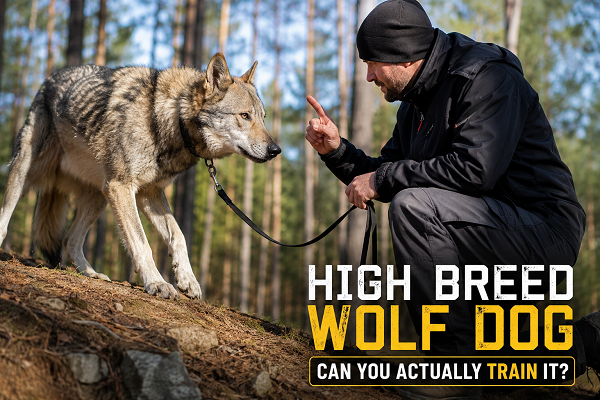
Can you train a high-content wolf dog? Yes, but only in a limited way. You can teach a high-content wolf dog (75% or more wolf ancestry) to take treats, walk on a leash, accept handling, and come when called inside a secure space. You cannot train away its wolf instincts, and you cannot rely on it the way you rely on a Labrador or a Malinois. Expect 2 to 3 years before it matures, a very short early socialization window, strict legal rules, no approved rabies vaccine, and a lifetime of fencing and supervision. If you want the wolf look with a trainable temperament, a Czechoslovakian Vlcak or a well-bred shepherd is a safer choice.
Table of Contents
- What “High Breed” Wolf Dog Really Means
- Why Wolfdogs Don’t Learn Like Dogs
- The Socialization Window Almost Nobody Mentions
- Wolf Content vs Trainability (Quick Table)
- How to Train a High-Content Wolf dog, Step by Step
- A Realistic Training Timeline
- Training Mistakes That Backfire
- How to Read a Stressed Wolf dog
- Laws, Rabies, and What Happens After a Bite
- What Wolf dog Ownership Really Costs
- Can a Wolf dog Do Working Dog Jobs?
- Is a Wolf dog Right for You?
- How We Researched This Guide
- FAQs
- Conclusion
Introduction
You saw a photo of a silver-grey animal that looks like it walked out of the forest, and now you’re asking the big question: can you actually train a high-content wolf dog?
Here’s the problem. Most advice online treats a wolf dog like a stubborn husky. It isn’t. Dog training works because dogs spent thousands of years being shaped to cooperate with people. Wolves never went through that. So the usual obedience-class playbook often fails, and the mistakes can get a person hurt or an animal killed.
In this guide you’ll learn what “high-content” really means, why wolf dogs learn differently, the early-life window that decides a lot of their temperament, a step-by-step training plan, a realistic timeline, the legal and rabies facts that surprise new owners, real costs, and safer alternatives. I’ll keep it plain and practical, whether you’re a first-time owner or a working handler.
What “High Breed” Wolf Dog Really Means
People search for “high breed wolf dog,” but the correct term is high-content wolf dog. It describes how much wolf ancestry an animal carries. It isn’t a breed.
A wolf dog is a cross between a domestic dog and a wolf, or the descendant of that cross. Wolves and dogs can breed and produce fertile pups, which is why wolf dogs exist at all. Owners and sanctuaries usually sort them like this:
- Low-content: roughly under 25% wolf. They behave much like dogs, with some surprises.
- Mid-content: roughly 25% to 75% wolf. Behavior varies a lot, even inside one litter.
- High-content: 75% or more, including F1 animals (one wolf parent). This is the group this article focuses on.
Here’s the catch: nobody can give you a perfect number. DNA tests can suggest wolf ancestry, but they can’t promise an exact percentage. Many owners in wolf dog communities also warn that sellers sometimes label ordinary husky or shepherd mixes as “high-content” and charge a lot more for them. Before you trust any claim, ask for the pedigree, photos of both parents, and a recent DNA result.
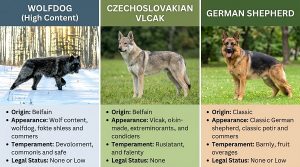
Don’t confuse wolf dogs with wolf-dog breeds. The Czechoslovakian Vlcak started in 1955 when Czechoslovak military breeders crossed German Shepherds with Carpathian wolves. The first litter arrived in 1958, the last wolf was added in 1983, and the FCI gave the breed full recognition in 1999. Generations of selection since then pulled it toward dog-like reliability. A Vlcak with papers and a backyard F1 are very different animals.
Why Wolf dogs Don’t Learn Like Dogs
So here’s the thing: a trained dog usually wants to work with you. A wolf doesn’t think that way.
Researchers at the Wolf Science Center in Austria raise wolves and dogs in nearly identical conditions to compare them. In a classic 2005 study by Gácsi and colleagues, wolf pups and dog puppies were hand-raised and socialized the same way. Even then, the wolf pups showed more avoidance, and they sometimes acted aggressively toward a person they already knew. The dog pups stuck closer to their human caregivers.
That tells you something important. Careful raising helps, but it doesn’t turn a wolf into a dog.
What does this look like in daily life?
- Less eye contact and people-pleasing. A wolf dog won’t check your face for approval the way a Labrador does.
- High caution. High-content animals are often wary of strangers, new places, and new objects.
- Independent problem solving. They think for themselves, and they quickly learn which rules you can actually enforce.
- A strong flight response. Many wolf dogs run first and think later when scared.
- Slow maturity. Many owners report that high-content wolf dogs don’t settle until around 2 to 3 years old, compared with about 12 to 18 months for many dogs.
The wolf dog community has a saying: you don’t train a wolfdog, it trains you. It’s a bit dramatic, but it points at something true. You aren’t giving orders. You’re building a working relationship, and the animal gets a vote.
The Socialization Window Almost Nobody Mentions
This is the part most competing articles skip, and it explains a lot of failed wolf dog placements.
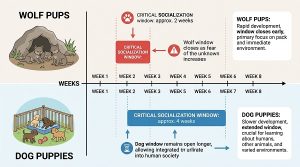
Puppies have a short period when they accept new things without fear. For dog puppies, that window opens around 4 weeks of age. Research by Katharine Lord found that wolf pups enter the same window much earlier, around 2 weeks. At that age wolf pups are still blind and deaf.
Now think about what that means in practice:
- The Wolf Science Center hand-raises its wolf pups from around 2 weeks old so they learn to trust people. Without that, they stay shy.
- Wolf Park in Indiana removes wolf pups from their mothers before two weeks and hand-raises them for roughly the first four months so they can be tamed enough to work with.
- Early US Fish and Wildlife Service experience, as reported in wolf-pet literature, found that pups taken at 3 to 4 weeks were far harder to tame. Only 1 in 11 became tame, even with about a month of eight-hour days of human contact.
- Studies of wolf behavior also show that wolf pups raised by their mother are very fearful of people by 8 weeks.
Now compare that to how wolf dog pups are usually sold: at 8 weeks, after living in a kennel with mom. For a high-content pup, that’s often already past the best window.
What this means for you: if a breeder can’t tell you exactly how the pup was handled during weeks 2 to 6, treat the animal as under-socialized. Ask. Then ask again. This single question will predict your training headaches better than the DNA percentage will.
Wolf Content vs Trainability (Quick Table)
Use this table as a rough guide. Individual animals vary, and breeders’ claims aren’t proof.
| Wolf content | Typical trainability | Main challenge | Best fit |
|---|---|---|---|
| Low (under ~25%) | Close to a husky or shepherd | Prey drive, escaping, independence | Experienced dog owners |
| Mid (~25–75%) | Unpredictable, can swing either way | Shyness or reactivity, marking, destruction | Experienced owners with secure property |
| High (75%+) | Trainable for basics, never fully reliable | Fear, flight response, containment, laws | Specialist owners or sanctuaries |
| Established breed (e.g., Vlcak, Saarloos) | Trainable with early socialization | Reserved with strangers, high energy | Committed, experienced owners |
SheKnows, citing Wolf Park, makes a fair point: there are no absolutes with hybrids. Two pups from the same litter can turn out very different. Plan for the harder one.
How to Train a High-Content Wolf dog, Step by Step
This plan borrows from working-dog handling and from what sanctuaries and wolf researchers report. In my own world of military and K9 work, the first lesson is always the same: set up the environment so the dog can’t practice bad behavior. That matters even more here.
Step 1: Build containment before you build obedience
No training program beats a good fence. Before the animal arrives, you need:
- A fence of at least 6 to 8 feet, with an inward-angled top or roof so climbing fails
- A dig barrier buried about 2 feet down, or a wire apron laid flat outward
- A double-gate “airlock” so there’s never a single open barrier between the animal and the road
- Secure latches. Wolf dogs open simple ones.
Some US state rules spell out fence height, double fencing, and buffer gaps. Check your local requirements before you build.
Step 2: Build trust first, commands second
For the first weeks, aim for calm, boring, positive time together.
- Sit near the animal without staring or reaching.
- Toss high-value treats (cooked chicken, liver, cheese) and let it come to you.
- Feed some meals by hand.
- Let the animal decide when to approach. Never corner it.
This “trust bank” feels slow. But a wolf dog that trusts you will try for you. One that doesn’t will simply leave.
Step 3: Use short sessions and a marker
Keep sessions to 3 to 5 minutes, several times a day. End on a win, always. Use a clicker or a marker word (“yes”) so the animal knows the exact moment it got it right. Then pay with a high-value reward.
Start with:
- Name response. Say the name, mark and reward when it glances at you.
- Hand touch (targeting). Great for moving the animal without grabbing it.
- Sit and down. Easy wins that build confidence.
- Place. A mat or bed it can go to when you need calm.
Step 4: Teach consent-based handling
Wolf dogs can panic when forced into handling. Train vet and grooming cooperation early:
- Touch a paw, mark, treat. Touch an ear, mark, treat.
- Practice with a harness, a muzzle (introduced slowly, as a game), and a crate.
- Let the animal opt out. If it pulls away, pause and try an easier step.
This matters a lot, because a vet visit is where many wolf dog stories go wrong.
Step 5: Teach recall on a long line, and respect its limits
Use a 30-foot long line inside your secure yard. Call the name, mark the moment it turns, and reward with something amazing. Practice 100 easy repetitions before you add distractions.
Be honest about the limit. Even a well-trained high-content wolf dog has a strong roaming and prey drive. Most experienced owners never trust one off-leash outside a fully enclosed area. A recall protects you inside the fence. It doesn’t replace the fence.
Step 6: Add “leave it” and door manners
These two cues prevent most accidents:
- Leave it stops the animal from grabbing food, small pets, and wildlife.
- Wait at doors and gates stops bolting.
Practice at every door, every day.
Step 7: Feed the brain
A bored wolf dog destroys things. Give it jobs:
- Scatter feeding and snuffle mats
- Food puzzles and frozen treats
- Scent games (hide treats in the yard)
- Digging pits where digging is allowed
- Daily long, calm walks on a secure harness in quiet areas, only where legal and safe
If you want a deeper look at how pro handlers build focus, timing, and consistency in high-drive animals, my book Beyond the Bark: Inside a Pro Handler’s Playbook for Raising the Ideal Dog walks through the same foundations. It’s written for working dogs, but the trust-and-timing principles carry over.
A Realistic Training Timeline
Use this as a rough guide, not a promise. Every animal sets its own pace.
| Age / stage | Goal | What to expect |
|---|---|---|
| 2–8 weeks | Daily gentle human contact, new sights and sounds | Usually happens at the breeder. Ask what they did. |
| 2–6 months | Trust, name, hand touch, crate, harness, handling | Fast learner, easily spooked. Keep sessions tiny. |
| 6–12 months | Sit, down, place, leave it, door manners, long-line recall | Testing begins. Progress can look uneven. |
| 12–24 months | Reliable basics at home, calm around visitors | Adolescent swings. Don’t skip sessions. |
| 2–3 years | Maturity | Many owners say behavior finally settles. |
| Lifetime | Maintenance, enrichment, fence checks | The training never fully ends. |
Some experienced handlers report 12 to 18 months before a recall is dependable even in a controlled setting. If someone promises results in six weeks, walk away.
Training Mistakes That Backfire
I’ve seen the same mistakes sink good owners again and again.
- Using “alpha” or dominance methods. Alpha rolls, leash pops, and staring contests can push a wolf dog into defensive aggression instead of obedience. Wolf biologists like L. David Mech have shown that wild wolf packs are families, not dominance ladders, so this old advice rests on a myth.
- Skipping the fence work. Training can’t fix an escape.
- Training only when it’s easy. Practice around mild distractions, then build up.
- Forcing contact. Hugging, hovering, and direct staring can scare a cautious animal.
- Leaving it alone for long stretches. Isolation breeds destruction and anxiety.
- Expecting a guard dog. More on that below.
- Trusting the DNA label. Train the animal in front of you.
How to Read a Stressed Wolf dog
Because wolf dogs often show stress quietly, learn the early signals. Stop the session when you see:
- A tucked tail, flattened ears, or a low body
- Whale eye (you can see the whites of the eyes)
- Repeated lip licking or yawning
- Freezing or a hard, fixed stare
- Raised hackles or stiff movement
- Pacing along the fence line
Give space, lower the difficulty, and try again later. A wolf dog that feels safe learns. One that feels trapped escalates.
Laws, Rabies, and What Happens After a Bite
This is the part new owners hate, and it’s the part that decides whether you can keep the animal at all.
Laws vary by place. In the US there is no single federal ban, so rules come from states, counties, and cities. Some places ban wolf dogs, some require permits, and some have no state rule at all. Cities and counties can override the state. California, for example, has used a generation-based standard in some rules and percentage-based standards in others, so two owners can face different outcomes. Check your local code first. Our guide on wolf dog breeds and whether they’re legal to own walks through this in more detail.
In the UK, Defra’s long-standing position is that wolf dog hybrids technically fall under the Dangerous Wild Animals Act 1976, because the Act covers the dog family with domestic dogs excluded. Local councils decide, and they may treat animals many generations from a wolf as ordinary dogs. A commonly quoted rule of thumb is that animals three or more generations from a wolf are treated more like dogs, but sources differ, so ask your council before you buy. Several other European countries also regulate hybrids under wolf-protection rules.
The rabies problem. In the US, no rabies vaccine is licensed for use in wolves or wolf hybrids. The AVMA Trust tells vets to warn owners that the vaccine isn’t licensed for hybrids and that no studies prove it works in them. Many health agencies treat a vaccinated hybrid as unvaccinated after a bite. Vermont’s law, for instance, orders a wolf-hybrid that bites or exposes a person to be destroyed and tested.
Read that again. A single bite, even a minor one from a well-loved pet, can end with the animal euthanized in some places. That one fact should shape every decision you make about visitors, children, and fences.
What Wolfdog Ownership Really Costs
The purchase price is the cheapest part. Costs below are commonly quoted ranges, and they vary by country.
- Secure enclosure: often thousands of dollars, with $3,000 to $10,000 or more commonly mentioned for compliant setups.
- Specialist vet care: you may drive far to find a vet who will see a wolf dog, and exotic-animal exam fees add up.
- Permits, inspections, and insurance: where required, these are yearly costs. Some home insurers won’t cover wolf hybrids at all.
- Food: large animals eat a lot, and high-quality diets cost more.
- Replacing damage: fences, doors, and furniture take hits.
- Time: expect hours every day, for 12 to 15 years in many cases.
One practical tip from sanctuaries: foster or volunteer with a wolf dog first. It’s the cheapest way to find out whether you really want this life.
Can a Wolf dog Do Working Dog Jobs?
Short answer: rarely, and not in the way most people hope.
Professional programs need a dog that is predictable under stress. If you want to see how selection works, read our guide on what it means to be a working dog and how a military K9 training program is built. Programs choose dogs for stable nerves, clear responses, and the ability to work in crowds, noise, and heat. High-content wolf dogs are valued for the opposite: independence and caution.
There are interesting exceptions. A 2006 report on research at Russia’s Perm Institute of Internal Troops said wolf dog crosses tracked a target in about 15 to 20 seconds, while ordinary police dogs needed 3 to 4 minutes. That shows the wolf side’s nose and stamina are real. But the same sources note the crosses were hard to manage. Speed isn’t useful if the animal can’t be controlled in the field.
The Czechoslovakian Vlcak shows the better path. It was designed for border patrol and is now used in tracking, search and rescue, and sport. That worked because breeders spent decades pulling temperament back toward the shepherd side.
Is a Wolf dog Right for You?
Ask yourself:
- Is a wolf dog legal at my exact address, not just my state or country?
- Can I pay for and build a double-gated, climb-proof, dig-proof enclosure first?
- Is there a vet within driving distance who will treat it?
- Can I live with a bite risk and the possibility of euthanasia if something goes wrong?
- Am I okay with 2 to 3 years of testing behavior and a lifetime of management?
- Do I have the space, time, and quiet home it needs?
If you answered “no” to even two, skip the high-content animal. You still have good options:
- Czechoslovakian Vlcak or Saarloos Wolf dog: wolf looks, standardized breeds, but still demanding.
- German Shepherd or Belgian Malinois: drive, intelligence, and trainability, with decades of working proof.
- Siberian Husky or Alaskan Malamute: wolf-like looks, fully domestic, and easier to insure.
How We Researched This Guide
Written by: Cpl. Rofiat Muritala, a Nigerian Army military working dog instructor and handler with more than 14 years at the Nigerian Army Dog Centre. Her background covers dog selection, foundation training, behavior shaping, and performance evaluation in operational settings.
A note on honesty: ARFS K9 Team works with military and working dogs, not wolf dogs. So this guide combines handler-level training principles with published research and sanctuary experience, and it points you to specialists for hands-on wolf dog work. We rewrote it using Wolf Science Center rearing notes, Wolf Park material, the 2005 Gácsi et al. study, Katharine Lord’s socialization research, a genomic study of the Czechoslovakian Wolf dog, Defra’s guidance on wolf dog hybrids, and veterinary and legal statements on hybrid rabies control. Laws change, so confirm local rules with your council, county, or state wildlife agency before you decide.
FAQs
1. Can you train a high-content wolf dog?
Yes, to a point. You can teach basic cues, leash and harness skills, handling, and a recall inside a secure area. You can’t remove wolf instincts like flight, roaming, and strong prey drive, so containment and supervision stay in place for life.
2. How long does it take to train a wolf dog?
Plan for 2 to 3 years before behavior settles. Basic cues often come in a few months, but a dependable recall can take 12 to 18 months, and many owners never trust one off-leash outside a fence.
3. Can a wolf dog be a guard or protection dog?
Not reliably. Protection work needs predictable, controllable responses under stress. High-content wolf dogs tend to be cautious and independent, which makes them a poor and risky fit. Established working breeds are the safer choice.
4. Can you ever let a wolf dog off-leash?
Only inside a fully enclosed, escape-proof space. Because of strong roaming and prey instincts, most experienced owners don’t risk off-leash freedom in open areas.
5. What’s the best wolf-like dog for a first-time owner?
A first-timer is usually better off with a husky, malamute, or a well-bred German Shepherd. If you want a wolf dog breed, choose an FCI-recognized Czechoslovakian Vlcak or Saarloos from a responsible breeder, and plan to learn from experienced owners.
Conclusion
So, can you actually train a high-content wolf dog? Yes, you can teach it useful skills and build a trusting bond. You can’t train away the wolf.
Here’s what to do next:
- Check your exact local law, down to the city or county, before anything else.
- Talk to a vet who accepts wolf dogs and ask what they’d do after a bite.
- Visit or volunteer at a wolf dog sanctuary before you commit.
- Build the enclosure first. Then think about the animal.
- If the risk feels too high, choose a wolf-like breed with a proven working record instead.
Done with realistic expectations, wolf dog ownership can be rewarding. Done on impulse, it often ends badly for the animal. Choose the version you can truly handle.
Want more practical K9 training guides like this one? Subscribe to our weekly articles roundup newsletter and get new posts straight to your inbox.
Sources and Further Reading
- Wolf Science Center (Austria): rearing and comparability notes, wolfscience.at
- Gácsi et al. (2005), Developmental Psychobiology, hand-raised dog and wolf pups
- Zimen (1987), Man and Wolf, wolf, poodle, and hybrid pup studies
- “Wolf outside, dog inside? The genomic make-up of the Czechoslovakian Wolfdog,” PMC6043967
- Czechoslovakian Wolfdog Club of GB, breed history
- California Veterinary Medical Association: policy on wolf hybrids and rabies vaccination
- Vermont Statutes, Title 20, Chapter 193, Domestic Pet or Wolf-Hybrid Control
- Defra guidance on wolf-dog hybrids and the Dangerous Wild Animals Act 1976
- Wikipedia, “Wolves as pets and working animals” (used only for reported figures; verify against primary sources)

Her work centres on obedience, detection, protection and operational readiness. She favours proven methods built on repetition, consistency and real-world conditioning, so that both dogs and handlers are prepared for high-pressure tasks.
Rofiat represented the Nigerian Army Dog Centre at the Nigerian Army Day Celebration (NADCEL) 2026, where she led demonstrations in obedience, explosive detection, agility and tactical movement. Through articles, training content and documentaries, she shares field-based insight into how structured training, clear communication and trust between handler and dog affect performance and reliability.
She is the author of Beyond the Bark: Inside a Pro Handler's Playbook for Raising the Ideal Dog, a practical guide that helps dog owners and handlers apply professional training principles in everyday situations.
- How to Enter the COBA National Dog Championship - October 20, 2026
- K9 Advantix Dosage Chart & Safety Guide for Dogs - October 19, 2026
- How to Set Up & Use Bousnic Dog Training Collar - October 18, 2026