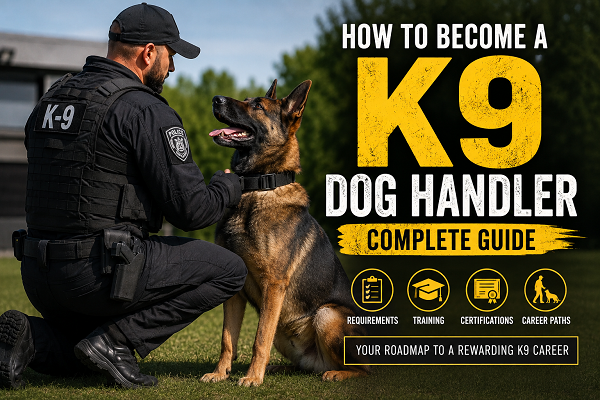
How to Become a K9 Dog Handler: Global Guide
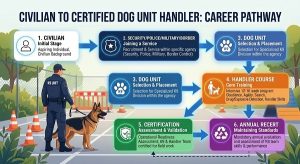
Most people become a K9 dog handler by first joining a police force, the military, a border agency or a licensed security company, then applying to the dog unit after one to three years. Handler courses then run from about 11 weeks to 8 months, depending on the agency. Only a few routes, like private security in the UK or enlisting for the US Army’s 31K job, let you aim at dog work from day one.
Table of Contents
- What a K9 handler actually does
- Which path fits you? (comparison table)
- K9 handler requirements
- Step-by-step: how to become a K9 handler on each path
- What selection boards look for
- K9 handler training: timelines and curriculum
- Certifications that matter
- Who pays for what? Real costs
- K9 handler salary in 2026
- The lifestyle nobody posts about
- Your 12-month “while you wait” plan
- Mistakes and scams to avoid
- About the author (experience behind this guide)
- FAQs
- Conclusion
Introduction
You’ve seen the videos. A Malinois launches off a ramp, the handler stays calm, and the whole thing looks like a dream job. Then you search for how to become a K9 dog handler and hit a wall of vague advice: “become a cop first,” “get experience,” “apply when a spot opens.”
So here’s the real problem. A K9 handler job isn’t a normal job listing. Most agencies don’t treat it as an entry-level role, and you can’t just ask for a dog. Between building a patrol record, waiting for an opening, going through selection, finishing the handler course and bonding with the dog, you’re looking at years, not months.
This guide fixes that. You’ll learn the exact routes (police, military, customs and border, private security, search and rescue), the training length for each, what it costs, what handlers earn, and what the job does to your home life. I’ll also show you what to do while you wait, because that waiting time decides who gets picked.
What Does a K9 Handler Actually Do?
A K9 handler is a trained professional who works with one specially trained dog to track, detect, search or protect. Depending on the role, that means narcotics or explosives detection, suspect tracking, building searches, patrol support, or search and rescue.
But the dog isn’t a tool you sign out and return. In police work, you often look after the dog in your own home. In TSA’s program, handlers must be willing to care for the canine around the clock, at work and at home.
If you’re new to this world, start with what actually defines a working dog. It explains why these dogs need a job, not just a walk.
Which K9 Handler Path Fits You?
Think of this as a decision table. Find the row that matches your situation today.
| Path | Direct entry? | What comes first | Handler course |
|---|---|---|---|
| UK police | No | Serve as a police officer for two years | Roughly 3 months |
| US police | No | Patrol time, often about two years | 8 to 16 weeks |
| US Army (31K) | Yes, but slots are limited | Basic training | 7 weeks at Fort Leonard Wood + 11 weeks at Lackland |
| US Air Force | No | Start in Security Forces; no direct enlistment | 65 days |
| TSA | Open to TSA staff and qualified applicants | Prescreening and physical testing | 11 or 16 weeks |
| Australian Border Force | No | Normally picked from general duties officers | About 7 to 8 months |
| UK private security | Yes | SIA licence | 60+ guided hours (Level 2) |
A few details behind that table:
- UK police: After probation, you apply to the dog unit for a trial course with a trained dog, then wait for a vacancy. Competition is stiff. Police dog handler is one of the most sought-after jobs in the force.
- US Army: Recruits enlist for the 31K job, then take a two-part training pipeline. Regulations require Phase 1 at Fort Leonard Wood and Phase 2 at the 341st Training Squadron at Lackland. The Army has far fewer MWD handler slots than general military police slots. Confirm the current pipeline with a recruiter, since schedules change.
- Border agencies: UK Border Force requires you to join first and gain experience before you apply to train as a detector dog handler. Australian Border Force handlers are normally chosen from general duties officers, and each team trains together for at least 7 months.
K9 Handler Requirements
Every agency sets its own rules, but most share this core list:
- Age: usually 21+ for police and military K9 roles. Private security can start at 18 in some regions.
- Legal status: citizenship or residency for police, military and federal roles.
- Clean record: background checks run deep, and federal and border jobs add security clearances.
- Fitness: you’ll sprint, climb and physically control a strong dog. The UK College of Policing profile lists force-specific fitness standards for the role.
- Education: a high school diploma is the usual baseline. Many police departments prefer an associate or bachelor’s degree in criminal justice for K9 handlers.
- Home setup (police): the UK check is specific. Your home is inspected for off-road parking and enough garden space for two kennels. Your family must also agree to live with a working dog.
- Driving licence: needed for almost every patrol and mobile detection role.
- Army 31K extras: a score of 91 or higher on the Skilled Technical section of the ASVAB.
Notice what’s not on the list: “loves dogs.” Loving dogs is easy. Agencies screen for judgment, discipline and reliability, because they’re trusting you with an animal that can use force.
Step-by-Step: How to Become a K9 Dog Handler
Police K9 handler
- Join the force and finish academy training.
- Build a clean patrol record. Reliability matters more than speed.
- Get close to the K9 unit early. Ask to watch training days.
- Apply when a vacancy opens. Expect an application, an interview and a review of your record.
- Complete the handler course with your dog.
- Pass the licensing or certification test. In the UK, the College of Policing profile lists the NPCC Police Dog Licence and a completed dog handling course as core skills.
- Recertify every year.
Military K9 handler
- Pick the right job. In the US Army that’s 31K. In the Air Force it’s Security Forces first, then the dog handler specialty.
- Finish basic training and technical school.
- Pass the medical, background check and kennel interview. Army applicants interview with a kennel master or unit commander for this voluntary assignment.
- Complete the handler course.
- Certify with your dog and re-certify every year.
If you want a feel for what that training looks like, read our breakdown of military K9 training techniques.
TSA and federal detection handler
TSA’s traditional explosives detection handlers take an 11-week course, and passenger screening handlers take 16 weeks. The scale is big: in 2025, TSA deployed 1,076 canine teams that ran over 430,000 explosives sweeps and logged 160,000 hours of training. Also, about 60% of graduating teams are law enforcement officers and 40% are TSA transportation security specialists. So you don’t have to be a sworn officer to get in.
Private security K9 handler
This is the most open door for civilians, especially in the UK.
- Get an SIA licence. There’s no separate SIA dog-handling licence; you hold a standard frontline licence and take a recognised canine course.
- Take a NASDU course. The Level 2 qualification has a minimum of 60 guided learning hours. Level 3 runs 150 hours.
- No dog yet? Some approved trainers lend a trained dog, but that leads to a handler-only certificate.
- Apply to security firms with dog divisions, and keep adding detection or protection skills.
Pay attention to the certificate types. The Level 2 award belongs to the handler for life, but the team certificate (handler plus dog) expires after 12 months.
Search and rescue (volunteer first)
SAR is often a volunteer route. A common starting point is playing the “dogsbody,” the casualty in rescue dog training, then moving into navigation and support work after about six months. That experience can lead to handler training.
What Do Selection Boards Look For?
Because handler spots are limited, boards pick people, not résumés. From what’s publicly documented:
- Your record. Agencies don’t see K9 as entry-level, because the handler carries the liability the dog brings.
- How you act around dogs and other teams. Some programs use a practical exercise. For TSA-style teams, selection includes an application, oral interviews and a practical test of how you interact with the canine and other teams.
- Whether you’re already involved. The people who get picked usually showed up before the vacancy. One tip floating around the community: people interested in K9 work are encouraged to become a good decoy.
K9 Handler Training: Timelines and What You Learn
| Program | Typical length |
|---|---|
| Police handler course (US) | Often 8 to 16 weeks depending on specialty |
| UK police dog handler course | About 3 months |
| US Army 31K | 7 weeks (Phase 1) + 11 weeks (Phase 2) |
| USAF Military Working Dog Handler | 65 days |
| TSA explosives detection / passenger screening | 11 / 16 weeks |
| Australian Border Force | A 12-week handler course, a 4-month regional phase and a 4-week final evaluation, about 8 months in total |
| NASDU Level 2 / Level 3 | 60+ / 150 guided hours |
The curriculum usually covers obedience and control, scent detection, handler safety, tactical deployment, kennel care and first aid, and the law (use of force, search rules and court testimony). Patrol teams add bite work and apprehension.
One more thing most guides skip: the course is the start, not the finish. Handlers train their dog for the entire partnership, and most agencies require set weekly training hours. One TSA-linked accreditation report notes training of at least two days per week.
Certifications and Standards Worth Knowing
- UK police: NPCC Police Dog Licence, under the College of Policing standards
- UK security: NASDU Levels 2 and 3, aligned to BS 8517-1
- US police: state certification plus bodies like NAPWDA, USPCA and NNDDA
- Military and federal: agency certification, repeated every year
Before you pay a private school for a “K9 handler certificate,” ask who recognizes it. A certificate that no employer, insurer or court accepts is a very expensive piece of paper.
Who Pays for What? Real Costs
For police, military and federal roles, the agency generally covers handler training. The costs show up in other places:
- The dog: K9s cost between $15,000 and $45,000 each. One US department reported $19,000 for the dog plus six weeks of training.
- Private courses: prices vary widely by country and provider, so get written quotes and compare what the certificate gets you.
- Retirement: this is the part nobody warns you about. Most US agencies don’t financially support K9s once they retire, so handlers often cover the bills. Emergency surgery or cancer care can top $10,000, and some handlers have spent $20,000 to $50,000. Most dogs retire at around 10.
- Your rights: Robby’s Law (2000) gives handlers first chance to adopt retired military and police dogs. Before it, those dogs were treated as surplus property.
K9 Handler Salary in 2026
Pay depends on agency, country and rank, and salary sites disagree. Treat these as ranges.
- K9 handler (all employers, US): ZipRecruiter lists an average of about $37,374. Glassdoor’s median is about $43,383.
- K9 officer (police): ZipRecruiter shows an average near $53,799. Location moves this a lot. One Texas estimate puts the average at $67,956.
- Private explosives detection: A current Allied Universal posting in California lists $31.64 an hour.
In police work, the dog usually adds a bonus on top of your normal salary. One collective bargaining sample shows a 5% premium for handlers, meant to cover off-duty care like feeding and grooming. Some agreements even assume 30 minutes a day of unpaid-looking dog care, which tells you how much of this job happens after shift.
I’d skip any guide that quotes one “K9 handler salary” with total confidence. Check your own agency’s pay scale and union agreement.
The Lifestyle Nobody Posts About
- Your home becomes a kennel annex. Inspections, fencing and parking all matter.
- Spontaneous plans die. Holidays need dog arrangements.
- Your family signs up too. Everyone living with a working dog needs rules.
- Retirement hurts. After roughly a decade, you’re managing the end of a partnership and often the bills.
None of this should scare you off. It should make sure you go in with open eyes.
Your 12-Month “While You Wait” Plan
You can’t force a vacancy, but you can become the obvious pick. Try this:
- Months 1–3: Fix your fitness. Run, carry loads, practice short sprints. Test yourself against the fitness standard for your target agency.
- Months 1–3: Learn dog behavior. Study body language, drive and stress signals. If breed choice matters to your goal, read German Shepherd vs Belgian Malinois.
- Months 3–6: Get dog hours. Volunteer at a training kennel, a SAR group or a sport club. Offer to be a decoy where it’s safe and supervised.
- Months 6–9: Build relationships. Watch K9 training days and ask real questions.
- Months 9–12: Fill your file. Keep your record clean, collect commendations and document any dog-related work.
- Ongoing: learn the obedience and handler mindset that professionals use. My book, Beyond the Bark: Inside a Pro Handler’s Playbook for Raising the Ideal Dog, covers obedience, drive-building and handler mindset in plain language.
Common Mistakes (and Scams) to Avoid
- Believing you can skip the day job. Most routes require another job first.
- Buying a “certification” before checking who accepts it. Ask your target employer first.
- Buying a dog before you have a role. A high-drive dog with no job becomes a household problem.
- Ignoring fitness. Physical testing eliminates people before a dog is ever involved.
- Waiting passively. The waiting period is your audition.
About the Author: Experience Behind This Guide
This guide comes from Cpl. Rofiat Muritala, a Nigerian Army military working dog instructor and handler with more than 14 years at the Nigerian Army Dog Centre. Her background covers dog selection, foundational training, behavior shaping and performance evaluation. She has completed advanced obedience, K9 patrol and advanced explosive detection courses. In 2026 she led obedience, explosive detection, agility and tactical movement demonstrations at the Nigerian Army Day Celebration (NADCEL).
Data in this guide comes from agency and association pages (TSA, US Army regulations, UK College of Policing, NASDU, Australian Border Force). Salary figures come from public salary sites and vary. Check your target agency’s current rules before applying.
FAQs
1. How long does it take to become a K9 handler?
Plan for roughly 2 to 6 years from your first application. That includes joining an agency, building experience, waiting for an opening, selection, and a handler course that ranges from about 11 weeks to 8 months.
2. Can civilians become K9 handlers?
Yes. Private security is the main civilian route, and in the UK it needs an SIA licence plus NASDU certification. You can also volunteer in search and rescue and train toward detection work.
3. Do you need a degree to be a K9 handler?
Not always. A high school diploma is the usual baseline, but many police departments prefer an associate or bachelor’s degree in criminal justice for handlers.
4. Can I become a K9 handler without police experience?
Yes, through the US Army 31K job, TSA (open to qualified applicants as well as officers), or private security and detection work. Police dog units, though, do require you to be a serving officer.
5. What breeds do K9 handlers work with?
German Shepherds and Belgian Malinois lead in patrol roles, while Labradors dominate detection-only work. If you’re curious how the first two compare, see our German Shepherd vs Malinois breakdown.
Conclusion
Here’s the bottom line. Becoming a K9 handler is a career you build toward, not a job you apply for. Pick your path (police, military, border, TSA or private security), meet the entry requirements, and use the waiting time to get fit, learn dog behavior and show up around the unit.
Then go in with open eyes about the cost, the lifestyle and the retirement years. The handlers who last aren’t the ones who love dogs the most. They’re the ones who stay consistent, patient and committed to the dog’s welfare.
Want more practical K9 guidance every week? Subscribe to our weekly articles roundup newsletter and we’ll send the best of our handler and training content straight to your inbox.

Her work centres on obedience, detection, protection and operational readiness. She favours proven methods built on repetition, consistency and real-world conditioning, so that both dogs and handlers are prepared for high-pressure tasks.
Rofiat represented the Nigerian Army Dog Centre at the Nigerian Army Day Celebration (NADCEL) 2026, where she led demonstrations in obedience, explosive detection, agility and tactical movement. Through articles, training content and documentaries, she shares field-based insight into how structured training, clear communication and trust between handler and dog affect performance and reliability.
She is the author of Beyond the Bark: Inside a Pro Handler's Playbook for Raising the Ideal Dog, a practical guide that helps dog owners and handlers apply professional training principles in everyday situations.
- How to Enter the COBA National Dog Championship - October 20, 2026
- K9 Advantix Dosage Chart & Safety Guide for Dogs - October 19, 2026
- How to Set Up & Use Bousnic Dog Training Collar - October 18, 2026