Military Dog Tag Format: What to Engrave
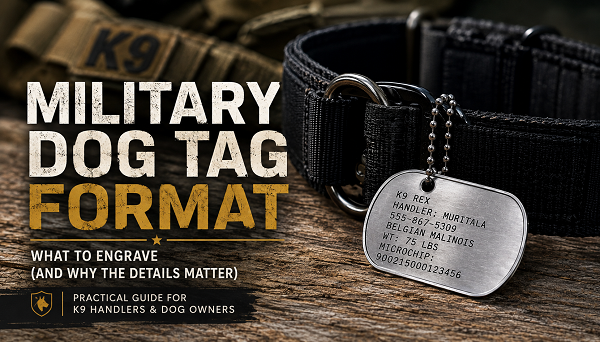
A traditional U.S. military dog tag carries the wearer’s last name, first name and middle initial, a 10-digit DoD identification number, blood type, and religious preference (or “no preference”), stamped across two to five lines on a 2-inch by 1-inch stainless steel tag. For a working or protection dog, the smart format swaps those fields for the dog’s name, your phone number, a medical alert line, and a microchip or tattoo ID number, keeping the same rugged military look but making it actually useful if your dog goes missing.
Table of Contents
- Introduction
- What a Military Dog Tag Actually Is (A Short History)
- The Official U.S. Military Dog Tag Format by Branch
- How Real Military Working Dogs Are Identified
- What to Engrave on a Military-Style Tag for Your K9
- Choosing the Right Material and Engraving Method
- 5 Mistakes I See Handlers Make When Ordering Tags
- Dog Tags vs. Microchips vs. GPS: What Should You Actually Rely On?
- Trainer Insight: Notes From the Field
- FAQs
- Conclusion
Introduction
If you’ve ever picked up a set of military-style dog tags and wondered exactly what’s supposed to go on them, you’re not alone. I get this question all the time from handlers, K9 hobbyists, and regular dog owners who want that rugged, no-nonsense look for their own dog’s collar. It seems simple until you actually sit down to order a set, and then you realize there are about six different formats depending on which branch you’re copying, and none of them are obvious.
In this guide, I’ll walk you through the real, regulation-accurate military dog tag format used by each U.S. service branch, show you how actual Military Working Dogs (MWDs) are identified (spoiler: it’s not with a tag around the neck), and then give you a practical, field-tested format you can use for your own K9 or protection dog. By the end, you’ll know exactly what to engrave, what to skip, and which mistakes cost people money and legibility down the road.
What a Military Dog Tag Actually Is (A Short History)
Dog tags didn’t start out as the polished, standardized items we picture today. Soldiers in the American Civil War often pinned scraps of paper with their names to their uniforms or scratched their identity into whatever metal they had on hand, because there was no formal system for identifying the dead. It wasn’t official, and it wasn’t reliable.
The U.S. Army didn’t formalize identification tags until General Order No. 24 on December 20, 1906, which introduced a single aluminum disc. A second tag followed on July 6, 1916, so one could stay with the body and the other could go with the paperwork, the same two-tag logic still used today. In 1918, the Army added a serial number to the tag after realizing there were simply too many soldiers sharing the same name to rely on names alone.
Stainless steel became the standard material during World War II because it held up far better in the field than the earlier aluminum and monel alloys. Since then, the size (roughly 2 inches by 1 inch, cut from 0.025-inch stainless steel sheet), the shape, and the stamping method have barely changed, even though the information on the tag has been updated more than once, most recently to remove Social Security numbers.
That last point matters if you’re trying to replicate an accurate tag: modern issue U.S. military dog tags no longer use Social Security numbers at all.
The Official U.S. Military Dog Tag Format by Branch
Here’s where most tag orders go wrong, people assume there’s one universal military format, but each branch actually lays out the information a little differently. If you’re building a historically accurate replica, or you just want to understand the source material before adapting it for your dog, here’s the real breakdown.
U.S. Army and Air Force
Since January 2019, the Army and Air Force have used identical formats:
- Last name, first name, middle initial
- 10-digit DoD Identification Number (DoDID)
- Blood type
- Religious preference
The Air Force also dropped its “AF” branch abbreviation from the tag around the same time, so newer Air Force tags look almost identical to Army tags.
U.S. Marine Corps
Marine Corps tags carry mostly the same fields but split across more lines and add two extra details:
- Last name (on its own line)
- First initial, middle initial, blood type
- DoD ID number, “USMC”
- Gas mask size (S, M, or L)
- Religious preference
U.S. Navy and Coast Guard
The Navy’s format is the simplest of the bunch, no branch abbreviation on the ID line, no gas mask size:
- Last name, first name, middle initial
- DoD ID number, “USN,” blood type (with plus or minus sign instead of “POS/NEG”)
- Religious preference
Coast Guard tags follow the same pattern but add “USCG” after the DoD ID number.
The DoDID Switch You Should Know About
Until late 2015, U.S. military dog tags used Social Security numbers as the primary identifier. Following a 2012 Department of Defense directive aimed at reducing identity theft risk, the services transitioned to a 10-digit Department of Defense Identification Number (DoDID) instead. If you’re recreating a tag for someone who served before that switch, you’ll see a 9-digit SSN formatted like 123-45-6789. Post-2015 issue tags use the 10-digit DoDID with no dashes.
This is a small detail, but it’s the kind of thing that separates an accurate replica from one that just “looks military.”
How Real Military Working Dogs Are Identified
Here’s the part that surprises most people: actual Military Working Dogs don’t rely on a neck tag as their primary form of identification at all.
When a dog is accepted into the DoD Military Working Dog Program, it’s assigned a permanent tattoo number on the underside of its left ear. That number stays with the dog for life and can only be issued or changed by the 341st Training Squadron (341 TRS) at Joint Base San Antonio-Lackland, Texas, the sole training and procurement source for every DoD Military Working Dog. That tattoo, combined with entries in the Working Dog Management System (the DoD’s electronic tracking database), is what actually identifies an MWD if it’s separated from its handler, transferred between units, or recovered after being lost during an operation.
To put the scale of the program in perspective:
- As of mid-2025, roughly 1,600 Military Working Dogs are actively serving across the U.S. armed forces.
- Since the program began, more than 30,000 dogs have served the United States military in total.
- The most commonly selected breeds are the Belgian Malinois, German Shepherd, and Dutch Shepherd, chosen for their drive, trainability, and tolerance for loud, high-stress environments like gunfire and explosions, according to the nonprofit U.S. War Dogs Association.
- Nearly every MWD in U.S. service is trained, whelped, or processed at some point through the 341st TRS at Lackland, which also runs the DoD’s dedicated Military Working Dog breeding and veterinary center.
So why do you still see MWDs wearing tags in photos? Handlers often add a collar tag with the dog’s call sign and kennel number for quick visual reference on base, but it’s a convenience item, not the dog’s official identification. The tattoo and the database record are what actually count if something goes wrong.
What to Engrave on a Military-Style Tag for Your K9
Now let’s get practical. Whether you’re a protection-dog owner, a hobbyist handler, or you just like the look and durability of a stainless steel tag, here’s the format I recommend after years of working alongside K9 teams. It borrows the military tag’s structure but replaces fields that only make sense for a human soldier.
Front of the tag:
- Dog’s call name — keep it short; this is what a stranger will call out if your dog bolts
- Your name or “Handler” followed by your cell number, this is the single most important line on the whole tag
- Breed and weight range — useful for anyone trying to describe or contain the dog
Back of the tag:
- Microchip number or ear tattoo ID — if your dog is chipped (and it should be), put the last 6–8 digits so a shelter or vet can cross-reference it fast
- Medical alert line, if relevant — e.g., “Allergic: Bee Stings” or “On Meds, See Vet”
- “Working Dog, Do Not Approach” or “Do Not Feed” — genuinely useful if your dog is trained for protection, detection, or has food-related training constraints
A quick note on what to leave off: don’t put your home address on the tag. It’s a common instinct, but a lost or stolen dog with your address engraved on its collar tells a stranger exactly where you live and when your dog and possibly your best deterrent, isn’t home. A phone number does the same identifying job without the security risk.
If you’re outfitting a working or protection dog specifically, I’d also point you toward a full read of our guide on choosing a safe and durable collar for your dog, the tag is only as good as the hardware it’s attached to, and a cheap collar ring is one of the most common reasons handlers lose tags in the field.
Choosing the Right Material and Engraving Method
Not all “military style” tags are built the same, and the material you pick affects both legibility and lifespan.
Materials, ranked by durability:
- Stainless steel (304 grade): The gold standard, and what the actual U.S. military uses. Corrosion-resistant, holds an engraving for years, and shrugs off water, mud, and rough handling. Expect to pay $8–$20 for a quality custom-engraved set.
- Titanium: Lighter than steel and just as corrosion-resistant, popular for dogs that wear a tag constantly during high-activity work. Runs a bit more expensive, typically $15–$35.
- Aluminum: Budget-friendly and easy to engrave, but it dents and scratches more easily. Fine for a backup tag, not ideal as the primary one for a working dog.
- Brass: Classic look, develops a vintage patina over time, but tarnishes and is heavier than steel, more of an aesthetic choice than a functional one for active dogs.
Engraving methods:
- Dot peen engraving stamps tiny indentations into the metal using a vibrating needle. It’s what the actual military uses because it’s fast, cheap at scale, and holds up under wear.
- Laser engraving burns the text into the surface with far more precision and works well for smaller fonts or added graphics like a unit crest or QR code. It’s become the standard for civilian custom tag companies.
- Embossing (raised lettering) is the traditional stamped look most people associate with classic dog tags, very tactile and easy to read by touch, which matters if you’re checking a tag in the dark.
If you’re outfitting a full working-dog kit and the tag is just one piece of the puzzle, our rundown of tactical K9 gear every working dog should have in 2026 covers the rest of the equipment list, from harnesses to protective boots.
5 Mistakes I See Handlers Make When Ordering Tags
- Cramming too much text onto one tag. A tag with six lines of tiny text is unreadable at arm’s length, which defeats the whole purpose. Stick to the essentials and let a second tag carry the rest if needed.
- Using a home address instead of a phone number. Covered above, but worth repeating because it’s the single most common request I get asked to talk people out of.
- Skipping the medical alert line. If your dog has a known allergy, a bite history, or takes regular medication, a stranger or a vet tech finding your dog needs that information immediately, not after a phone call goes unanswered.
- Choosing aluminum for a dog that works outdoors daily. It looks fine on day one and starts denting and fading within a few months of real field use.
- Forgetting to double-check the DoD ID or tattoo number before engraving. Once it’s stamped into steel, a typo means starting over. Always verify against the actual microchip certificate or vet record, not memory.
Dog Tags vs. Microchips vs. GPS: What Should You Actually Rely On?
A tag is fast, visual, and doesn’t need batteries, anyone who finds your dog can read it immediately. But it’s also the first thing that can fall off, get chewed through, or go missing in heavy brush. That’s exactly why the DoD doesn’t rely on a neck tag as an MWD’s primary ID; the ear tattoo can’t be lost.
For civilian working and protection dogs, the smartest approach layers all three:
- A microchip (roughly $45–$55 at most vet clinics) as the permanent, tamper-proof backup that survives even if the collar comes off entirely.
- An engraved tag as the fast, no-scanner-needed option for anyone who finds your dog.
- A GPS tracker for real-time location if your dog works off-leash or in the field. If that’s part of your setup, our guide on choosing a dog GPS tracker that actually lasts breaks down what’s worth the money and what isn’t.
None of these replace the others. A tag with no microchip backup is one collar-snag away from a dead end. A microchip with no tag means a random passerby who finds your dog has no way to help without a trip to the vet or shelter for a scan.
Trainer Insight: Notes From the Field
I’m Cpl. Muritala Rofiat, and I’ve handled Military Working Dogs in live demonstration and operational training environments, including agility, tactical movement, and explosive detection exercises. One thing I tell every new handler: your dog’s ID setup is not a “set it and forget it” item. Tags wear down, chains snap, and dogs grow, check the legibility and fit of your dog’s tag every time you do a gear check, not just when you first buy it.
If you’re building out a full training and equipment routine for a working or protection dog, our team put together a more complete breakdown in our e-book, Beyond the Bark, which walks through the exact structure professional handlers use to build obedient, dependable dogs from the ground up, ID and gear setup included. It’s a resource I’d have wanted when I was starting out.
Insights from the ARFS K9 Training Team.
FAQs
1. What information goes on a real military dog tag?
Modern U.S. military dog tags carry the service member’s last name, first name, middle initial, 10-digit DoD Identification Number, blood type, and religious preference (or “no preference”). The exact layout varies slightly by branch.
2. Do military working dogs wear ID tags?
Not as their primary identification. MWDs are identified by a permanent tattoo on the underside of the left ear, assigned by the 341st Training Squadron, along with a record in the DoD’s Working Dog Management System. Handlers sometimes add a collar tag for convenience, but it isn’t the dog’s official ID.
3. What should I engrave on my own dog’s military-style tag?
Use your dog’s call name, your phone number, breed and weight, and on the back, a medical alert if relevant and a microchip or tattoo ID number. Skip your home address for security reasons.
4. What’s the best material for a durable dog tag?
304-grade stainless steel is the most durable and is what the actual U.S. military uses. Titanium is a close second and slightly lighter. Aluminum is budget-friendly but dents easily and isn’t ideal for a daily-wear working dog.
5. Should I use a tag, a microchip, or a GPS tracker for my working dog?
All three, ideally. A microchip is the permanent backup that survives even if the collar is lost, a tag gives anyone who finds your dog immediate contact information without needing a scanner, and a GPS tracker helps you locate a dog working off-leash in real time.
Conclusion
Getting the format right on a military-style dog tag isn’t just about looking authentic, it’s about making sure the tag actually does its job if your dog ever needs it to. Real military dog tags follow strict, branch-specific formats built around fast identification and medical safety, while actual Military Working Dogs rely on a permanent ear tattoo and a DoD database entry rather than a tag alone.
For your own K9 or protection dog, borrow the discipline of that system without copying it blindly: keep the text short and legible, lead with a working phone number instead of an address, back it up with a microchip, and check the tag’s condition regularly instead of assuming it’ll hold up forever. Get that right, and you’ve built an ID system that actually works when it matters, not just one that looks good on the collar.

Her work centres on obedience, detection, protection and operational readiness. She favours proven methods built on repetition, consistency and real-world conditioning, so that both dogs and handlers are prepared for high-pressure tasks.
Rofiat represented the Nigerian Army Dog Centre at the Nigerian Army Day Celebration (NADCEL) 2026, where she led demonstrations in obedience, explosive detection, agility and tactical movement. Through articles, training content and documentaries, she shares field-based insight into how structured training, clear communication and trust between handler and dog affect performance and reliability.
She is the author of Beyond the Bark: Inside a Pro Handler's Playbook for Raising the Ideal Dog, a practical guide that helps dog owners and handlers apply professional training principles in everyday situations.
- Is K9 Advantix Safe for Dogs? A Handler’s Honest Review - October 2, 2026
- Australian Cattle Dog vs Blue Heeler: Any Difference? - October 1, 2026
- Bousnic Dog Training Collar Review: Is It Safe? - September 30, 2026