Rottweiler Training & Care Guide: Expert Tips That Work
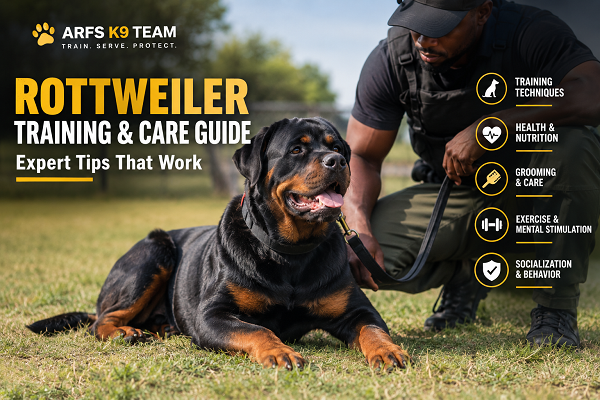
Rottweilers are highly intelligent, food- and praise-motivated working dogs that respond best to early socialization (before 16 weeks), positive reinforcement obedience training starting at 8 weeks, and a minimum of 60-90 minutes of physical and mental exercise daily. With consistent structure, most Rottweiler puppies master basic commands within 4-6 weeks and are largely house-trained by 6 months. Skipping socialization or exercise is the single biggest cause of the “stubborn” or “aggressive” Rottweiler owners complain about, the breed itself isn’t the problem.
Table of Contents
- Rottweiler Breed Overview: History, Standard & Stats
- Rottweiler Temperament: What They’re Really Like
- Puppy Training Timeline: Week-by-Week
- Core Obedience Training: Commands & Methods That Work
- Socialization: The Non-Negotiable Foundation
- Exercise & Mental Stimulation Needs
- Grooming & Daily Care
- Nutrition & Feeding Guide
- Health Issues, Life Expectancy & Real Costs
- Advanced Training: Protection Work, IGP/Schutzhund & K9 Roles
- Common Mistakes First-Time Rottweiler Owners Make
- Total Cost of Ownership
- FAQs
- Conclusion & Next Steps
Rottweiler Breed Overview: History, Standard & Stats
The Rottweiler’s story starts with the Roman army. Roman legions marching through what’s now southern Germany brought cattle-driving mastiff-type dogs along to herd livestock that fed the troops. When the Romans reached a settlement the locals later called Rottweil, those dogs stuck around, working as drover and butcher’s dogs, pulling carts loaded with meat and, according to breed lore, guarding the money pouches tied around their owners’ necks. That’s actually where the nickname “Rottweiler Metzgerhund” (Rottweil butcher’s dog) comes from.
By the late 1800s, railways had replaced cattle drives, and the breed nearly disappeared. A small group of dedicated German breeders revived it in the early 1900s, and the Allgemeiner Deutscher Rottweiler-Klub (ADRK), founded in 1921, still writes the breed standard the world works from today. The American Kennel Club recognized the Rottweiler in 1931, and the breed has held a spot in the AKC’s top 10 most popular breeds for years running.
Quick breed stats:
| Trait | Detail |
|---|---|
| Height | Males 24-27 in (61-69 cm); Females 22-25 in (56-63 cm) |
| Weight | Males 95-135 lbs (43-61 kg); Females 80-100 lbs (36-45 kg) |
| Life expectancy | 8-10 years on average |
| Coat | Short, dense double coat, black with rust/mahogany markings |
| Group | Working Group (AKC) / Group 2 (FCI) |
| Bite force | Commonly cited around 328 PSI, among the strongest of any domestic breed |
| Trainability | High, consistently ranked in the top tier for working intelligence |
That bite force number gets thrown around a lot in clickbait articles, and I want to reframe it: it’s not a warning sign, it’s a reason training matters. A dog with that much raw power needs an owner who’s put in the obedience work so that strength is always under control, not a reason to be afraid of the breed.
Rottweiler Temperament: What They’re Really Like
Here’s the thing nobody tells you before you bring one home: a well-bred, well-raised Rottweiler is one of the calmest dogs you’ll ever live with. They’re not hyper. They’re not yappy. They’re watchful, a little aloof with strangers until they decide you’re okay, and completely devoted to their people once that bond forms.
What throws people off is the gap between the calm adult they pictured and the pushy, mouthy, testing-every-boundary adolescent they actually get between 6 and 18 months. That’s not “the breed turning aggressive.” That’s a large, smart, physically maturing dog checking whether the rules from puppyhood still apply. They almost always do, if you enforce them.
A few temperament traits worth knowing going in:
- Natural wariness of strangers. This is bred-in guarding instinct, not fear or aggression. Without socialization, it can tip into over-suspicion. With it, you get a dog that’s polite with guests and alert without being reactive.
- Strong resource guarding tendency in some lines. Not universal, but common enough that early “trade” and “drop it” work (more on that below) should start in puppyhood, not after a problem shows up.
- High “off switch” once trained. Ask any experienced handler and they’ll tell you the same thing, a tired, well-exercised, well-trained Rottweiler will happily nap under your desk for six hours straight.
- Sensitivity to tone. These dogs shut down under harsh, punishment-heavy training and light up under fair, structured, reward-based handling. Old-school “dominance” training does more harm than good with this breed.
The Rottweiler consistently shows up on lists of the world’s most capable guardian breeds, and for good reason, if you’re weighing it against other options, our breakdown of guard protection dog breeds and the rules for owning one covers how it stacks up against German Shepherds, Cane Corsos, and Boerboels.
Puppy Training Timeline: Week-by-Week
This is the part most guides gloss over. Training a Rottweiler isn’t one long undifferentiated blob of “be consistent.” It happens in stages, and each stage has a job.
| Age | Training focus | What to actually do |
|---|---|---|
| Birth-7 weeks (with breeder) | Neurological stimulation, handling, litter socialization | This is on the breeder, but ask about it before you buy, daily handling and early neurological stimulation (ENS) protocols in this window measurably affect adult temperament |
| 8-9 weeks | Home arrival, name recognition, potty routine | Set a fixed potty schedule, start crate naps, begin “sit” and “off” using food lures |
| 8-12 weeks | Early socialization sprint, basic cues | Controlled exposure to new people, surfaces, sounds; short 5-minute training sessions, 3-4x daily |
| 12-16 weeks | Puppy classes, bite inhibition, leash intro | Enroll in a puppy class as soon as your vet clears it (usually after the 2nd vaccination round); leash walking indoors first |
| 4-6 months | Impulse control, “leave it,” recall building | Teething and mouthing peak here, redirect, don’t punish; start recall in a fenced yard with high-value treats |
| 6-12 months | Adolescence, testing boundaries, distraction-proofing | Retrain “known” commands around real distractions (other dogs, food, people); this is where most owners quit, don’t |
| 12-24 months | Advanced obedience, off-leash reliability, structured “jobs” | Consider AKC Canine Good Citizen, tracking, or a formal sport, Rottweilers do best with a defined task |
A note on timing that I don’t see enough guides make clear: the 8-16 week window is doing more long-term temperament work than the entire rest of the dog’s life combined. If you only have bandwidth for one thing to get right, get that window right. The AKC’s own breed experts point to the same window, noting puppies shouldn’t leave the litter before 7 weeks specifically to protect that developmental period.
Crate training runs alongside this same timeline and is worth starting the day your puppy comes home, our K9 trainer’s guide to crate training a puppy walks through the exact routine that makes it click faster with a strong-willed breed like a Rottweiler.
Core Obedience Training: Commands & Methods That Work
Rottweilers are working dogs bred to think for themselves within a job, which means they’re smart enough to get bored fast and stubborn enough to test whether a command is actually non-negotiable. Positive reinforcement, paired with rock-solid consistency, is what actually works long term.
Foundational commands, in the order I’d teach them:
- Name recognition + eye contact — the building block for everything else
- Sit — usually the fastest command a Rottweiler puppy learns, often within a single session
- Down — takes longer; don’t force the body into position, lure with food
- Off / no jump — critical early, before the dog weighs 80+ lbs
- Leave it / drop it — non-negotiable for a breed prone to resource guarding
- Come (recall) — build this in a fenced area before ever testing it off-leash
- Heel — matters more with a strong breed than almost any other command on this list
- Place / settle — teaches the “off switch” that makes adult Rottweilers so livable
Training method notes from the field:
- Keep sessions to 5-10 minutes for puppies under 6 months, their attention span genuinely can’t handle more, and long sessions just build frustration on both ends.
- Use high-value food rewards (small pieces of chicken or cheese) for anything new, then fade to praise and petting once the behavior is solid.
- Avoid choke chains, prong corrections, or “alpha rolls” with this breed. Modern trainers and behaviorists have moved away from dominance-based methods across the board, and Rottweilers in particular tend to become more defensive, not more compliant, under harsh handling. Our piece on dominance vs. discipline in K9 training breaks down exactly why the “be the alpha” approach is outdated and what professional handlers use instead.
- End every session on a win, even if that means asking for something easy right before you stop.
Rottweilers are also textbook cases for understanding drive versus obedience in dog intelligence, a working breed with strong natural instincts still needs trained obedience layered on top, and the two aren’t the same thing.
Socialization: The Non-Negotiable Foundation
If there’s one section of this guide I’d want you to bookmark, it’s this one. Under-socialization is the root cause behind the vast majority of “aggressive Rottweiler” stories you’ll read online, not genetics, not the breed itself.
The critical socialization window closes around 16 weeks. After that, the brain is still plastic and you can absolutely keep working on it, but nothing replaces what happens (or doesn’t happen) before then.
A practical socialization checklist for the 8-16 week window:
- Meet at least 100 new people of different ages, sizes, and appearances (yes, actually count)
- Experience different surfaces, grass, gravel, tile, metal grates, wobbly boards
- Hear vacuum cleaners, thunder recordings, traffic, kids yelling, fireworks recordings (at low volume, paired with treats)
- Ride in a car for short, positive trips, not just to the vet
- Meet vaccinated, friendly adult dogs and appropriate puppies in a controlled setting
- Visit a pet-friendly store, a patio café, a friend’s house with a different layout than yours
Keep every encounter positive, short and sweet beats long and overwhelming. If your puppy shows fear, don’t force it; back off, add distance, and let them approach at their own pace with treats as encouragement.
Exercise & Mental Stimulation Needs
Rottweilers are moderate-to-high energy working dogs, and an under-exercised Rottweiler is where most “destructive” or “hyper” behavior complaints come from. Budget for:
- 60-90 minutes of physical activity daily for adult dogs, split across two or three sessions works better than one long one
- Puppies: follow the “5-minute rule”, roughly 5 minutes of structured exercise per month of age, per session, to protect growing joints (a 4-month-old gets about 20 minutes, not an hour-long hike)
- Mental work matters as much as physical work. Puzzle feeders, scent games, a 10-minute training session, or a short tracking exercise can tire a Rottweiler out faster than a jog
- Avoid high-impact jumping or long runs on hard pavement before growth plates close, typically around 12-18 months, this is one of the most overlooked contributors to early joint problems in the breed
For a deeper breakdown of what “enough exercise” actually looks like hour by hour for a working-type breed, see our guide on how often you should exercise a working dog.
Grooming & Daily Care
Good news here, Rottweilers are low-maintenance in the grooming department compared to most large breeds.
- Brushing: Once or twice a week with a rubber curry brush or short-bristle brush; more often (2-3x weekly) during seasonal shedding in spring and fall
- Bathing: Roughly once a month, or when visibly dirty, over-bathing strips natural oils and can trigger the skin allergies the breed is somewhat prone to
- Nail trims: Weekly for puppies, every 2-3 weeks for adults; start early because a strong-willed 100-lb adult who hates nail trims is a genuine handling challenge
- Ears: Check weekly for wax buildup or odor, especially if your dog swims often
- Teeth: Brush 2-3 times a week; dental disease is common in large breeds and cheaper to prevent than treat
If you want the full routine, from first bath to nail-trim desensitization, our essential grooming tips for a healthy puppy guide covers the habits worth building in the first year.
Nutrition & Feeding Guide
Rottweilers are prone to rapid growth as puppies, which is directly linked to their elevated risk of hip and elbow dysplasia, so feeding right matters more than with many breeds.
- Puppies: Feed a large-breed-specific puppy formula with controlled calcium and calorie density; large-breed formulas are engineered to slow growth rate slightly, which protects developing joints
- Adults: 2 meals a day (not one large meal), splitting meals is one of the recommended precautions against bloat, discussed more below
- Portion by body condition, not just the bag chart. You should be able to feel (not necessarily see) ribs with light pressure
- Avoid exercise for 60-90 minutes before and after meals, again, a bloat precaution given the breed’s deep chest
Health Issues, Life Expectancy & Real Costs
Rottweilers typically live 8-10 years. Like most large, deep-chested breeds, they carry a higher-than-average risk for a specific set of conditions. Knowing them ahead of time and what treatment realistically costs helps you plan rather than panic.
| Condition | What it is | Typical treatment cost (USD) |
|---|---|---|
| Hip dysplasia | Malformed hip joint causing arthritis and pain | $4,000-$6,000 (surgical) |
| Elbow dysplasia | Similar joint malformation in the elbow | $3,000-$6,000 |
| Gastric dilatation-volvulus (bloat) | Stomach fills with gas and twists, a true emergency | $1,500-$7,500 |
| Osteosarcoma (bone cancer) | Rottweilers have one of the highest breed-specific rates of this cancer | $5,000-$20,000 |
| Aortic/subaortic stenosis | Congenital narrowing of the aortic valve | $3,000-$6,000 |
| Osteoarthritis | Progressive joint degeneration, often secondary to dysplasia | $2,000-$4,000 |
What you can actually do about it:
- Buy from a breeder who provides OFA or PennHIP hip/elbow certifications and cardiac clearance for both parents, this is the single biggest lever you have
- Keep your dog lean; excess weight is the number one modifiable risk factor for both joint disease and shortened lifespan
- Learn the bloat warning signs cold: a distended, hard abdomen, unproductive retching, restlessness, and drooling. This is a “drive to the emergency vet right now” situation, not a “wait and see” one
- Ask your vet about baseline bloodwork and imaging starting around age 5-6, since Rottweilers’ elevated cancer risk means earlier screening catches more
- Consider pet insurance before age 2, while your dog is still healthy, premiums are lower and pre-existing condition exclusions won’t have kicked in yet
Advanced Training: Protection Work, IGP/Schutzhund & K9 Roles
This is where the Rottweiler’s working heritage really shows. Once basic obedience is rock solid, usually not before 12-18 months of age and physical maturity, many owners and handlers move into structured working disciplines:
- IGP (formerly Schutzhund/SchH): A three-phase sport testing tracking, obedience, and protection work, governed internationally by the WUSV and, in the US, by clubs affiliated with the USRC (United Schutzhund Clubs of America) and DVG America. This is not “aggression training”, it’s some of the most structured, control-focused work a dog can do, and poorly-suited dogs are screened out early
- AKC Canine Good Citizen (CGC): A great, accessible first title for any Rottweiler owner, testing manners and temperament in real-world scenarios
- Tracking and scent work: Rottweilers have a strong nose and take naturally to AKC Tracking or Scent Work titles
- K9 and service roles: While German Shepherds and Malinois dominate modern police K9 units, Rottweilers have a documented history in European and American police work, particularly in patrol and detection roles, thanks to their size, confidence, and trainability
- Weight pull and carting: A nod to the breed’s original cart-pulling job, and a genuinely fun outlet for a dog that likes having a job to do
If you’re building toward protection or working-dog training specifically, that’s specialized work best done with a certified club or decoy-trained instructor, not solo, and not with generic online tutorials. The stakes (and liability) are simply too high to DIY.
If you’re serious about developing your Rottweiler’s working potential, I put together a deeper, step-by-step training resource for handlers who want to go beyond basic obedience, you can check it out here.
Common Mistakes First-Time Rottweiler Owners Make
After years around this breed, the same handful of mistakes show up again and again:
- Skipping puppy class because “I’ve trained dogs before.” Rottweiler-specific handling, their size trajectory, their sensitivity to correction, their guarding instincts, benefits from breed-aware instruction
- Under-socializing out of over-caution. Some new owners hold their puppy back from the world out of fear of “creating a guard dog.” The opposite happens, isolation is what creates the wary, reactive adult
- Letting puppy jumping slide because it’s “cute.” A 15-lb puppy jumping up is cute. The same behavior at 100 lbs is a liability. Correct it from day one
- Over-exercising young puppies. Long runs and repeated stair use before growth plates close is a leading contributor to joint problems that show up years later
- Inconsistent household rules. If one family member allows the dog on the couch and another doesn’t, the dog isn’t confused, it’s just going to test whichever human is around
- Waiting for a “problem” before starting training. By the time resource guarding or leash reactivity shows up as a visible issue, you’re managing an established pattern instead of preventing one
Total Cost of Ownership
Budgeting realistically avoids a lot of heartbreak later. Here’s a rough first-year and annual breakdown (figures in USD, will vary by region):
First year:
- Puppy purchase price (reputable breeder): $1,500-$3,500
- Initial vet visits, vaccines, spay/neuter: $500-$1,000
- Puppy class + basic obedience training: $150-$400
- Crate, leash, bowls, initial supplies: $200-$400
- Food (large-breed puppy formula): $500-$700
Ongoing annual costs (adult dog):
- Food: $600-$900
- Routine vet care: $300-$600
- Pet insurance (recommended): $400-$700
- Grooming supplies, flea/tick/heartworm prevention: $300-$500
Add emergency and breed-specific health costs from the table above, and it’s fair to budget for the Rottweiler being a genuinely significant financial commitment over its 8-10 year lifespan, this is a big part of why pet insurance taken out early is worth serious consideration.
Trainer’s Notes: Why This Guide Is Different
Most Rottweiler articles you’ll find recycle the same five facts, Roman origin, loyal temperament, needs training, without ever getting into the mechanics of when to do what, what things actually cost, or what a real training timeline looks like week by week. This guide pulls from AKC breed-expert interviews, veterinary orthopedic and oncology data on breed-specific risk, ADRK/FCI breed standard figures, and working-dog sport organizations (WUSV, USRC, DVG America) rather than generic pet-blog summaries, because a breed this powerful deserves more than surface-level advice.
FAQs
1. At what age should I start training my Rottweiler puppy?
Right away, as soon as your puppy comes home at 8 weeks. Basic cues like sit and name recognition can start immediately; formal puppy classes typically start around 10-12 weeks once your vet clears socialization based on the vaccination schedule.
2. Are Rottweilers naturally aggressive?
No. Well-bred, properly socialized Rottweilers are confident and watchful, not aggressive. Reactivity or aggression in the breed is almost always linked to poor socialization, lack of training, or, less commonly, poor breeding, not an inherent breed trait.
3. How much exercise does an adult Rottweiler need daily?
Plan for 60-90 minutes of physical activity split across the day, combined with mental stimulation like training sessions or puzzle toys. Under-exercised Rottweilers are far more likely to develop destructive or pushy behavior.
4. What is the average lifespan of a Rottweiler, and what should I watch for?
Rottweilers typically live 8-10 years. Watch for hip/elbow dysplasia symptoms (difficulty rising, reluctance to jump), and know the bloat warning signs (distended abdomen, unproductive retching) as an emergency requiring immediate vet care.
5. Do Rottweilers make good family dogs with children?
Yes, when properly socialized and supervised. Rottweilers tend to be gentle and protective with children in their own family, though any large, powerful breed should always be supervised around young kids, and early socialization with children specifically makes a measurable difference.
Conclusion & Next Steps
A Rottweiler is one of the most rewarding dogs you can bring into your life, loyal, intelligent, and genuinely fun to train once you understand how they think. But that reward is directly proportional to the work you put in during the first 18 months: early socialization before 16 weeks, consistent positive-reinforcement obedience work, breed-appropriate exercise, and honest awareness of the health risks that come with the package.
If you’re just starting out, your action list is simple: lock in socialization now if your puppy is under 16 weeks, enroll in a puppy class if you haven’t, start a fixed feeding and exercise routine, and find a vet who knows large-breed orthopedic and cardiac screening. Do those four things consistently, and the “problem” Rottweiler you’re worried about becomes the calm, devoted companion the breed is capable of being.

Her work centers on applied training across obedience, detection, protection, and operational readiness, with a strong focus on Military Working Dogs (MWDs) and security K9 programs. Rather than relying on theory alone, Rofiat emphasizes proven training methods built on repetition, consistency, and real-world conditioning principles that prepare both dogs and handlers for high-pressure tasks.
Through articles, training content, and documentaries, she shares experience-based insights from the field, highlighting how structured training, clear communication, and trust between handler and dog directly impact performance and reliability.
Drawing from years of frontline experience, she is also the author of “Beyond the Bark: Inside a Pro Handler’s Playbook for Raising the Ideal Dog,” a practical guide designed to help dog owners and handlers apply professional training principles in everyday situations.
She remains committed to responsible K9 development, continuous skill refinement, and practical education for handlers, trainers, and dog professionals.
- How Many Teeth Do Dogs Have? Puppy vs Adult Chart - September 22, 2026
- What Colors Do Dogs See? (Dog Vision Spectrum) - September 22, 2026
- Is Cinnamon Bad for Dogs? Safe Dosage by Weight - September 21, 2026