What Colors Do Dogs See? (Dog Vision Spectrum)
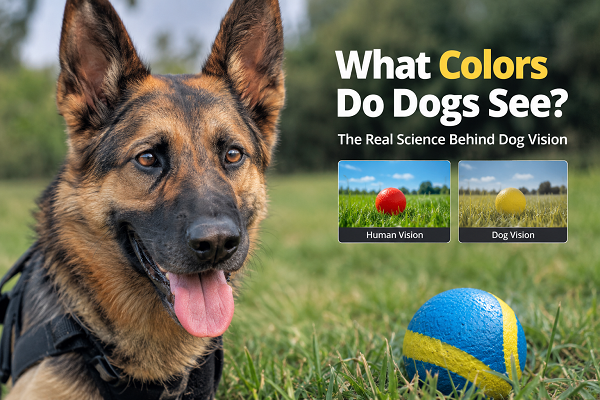
Dogs see a world of blues, yellows, and grays. Their eyes have only two types of color-sensing cones (dichromatic vision), compared to our three, so they can’t tell reds, oranges, and greens apart the way we do. Red objects usually look dark brown or gray to a dog, while blue and yellow stand out sharply. It’s nothing like the old “black and white TV” myth, it’s closer to how a person with red-green color blindness sees the world.
Table of Contents
- The Black-and-White Myth: Where It Came From
- How a Dog’s Eye Actually Works
- What Colors Can Dogs See?
- Dog Vision vs. Human Vision: The Real Comparison
- Does Color Vision Differ by Breed?
- Why This Matters for Training and Working Dogs
- Choosing Dog-Friendly Colors: Toys, Gear, and Equipment
- Trainer’s Notes: What I’ve Seen in the Field
- FAQs About Dog Color Vision
- Conclusion
Introduction
If you’ve ever thrown a red ball across a green lawn and watched your dog completely lose it for a few seconds, you’ve actually witnessed dog color vision in action. That’s not a clumsy dog. That’s a dog whose eyes physically can’t separate red from the grass around it.
I’ve spent years working with security and detection dogs, and honestly, understanding canine vision changed how I pick training gear, agility equipment, and even the collars I recommend to handlers. It’s one of those small details that makes a real difference in training speed and safety and most pet owners have no idea it matters this much.
In this guide, we’re going to cover exactly what dogs can and can’t see, the eye science behind it, how it compares to human and other-animal vision, and because I train working dogs for a living, practical, real-world advice on choosing colors that your dog can actually see clearly.
The Black-and-White Myth: Where It Came From
For most of the 20th century, almost everyone, vets included, believed dogs saw the world in pure black, white, and gray, like an old film reel. That idea took hold largely because of an influential 1942 book by optometrist Gordon Walls, which claimed dogs had little to no functional color vision. It got repeated in textbooks, pet care columns, and vet offices for decades, and nobody actually tested it properly.
That changed in 1989. Ophthalmologist Jay Neitz, then at UC Santa Barbara and now running the Neitz Color Vision Lab at the University of Washington, ran the first real behavioral color-discrimination experiments on dogs. He and his team trained dogs to pick out colored panels for a reward, then swapped in different shades and brightness levels to rule out the possibility the dogs were just judging light versus dark. The result: dogs clearly could tell colors apart, just not the same colors humans do.
So the myth is dead, but a softer version of it survives: the idea that dogs see everything “washed out” or barely colored at all. That’s also not accurate. Dogs see real color, it’s just a narrower slice of the spectrum than ours.
How a Dog’s Eye Actually Works
Cone Cells and Color Vision
Color vision comes down to cone cells in the retina, the cells that respond to different wavelengths of light. Humans are trichromatic, meaning we have three cone types, roughly tuned to red, green, and blue wavelengths. That combination is what lets you tell a ripe tomato from an unripe one, or spot a orange traffic cone from fifty feet away.
Dogs are dichromatic. They have only two cone types, with peak sensitivity around 429 nanometers (blue-violet) and 555 nanometers (yellow-green), according to Neitz’s original spectral measurements. That’s the whole toolkit. There’s no third cone tuned to the red end of the spectrum, so any color that depends on “red” input, reds, oranges, and most greens, gets compressed into shades of brown, dull yellow, or gray.
It’s genuinely comparable to red-green color blindness in humans (deuteranopia/protanopia), which affects roughly 1 in 12 men worldwide. If you know someone with that kind of color blindness, you already have a decent mental model of dog vision.
Rods, Night Vision, and the Trade-Off
Here’s the part most color-vision articles skip entirely: dogs didn’t lose that third cone type for no reason. Their retinas are packed with far more rod cells, the cells responsible for low-light and motion detection, relative to cones than ours are. Rods don’t detect color; they detect brightness and movement.
Dogs also have a reflective layer behind the retina called the tapetum lucidum (it’s why your dog’s eyes glow green or gold in photos and headlights). It bounces light back through the retina a second time, giving photoreceptors another chance to catch it. That’s a major night-vision upgrade, dogs generally see far better than humans in dim light, but it comes at the cost of some visual sharpness during the day.
So the evolutionary trade-off is simple: dogs’ ancestors needed to hunt at dawn, dusk, and in low light far more than they needed to distinguish a red berry from a green leaf. Their eyes evolved accordingly, and that’s the vision system every domestic dog has inherited.
What Colors Can Dogs See?
Based on Neitz’s research and later confirmed by follow-up studies (including work by Marcello Siniscalchi’s team in 2017), here’s the breakdown:
- Blue – Seen clearly and vividly. This is one of the strongest, most distinct colors in a dog’s world.
- Yellow – Also seen clearly. Yellow and blue are the two anchor colors of canine vision.
- Violet/Blue-violet – Perceived as a shade of blue.
- Grays and blacks/whites – Dogs distinguish brightness and contrast extremely well, even though they don’t add color to it.
- Red – Not perceived as red. It typically reads as a dark brownish-gray or dull black.
- Orange – Blends toward a muddy yellow or brown, similar to red.
- Green – Also shifts toward a yellowish or grayish tone, which is exactly why a red or orange ball on green grass is so hard for a dog to spot by color alone (they’re relying on brightness contrast and movement instead).
- Purple – Since purple depends on red input, dogs likely see it as another shade of blue.
Featured Snippet Answer: Dogs see mainly in blue, yellow, and shades of gray. Because their eyes lack a red-detecting cone, colors like red, orange, and green appear as muted browns, dull yellows, or grays rather than the vivid hues humans see.
One interesting side note from Neitz’s interviews: he pointed out that dogs can sometimes still tell red and green apart indirectly, because red objects tend to reflect slightly less light than green ones. So a dog might correctly guess an apple is red versus green, not because it “sees red,” but because it’s reading a subtle brightness cue. Clever, but it’s a workaround, not color vision.
Dog Vision vs. Human Vision: The Real Comparison
Color is only one piece of the puzzle. Here’s how canine and human vision actually stack up across the board:
| Feature | Dogs | Humans |
|---|---|---|
| Cone types | 2 (dichromatic) | 3 (trichromatic) |
| Visual acuity | Roughly 20/50 to 20/75 (nearsighted) | 20/20 baseline |
| Field of view | ~250–270° (breed-dependent) | ~180–190° |
| Motion detection | Excellent, can spot movement humans miss | Good, but less sensitive |
| Flicker sensitivity | Higher; can perceive faster flicker rates than us | Lower, old CRT TVs looked “smooth” to us but flickery to dogs |
| Night vision | Superior, thanks to tapetum lucidum and rod-dense retinas | Weaker in low light |
| Depth perception | Reduced in some breeds due to eye placement | Strong, forward-facing binocular vision |
A 2013 study out of the University of Wisconsin (using whippets, pugs, and a Shetland sheepdog) measured canine visual acuity at roughly 20/50 in good lighting, meaning a dog has to stand 20 feet from an object to see it as clearly as a human standing 50 feet away. Some researchers put average acuity closer to 20/75. Either way: dogs are nearsighted by human standards, but that blur is offset by outstanding motion detection and peripheral vision, especially in breeds with eyes set more to the sides of the head.
This is also why dogs are so good at catching a frisbee mid-flight even when they can’t clearly make out its color, they’re locked onto movement and contrast, not hue.
Does Color Vision Differ by Breed?
The two-cone, blue-yellow system is consistent across all dog breeds, a Chihuahua and a Great Dane process color the exact same way. What does differ by breed and skull shape is visual acuity, field of view, and depth perception:
- Sighthounds (Greyhounds, Salukis, Whippets) have a wide “visual streak” across the retina instead of a concentrated focal point, giving them an almost panoramic view built for spotting movement at a distance, ideal for chasing fast-moving prey.
- Brachycephalic breeds (Pugs, Bulldogs, Boxers) tend to have a more human-like “area centralis” (a focused vision zone), narrower peripheral vision, and reduced depth perception because their eyes sit more forward and close together.
- Working and herding breeds (German Shepherds, Belgian Malinois, Border Collies) sit somewhere in between, a good mix of peripheral awareness and enough central focus to track a handler’s hand signals or a moving target.
None of this changes what colors they see. It changes how sharply and how widely they see it.
Why This Matters for Training and Working Dogs
This is where color vision stops being trivia and starts affecting real training decisions, something a lot of the generic pet-blog articles on this topic never touch.
1. Equipment visibility affects response time. A dog reacts faster to a hand signal, target, or toy it can actually distinguish from the background. Red targets on green grass or brown dirt are nearly invisible by color to a dog, it’s relying entirely on movement and shape, which slows reaction time in fast-paced obedience or agility work.
2. Detection and tracking work leans on contrast, not color. Detection dogs (narcotics, explosives, search and rescue) aren’t picking targets by color at all, they’re working on scent. But the visual markers handlers use in the field (marker flags, target boxes, agitation sleeves) are far more effective in blue or yellow than in red.
3. Hand signals and visual cues need to pop. If you’re building a visual command system alongside verbal cues, something I always recommend for protection and security dogs, since a dog can’t hear you across a large property, blue and yellow gear (vests, sleeves, target discs) will register faster and more consistently than red or orange. If you want a full breakdown of building solid visual and verbal commands together, our guide on essential protection dog commands walks through exactly how we layer both.
4. Agility and obstacle courses. Poles, tunnels, and jump bars in high-contrast blue/yellow combinations are easier for a dog to judge distance and speed against than red-and-white striping, which tends to blend into a flat gray blur at speed.
If you’re setting up training gear at home, our DIY dog agility equipment guide is a good next read, I’d lean toward blue or yellow paint on any poles or markers if you’re building your own.
Choosing Dog-Friendly Colors: Toys, Gear, and Equipment
Here’s the practical checklist I give handlers and pet owners once they understand dichromatic vision:
- Best colors for toys and training aids: Blue and yellow, hands down. A yellow tennis ball or blue frisbee will stand out against grass, dirt, snow, and pavement far better than red or green ones.
- Worst colors for outdoor visibility: Red and orange on green grass, and green on green grass, both collapse into similar muted tones for your dog.
- Collars and leashes: Color matters less here since your dog isn’t relying on seeing its own gear, but if you want a leash that’s easy for you to spot your dog wearing at a distance (useful for recall training in open fields), bright blue or yellow works for both of you.
- Target training discs and clickers: Use blue or yellow discs for visual target training, dogs pick these up noticeably faster than red ones in my experience running target drills.
- Tactical and working gear: For structured harnesses, vests, and leads that need to hold up under real working conditions (not just visibility), our tactical K9 harness guide covers what handlers actually check before buying, and our roundup of tactical K9 gear for working dogs is worth a look if you’re building out a full kit.
- Training collars: If color is a factor for you when picking training tools, our dog training collar guide breaks down types and options for stubborn or high-drive dogs.
Quick tip: if your dog constantly “loses” a toy in the grass, it’s rarely a smell or hearing issue, try swapping a red or green toy for a blue or yellow one first. It’s the cheapest training fix I know.
Trainer’s Notes: What I’ve Seen in the Field
I run ARFS K9 Team, working hands-on with security and military working dogs, and color vision is one of those things you learn to respect the hard way. Years back, I watched a handler run repeated failed recalls with a red training dummy across a soccer pitch, the dog kept overshooting and circling before locking on. Swap that same dummy for a bright yellow one, and the dog picked it up almost instantly, even at 40+ meters. Nothing about the dog’s nose, hearing, or obedience changed. Only the color did.
That single change is now baked into how I set up detection and obedience drills, target markers, agitation equipment, and remote training aids all get chosen with blue/yellow visibility in mind, not just durability. It’s a small detail, but over hundreds of training hours, it adds up to real time saved and fewer frustrated dogs (and handlers).
If you want the deeper training philosophy behind how we build obedience, drive, and control in working dogs, including how sensory science like this shapes real sessions, I cover a lot of it in my e-book, Beyond the Bark. It’s written from real fieldwork, not textbook theory. For a broader look at how professional programs structure this kind of training from day one, see our piece on how military working dogs are trained.
FAQs About Dog Color Vision
1. Are dogs completely color blind?
No. That’s an outdated myth traced back to a 1942 book that claimed dogs had almost no color vision. Research from 1989 onward, led by Jay Neitz, confirmed dogs see color, just a narrower range limited to blues, yellows, and grays.
2. What color can dogs see best?
Dogs see blue and yellow most clearly and vividly. These two colors sit right in the range their two cone types can process, which is why most dog toys, target discs, and agility equipment are made in these shades.
3. Can dogs see red?
Not as red. Because dogs lack a red-sensitive cone, red objects typically appear as a dark brown, dull gray, or muted black to them, similar to how a person with red-green color blindness perceives red.
4. Why do dogs struggle to find red toys in grass?
Red and green both compress into similar muted tones in dog vision, so a red ball on green grass has very low color contrast for your dog. They end up relying on movement, scent, and brightness differences instead of color to locate it, which is slower.
5. Do all dog breeds see color the same way?
Yes, every breed shares the same dichromatic, blue-yellow cone system. What differs between breeds is visual acuity, field of view, and depth perception, not the actual colors they can detect.
Conclusion
Dogs aren’t seeing a black-and-white world, and they’re not seeing our world either, they’re seeing their own version of it, built around blue, yellow, and a wide range of grays, with red and green fading into muted browns. It comes down to having two color-sensing cones instead of three, backed up by a retina built for motion and low-light performance instead of a wide color range.
For everyday dog owners, the takeaway is simple: pick blue and yellow toys and gear if you want your dog to find and track them faster. For handlers and trainers working detection, protection, or agility dogs, it’s worth going a step further, auditing your target markers, training aids, and visual cue equipment for color visibility, not just durability. It’s a small adjustment that consistently speeds up training and cuts down on frustration for both ends of the leash.
If you’re building out a full training or equipment setup with this in mind, our training and handling library has more field-tested guides, and Beyond the Bark is there if you want the full framework behind how we train working dogs from the ground up.

Her work centers on applied training across obedience, detection, protection, and operational readiness, with a strong focus on Military Working Dogs (MWDs) and security K9 programs. Rather than relying on theory alone, Rofiat emphasizes proven training methods built on repetition, consistency, and real-world conditioning principles that prepare both dogs and handlers for high-pressure tasks.
Through articles, training content, and documentaries, she shares experience-based insights from the field, highlighting how structured training, clear communication, and trust between handler and dog directly impact performance and reliability.
Drawing from years of frontline experience, she is also the author of “Beyond the Bark: Inside a Pro Handler’s Playbook for Raising the Ideal Dog,” a practical guide designed to help dog owners and handlers apply professional training principles in everyday situations.
She remains committed to responsible K9 development, continuous skill refinement, and practical education for handlers, trainers, and dog professionals.
- How Many Teeth Do Dogs Have? Puppy vs Adult Chart - September 22, 2026
- What Colors Do Dogs See? (Dog Vision Spectrum) - September 22, 2026
- Is Cinnamon Bad for Dogs? Safe Dosage by Weight - September 21, 2026