How to Choose a Dog Therapist in Nigeria
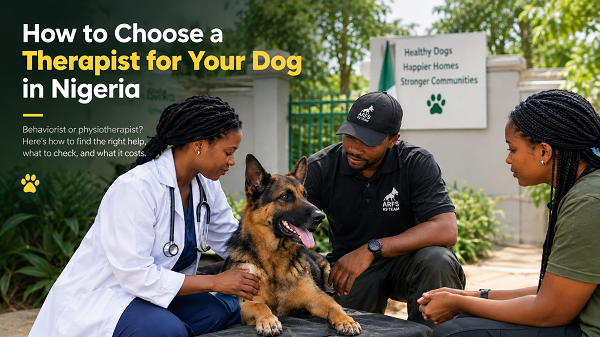
To choose the right dog therapist in Nigeria, first figure out whether your dog needs a canine behaviorist (for aggression, anxiety, or fear-based issues) or a veterinary physiotherapist (for injury, surgery recovery, or mobility problems). Get a referral from a Veterinary Council of Nigeria (VCN)-registered vet first, ask for real case examples, avoid anyone who guarantees results in one session, and expect to pay anywhere from ₦15,000 to ₦80,000+ per session depending on the city and specialty.
Table of Contents
- The Problem: “Dog Therapist” Means Different Things
- Behaviorist or Physiotherapist? Know Which One You Need
- Why This Is Trickier in Nigeria Than in the US or UK
- 7 Steps to Actually Vetting a Dog Therapist
- What a Real Session Looks Like (and What It Costs in Naira)
- Red Flags That Should Make You Walk Away
- Where to Actually Find One: Lagos, Abuja, Port Harcourt & Beyond
- What to Do While You’re Still Searching
- Trainer’s Note: Why I’m Qualified to Write This
- FAQs
- Final Thoughts + Action Checklist
Introduction
Here’s a scenario I run into a lot: someone messages me because their dog just had a bad reaction to a visitor, or their German Shepherd is limping after a fall, and they ask the same question, “Where can I find a dog therapist near me?”
Then they Google it. And they get nothing useful. Maybe a random Instagram page. Maybe a “dog trainer” who says they “do everything.” Maybe nothing at all in their city.
That’s the real problem with finding a dog therapist in Nigeria, it’s not that the help doesn’t exist, it’s that nobody’s told you how to actually find and check it. Most of the guides you’ll find online are written for the US or UK, where there are national certification boards, searchable directories, and decades of an established profession. Nigeria doesn’t have that yet, and pretending otherwise doesn’t help you.
So in this guide, I’m going to walk you through exactly how to figure out what kind of help your dog needs, how to check if someone is actually qualified (even without a fancy directory to search), what it should realistically cost you, and where people in Lagos, Abuja, Port Harcourt, and Ibadan are actually finding legitimate help right now. No fluff, no recycled checklist you’ve already seen ten times.
Behaviorist or Physiotherapist? Know Which One You Need
This is where almost every article on this topic, including the top-ranking ones, falls short. They lump “dog therapist” into one category and give generic advice. But in practice, you’re usually looking for one of two very different professionals.
Canine Behaviorist (Behavior Modification)
You need a behaviorist if your dog is dealing with:
- Aggression toward people, other dogs, or specific triggers
- Separation anxiety (destroying furniture, non-stop barking, self-harm when left alone)
- Fear or phobias (thunderstorms, generators, strangers, car rides)
- Resource guarding (growling over food, toys, or space)
- Compulsive behaviors (tail chasing, excessive licking, pacing)
A behaviorist works on the “why” behind the behavior, not just obedience commands. If your dog already sits, stays, and heels perfectly but still bites the gateman every time he opens the gate, obedience training alone won’t fix that, you need behavior modification.
Veterinary Physiotherapist (Physical Rehabilitation)
You need a physiotherapist if your dog is recovering from:
- Surgery (cruciate ligament repair, fracture fixation, spinal surgery)
- Hip or elbow dysplasia
- Arthritis or age-related mobility loss
- A soft tissue injury, strain, or sprain
- Neurological issues affecting movement (like IVDD)
This is hands-on physical work, massage, guided exercises, sometimes hydrotherapy or laser therapy, done in coordination with a vet, not instead of one.
Quick self-check: If the issue is in your dog’s head (fear, reactivity, anxiety), you want a behaviorist. If it’s in the body (limping, stiffness, post-op recovery), you want a physiotherapist. Some dogs genuinely need both, a dog recovering from a traumatic injury can develop fear-based behaviors around the vet or around movement, and that’s where the two fields actually overlap.
If your issue is more about basic manners, leash pulling, or teaching commands rather than a deep-rooted behavioral or physical problem, you probably just need a qualified dog trainer instead, not a therapist. Don’t overpay for behavior modification services when a solid obedience program would solve it.
Why This Is Trickier in Nigeria Than in the US or UK
I want to be upfront about something most articles won’t tell you: in Nigeria, the terms “dog behaviorist,” “canine therapist,” and even “trainer” are not legally protected. Anyone can print a business card that says “Certified Dog Behaviorist” without having a single credential to back it up.
Compare that to what exists elsewhere:
- In the US, credentials like CDBC (Certified Dog Behavior Consultant) come from the IAABC, and the title “veterinary behaviorist” requires board certification through the American College of Veterinary Behaviorists (ACVB), a process that typically takes years of residency after veterinary school.
- In the UK, the Certified Clinical Animal Behaviourist (CCAB) designation, run through the Association for the Study of Animal Behaviour, requires a relevant degree plus supervised practical hours.
Nigeria doesn’t have an equivalent body specifically for dog behavior. What we do have is real, and it matters:
- The Veterinary Council of Nigeria (VCN) registers and licenses veterinary surgeons under the Veterinary Surgeons Act (Cap V3, LFN 2004). Any vet doing physical rehab work on your dog should be VCN-registered, you can verify this directly through them.
- The Nigerian Veterinary Medical Association (NVMA), the professional umbrella body for registered vets (incorporated with the Corporate Affairs Commission in 1996), is affiliated with the World Veterinary Association.
So here’s the practical takeaway: for physical rehabilitation, insist on VCN registration, no exceptions, because this involves your dog’s medical recovery. For behavior work, since there’s no local licensing board yet, you’re relying more heavily on international certifications (IAABC, CCAB, CPDT-KA with behavior specialization), verifiable case history, and a vet referral. That’s simply the reality of the current landscape, and any guide that tells you to “just check their license” without explaining this gap is leaving out the most important part.
7 Steps to Actually Vetting a Dog Therapist
1. Start with your vet, not Google
Ask your regular veterinarian for a referral first. Vets in Lagos, Abuja, and Ibadan increasingly work alongside behaviorists and physio-trained professionals, and a referral from someone who’s seen the results firsthand is worth more than five-star reviews you can’t verify.
2. Ask for their actual credentials and check them
Don’t accept “I’ve been doing this for years” as an answer. Ask specifically:
- What certification do they hold, and from which organization?
- Are they VCN-registered (for anything involving physical treatment)?
- Have they done continuing education in the last 2 years?
If they hesitate or get defensive, that’s your answer.
3. Ask about their training methods
This one trips up a lot of Nigerian dog owners. Some “behaviorists” here are really just trainers using heavy-handed, punishment-based corrections and calling it “discipline.” Ask directly: do they use force-free, positive reinforcement-based methods, or do they rely on choke chains, prong collars, or e-collars as a first resort? A qualified behaviorist should be able to explain their method without dodging the question.
4. Request references or case examples
A legitimate professional will happily connect you with 2-3 past clients or walk you through a case similar to yours (without breaking anyone’s privacy). If they can’t produce a single example, be cautious.
5. Do a phone or video consult first
Most reputable behaviorists and physiotherapists offer an initial consultation before committing to a full program. Use this call to gauge how they communicate, do they listen to your description of the problem, or do they jump straight to a diagnosis before even meeting your dog?
6. Confirm they’ll coordinate with your vet
For physical rehab especially, this is non-negotiable. By international standard of practice, physiotherapy on an animal should happen with veterinary sign-off, especially post-surgery. If someone offers to start “treatment” without ever talking to your vet, that’s a red flag.
7. Get the full cost and timeline upfront
Ask exactly how many sessions they expect the program to take, and get a total cost estimate, not just a per-session price. Behavior modification programs typically run 4-12 weeks of consistent work; physical rehab timelines depend heavily on the injury (a cruciate ligament recovery, for example, commonly runs 12-16 weeks even with excellent rehab support).
What a Real Session Looks Like (and What It Costs in Naira)
Pricing in Nigeria varies a lot by city and by whether you’re working with an independent K9 professional or going through a veterinary hospital. Based on current market rates across Lagos, Abuja, and Port Harcourt:
| Service | Typical Session Length | Estimated Cost Range (₦) |
|---|---|---|
| Initial behavior consultation | 60-90 minutes | ₦15,000 – ₦35,000 |
| Follow-up behavior session | 45-60 minutes | ₦10,000 – ₦25,000 |
| Veterinary physiotherapy session | 30-45 minutes | ₦12,000 – ₦40,000 |
| Home-visit behavior/training package (4-6 weeks) | Varies | ₦80,000 – ₦250,000+ |
| Full post-surgery rehab program | 8-16 weeks | ₦150,000 – ₦500,000+ |
(Ranges reflect what independent K9 handlers and vet-affiliated professionals in major Nigerian cities are currently charging as of 2026. Always confirm current pricing directly, since costs shift with inflation and location.)
A first session, whether behavior or physical, should always start with an assessment, not treatment. Expect the professional to ask detailed questions about your dog’s history, watch your dog’s body language, and in physio cases, physically examine gait and range of motion before recommending anything. If someone starts “treating” on day one without an assessment, that’s a shortcut you shouldn’t accept.
Red Flags That Should Make You Walk Away
- Guarantees of a fixed outcome (“Your dog will stop biting in one session”), no ethical professional promises this, because behavior change depends on consistency from you, not magic from them.
- Refusal to explain their methods or vague answers about “special techniques.”
- No willingness to talk to your vet, especially for physical cases.
- Heavy reliance on punishment tools as a first-line approach rather than a last resort under supervision.
- Pressure to pay for a long package upfront before you’ve even had one session to see if it’s a good fit.
- No online presence or verifiable track record at all, a total blank slate should make you dig deeper before committing.
Where to Actually Find One: Lagos, Abuja, Port Harcourt & Beyond
Since Nigeria doesn’t have a centralized searchable directory (yet), here’s where owners are realistically finding legitimate help:
- Veterinary teaching hospitals — the Veterinary Teaching Hospital at the University of Ibadan, the Zaria Veterinary Teaching Hospital at Ahmadu Bello University, and the teaching hospital at the Federal University of Agriculture, Abeokuta (FUNAAB) all handle companion animal cases and can refer you to rehab-trained staff or point you toward legitimate practitioners.
- NVMA state chapters — the Lagos State chapter and others can sometimes point you to VCN-registered vets who also offer rehab services.
- Established K9/security dog training organizations — many teams that train working and protection dogs also handle behavior modification cases, since aggression and fear issues overlap heavily with the skills used in professional K9 work.
- Expat and pet-owner community groups on Facebook and WhatsApp — genuinely useful for word-of-mouth referrals in Lagos and Abuja, where a lot of good practitioners rely on reputation rather than advertising.
- International tele-consultation — for behavior cases specifically (not physical rehab, which needs hands-on assessment), some Nigerian dog owners now consult IAABC or CCAB-certified behaviorists abroad via video call, then implement the plan locally with an in-person trainer’s support. This hybrid approach has become more common since 2023 as remote consulting tools improved.
If your dog’s issue involves guarding, territorial aggression, or bite risk around your home or family, this also crosses into personal safety territory, it’s worth reading how to recognize warning signs before a dog bite happens so you know what you’re dealing with while you search for professional help.
What to Do While You’re Still Searching
Finding the right professional can take a few weeks, especially outside Lagos and Abuja. In the meantime:
- Manage the environment, don’t just wait it out. If your dog reacts to visitors, use a leash or a separate room during arrivals instead of hoping it goes better next time.
- Avoid triggering the behavior repeatedly. Every repetition without intervention can reinforce the pattern.
- Keep a simple log. Note the date, what happened right before the incident, and how your dog reacted. This becomes incredibly useful for whoever you eventually work with.
- Don’t skip basic structure. Reinforcing crate training and consistent daily routines gives an anxious or reactive dog a sense of predictability, which helps regardless of what deeper work comes next.
- Rule out pain first. A surprising number of “behavior” problems, sudden aggression, reluctance to be touched, irritability, actually trace back to undiagnosed physical pain. A vet check should always happen before assuming it’s purely behavioral.
Trainer’s Note: Why I’m Qualified to Write This
I work hands-on with working and security dogs, including dogs that have gone through real behavior modification programs after aggression or fear-based incidents. I’ve also sat in on physical rehab sessions with dogs recovering from field injuries. This guide comes from what I’ve actually seen work and what I’ve seen go wrong, helping Nigerian dog owners navigate a system that doesn’t yet have the same structure as the US or UK. If you want a deeper, structured breakdown of behavior work and handler psychology, I cover a lot of this in more depth in my e-book, Beyond the Bark.
FAQs
1. Is there a licensing board for dog behaviorists in Nigeria?
No, not specifically for dog behavior. The Veterinary Council of Nigeria (VCN) licenses veterinary surgeons, and any physical rehabilitation work should be done by a VCN-registered vet or someone working under one. For pure behavior work, there’s currently no equivalent local board, so international certifications and a vet referral are your best verification tools.
2. How much does a dog behaviorist cost in Nigeria?
Expect roughly ₦15,000-₦35,000 for an initial consultation, and ₦10,000-₦25,000 per follow-up session. Full behavior modification packages over 4-6 weeks commonly run ₦80,000-₦250,000 depending on severity and location.
3. Can a regular dog trainer also be a behaviorist?
Sometimes, but not automatically. Training focuses on teaching commands and obedience; behavior modification addresses the root cause of fear, anxiety, or aggression. Some trainers have pursued additional certification in behavior work, but you should ask specifically rather than assume.
4. How long does dog behavior therapy usually take to show results?
Most structured programs run 4-12 weeks before you see meaningful, lasting change, though you may notice small improvements earlier. Consistency from you at home matters as much as the sessions themselves.
5. Do I need my vet’s approval before starting physical therapy for my dog?
Yes. Physical rehabilitation should always be coordinated with your veterinarian, especially after surgery, since it needs to fit safely within your dog’s recovery plan. Any physiotherapist who skips this step is cutting a corner that could hurt your dog.
Final Thoughts + Action Checklist
Finding the right dog therapist in Nigeria takes more legwork than it should, mainly because the industry here is still catching up to where it is in the US, UK, or Europe. But that doesn’t mean good help isn’t out there, it means you have to be the one doing the vetting instead of relying on a directory to do it for you.
Before you commit to anyone, run through this checklist:
- [ ] Identified whether your dog needs behavior work, physical rehab, or both
- [ ] Got a referral from your VCN-registered vet
- [ ] Verified their credentials directly, not just taken their word for it
- [ ] Asked about their training/treatment methods
- [ ] Requested references or case examples
- [ ] Confirmed they’ll coordinate with your vet
- [ ] Got a full cost and timeline estimate upfront
- [ ] Watched for red flags during the first consultation
Take your time with this decision. A dog with an untreated behavior or physical issue only gets harder to help the longer it’s left unaddressed, but rushing into the wrong hands can set your dog back even further. Do the vetting once, do it properly, and you’ll save yourself months of frustration.
If your dog’s issue is more about foundational obedience than deep behavior work, start with our guide on choosing the right dog trainer first, it might solve the problem before you need a specialist at all.

Her work centers on applied training across obedience, detection, protection, and operational readiness, with a strong focus on Military Working Dogs (MWDs) and security K9 programs. Rather than relying on theory alone, Rofiat emphasizes proven training methods built on repetition, consistency, and real-world conditioning principles that prepare both dogs and handlers for high-pressure tasks.
Through articles, training content, and documentaries, she shares experience-based insights from the field, highlighting how structured training, clear communication, and trust between handler and dog directly impact performance and reliability.
Drawing from years of frontline experience, she is also the author of “Beyond the Bark: Inside a Pro Handler’s Playbook for Raising the Ideal Dog,” a practical guide designed to help dog owners and handlers apply professional training principles in everyday situations.
She remains committed to responsible K9 development, continuous skill refinement, and practical education for handlers, trainers, and dog professionals.
- Dog Breed Selector: Find Your Perfect Dog Match - September 23, 2026
- How to Choose a Dog Therapist in Nigeria - September 23, 2026
- How Many Teeth Do Dogs Have? Puppy vs Adult Chart - September 22, 2026