How to Spot Fake AKC Registered Dogs: 5 Warning Signs
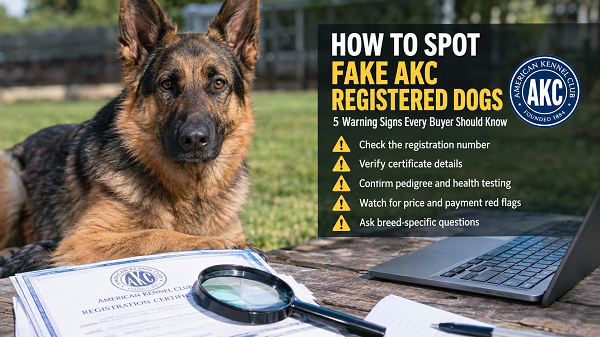
You can spot a fake AKC registered dog by checking five things: whether the registration number actually returns a match in the AKC’s official Dog Search tool, whether the certificate details match the dog exactly (no “hung papers”), whether the breeder can produce a full pedigree and health testing, whether the price and payment terms feel rushed or too cheap, and whether the seller can answer real breed-specific questions without hesitating. If two or more of these don’t check out, walk away.
Table of Contents
- What “AKC Registered” Actually Means
- Why Scammers Target AKC Paperwork
- The 5 Warning Signs of a Fake AKC Registration
- How to Verify an AKC Registration in Under 5 Minutes
- Real Cases: What Fake Papers Actually Cost Buyers
- Special Notes for Working & Protection Dog Buyers
- What to Do If You Already Bought a Dog With Fake Papers
- Trainer’s Checklist Before You Pay a Deposit
- FAQs
- Conclusion
Introduction
I’ve been on the wrong end of a “guaranteed AKC papers” promise before, not personally, but I’ve sat with more than one client who paid full price for a working-line German Shepherd or Malinois and later found out the “AKC registered” claim on the ad was, at best, a stretch. So here’s the thing: this isn’t a rare problem. It’s a growing one, and it’s costing buyers real money, not just in the US, but in the UK, Canada, Europe, and anywhere the AKC name carries weight.
This guide breaks down exactly what to look for, how to verify registration in under five minutes, and what working and protection dog buyers specifically need to watch out for, because scammers know that a “purebred, AKC-registered Belgian Malinois” ad gets a lot more clicks (and a lot more money) than a plain mixed-breed puppy listing.
What “AKC Registered” Actually Means (and What It Doesn’t)
Let’s clear this up first, because a lot of the confusion buyers run into starts here.
AKC registration is a record-keeping system. It tracks a dog’s lineage, who its parents were, what litter it came from, and whether that lineage traces back to dogs already in the AKC studbook. That’s it. It is not a quality guarantee, it’s not a health certification, and it says nothing about temperament, structure, or working ability.
There are also different tiers most buyers never hear about until it’s too late:
- Full Registration – The dog can be shown, bred, and its puppies can be registered. The certificate has a distinct border and design.
- Limited Registration – The dog is AKC registered, but its offspring cannot be registered. Breeders often use this to prevent a pet-quality puppy from being bred further.
- AKC Canine Partners – This is a completely different program for mixed-breed or unknown-pedigree dogs who want to compete in AKC sports like agility or obedience. It is not the same as purebred registration, but scammers love slapping “AKC” on these certificates because the letters alone create trust.
Knowing this distinction alone will save you from at least one common trick: a seller showing you an “AKC” document that’s actually a Canine Partners listing for a dog with no verified pedigree at all.
Why Scammers Target AKC Paperwork
The AKC is the largest purebred dog registry in the world, registering close to a million dogs and over 400,000 litters a year. That scale is exactly why its name gets borrowed so often, buyers trust it, so faking it (or bending the truth around it) is profitable.
The numbers back this up. According to the Better Business Bureau’s Scam Tracker data, pet-related scam reports climbed from 680 in 2022 to a peak of nearly 2,900 in 2023, with median losses hovering between $600 and $750 per victim. Texas alone saw a 107% jump in puppy scam complaints between December 2025 and February 2026, with losses topping $31,000 in just three months. The BBB has also found that a striking share of sponsored pet-sale ads that show up in search results may not be legitimate at all.
Real prosecutions show how organized this gets. In one federal case out of Arkansas, two individuals were charged with running a scheme that “sold” 153 nonexistent purebred, supposedly AKC-registered puppies, French Bulldogs, Boxers, Toy Poodles, and more, collecting payments ranging from $500 to $5,000 per buyer before vanishing. In another widely reported case, a Colorado buyer lost over $7,000 chasing a “purebred Siberian Husky” that never existed, after being shown a registration certificate that turned out to be a forged version of one issued by a completely different (and legitimate) registry.
Then there’s the term breeders use for outright document fraud: “hung papers.” This is when a seller either forges an AKC certificate outright, or more commonly, renames a different dog to match the paperwork of a dog that already has legitimate AKC registration. The registration number might be real. It just doesn’t belong to the dog in front of you.
The 5 Warning Signs of a Fake AKC Registration
Here’s the core of it. If you remember nothing else from this article, remember these five.
1. The Registration Number Doesn’t Check Out
This is the single fastest way to catch a fake, and most buyers never bother to do it. Every legitimate AKC registration has a number, and that number is searchable through the AKC’s own Dog Search tool on akc.org. If the seller gives you a number and it returns nothing, returns a different breed, or returns a dog with a different name and birth date than what you’re being shown, that’s your answer.
A legitimate breeder won’t hesitate when you ask for this number. A scammer will suddenly need “a few days” to send it, or will send you a photo of a certificate instead of the actual number, hoping you won’t look closer.
2. “Hung Papers” — the Certificate Doesn’t Match the Dog
Pull the certificate details apart line by line: breed, color, markings, sex, date of birth, sire and dam names, and breeder of record. Every single field needs to match the dog standing in front of you and the story the seller is telling you.
Watch for:
- A registration number that’s real but attached to a different dog (classic hung papers)
- Missing or smudged official AKC seal, genuine certificates have a raised or foil seal, not a plain printed logo
- Typos, inconsistent fonts, or a document that looks like it was edited in image software
- A breeder who can’t explain a mismatch, or gets defensive when you point one out
I always tell clients: a breeder proud of their dog’s pedigree will happily walk you through every line of that paperwork. Someone hiding something changes the subject.
3. No Full Pedigree, No Health Testing, No Willingness to Show the Parents
This one matters even more for working and protection breeds, where hip, elbow, and cardiac health directly affect whether a dog can do its job for a full working life. A legitimately AKC-registered breeder of a German Shepherd, Rottweiler, or Doberman should be able to show you:
- A multi-generation pedigree, not just the sire and dam’s names
- OFA (Orthopedic Foundation for Animals) or PennHIP results for hips and elbows
- Proof of any relevant genetic panel testing for the breed
- The actual parent dogs, in person or on a live video call, not just old photos
If a seller can produce a shiny certificate but can’t produce the dog’s own parents, treat that as a serious red flag, not a minor inconvenience.
4. Price, Pressure, and Payment Red Flags
Purebred working-line puppies from reputable breeders typically run anywhere from $1,500 to $4,000+ depending on breed, lines, and country, with police- or protection-trained adult dogs going for significantly more. If someone’s offering an “AKC registered Malinois” for a few hundred dollars, that price is doing the talking for them and it’s lying.
Other payment red flags the BBB and AKC both flag repeatedly:
- Refusing phone or video calls, communicating only by email or text
- Demanding wire transfers, gift cards, or app-to-app payments like Zelle or CashApp with no buyer protection
- Adding “surprise” fees after you’ve already paid, crates, vaccinations, “COVID insurance,” airline fees
- Creating false urgency (“another buyer is interested, pay the deposit today”)
Median losses in pet scams sit around $600–$750, but they add up fast once a seller starts layering on fake shipping and insurance charges, some victims have lost $30,000 to $40,000+ chasing a dog that was never real to begin with.
5. The Breeder Can’t Answer Real Breed-Specific Questions
This is my favorite test because it’s nearly impossible to fake. Ask a genuine breeder about drive, temperament testing, working line vs. show line differences, or what titles (like Schutzhund/IGP, herding, or conformation) are in the pedigree. A real breeder lights up talking about this stuff, it’s their whole world.
A scammer running multiple “listings” across breeds they’ve never actually bred will give vague, generic answers, or dodge the question entirely by redirecting you back to price and shipping logistics.
How to Verify an AKC Registration in Under 5 Minutes
You don’t need special access or a subscription to check any of this. Here’s the actual process:
- Use the AKC Dog Search tool on akc.org and enter the registration number. Confirm the breed, name, and date of birth match what the seller told you.
- Call the AKC directly if anything looks off. Their customer service can confirm whether a registration number is active and legitimate, scammers count on buyers not taking this extra step.
- Ask about AKC DNA verification. The AKC offers DNA profiling that compares a dog’s genetic markers against its claimed parentage. If a breeder has nothing to hide, they won’t push back on this request.
- Cross-check the breeder’s kennel name against AKC’s registered breeder records, and search that kennel name plus the word “scam” or “complaint” before you commit.
- Reverse-image search the puppy photos. Scammers recycle the same photos across dozens of fake listings. If that “one-of-a-kind” puppy photo shows up on five other websites, you’ve found your answer.
Real Cases: What Fake Papers Actually Cost Buyers
These aren’t hypotheticals, they’re documented cases that show how this plays out:
- The Arkansas “phantom litter” case: Federal prosecutors charged two people with wire fraud after they allegedly sold 153 nonexistent AKC-registered puppies to buyers across multiple states, collecting anywhere from $500 to $5,000 per sale before disappearing.
- The Colorado shipping scam: A buyer chasing a discounted “purebred” Siberian Husky ended up paying over $7,000 in escalating “insurance” and “quarantine” fees for a puppy and a registration certificate, that never existed.
- The Texas 2025–2026 surge: BBB Scam Tracker recorded a 107% jump in puppy scam reports across Texas in just three winter months, with one buyer alone reporting $7,450 lost to repeated fake medical fees.
- The forged-registry trick: Some scammers don’t even fake the AKC, they mimic a smaller, legitimate registry’s certificate design closely enough that buyers assume it’s equivalent, then use registration numbers that don’t correspond to any real record.
The pattern across nearly every case is the same: escalating fees after the first payment, refusal to meet or video call, and a “AKC registered” claim that was never checked.
Special Notes for Working & Protection Dog Buyers
If you’re specifically shopping for a working-line German Shepherd, Belgian Malinois, Rottweiler, Doberman, or Dutch Shepherd for protection, sport, or K9-style work, there’s an extra layer to watch for.
Scammers targeting this market know buyers will pay a premium for “police line” or “import” bloodlines, so they’ll pair a fake AKC certificate with invented working titles or vague claims about European import papers (like SV, KNPV, or Belgian club registrations). These foreign working registries have their own verification systems too, don’t assume a certificate is legit just because it’s in another language or has an unfamiliar logo.
If you want to understand what legitimate working-line sourcing actually looks like, it’s worth reading how real K9 units evaluate and select dogs, our breakdown of the top police dog breeds and their real K9 roles covers what departments actually screen for, and our look at how Fort Collins Police Services sources and certifies its K9s shows just how rigorous legitimate programs are compared to a backyard “AKC papers guaranteed” listing.
And if you’re weighing a less common protection breed, say, a Giant Schnauzer instead of the usual Malinois or GSD, read our guide on whether a Giant Schnauzer makes a good protection dog before you commit, since rarer breeds attract their own share of inflated pedigree claims. The same goes for livestock guardian breeds like the Kangal, where AKC recognition and bite-force claims both get exaggerated online, our piece on Kangal bite force and guarding ability separates the real data from the marketing.
Once you’ve verified the dog is legitimately who the seller says it is, the next investment is making sure you’re set up to actually train it right, our guide to essential K9 training equipment for working dog handlers is a solid starting point.
What to Do If You Already Bought a Dog With Fake Papers
If you’re reading this after the fact, here’s what actually helps:
- Contact the AKC directly and report the registration discrepancy. They investigate hung papers and fraudulent certificates, and they can flag or void a registration number tied to fraud.
- File a report with your local consumer protection agency or the BBB Scam Tracker, even if you don’t expect to recover money, these reports help build cases against repeat offenders.
- Dispute the charge with your bank or card issuer if you paid by credit card; this is one of the few payment methods with real buyer protection.
- Report it to the FBI’s Internet Crime Complaint Center (IC3) if the seller was operating online and the loss was significant.
- Keep every message, screenshot, and payment record, this documentation matters if law enforcement gets involved, and it matters for your bank dispute too.
Your dog is still your dog, even without valid papers, but pursuing these steps can help you recover funds and stops the same seller from scamming the next buyer.
Trainer’s Checklist Before You Pay a Deposit
- [ ] Registration number verified through AKC Dog Search
- [ ] All certificate details match the dog and the seller’s story
- [ ] Multi-generation pedigree provided, not just parent names
- [ ] Health testing (OFA/PennHIP, genetic panels) documented
- [ ] Video call or in-person visit completed with both parent dogs visible
- [ ] Price is consistent with market rates for the breed and lines
- [ ] Payment method offers buyer protection (credit card, not wire/gift card)
- [ ] Breeder answers breed-specific questions confidently and specifically
- [ ] Puppy photos don’t appear on other, unrelated listings online
Once your paperwork checks out and your new puppy is legitimately yours, the real work starts. My e-book covers exactly that side of it, building solid obedience from day one, understanding the psychology behind your dog’s behavior, the common mistakes that quietly ruin training, and the handler routines that actually produce a balanced, well-behaved dog: BEYOND THE BARK — Inside a Pro Handler’s Playbook for Raising the Ideal Dog.
FAQs
Can I verify AKC registration for free?
Yes. The AKC’s Dog Search tool on akc.org is free to use, and calling AKC customer service to confirm a registration number is also free. There’s no reason to pay a third party to “verify” this for you.
Does AKC registration mean the dog is healthy or well-bred?
No. AKC registration only confirms lineage and paperwork, not health, temperament, or structural soundness. Always ask separately for OFA/PennHIP results and genetic testing, especially in working and protection breeds.
What is a “hung papers” dog?
It’s a dog sold with a real AKC registration number that actually belongs to a different dog, or a forged certificate designed to look official. The paperwork looks legitimate at a glance, but the details don’t match the dog you’re buying.
Is AKC Canine Partners the same as full AKC registration?
No. Canine Partners is a program for mixed-breed or unknown-pedigree dogs to compete in AKC sports. It’s a legitimate AKC program, but it is not proof of purebred status, and scammers sometimes use it to imply a dog is fully registered when it isn’t.
What should I do if a breeder refuses a video call before selling a puppy?
Treat it as a serious red flag and walk away. Reputable breeders, AKC or otherwise, expect buyers to want to see the puppy, the parents, and the living conditions before committing money, and they’ll accommodate that without pushback.
Conclusion
Fake AKC papers aren’t rare, and they’re not always obvious. Sometimes it’s a forged certificate. More often, it’s hung papers, a Canine Partners document passed off as full registration, or a real registration number attached to the wrong dog. The five signs to check every time are simple: a verifiable registration number, a certificate that matches the dog exactly, a full pedigree with health testing, fair pricing with a safe payment method, and a breeder who actually knows their breed.
Run the registration number through AKC’s Dog Search before you send a single dollar. Ask for a video call. Ask to see both parents. If a seller hesitates on any of these, that hesitation is the answer, not the paperwork they eventually send you.
Do this upfront, and you’ll skip the heartbreak (and the drained bank account) that thousands of buyers deal with every year chasing a dog that was never really there.

Her work centres on obedience, detection, protection and operational readiness. She favours proven methods built on repetition, consistency and real-world conditioning, so that both dogs and handlers are prepared for high-pressure tasks.
Rofiat represented the Nigerian Army Dog Centre at the Nigerian Army Day Celebration (NADCEL) 2026, where she led demonstrations in obedience, explosive detection, agility and tactical movement. Through articles, training content and documentaries, she shares field-based insight into how structured training, clear communication and trust between handler and dog affect performance and reliability.
She is the author of Beyond the Bark: Inside a Pro Handler's Playbook for Raising the Ideal Dog, a practical guide that helps dog owners and handlers apply professional training principles in everyday situations.
- Bousnic Dog Training Collar Review: Is It Safe? - September 30, 2026
- Gravy Train Dog Food Review: Ingredients & Recalls - September 30, 2026
- How to Spot Fake AKC Registered Dogs: 5 Warning Signs - September 29, 2026