Australian Cattle Dog vs Blue Heeler: Any Difference?
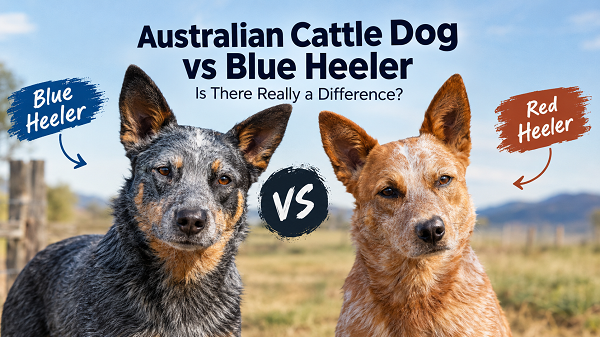
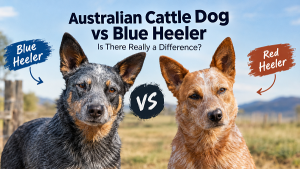
No, an Australian Cattle Dog and a Blue Heeler are the exact same breed. “Blue Heeler” is simply a nickname for an Australian Cattle Dog with a blue-speckled or blue-mottled coat. A “Red Heeler” is the same breed with a red coat instead. Kennel clubs like the AKC, FCI, and ANKC only recognize one breed name: the Australian Cattle Dog.
Table of Contents
- Where the Confusion Comes From
- Is It Really the Same Breed? What Kennel Clubs Say
- Blue Heeler vs Red Heeler vs Queensland Heeler: Every Name Explained
- Physical Characteristics: Size, Coat, and Color
- Temperament and Energy: What Owning One Is Actually Like
- Health Issues Every Owner Should Know
- Training Timeline, Difficulty, and Cost
- Working Dog and Protection Potential
- How Much Does an Australian Cattle Dog Cost?
- Is This Breed Right for You?
- Trainer’s Notes
- FAQs
- Final Thoughts
Introduction
So let’s clear this up properly, where the confusion started, what actually separates a “Blue” from a “Red,” what health issues to watch for, what it costs to own one, and whether this breed is a fit for your home, farm, or protection work. By the end, you’ll know more about this breed than most people who’ve owned one for a decade.
An Australian Cattle Dog (ACD) and a Blue Heeler are one and the same breed, the “Blue Heeler” name just describes the blue-coated variety. Both stand 17–20 inches tall, weigh 35–50 pounds, and live 12–16 years on average. They’re ranked among the most intelligent working dogs alive, carry a documented 10.8% rate of congenital deafness, and hold the Guinness World Record for the oldest dog ever verified (Bluey, who lived 29 years and 5 months). This guide covers the breed’s real history, physical traits, temperament, health risks, training needs, working roles, and true cost of ownership, with the details most other articles on this topic leave out.
Where the Confusion Comes From
Here’s the thing, this isn’t a case of people being careless with names. The confusion has real historical roots.
In the 1840s, an Australian settler named Thomas Hall needed a dog tough enough to drive semi-wild cattle across hundreds of miles of harsh outback terrain, through heat, dust, and cattle that had zero interest in cooperating. He crossed imported blue merle Smooth Collies with tamed dingoes, producing dogs nicknamed “Hall’s Heelers” for their signature move: nipping at the heels of cattle to steer them without getting kicked in the head.
Decades later, in the 1890s, brothers Jack and Harry Bagust of Sydney refined the line further, adding Dalmatian blood (for loyalty to horses and a tolerance for dust) and Black and Tan Kelpie blood (to sharpen the herding drive). By 1897, the breed had a formal standard and the name “Australian Cattle Dog.”
But out on the stations and ranches, nobody was calling out breed standards. Ranchers just called their dogs what they saw, a dog with a blue-speckled coat was a “Blue Heeler,” one with red speckling was a “Red Heeler.” The nicknames stuck so hard that many people today have genuinely never heard the official name.
It’s a bit like how some people call every Golden Retriever with a pale coat an “English Cream Golden”, as if that’s a separate breed. It isn’t. Same logic applies here.
Is It Really the Same Breed? What Kennel Clubs Say
Every major kennel club confirms it:
- American Kennel Club (AKC): Recognizes only “Australian Cattle Dog”, no separate registration exists for “Blue Heeler.”
- Australian National Kennel Council (ANKC): Same, one breed standard, two accepted colors (blue and red).
- Fédération Cynologique Internationale (FCI): Lists the breed as Australian Cattle Dog, standard number 287.
- UK Kennel Club: Also registers the breed exclusively as Australian Cattle Dog.
There’s no separate bloodline, no DNA marker, no distinct temperament profile between a “Blue Heeler” and an “Australian Cattle Dog.” If you register a Blue Heeler with the AKC, the paperwork will read “Australian Cattle Dog” with the color listed as blue.
Blue Heeler vs Red Heeler vs Queensland Heeler: Every Name Explained
Since we’re clearing things up, here’s the complete list of nicknames you’ll run into, and what each one actually means:
- Blue Heeler — an Australian Cattle Dog with a blue, blue-mottled, or blue-speckled coat
- Red Heeler — an Australian Cattle Dog with a red-mottled or red-speckled coat
- Queensland Heeler — a regional nickname tied to Queensland, Australia, where the breed was heavily used; applies to either color
- Australian Heeler — a more generic catch-all nickname
- Halls Heeler — the breed’s original working name, after founder Thomas Hall
One genuinely interesting wrinkle: Australian Cattle Dog puppies are born almost completely white. The coat color only starts to show at around 3 to 6 weeks of age, and it doesn’t fully develop until closer to 12 months. So if you’re picking a puppy from a litter expecting to see the “final” blue or red coat, you’re going to be disappointed, nature makes you wait.
Physical Characteristics: Size, Coat, and Color
Because it’s one breed, the physical stats are identical regardless of coat color:
| Trait | Details |
|---|---|
| Height (male) | 18–20 inches at the shoulder |
| Height (female) | 17–19 inches at the shoulder |
| Weight | 35–50 pounds |
| Lifespan | 12–16 years |
| Coat | Short, dense, weather-resistant double coat |
| Colors | Blue, blue-mottled, blue-speckled, red-mottled, red-speckled |
| Body shape | Compact, muscular, slightly longer than tall |
| Ears | Pricked, medium-sized, set wide apart |
The double coat is genuinely built for outdoor work, a coarse, weatherproof outer layer over a dense undercoat that sheds water and insulates against both heat and cold. That’s exactly what you’d want in a dog bred to spend all day outdoors in the Australian bush.
One structural detail worth knowing: the breed standard calls for a body that’s noticeably longer than it is tall. That’s not a cosmetic choice, it gives the dog a longer, ground-covering stride, which matters when you’re covering miles of open range behind cattle all day.
Temperament and Energy: What Owning One Is Actually Like
I’ll be straight with you: this is not a low-maintenance couch companion. Australian Cattle Dogs were bred to work from sunrise to sunset, and that drive doesn’t switch off just because you moved to a suburban house with a small yard.
Expect a dog that is:
- Extremely intelligent — often ranked among the top 10 smartest dog breeds by working/obedience intelligence researchers
- High-energy — needs at least 60-90 minutes of real physical and mental exercise daily, not just a lap around the block
- Fiercely loyal — bonds tightly with one household, sometimes one primary person
- Naturally wary of strangers — not aggressive by default, but reserved and watchful, which makes them decent natural watchdogs
- Prone to nipping at heels — that herding instinct doesn’t stay on the farm; it shows up chasing joggers, cyclists, and running kids if it’s not redirected early
- Stubborn and independent — bred to make split-second decisions without waiting for a human’s permission, which can make obedience training a genuine test of patience
A common mix-up worth mentioning here: people sometimes confuse Australian Cattle Dogs with Australian Shepherds because of the shared “Australian” name and herding background. They’re not related breeds. The Cattle Dog has a shorter coat, a more intense drive, and a more independent streak. The Aussie tends to be more velcro and biddable. Different dogs, different jobs.
Health Issues Every Owner Should Know
This is where a lot of articles gloss over the real numbers. Here’s what the research actually shows.
Congenital Deafness
A landmark University of Queensland study tested 899 Australian Cattle Dogs using brainstem auditory evoked response (BAER) testing, the gold-standard hearing test for dogs. The results:
- 10.8% of dogs tested were deaf in at least one ear
- 7.5% were unilaterally deaf (one ear)
- 3.3% were bilaterally deaf (both ears)
The same research found dogs with a bilateral facial mask (dark patches around both eyes) had a significantly lower risk of deafness than dogs without one. If you’re buying a puppy, ask the breeder directly whether the litter was BAER tested, reputable working-line breeders do this routinely.
Progressive Retinal Atrophy (PRA)
An inherited eye condition that causes gradual vision loss, eventually leading to blindness. DNA testing is available and responsible breeders screen for it before breeding.
Hip and Elbow Dysplasia
Common in most medium-to-large working breeds. OFA (Orthopedic Foundation for Animals) hip certification is worth checking for before buying from a breeder, especially if you plan on hiking, agility, or farm work with the dog.
Longevity — The Bluey Factor
Here’s a fact that surprises almost everyone: the Australian Cattle Dog holds the Guinness World Record for the oldest dog ever verified. A blue Cattle Dog named Bluey, owned by Les and Rosalie Hall of Rochester, Victoria, lived from 1910 to 1939, 29 years and 5 months. Bluey worked cattle and sheep for close to 20 years before retiring. As of 2026, that record still stands, outlasting multiple later challengers.
That longevity isn’t a fluke of one dog, it points to a breed that’s genuinely hardy when kept lean, active, and well-bred. Average lifespan for the breed today sits at 12–16 years, well above the average for medium-sized dogs.
Training Timeline, Difficulty, and Cost
Cattle Dogs are smart enough to learn fast, but “smart” and “easy” aren’t the same thing. A bored, under-exercised Cattle Dog will find its own jobs to do, and you probably won’t like the ones it picks (chewed furniture, obsessive fence-pacing, nipping ankles).
Here’s a realistic training roadmap I use with clients:
- Weeks 8–16 (puppy socialization): Focus on exposure to people, noises, surfaces, and other dogs. This window is critical for a breed with a naturally reserved, wary temperament, skip it, and you’ll likely end up with an adult dog that’s fearful or overly guarded.
- Months 4–8 (basic obedience): Sit, stay, recall, loose-leash walking. Expect faster comprehension than average breeds, but slower reliability, the dog understands the command quickly, but testing you to see if it actually has to comply is part of the process.
- Months 8–18 (impulse control and redirection): This is where you address heel-nipping and chase instincts by giving the dog a “legal” outlet, flirt pole work, herding balls, structured fetch.
- Ongoing (mental enrichment): Puzzle feeders, nose work, agility, or actual herding trials. A Cattle Dog without a job invents one.
Professional obedience training in the US and UK typically runs $500–$1,500 for a structured group or basic private program, and $2,500–$6,000+ for board-and-train or advanced protection/working programs. Given how food- and drive-motivated this breed is, they typically respond very well to structured, reward-based training with clear boundaries, which is exactly the kind of foundational work covered in my ebook on raising a well-balanced working dog: BEYOND THE BARK — Inside a Pro Handler’s Playbook for Raising the Ideal Dog.
Working Dog and Protection Potential
This is where the breed gets interesting for anyone reading a K9-focused site like this one.
Australian Cattle Dogs were never bred as protection or detection dogs the way German Shepherds or Belgian Malinois were. Their job was livestock control, not personal protection or law enforcement work, you won’t typically find them on police or military K9 rosters.
That said, don’t underestimate what they bring to a working household:
- Natural territorial alertness makes them excellent watchdogs for farms and rural properties, they notice everything and vocalize early
- Bite inhibition combined with a strong grip (from nipping cattle heels) means they can be channeled into bitework sports like French Ring or IGP with the right foundation, though their smaller size limits them against dogs bred specifically for that work
- High pain tolerance and grit, a trait bred into them for absorbing kicks from cattle, makes them resilient in demanding physical training
- Herding trial success, the breed regularly competes and places in AHBA and AKC herding trials, and this is genuinely the sport that shows off what they were built for
If your goal is a dedicated personal protection dog, a Cattle Dog isn’t the first breed I’d recommend. If your goal is a sharp, loyal, low-nonsense farm and family guardian with serious drive, it’s hard to beat.
How Much Does an Australian Cattle Dog Cost?
Budget for more than just the puppy price. Here’s a realistic breakdown based on current US and UK markets:
- Puppy from a backyard breeder or unpapered litter: $300–$600
- Puppy from a reputable, health-tested breeder: $800–$1,500
- Working-line or field-trial-bred puppy: $1,500–$3,000
- Adoption/rescue fee: $75–$400 (breed-specific rescues exist in the US, UK, and Australia)
- Annual cost of ownership (food, vet, insurance, grooming): $1,200–$2,500
Given the health screening involved (BAER hearing tests, hip and eye certifications), a higher upfront price from a responsible breeder is usually money well spent versus a cheaper, unscreened puppy that could develop expensive health issues later.
Is This Breed Right for You?
Ask yourself these questions honestly before bringing one home:
- Can you commit to 60+ minutes of real exercise every single day, rain or shine?
- Do you have experience with strong-willed, independent breeds, or are you a first-time dog owner?
- Do you have livestock, kids who run around a lot, or joggers nearby that the dog might try to “herd”?
- Are you prepared for a dog that bonds intensely and doesn’t do well left alone for long stretches?
- Can you afford health screening costs and potential vet bills tied to hip, eye, or hearing issues?
If you answered yes across the board, this breed will reward you with one of the most loyal, capable working partnerships in the dog world. If you’re looking for a low-key apartment companion, look elsewhere, this isn’t that dog.
Trainer’s Notes
I’ve worked hands-on with working and protection breeds for years, including Cattle Dogs brought in specifically for heel-nipping and reactivity issues in suburban homes. The pattern I see over and over: owners fall for the breed’s looks and intelligence without realizing they’re bringing home a dog engineered to work cattle for 10+ hours a day. The dogs aren’t “badly behaved”, they’re under-stimulated. Fix the exercise and job deficit, and 80% of the “problem behaviors” I get called in for disappear within weeks.
FAQs
Is a Blue Heeler more aggressive than an Australian Cattle Dog?
No, they’re the same breed, so temperament doesn’t differ by coat color. Any perceived difference in “aggression” comes down to individual breeding lines, socialization, and training, not whether the dog is called a Blue Heeler or an Australian Cattle Dog.
Do Blue Heelers and Red Heelers have different personalities?
No. Coat color has no scientifically documented link to temperament in this breed. Any personality differences you notice come from genetics within a specific bloodline, not the color itself.
Why do Australian Cattle Dogs nip at heels?
It’s an inherited herding behavior. The breed was developed to move cattle by nipping at their heels and dodging kicks. Without an outlet like herding, agility, or structured play, that instinct often redirects toward running kids, joggers, or cyclists.
How long do Australian Cattle Dogs typically live?
The average lifespan is 12 to 16 years. The breed also holds the Guinness World Record for the oldest dog ever verified, Bluey, who lived 29 years and 5 months.
Are Australian Cattle Dogs good with kids?
They can be, especially when raised with children from puppyhood, but their herding instinct means they may nip at running or shrieking kids. Supervision and early training to redirect that instinct make a big difference.
Final Thoughts
An Australian Cattle Dog and a Blue Heeler aren’t two different dogs weighing different qualities against each other, they’re the same dog wearing two different names, one official and one born on the cattle stations of 19th-century Australia. The real decision isn’t “which one should I get.” It’s whether you can meet the exercise, training, and mental stimulation needs of one of the most driven working breeds on the planet.
Get that right, and you’ll have a partner that’s smart, loyal, and tough enough to hold the Guinness World Record for canine longevity. Get it wrong, and you’ll have a bored, frustrated dog looking for its own job around your house.
Do your research on the breeder, insist on health testing (especially BAER hearing tests), and go in with a real plan for daily exercise and mental work. That’s the difference between a Cattle Dog that thrives and one that struggles.

Her work centres on obedience, detection, protection and operational readiness. She favours proven methods built on repetition, consistency and real-world conditioning, so that both dogs and handlers are prepared for high-pressure tasks.
Rofiat represented the Nigerian Army Dog Centre at the Nigerian Army Day Celebration (NADCEL) 2026, where she led demonstrations in obedience, explosive detection, agility and tactical movement. Through articles, training content and documentaries, she shares field-based insight into how structured training, clear communication and trust between handler and dog affect performance and reliability.
She is the author of Beyond the Bark: Inside a Pro Handler's Playbook for Raising the Ideal Dog, a practical guide that helps dog owners and handlers apply professional training principles in everyday situations.
- Australian Cattle Dog vs Blue Heeler: Any Difference? - October 1, 2026
- Bousnic Dog Training Collar Review: Is It Safe? - September 30, 2026
- Gravy Train Dog Food Review: Ingredients & Recalls - September 30, 2026