Do Hypoallergenic Dogs Really Exist? (The Real Truth)

No, truly hypoallergenic dogs don’t exist. Every dog, even a hairless one, makes dander, saliva and urine, and those carry allergens. Studies that tested dust from real homes found no meaningful difference in allergen levels between “hypoallergenic” breeds and other dogs. The truth is that allergen output changes from one individual dog to another, so some dogs (including some Poodles and Poodle mixes) may bother you less. A tested, step-by-step plan matters more than the label.
Table of Contents
- What “Hypoallergenic” Really Means
- What Actually Causes Dog Allergies (Hint: Not Just Hair)
- What the Research Says About Hypoallergenic Dog Breeds
- Why So Many Owners Swear Their Poodle “Works”
- The Labradoodle Story: How a Marketing Line Became a Myth
- Dog Breeds That May Cause Fewer Allergy Problems
- How to Test a Dog Before You Commit (Step by Step)
- How to Live With a Dog When You’re Allergic
- A Handler’s View: Why I’d Never Buy on a Label
- When to Talk to an Allergist
- FAQs
- Conclusion
Introduction
You love dogs, but your nose, eyes and chest don’t. So you search for a dog that won’t make you sneeze, and every site shows you the same list: Poodles, Bichons, Maltese, Schnauzers. Breeders put “hypoallergenic” in their ads and charge a premium for it.
So here’s the problem. Roughly 10 to 20 percent of people are allergic to dogs and cats, and a lot of them spend big money on a label that science can’t back up. Some end up rehoming a dog they’ve already bonded with. That’s heartbreaking for the person and the dog.
In this guide, you’ll learn:
- What “hypoallergenic” actually means (and who decides)
- What really triggers a dog allergy, including one allergen almost every article skips
- What the major studies found
- Which breeds may cause fewer reactions, and the honest limits of that idea
- A practical test plan before you bring a dog home
- Cleaning routines with real numbers behind them
I’m a dog trainer and handler, not a doctor. I’ll stick to what the research shows and tell you where a medical professional needs to step in.
What “Hypoallergenic” Really Means
The word “hypoallergenic” means less likely to cause an allergic reaction. It doesn’t mean no reaction. No official body certifies the term for dogs, and the “hypoallergenic” label often just points to a more predictable shedding pattern.
Think about it like “low-fat” on a food label. It tells you something, but it doesn’t guarantee your outcome.
The Asthma and Allergy Foundation of America says a truly hypoallergenic dog doesn’t exist. The American Academy of Allergy, Asthma and Immunology agrees: there are no truly hypoallergenic breeds.
So where did the idea come from? It started with a simple guess: less hair on the floor means less allergen in the air. It sounds logical. It just turns out to be wrong, and the next section shows why.
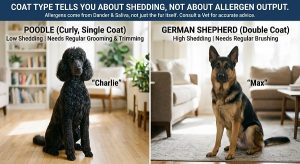
What Actually Causes Dog Allergies (Hint: Not Just Hair)
Most people blame dog hair. Hair is only the delivery truck. The real culprits are proteins.
The common assumption is that dander (dead skin cells) triggers the reaction, and that dogs who shed less leave less behind. But the proteins live in more places than fur.
The Main Dog Allergens in Plain English
Researchers have named several dog allergens, labeled Can f 1 through Can f 6. Eight dog allergens have been identified, and between 50 and 70 percent of dog-allergic people react to Can f 1, the best-known one.
Here’s a simple breakdown:
- Can f 1: A protein found in saliva and dander. Most studies measure this one.
- Can f 2 and Can f 4: Related proteins that also trigger reactions in many allergic people.
- Can f 3: A protein found in blood and dander.
- Can f 5: A protein made in the prostate of male dogs (more on this below).
- Can f 6: Another protein from the same family as Can f 1.
A person might react to just one of these allergens or to several. That’s why two allergic people can have very different experiences with the same dog.
The Allergen Most Articles Skip: Can f 5
This is where I can add something the top articles leave out.
Can f 5 is produced in the prostate of intact male dogs, and neutered males make much less of it. Female dogs don’t make it. In one large Swedish study, about 16.5 percent of dog-sensitized adults reacted only to Can f 5.
What does that mean in real life? Some allergic people may tolerate a female dog or a neutered male far better than an intact male. It won’t help everyone, because many people react to several proteins. But it’s one of the few evidence-based levers you can actually pull. A proper allergy test, which I’ll cover below, can tell you whether this applies to you.
Where the Allergens Travel
Allergens stick to everything. Dog allergens turn up even in schools and daycare centres where dogs aren’t regularly present. They ride on clothes, fabric and dust.
Indoor levels of Can f 1 relate more to how much time the dog spends inside than to how many dogs live in the house. So a small dog that sleeps on your bed can raise your exposure more than a big dog that lives mostly outdoors.
What the Research Says About Hypoallergenic Dog Breeds
Two studies shaped how experts think about this topic. Both are worth knowing, because breeders rarely mention them.
Study 1: The 2011 Home Dust Study
Researchers examined dust from 173 homes that each had one dog. The dogs covered 60 breeds, including 11 breeds considered hypoallergenic. The result? Even when the team compared dogs on the American Kennel Club’s “more hypoallergenic” list with all other dogs, they found no statistically significant difference in Can f 1.
One more detail: Can f 1 turned up in 94 percent of the homes. Dog allergen is nearly everywhere dogs live.
Study 2: The 2012 Hair and Home Study
A second study, from Utrecht University in the Netherlands, looked at allergen on the dogs themselves. It measured Can f 1 in nearly 200 dogs and found higher levels in the “hypoallergenic” breeds: about 2.26 micrograms per gram of hair, compared with 0.77 in the others. Poodle and Labradoodle hair tested higher for Can f 1 than the control breeds, and airborne levels in homes weren’t lower either.
Let me be fair about the limits. These studies measured Can f 1 only, not every allergen. Sample sizes per breed were small. And house dust isn’t the same as how you feel when you pet a dog. But the findings do kill the old idea that low shedding automatically means low allergen.
Quick Reference: Myth vs. Fact
| Common claim | What the evidence shows |
|---|---|
| “Non-shedding dogs make less allergen” | Not supported. Low-shedding breeds showed no lower home allergen levels. |
| “Hairless dogs are allergy-free” | No. They still make saliva, urine and dander. |
| “Poodle mixes are safe for allergies” | Unreliable. Mixed-breed coats and allergen output are unpredictable. |
| “Small dogs cause fewer problems” | Possible for some people, but it depends on the individual dog. |
| “Breed decides allergen level” | Individual dogs vary more than breeds do. |
Mixed-breed dogs sold as hypoallergenic are often just marketing, because mixing breeds gives unpredictable genes and coats.

Why So Many Owners Swear Their Poodle “Works”
If the science is so clear, why do so many people say their Poodle or Doodle doesn’t bother them? I hear this all the time, and I don’t think those owners are lying. There are three honest explanations.
1. Allergen Output Varies by Individual Dog
Researchers have found that allergen levels vary among individual dogs but not among breeds. So your specific dog might simply make less of the protein you react to. That’s luck, not breed magic.
2. You May React to a Different Protein
Remember, there are several allergens. A dog that’s low in the one you react to will feel “hypoallergenic” to you. That same dog could set off your friend.
3. Expectation and Exposure Play a Role
In one study, over 80 percent of allergic owners of “hypoallergenic” dogs said they had fewer symptoms with those dogs than with others. Yet home allergen levels didn’t differ. Part of the answer may be perception, and part may be that allergic owners who stay with a dog are the ones who tolerate it. I’d call that selection, not proof.
Here’s the practical takeaway. A dog can be a good fit for you without the breed being hypoallergenic. That’s why testing the individual dog matters so much.
The Labradoodle Story: How a Marketing Line Became a Myth
The best example of this myth is the Labradoodle, and the creator’s own regret is worth knowing about.
Wally Conron created the first Labradoodle in 1989 while working at the Royal Guide Dogs Association of Australia. His goal was a guide dog for a blind woman in Hawaii whose husband was allergic to dogs. He tried training Poodles first, but they didn’t have the right temperament, so he crossed a Poodle with a Labrador.
Here’s the part that matters. Nobody wanted the crossbred puppies at first, so he asked the organization’s PR team to promote them as a special hypoallergenic guide dog. It worked, and the demand exploded.
Years later, he called it his life’s regret. He said he had created demand that unethical, ruthless breeders were happy to meet. He also said healthy Labradoodles were few and far between.
Even in Conron’s original program, success wasn’t guaranteed. Only one of the puppies he bred didn’t set off the husband’s allergies.
The lesson is simple. The “hypoallergenic” idea began as a smart story that solved one family’s problem, and then it spread far beyond the evidence.
Dog Breeds That May Cause Fewer Allergy Problems
I won’t pretend breed means nothing. Coat type changes how much hair and dander ends up on your floor and furniture. It also changes how easy the dog is to groom. For some allergic people, a dog with a steady, low-shedding coat is simply easier to manage.
Just remember the caveat: this table lists dogs people commonly choose for allergy reasons. It isn’t a promise.
| Breed | Coat type | What to know |
|---|---|---|
| Poodle (toy, miniature, standard) | Dense, curly | Needs regular professional grooming. Studies found Poodle hair carried plenty of Can f 1. |
| Bichon Frise | Curly, fluffy | Small and friendly. Needs frequent brushing to prevent mats. |
| Maltese | Long, silky | Low shedding, but coat care is a daily job. |
| Yorkshire Terrier | Fine, silky | Small and bold. Can be tough to housebreak. |
| Miniature Schnauzer | Wiry | Needs regular trimming. |
| Portuguese Water Dog | Curly or wavy | Active and needs lots of exercise. |
| Soft Coated Wheaten Terrier | Soft, wavy | Needs steady grooming. |
| Xoloitzcuintli, Chinese Crested | Hairless (some coated) | No coat to shed, but skin still makes allergens and needs skin care. |
A few honest notes on this list:
- Low shedding means high grooming. These breeds don’t drop hair everywhere because the hair stays in the coat. It then tangles and mats unless you brush it often. If you want an easy-care dog, read our guide to the 10 best low-maintenance dog breeds with basic grooming needs before you commit to a coat that needs daily work.
- Small dogs can be harder to housebreak. Many popular allergy-friendly picks are toy breeds. If you pick one, you’ll want to know about the hardest toy dog breeds to housebreak and how to fix it. This matters for allergies too, because urine carries allergen and indoor accidents spread it.
- Hairless doesn’t mean allergen-free. Hairless dogs still produce allergens.

Female or Neutered Males? A Practical Tip
Because of Can f 5, I’d put this on your checklist. If a test shows you react mainly to Can f 5, a spayed female or a neutered male may be a better bet than an intact male. If you react to Can f 1 and other proteins, this won’t solve it. Either way, ask an allergist rather than guessing.
How to Test a Dog Before You Commit (Step by Step)
This is the part most articles skip, and it’s the part that saves you from heartbreak. Don’t pick a breed. Test a specific dog.
- Get tested first. Ask your doctor or an allergist for a skin prick test or a blood test for dog allergy. Ask whether they can check which dog proteins you react to. Knowing whether Can f 5 is your main trigger changes your choices.
- Spend real time with the exact dog. One quick cuddle at a breeder’s house tells you nothing. Plan several visits, ideally one that lasts a few hours and includes time indoors.
- Go back more than once. Allergic reactions can build over days. Visit a few times across a couple of weeks if you can.
- Ask about a foster or trial period. Many rescues offer foster-to-adopt. Fostering for two to four weeks shows you how you react at home, not in a shop or kennel.
- Meet the parents when you can. If you’re buying a puppy, meet the mother and father. Allergen output is individual, so this is only a hint, but it’s more useful than a coat label.
- Watch your symptoms and write them down. Note sneezing, itchy eyes, skin rashes, wheezing or tight chest. Wheezing and breathing trouble need a doctor, not a pep talk.
- Check every person in the house. Everyone who lives with the dog needs to be okay with it, including kids.
If you buy a puppy, expect the allergen picture to shift as the dog grows and its coat changes. I’d always rather someone take an extra month to test than rehome a dog after a year.
How to Live With a Dog When You’re Allergic
Let’s say you already have a dog, or you’ve tested one and you want to go ahead. Good news: there’s real evidence on what helps. Here’s what works, with the numbers.
Wash the Dog (But Do It the Smart Way)
An older but well-known study found that washing cut recoverable Can f 1 by 84 percent from hair clippings and by 86 percent from dander samples. The catch is timing. The dog needed washing at least twice a week to keep the reduction in place. Another team found that the drop from washing lasted about three days.
Airborne allergen fell too, but less dramatically. Air levels dropped 41 percent on days 1 to 4 after washing and 61 percent on days 5 to 7.
My honest advice: twice-weekly baths can dry out skin, so talk to your vet about a gentle shampoo and a schedule your dog’s skin can handle. One vet clinic says bathing once every one to two weeks with a gentle dog shampoo is usually safe. Also, wipe your dog down with a damp cloth between baths. For more on a healthy routine, see our essential dog grooming tips for a healthy puppy.
Use a HEPA Air Cleaner
A HEPA filter pulls tiny particles out of the air. In one study, airborne Can f 1 was 3.8 times higher when the dog was in the room than when it was elsewhere in the house. HEPA filtering cut airborne Can f 1 by about 75 percent with the dog in the room, and by about 90 percent when the dog was elsewhere. That was a small study, so treat it as encouraging rather than final.
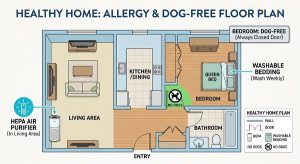
Make the Bedroom a Dog-Free Zone
Researchers found the total allergen load people breathed was lower when dogs couldn’t enter the bedroom. You spend about a third of your life there, so this one change matters a lot. Train your dog to sleep in a crate or bed in another room. If crate training is new to you, our guide on how to crate train a puppy walks you through it.
Wash Fabrics, Not Just Floors
Washing fabrics with detergent reduces dog and cat allergens. Wash dog bedding, throws and cushion covers weekly, and choose washable covers over heavy upholstery. Hard floors beat carpet because there’s less for allergen to cling to.
Get Potty Training Right From Day One
Here’s a tip you won’t find in most allergy guides. Urine carries allergen, and indoor accidents soak into carpets and floors. A fast, reliable house-training routine cuts that exposure. If you’re bringing home a puppy, my e-book Beyond the Bark includes a structured 7-day potty-training plan you can grab on Amazon. It’s built on the same schedule-and-supervision method I’d teach a new handler.
Quick Allergy-Control Checklist
- Keep the dog out of the bedroom
- Use a HEPA air cleaner in the rooms you use most
- Bathe the dog on a schedule your vet approves, and wipe between baths
- Wash bedding and covers weekly
- Vacuum with a HEPA vacuum and choose hard floors where you can
- Wash your hands after petting, and keep your hands off your face
- Fix house-training problems fast
A Handler’s View: Why I’d Never Buy on a Label
I work with working dogs, and in the K9 world we judge dogs by what they do, not what a brochure says. We test temperament, drive, health and fitness one dog at a time. Nobody buys a detection dog because a breed list says “good nose.”
The same rule fits allergies. A label tells you about a group. You live with one dog. Here’s what I’d tell any new owner:
- Test the individual. Breed is a starting point, not an answer.
- Treat allergen control as a routine. It’s like fitness for a working dog. A bit of effort every week beats a big push once.
- Choose a dog for its health and temperament too. Wally Conron’s regret is a reminder that chasing one trait, like a non-shedding coat, can bring unhealthy breeding.
- Buy from a breeder who health-tests, or adopt from a rescue that lets you foster first.
Even in working-dog circles, handlers with allergies are common. They manage it with the same steps in this guide: grooming, cleaning, ventilation and medical support.
Note: I’m a trainer and handler, not a medical professional. This article doesn’t replace advice from your doctor or allergist.
When to Talk to an Allergist
See a doctor or allergist before you buy a dog, or soon after if you already have one, if you have:
- Asthma or a history of breathing problems
- Wheezing, chest tightness or shortness of breath around dogs
- Skin rashes or hives after dog contact
- Symptoms that keep getting worse
- Children in the house with asthma or allergies
An allergist can test which proteins trigger you and talk through options such as allergy medicines or immunotherapy (allergy shots). Those are medical decisions, so I’d leave them to the professionals. I’d also never tell anyone with asthma to “just try it and see.”
FAQs
1. Is there really a 100% hypoallergenic dog?
No. Every dog makes dander, saliva and urine, and those carry allergen proteins. Some individual dogs cause fewer symptoms than others, but no breed is guaranteed allergy-free.
2. Are Poodles and Labradoodles hypoallergenic?
Not reliably. Poodles shed little, but studies found Poodle and Labradoodle hair carried as much or more Can f 1 as other breeds. Doodle coats and allergen levels also vary widely from puppy to puppy.
3. Which dog breeds are best for people with allergies?
There’s no guaranteed best breed. People often choose low-shedding dogs such as Poodles, Bichons, Maltese, Miniature Schnauzers and Portuguese Water Dogs. Spend time with the individual dog, and consider a female or neutered male if you react mostly to Can f 5.
4. Does neutering a dog reduce allergies?
It can help for one allergen. Can f 5 comes from the prostate of male dogs, and neutered males make much less of it. If you react to other proteins like Can f 1, neutering alone won’t fix the problem.
5. Can you live with a dog if you’re allergic?
Many people do, with the right plan. Get tested, trial the individual dog first, keep the dog out of the bedroom, use a HEPA air cleaner, wash the dog and bedding regularly, and work with an allergist. If you have asthma, talk to your doctor before you commit.
Conclusion
So, do hypoallergenic dogs really exist? Not in the way the marketing says. No breed is allergy-proof, and the studies on home dust and dog hair show that “hypoallergenic” breeds don’t reliably carry less allergen. What does exist is individual variation. Some dogs will bother you less, and some of them may be Poodles, Bichons or Doodles.
Here’s your action plan:
- Get an allergy test and ask which dog proteins you react to.
- Test the specific dog, with several visits or a foster trial.
- Consider a spayed female or neutered male if Can f 5 is your issue.
- Build a routine: dog-free bedroom, HEPA filter, regular washing, washable fabrics.
- Pick a healthy dog from a responsible breeder or rescue, not just a trendy coat.
Be careful, patient and honest with yourself, and you can enjoy a dog without paying for a myth.
Want more practical dog and K9 guides like this? Subscribe to our weekly articles roundup newsletter and get new tips in your inbox every week.

Her work centres on obedience, detection, protection and operational readiness. She favours proven methods built on repetition, consistency and real-world conditioning, so that both dogs and handlers are prepared for high-pressure tasks.
Rofiat represented the Nigerian Army Dog Centre at the Nigerian Army Day Celebration (NADCEL) 2026, where she led demonstrations in obedience, explosive detection, agility and tactical movement. Through articles, training content and documentaries, she shares field-based insight into how structured training, clear communication and trust between handler and dog affect performance and reliability.
She is the author of Beyond the Bark: Inside a Pro Handler's Playbook for Raising the Ideal Dog, a practical guide that helps dog owners and handlers apply professional training principles in everyday situations.
- K9 Ballistics Dog Bed Review: Tested on Working K9s - November 28, 2026
- Do Hypoallergenic Dogs Really Exist? (The Real Truth) - November 27, 2026
- 5 Best Hypoallergenic Dog Shampoos (Handler Review) - November 26, 2026