Bird Dog Breeds: The 8 Best Hunting Dogs (Guide)
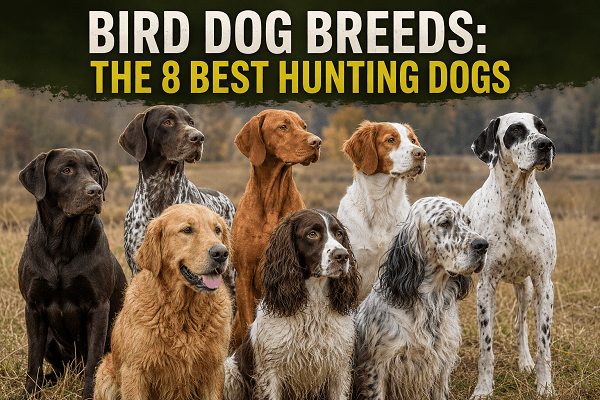
The best bird dog breeds for hunting are the German Shorthaired Pointer, Labrador Retriever, English Springer Spaniel, English Setter, Brittany, Golden Retriever, Vizsla, and Chesapeake Bay Retriever. Pointers find and freeze on birds, flushers push birds into the air, and retrievers bring them back. The best breed for you depends on your game, your terrain, and your experience. For a first bird dog, the Labrador, Golden Retriever, and Brittany are the easiest to train.
Table of Contents
- What Is a Bird Dog? Pointers, Flushers and Retrievers
- The 8 Best Bird Dog Breeds for Hunting
- Honorable Mentions: Other Great Hunting Dogs
- Bird Dog Breed Comparison Table
- How to Choose the Right Bird Dog for You
- Field Line vs Show Line: The Mistake That Costs Hunters Seasons
- Health Testing and Lifespan
- How Much Does a Bird Dog Cost?
- Bird Dog Training Timeline
- A Trainer’s Notes
- Field Safety: Heat, Cold, Hearing and Ticks
- Hunt Tests and Field Trials Worldwide
- FAQs
- Final Thoughts
Introduction
Pick the wrong bird dog and you’ll feel it all season. A wide-ranging pointer in thick swamp cover will vanish from sight. A calm family Labrador from show lines may never show real hunting drive. A high-energy Vizsla left in a kennel all week will tear your house apart.
Most “best bird dog breeds” lists give you names and photos, and that’s it. They don’t tell you how to match a dog to your hunt, what to ask a breeder, or what the first two years of training look like.
This guide does all of that. You’ll learn how pointers, flushers, and retrievers differ, meet the 8 best hunting dogs with real details on each, and see what a bird dog actually costs. You’ll also get a training timeline you can follow. Whether you hunt pheasant in the US Midwest, grouse in Scotland, or driven birds in Europe, you’ll know which dog to look for.
What Is a Bird Dog? Pointers, Flushers and Retrievers
A bird dog is any breed developed to help hunters find, flush, or retrieve game birds like pheasant, quail, grouse, partridge, woodcock, ducks, and geese. In the UK and Europe, you’ll also hear the word “gundog.”
Bird dogs fall into three working groups. Knowing them matters more than any “cutest dog” list.
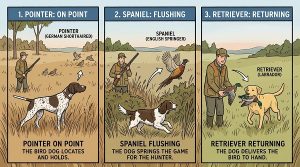
Pointers (and Setters)
Pointers use their noses to find a bird, then freeze with the body, nose, and tail aimed at it. That freeze is the “point.” Setters do the same job, and the name comes from older times when they crouched or “set” for the net.
The instinct is inherited. A well-bred puppy will often point a wing, a butterfly, or a thrown sock before five months old. German Shorthaired Pointers, English Setters, Brittanys, and Vizslas all belong here.
Flushers
Flushers hunt close to you and push birds out of heavy cover so they fly within shotgun range. Then they retrieve. Springer Spaniels got their name from making birds “spring” into the air.
Retrievers
Retrievers mark where a bird falls and bring it back without damage, often through water. They carry a bird with a “soft mouth,” meaning they don’t bite down hard. Labradors, Golden Retrievers, and Chesapeake Bay Retrievers are built for this job.
Upland vs Waterfowl Dogs
You’ll also see dogs split by where they work. Upland dogs hunt birds that live on land, like pheasant, quail, and grouse. Waterfowl dogs hunt ducks and geese. Some breeds, like the Brittany and the German Shorthaired Pointer, do both.
Quick answer: A pointer finds the bird and holds still. A flusher drives the bird into the air. A retriever brings it back.
A natural instinct is only half the job. If you want to understand how drive and training work together, read our guide on obedience vs instinct in working dogs.
The 8 Best Bird Dog Breeds for Hunting
Here’s the list, built from breed history, kennel club data, and how these dogs actually perform in the field. Each entry gives you size, lifespan, and the one thing to watch for.
1. German Shorthaired Pointer (GSP)
The GSP is the do-it-all bird dog. It points upland birds, retrieves from water, and still sleeps happily on the sofa. Germany developed it in the 1800s as a versatile hunter, and in Europe you’ll hear it called the Kurzhaar.
It’s also popular in homes. The AKC’s 2025 rankings had the German Shorthaired Pointer in the US top 10. A GSP also won Best in Show at Westminster in 2016, which shows that field ability and looks can live in one dog.
- Size and lifespan: 45–70 lb, about 10–12 years
- Best for: Upland birds, waterfowl, hunters who want one dog for everything
- Energy: Very high. It needs a job, not just a walk.
- Watch for: Hip dysplasia, bloat (it has a deep chest), and destructive behavior if under-exercised.
2. Labrador Retriever
The Lab is the gold standard retriever. It came from the working water dogs of Newfoundland, and English sportsmen refined it for waterfowl. Its soft mouth, water-shedding coat, and drive to please make it the default dog for duck blinds worldwide.
Labs rank among the most popular dogs in the US. In the AKC’s 2025 rankings, the Labrador Retriever placed second and the Golden Retriever third. In the UK, the Lab is also the top dog on shooting days, where it picks up birds behind the line.
- Size and lifespan: 55–80 lb, about 10–12 years
- Best for: Waterfowl, picking up, upland retrieving, first-time owners
- Energy: High, but easier to manage than pointing breeds
- Watch for: Obesity, hip and elbow problems, and exercise-induced collapse (EIC), a genetic condition you can test for
If you’re choosing a Lab specifically for work, coat color matters far less than bloodline. Our guide to Labrador colors covers what really counts.
3. English Springer Spaniel
The Springer is the classic flushing breed. It works close, reads cover like a map, and bursts birds into the air, then sits and waits for the shot. In the UK, spaniels are the backbone of rough shooting for exactly that reason.
If you hunt thick brush, swamp edges, or hedgerows where a wide-ranging pointer would run past half the birds, a Springer will outwork almost anything else on this list.
- Size and lifespan: 40–50 lb, about 12–14 years
- Best for: Thick cover, close-range hunting, hunters on foot
- Energy: High. It needs daily mental and physical work.
- Watch for: Ear infections from long, low ears, and the show vs field split (see the section on lines below)
4. English Setter
Old-timers call the setter “the gentleman’s bird dog.” The breed’s modern form comes from 19th-century breeder Edward Laverack, and it shines on grouse and woodcock in tight, tangled woods. It runs with a smooth, flowing style that’s beautiful to watch.
At home, it’s one of the gentlest breeds on this list. That makes it a favorite with hunters who want a dog that goes from truck to living room without any fuss.
- Size and lifespan: 45–80 lb, about 10–12 years
- Best for: Grouse, woodcock, hunters who value a calm house dog
- Energy: High in the field, calm indoors
- Watch for: Deafness in some mostly white dogs, and regular brushing (2–3 times a week)
5. Brittany
The Brittany comes from the Brittany region of France. For a long time it was called the “Brittany Spaniel,” but it’s a pointing breed, and the AKC dropped the “Spaniel” in 1982. At 30–40 lb, it’s the smallest pointer on this list, so it’s easy to travel with and easy to carry through rough country.
It’s the all-rounder for hunters who want one compact dog that points, retrieves on land and water, and fits in a small home.
- Size and lifespan: 30–40 lb, about 12–14 years
- Best for: First-time pointer owners, smaller households, one-dog hunters
- Energy: Extremely high for its size
- Watch for: Sensitivity. A Brittany shuts down under harsh correction and learns best with positive training.
6. Golden Retriever
Yes, the same breed on millions of sofas is a real gun dog. Lord Tweedmouth developed the Golden in Scotland in the 1800s to retrieve game on land and water. A well-bred field-line Golden still has real hunting instinct, a soft mouth, and the patience to sit quietly in a duck blind.
Goldens are also among the easiest dogs here to train, which is why they suit first-time owners.
- Size and lifespan: 55–75 lb, about 10–12 years
- Best for: First bird dog, waterfowl, family hunters
- Energy: Moderate to high
- Watch for: Show lines (see below), heavy shedding, and a higher cancer risk than many breeds. Ask the breeder about the health history of the whole bloodline.
7. Vizsla
The Vizsla is Hungary’s pointing breed. It’s lean, athletic, and covered in a short rust-colored coat. The breed nearly vanished after the world wars and was rebuilt by dedicated breeders, which is part of why many Vizsla owners feel so loyal to it.
Vizslas hunt close and intensely, so they suit hunters who like to walk beside their dog instead of watching it disappear over a ridge. They’re nicknamed “Velcro dogs” because they hate being apart from their person.
- Size and lifespan: 44–60 lb, about 12–14 years
- Best for: Upland hunters who want a close-working, high-drive partner
- Energy: Very high
- Watch for: Separation anxiety. It’s a poor fit if the dog will be alone for long stretches.
8. Chesapeake Bay Retriever
The “Chessie” is the toughest retriever here. Legend says the breed began in 1807, when two Newfoundland puppies were rescued from a shipwreck off the Maryland coast and crossed with local dogs. Its oily, wavy coat sheds water, and its stocky build lets it fight current and break thin ice.
Chessies are also more independent than Labs, so they need a confident handler and early training. The breed sits outside the AKC’s top 10 (it’s ranked in the 11th to 100th range), which means you’ll have to search a bit harder for a good puppy.
- Size and lifespan: 55–80 lb, about 10–13 years
- Best for: Serious waterfowl hunters, cold, rough water
- Energy: High, with a strong independent streak
- Watch for: Territorial or one-person tendencies, and EIC and hip issues.
Honorable Mentions: Other Great Hunting Dogs
Eight breeds can’t cover everything. If your hunting is a bit different, look at these too.
- English Pointer: Many bird hunters call it the best upland dog in the world. It’s fast and has a wide range, and it’s a favorite in open country for quail and chukar. The catch is that it needs plenty of space and an experienced handler.
- German Wirehaired Pointer (Drahthaar): A tough, wire-coated, do-it-all dog for cold weather, rough cover, and water.
- Weimaraner: The famous “Gray Ghost.” A well-bred field Weimaraner is a great hunter. But many are bred only for the show ring, so check the bloodlines carefully.
- Irish Setter: A flashy, fast, friendly setter. Field lines are far more driven than show lines.
- Boykin Spaniel: A compact flusher developed in South Carolina for turkey and duck hunting from small boats.
- English Cocker Spaniel (working type): A small, tireless flusher popular in the UK, and a good option if you live in a small space.
- Bracco Italiano and Italian Spinone: European pointing breeds that are gaining followers elsewhere for their calm temperament.
Bird Dog Breed Comparison Table
| Breed | Role | Best game | Energy | Grooming | Beginner-friendly? |
|---|---|---|---|---|---|
| German Shorthaired Pointer | Pointer / versatile | Upland and waterfowl | Very high | Low | Some experience helps |
| Labrador Retriever | Retriever | Waterfowl, upland | High | Moderate | Yes |
| English Springer Spaniel | Flusher | Thick cover, upland | High | Moderate | Some experience helps |
| English Setter | Setter | Grouse, woodcock | High | High | Some experience helps |
| Brittany | Pointer / versatile | Upland, all-round | Very high | Low–moderate | Yes (positive training) |
| Golden Retriever | Retriever | Waterfowl, upland | Moderate–high | High | Yes |
| Vizsla | Pointer | Close-range upland | Very high | Low | Some experience helps |
| Chesapeake Bay Retriever | Retriever | Cold-water waterfowl | High | Moderate | Experienced handlers |
How to Choose the Right Bird Dog for You
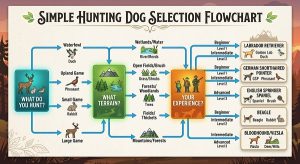
Don’t start with breed. Start with your hunt. Ask yourself these five questions.
1. What do you hunt most?
Ducks and geese point to a Lab or Chessie. Pheasants in open fields suit a GSP or English Pointer. Grouse and woodcock in tight cover favor a setter or Springer. If you do a bit of everything, look at a GSP or Brittany.
2. What’s your terrain and climate?
Heavy, thick cover favors close-working dogs like Springers. Wide open ground suits big-running pointers. In hot climates, short-coated dogs like the Vizsla, GSP, and English Pointer cope better than long-coated setters. In cold water, you want the Chessie or a Lab.
3. How experienced are you?
For a first bird dog, the Lab, Golden, and Brittany are the most forgiving. A Chessie or English Pointer asks more from the handler.
4. How much time do you have?
High-drive breeds need one to two hours of real work every day. If you can’t give that, pick a calmer dog. Our guide to how often to exercise a working dog explains why a walk around the block isn’t enough.
5. Is this a hunting dog or a family dog first?
If the dog lives in your home, temperament matters. Labs, Goldens, Brittanys, and setters usually fit family life better than a high-octane English Pointer.
Field Line vs Show Line: The Mistake That Costs Hunters Seasons
Here’s something most lists skip. The same breed can be two very different dogs.
Over decades, many breeds split into field lines (bred for hunting drive, stamina, and nose) and show lines (bred for looks). A show-line Springer or Golden can look beautiful and have little interest in birds. A field-line one may be leaner, faster, and far more intense.
To get the right dog:
- Ask the breeder for the parents’ hunt test or field trial titles.
- Ask to see the parents work, or watch videos of them.
- Ask what percentage of their puppies end up hunting.
- Be wary of a breeder who can’t answer any of these.
If you want a hunting partner, a field-line pup from proven parents is worth the extra money.
Health Testing and Lifespan
A hunting dog is an athlete, so structure and health matter. Before you pay a deposit, ask for proof of health screening on both parents. Common checks include:
- Hips and elbows: For dysplasia (organizations like OFA in the US and the BVA in the UK score these)
- Eyes: Annual eye exams for inherited eye disease
- DNA tests: For example, EIC in Labs and Chessies, and other breed-specific conditions
Most bird dogs live 10–14 years. Lean body condition is the single best thing you can do for longevity. A Lab carrying extra weight takes strain on every joint, so keep your working dog fit but not fat.
How Much Does a Bird Dog Cost?
Prices vary by country and bloodline, but these are typical US ranges.
| Cost | Typical range |
|---|---|
| Well-bred puppy (health-tested parents) | $1,000–$3,000 |
| Professional board-and-train | $150–$300 per week, or $2,000–$5,000 for a full program |
| Training gear if you DIY (check cord, whistle, bird launcher, e-collar) | $250–$700 |
| Pen-raised birds for training | $8–$15 per bird |
| Yearly costs (food, vet, licenses, gear) | $1,200–$2,000 |
Realistic first-year budget: $3,000–$8,000 with a pro trainer. DIY training costs less money but more time.
A note on e-collars: some countries and regions restrict or ban them (Wales and parts of Europe, for example). Check your local rules, and learn proper use before you buy.
Bird Dog Training Timeline
Here’s a realistic timeline based on standard gun dog progressions. Every dog moves at its own pace, so treat these as a guide.
- 8–16 weeks: Name, sit, come, leash manners, and socialization. Introduce a bird wing or a dead bird to build excitement with no pressure.
- 4–7 months: Gunfire introduction, starting far away and pairing the sound with food or play. Pointing breeds start early bird work on pen-raised birds.
- 7–12 months: Steadiness (holding still when birds flush and guns fire), whistle commands, and controlled retrieves.
- 12–18 months: Live hunting under close supervision, building range and handling in real cover.
- 18–24 months: Most dogs reach reliable “finished” work in this window. Many keep improving for years, and the second and third seasons are almost always better than the first.
The gun-shy mistake: Never fire a gun beside a young dog on day one. Start from a long distance and bring the sound closer over weeks. A gun-shy dog is usually the result of a rushed introduction, not a “bad” dog.
Training principles carry across all working dogs. Our K9 security dog handler training tips explain why short, consistent sessions beat long, frustrating ones.
A Trainer’s Notes
I’ve spent more than 14 years instructing and handling working dogs at the Nigerian Army Dog Centre, covering obedience, detection, and patrol work. The breeds and jobs differ from bird hunting, but one pattern holds in every discipline: genes get a dog in the door, and consistent training makes it reliable.
Here are the three mistakes I see most often with bird dogs.
Mistake 1: Thinking instinct means “already trained.”
A puppy that points a wing at ten weeks has raw material, not a finished dog. It still needs months of structured work before it’ll hold steady on a wild bird with another dog crashing through the cover beside it.
Mistake 2: Long, rare sessions.
Ten to fifteen minutes, several times a week, beats one long, frustrating weekend session. Dogs learn through repetition and success, and tired dogs and handlers both get sloppy.
Mistake 3: Skipping obedience.
Every bird dog needs a solid “come,” “sit,” and “whoa” before it meets a live bird. A dog that ignores you in the yard won’t listen in the field.
If I could give one piece of advice, it’s this: train the dog you have, not the dog in the YouTube video. Each dog moves at its own pace, and pushing too hard creates a gun-shy or hard-headed dog no matter how good the pedigree is.
I cover these handler habits, such as timing, consistency, and communication, in my book, Beyond the Bark: Inside a Pro Handler’s Playbook for Raising the Ideal Dog. It’s a good next read if you want to apply professional training principles to your own bird dog.
Field Safety: Heat, Cold, Hearing and Ticks
A great bird dog is also a safe one. Keep an eye on these four risks.
- Heat: Hunting dogs overheat fast, especially in warm weather. Hunt early or late, carry water, and rest often. Signs of heatstroke include heavy panting, thick drool, wobbling, and bright red gums. Cool the dog with water and see a vet right away.
- Cold water: Even a Chessie can get hypothermia. Dry the dog after a retrieve, use a dog vest for long sits, and don’t send a dog into thin ice.
- Hearing: Repeated gunfire near a dog’s ears can cause hearing loss over time. Keep the dog away from the muzzle and consider ear protection made for dogs.
- Ticks and burrs: Check the dog’s body after every hunt, especially ears, armpits, and between the toes. Use a vet-approved tick preventive.
Hunt Tests and Field Trials Worldwide
Hunt tests are a great way to measure your dog’s progress against a standard. Here’s where to look:
- AKC Hunt Tests (US): For retrievers, spaniels, and pointing breeds, with Junior, Senior, and Master levels.
- NAVHDA (North America): Tests versatile hunting breeds like the GSP, Brittany, and Vizsla.
- Hunting Retriever Club (US): Retriever tests that mimic real hunting.
- The Kennel Club (UK): Gundog working tests and field trials.
- JGHV and FCI (Germany and Europe): Strict versatile hunting dog tests, especially for Kurzhaar and Drahthaar.
Even if you never compete, entering a test shows you what your dog does well and where it needs work.
FAQs
What are the best bird dog breeds for hunting?
The most popular are the German Shorthaired Pointer, Labrador Retriever, English Springer Spaniel, English Setter, Brittany, Golden Retriever, Vizsla, and Chesapeake Bay Retriever. Pointers locate birds, spaniels flush them, and retrievers bring them back.
What is the best bird dog for a beginner?
The Labrador, Golden Retriever, and Brittany are the easiest first bird dogs. They’re eager to please and forgiving of beginner mistakes. Choose a field-line puppy from health-tested parents.
What’s the difference between a pointer, a flusher, and a retriever?
A pointer freezes to show you where a bird is. A flusher chases it into the air within gun range. A retriever marks the fall and brings the bird back to you, often through water.
How much does a bird dog cost?
A well-bred puppy usually costs $1,000–$3,000. Add $2,000–$5,000 if you use a professional trainer, plus $1,200–$2,000 each year for food, vet care, and gear.
At what age is a bird dog fully trained?
Most reach reliable, “finished” work between 18 and 24 months, but they keep improving for years. Rushing gun introduction and steadiness is the most common mistake.
Final Thoughts
There’s no single best bird dog. There’s only the best one for how, where, and what you hunt.
Wide-open fields point toward a GSP or English Pointer. Thick cover favors a Springer. Duck season belongs to a Lab or Chessie. If this is your first dog, start with a Lab, Golden, or Brittany.
Whatever you choose, the formula stays the same:
- Pick a field-line dog from health-tested parents.
- Train in short, consistent sessions and don’t skip obedience.
- Introduce gunfire slowly.
- Give the process 18–24 months.
- Keep your dog fit, safe, and part of the family.
Do that, and you’ll end up with a partner worth every season you put into it.
Want more guides like this? Subscribe to our weekly articles roundup newsletter and get new K9 and working dog articles straight to your inbox.

Her work centres on obedience, detection, protection and operational readiness. She favours proven methods built on repetition, consistency and real-world conditioning, so that both dogs and handlers are prepared for high-pressure tasks.
Rofiat represented the Nigerian Army Dog Centre at the Nigerian Army Day Celebration (NADCEL) 2026, where she led demonstrations in obedience, explosive detection, agility and tactical movement. Through articles, training content and documentaries, she shares field-based insight into how structured training, clear communication and trust between handler and dog affect performance and reliability.
She is the author of Beyond the Bark: Inside a Pro Handler's Playbook for Raising the Ideal Dog, a practical guide that helps dog owners and handlers apply professional training principles in everyday situations.
- Dog Agility Course Layout: Easy DIY Setup - October 7, 2026
- Local Dog Breeds: Temperament, Health & Training Guide - October 6, 2026
- How Long Do Military Working Dogs Serve? Full Guide - October 5, 2026