Dog Gestation Period: Complete 63-Day Expert Guide
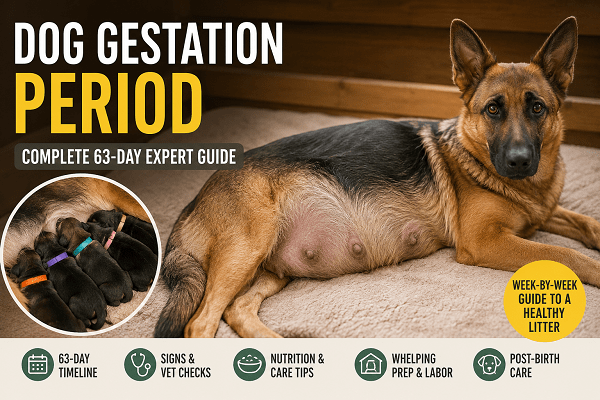
A dog’s gestation period is about 63 days (9 weeks) from ovulation. Counted from the first mating, puppies can arrive anywhere between 58 and 72 days, because mating doesn’t always happen on the day the eggs are released. The most accurate due date comes from a vet-run hormone test: 65 to 66 days after the LH surge, or about 63 days after ovulation.
Table of Contents
- Why Gestation Timing Matters (Introduction)
- Why “63 Days” Isn’t a Promise
- How to Calculate Your Dog’s Due Date (With Worked Examples)
- The Dog Pregnancy Timeline, Week by Week
- How to Confirm Pregnancy: Methods and Timing
- Breed, Litter Size and Gestation Length
- Vet Schedule and Pre-Breeding Checklist
- Feeding, Deworming and Exercise (Including Working Dogs)
- Whelping Prep, Temperature Drop and Stages of Labor
- Overdue Dogs: When Waiting Becomes Risky
- After Whelping: Caring for the Dam
- Five Mistakes I See Again and Again
- About the Author and Sources
- FAQs
- Conclusion and Final Checklist
Why Gestation Timing Matters
Here’s a question that trips up even experienced breeders: “My dog was bred on the 12th, so she’s due on the 14th of the second month, right?” Maybe. Maybe not. And that gap between “maybe” and “exactly” can decide whether you’re ready for a calm whelping at home or racing to an emergency clinic at 3 a.m.
The dog gestation period is short. Nine weeks is all you get. That means every day matters for feeding changes, deworming, X-rays and whelping prep. Whether you’re breeding a working Malinois, planning a single litter of family Labs, or just wondering how long dogs are pregnant, this guide gives you the full picture.
You’ll learn how to count the days properly, what’s happening inside your dog each week, which vet tests to book and when, and what to do if labor starts early, late or goes wrong. I’ve also included the things most pregnancy articles skip: how to adjust a working dog’s duties, how to handle an overdue bitch, and why calculating from the mating date alone can mislead you.
Quick note: This guide is educational. Your reproductive vet knows your dog’s history, so treat their advice as the final word.
Why “63 Days” Isn’t a Promise
Every article says 63 days. That’s true, but it’s only half the story.
Dogs have an unusual reproductive cycle. A female can accept a male for several days before she ovulates, and the eggs she releases aren’t ready to fertilize right away. They need roughly 24 to 72 hours to mature. Meanwhile, healthy sperm can survive in her body for 5 to 11 days.
So a mating on day one of her fertile window might not lead to fertilization until days later. That’s why counting from mating can be off by almost two weeks.
Here’s how the same pregnancy looks depending on where you start counting:
| Counting from | Expected whelping | Accuracy |
|---|---|---|
| LH surge (day 0) | 65–66 days | Most accurate. Needs vet blood tests |
| Ovulation (about 2 days after the LH surge) | About 63 days | Very accurate |
| First significant progesterone rise | 64–66 days | Very accurate |
| First mating date | 58–72 days | Rough window only |
Those figures follow the American Kennel Club’s reproductive guidance, and veterinary schools such as Colorado State University describe the same pattern: about 63 days (give or take one day) after ovulation and 65 days (give or take one day) after the LH peak.
Bottom line: if you only have the mating date, you have a window, not a date. If you want a date you can plan around, you need progesterone testing during the heat cycle.
How to Calculate Your Dog’s Due Date (With Worked Examples)
Online dog due date calculators are handy, but they all use the same simple math. Here’s how to do it yourself and what the results actually mean.
Method 1: From the LH Surge (Best)
Your vet runs progesterone tests every day or two during her heat. The LH surge happens roughly 48 hours before ovulation.
- Formula: LH surge date + 65 to 66 days
- Example: LH surge on January 10. Add 65 days and you get March 16 (in a non-leap year). Plan for March 15 to 17.
Method 2: From Ovulation
- Formula: Ovulation date + 63 days
- Example: Ovulation on January 12 gives March 16. It matches the LH example because ovulation is about two days after the surge.
Method 3: From the Mating Date Only (Rough)
- Formula: First mating + 58 days to + 72 days
- Example: First mating on January 12 gives a window from March 11 to March 25, with March 16 (day 63) as the midpoint.
That’s a two-week window. If you’re relying on it, plan for the whole stretch. Don’t circle one date on the calendar and relax.
The Best Backup: Ultrasound Dating
If you never tested hormones, a vet can estimate fetal age by measuring the puppies on ultrasound. This works best between about day 25 and day 40. Later in pregnancy, vets can measure the fetal head diameter to refine the due date.
The Dog Pregnancy Timeline, Week by Week
Here’s the quick view first, then the details. Day numbers are counted from ovulation or the LH-based estimate, and the development milestones follow AKC and veterinary school sources.
| Week | Days | What’s happening | What you do |
|---|---|---|---|
| 1–2 | 0–14 | Fertilization; embryos travel to the uterus | Keep her routine normal |
| 3 | 15–21 | Embryos float in the uterus; implantation starts around day 18–23 | Watch appetite; no new meds |
| 4 | 22–28 | Fetuses take shape; heartbeats visible by ultrasound around day 25–30 | Book ultrasound |
| 5 | 29–35 | Eyelids form (day 32), toes visible (day 35) | Start the diet switch |
| 6 | 36–42 | Nails form (day 40); rapid growth | Start deworming plan if your vet agrees (day 40) |
| 7 | 43–49 | Coat and skeleton develop (about day 45) | Introduce whelping box |
| 8 | 50–56 | Movement visible; X-ray can count puppies by about day 55 | Book X-ray; set up kit |
| 9 | 57–63+ | Nesting (day 58–62); temperature drop; labor | Temperature checks twice a day |
Weeks 1 and 2 (Days 0–14): Quiet Start
Fertilization happens, but you won’t see a thing. Your dog may seem completely normal, and that’s fine. Skip diet changes, new supplements and stressful events. Don’t give any medication unless your vet approves it.
Week 3 (Days 15–21): Implantation Begins
The embryos settle into the uterine wall around day 18 to 23. A few dogs get mild “morning sickness” with a slightly lower appetite or a bit of vomiting. If she’s bright, drinking and eating a little, it’s usually normal. If she’s dull, vomiting repeatedly or refusing all food, call your vet.
Week 4 (Days 22–28): First Confirmation
The fetuses take shape by day 22. A vet using ultrasound can usually see pregnancy and detect heartbeats around day 28 to 30. Some vets can feel the embryos by gentle abdominal palpation around days 20 to 28, but that takes real skill. Never try it at home, because you can hurt the pups.
You might notice “pinking up”: nipples that look slightly larger and pinker. She may also get more affectionate or a little quieter.
Week 5 (Days 29–35): Puppies Look Like Puppies
Eyelids form by day 32 and toes are visible by day 35. Her belly starts to fill out, especially on slim breeds. This is a good time to begin switching to a higher-quality diet, slowly, over about a week.
Week 6 (Days 36–42): Growth Spurt
Nails form around day 40. The puppies are growing fast, and she may pant more, get uncomfortable or vomit once in a while because of the pressure. A clear, odorless discharge is normal. Anything cloudy, bloody, green or foul-smelling needs a vet visit.
Week 7 (Days 43–49): Coat and Skeleton
The coat and skeleton develop around day 45, and fetal skeletons show up on radiographs around day 46. Her appetite may dip briefly around day 45 as the uterus presses on her stomach. Offer smaller, more frequent meals. Her abdomen is firm now.
This is the week to introduce the whelping box. Let her sniff it, sleep in it and treat it as hers.
Week 8 (Days 50–56): Movement and the X-ray
You can often see or feel puppies moving. By about day 55, an X-ray can count them reliably. (Earlier skeleton shadows exist, but the count is easiest to trust once the skeletons are well mineralized.) Knowing the count matters enormously. When she finishes whelping, you’ll know whether she’s truly done or still has a puppy inside.
Week 9 (Days 57–63+): The Final Stretch
Puppy development is basically complete by day 58. She may look for a nesting spot around day 58 to 62, and her waist can look trimmer as the puppies move into position. Many dogs lose their appetite around day 61 to 62. The next 12 to 24 hours after her temperature drops is when things usually start. More on that below.
How to Confirm Pregnancy: Methods and Timing
There’s no reliable early at-home test. Here’s what vets actually use:
| Method | Best timing | What it tells you |
|---|---|---|
| Abdominal palpation | About day 20–28 | Maybe detects embryos; needs expert hands |
| Relaxin blood test | About day 27–30 after breeding | Pregnant or not. No puppy count or due date |
| Ultrasound | About day 25–30 onward | Confirms pregnancy, shows heartbeats, helps judge viability |
| X-ray (radiograph) | About day 55 | Counts puppies; checks size against her pelvis |
Two important notes:
- Commercial “pregnancy tests” don’t give you milestone dates. They won’t tell you the due date or stage.
- False pregnancy is real. A non-pregnant dog can show nesting, weight gain and even milk. If the signs don’t match your dates, get an ultrasound before you spend money on a whelping setup.
Signs by Stage
- Weeks 3–4: Pinker nipples, a quieter or clingier dog, mild morning sickness
- Weeks 5–6: Bigger appetite, weight gain, more urination, a clear discharge
- Weeks 7–8: Firm belly (around days 45–50), visible puppy movement (around day 50)
- Week 9: Nesting, panting, restlessness, loss of appetite, a drop in temperature
Breed, Litter Size and Gestation Length
Here’s a surprise for many owners: a Chihuahua and a Great Dane both run about 63 days from ovulation. What changes is litter size. These ranges are typical, and individual dogs vary a lot.
| Breed | Gestation from ovulation | Typical litter size |
|---|---|---|
| Chihuahua | ~63 days | 1–3 |
| French Bulldog | ~63 days | 2–4 |
| Labrador Retriever | ~63 days | 6–8 |
| Golden Retriever | ~63 days | 6–8 |
| German Shepherd | ~63 days | 5–9 |
| Belgian Malinois | ~63 days | 5–10 |
Some websites claim that big litters always come early and small litters always come late. Veterinary sources don’t confirm a strict rule, so treat it as a tendency at best. Rely on hormone-based dating instead.
Breed risk matters more than breed timing. Dystocia (difficult birth) happens in under 5% of deliveries overall, according to AKC reporting, but research shows it’s considerably higher in Chihuahuas, Pugs, Boston Terriers and French Bulldogs. If you own one of those breeds, talk to your vet early about a planned C-section or close monitoring.
Vet Schedule and Pre-Breeding Checklist
The best pregnancy starts before the mating. Book these with your vet:
Before Breeding
- Health testing for your breed (hips, elbows, eyes, heart and so on)
- Vaccinations up to date at least two weeks before breeding. Don’t vaccinate during pregnancy unless your vet says so
- Brucellosis test. It’s a contagious bacterial infection that can cause abortion and infertility. Many breeding programs test annually and before every new mating
- Parasite screening and a deworming plan
- Body condition check. Overweight bitches have lower conception rates and higher dystocia risk, so get her fit before breeding
- Progesterone testing to pin down ovulation
During Pregnancy
- Days 25–30: Ultrasound to confirm pregnancy
- Around day 40: Deworming plan starts (see below)
- Around day 55: X-ray to count puppies
- Around day 55–57: Discuss your whelping plan, emergency number and C-section option.
Feeding, Deworming and Exercise (Including Working Dogs)
Feeding Your Pregnant Dog
Vet nutrition guidance is consistent on the big picture. A high-quality adult food is fine early on. Most of the extra feeding comes late:
- First half of pregnancy: Keep her on her normal, good-quality diet. Her intake rises only slightly (about 10% above maintenance in the first weeks).
- From about week 5 to 6: Transition gradually, over about a week, to a quality puppy, performance or gestation diet.
- Last four weeks: Increase food gradually, roughly 25–30% over the last four weeks, and more if she carries a big litter. Veterinary references show intake can reach about 40% above maintenance in late pregnancy.
- Split the meals. Three or four small meals work better because the uterus leaves little stomach room.
- Don’t over-supplement calcium. A good gestation or puppy diet already covers it. Extra calcium before whelping can backfire and raise the risk of problems after birth.
- Don’t skip carbohydrates. Bitches on carb-poor diets can develop low blood sugar in the last two weeks.
- Expect a dip. Many bitches stop eating 24 to 48 hours before delivery. That’s common, not an emergency, if everything else looks normal.
For a deeper look at building a balanced feeding plan, see our guide on Best Nutrition and Health Tips for Working Dogs.
Deworming: The Step Most Guides Skip
Roundworm larvae can sleep in a bitch’s muscle tissue and wake up during late pregnancy, then cross to the puppies. Veterinary references describe fenbendazole starting around day 40 of pregnancy and continuing until a couple of days after whelping (some protocols run longer). Protocols differ between countries and clinics, so never self-prescribe dosage. Ask your vet which product and schedule they want.
Exercise and Working Dogs
This is the part nobody explains clearly, and it’s where handlers feel the most pressure.
For the first three to four weeks, a healthy working dog can usually keep her normal routine, but I’d already cut back anything extreme. From week 4 or 5 onward, here’s how I’d approach it:
- Stop: bite work, decoy contact, high jumps, hard agility, rough group play and long-distance running
- Keep: regular walks, gentle obedience and scent games (these keep her mind busy without stressing her body)
- Last two weeks: short, calm walks only. Keep her away from other dogs
- Don’t drive a pregnant dam to “just finish” a course or a deployment. Take her off duty for the pregnancy and nursing period
That last point matters for operational kennels. A dam that’s retired from active tasking during the whole cycle is far safer than one pulled in at the last minute.
Whelping Prep, Temperature Drop and Stages of Labor
Whelping Box and Kit (Ready by Day 49 to 55)
- Whelping box in a warm, dark, quiet room away from other pets
- Clean towels, newspapers or washable pads
- Digital rectal thermometer and lubricant
- Kitchen scale and notebook for birth times and weights
- Puppy ID collars or colored ties
- Heat lamp or heating pad with safe thermostat control (puppies need around 29 to 32°C / 85 to 90°F in the first week)
- Clean scissors, unwaxed dental floss, a bulb syringe, disinfectant and gloves
- A fully charged phone with your vet’s and emergency clinic’s numbers saved
- A confirmed plan for transport at any hour
The Temperature Trick That Predicts Labor
This one tool saves breeders sleepless nights. Start twice-daily rectal temperature checks about a week before the due date to learn her baseline. A normal temperature usually sits around 100 to 102°F (37.8 to 38.9°C). About 12 to 24 hours before labor starts, it often drops below 99°F (37.2°C).
- A drop means: get ready, because labor is likely within a day
- A drop with no labor after 24 hours: call your vet
- Normal temperature plus hard straining: call your vet. Not every dog drops cleanly
The Three Stages of Labor
Stage 1: Contractions begin (about 12–24 hours). You may see pacing, panting, shivering, nesting, vomiting and refusal of food. The cervix is opening, and often nothing obvious happens on the outside.
Stage 2: Puppies are born. A sac or a puppy appears at the vulva. A puppy usually follows every 30 to 60 minutes, and each delivery should not take more than 1 to 2 hours. Puppies may arrive head first or tail first, and both are normal.
Stage 3: Placentas. These are delivered after each puppy, or sometimes after two puppies together. Stages 2 and 3 overlap. Count the placentas to make sure none stays inside.
Call Your Vet Right Away If:
- She has strong, steady contractions for 30 to 60 minutes with no puppy
- More than two hours pass between puppies while she’s still in labor
- Labor lasts over 24 hours overall
- Green discharge appears before the first puppy. It can mean a placenta has separated and the puppy needs help fast
- She’s in obvious severe pain, collapses, or has heavy bleeding or foul-smelling discharge
- You know (from the X-ray) that puppies remain, but she’s gone quiet for hours.
Overdue Dogs: When Waiting Becomes Risky
This is the question people search at midnight, yet most guides barely touch it.
Whelping usually lands at 63 days (±1) from ovulation or 65 days (±1) from the LH surge. If you used hormone testing and she hasn’t started labor within about two days of the end of that range, call your vet that day. Don’t wait for “day 70.”
If you only know the mating date, use the window as a guide, but watch for these signs of trouble:
- No temperature drop and no nesting, well past your expected window
- Green or bloody discharge with no puppies
- She’s lethargic, vomiting or drinking excessively
Your vet may use another ultrasound to check heartbeats, a progesterone level, or a planned C-section. Stress in the puppies can build while you wait, so early advice is cheap insurance.
After Whelping: Caring for the Dam
- Lochia (post-birth discharge) can be green, red or brown and usually lasts three to eight weeks. A foul smell or a sudden increase in flow suggests infection and needs a vet
- Mastitis: check her mammary glands daily for heat, redness or hard lumps. If you see any, take her temperature and call your vet
- Eclampsia (low blood calcium): trembling, restlessness, stiff walking or collapse during nursing is an emergency. Call your vet immediately
- Food and water: she may refuse to leave her puppies, so bring meals and fresh water to the box. Her energy needs peak during nursing and can rise to several times her normal intake
- Rest: give her short breaks. Mothers can get snappy two to three weeks after whelping, so keep visitors limited
When the puppies reach about four weeks, you’ll move into weaning. Our guide on What to Feed Puppies from Week 1 to Month 12 walks through the feeding schedule step by step.
Selling or placing puppies later? Early socialization is where the first foundations get built. Our crate training guide is a great handout for new owners.
Five Mistakes I See Again and Again
- Treating the mating date like a due date. It’s a window. Use progesterone testing if you want precision.
- Over-supplementing calcium. Good gestation food already covers it.
- Skipping the X-ray. Without a puppy count, you won’t know if whelping is finished.
- Waiting too long to call the vet. Two hours between puppies in labor is the limit, not the starting point.
- Working the dam too hard. High-impact work late in pregnancy puts her and the litter at risk.
About the Author and Sources
Written by Cpl. Rofiat Muritala, a Nigerian Army military working dog instructor and handler with more than 14 years of experience at the Nigerian Army Dog Centre. Her work covers dog selection, foundational training, behavior shaping and performance evaluation in real operational environments. She represented the Nigerian Army Dog Centre at the Nigerian Army Day Celebration (NADCEL) 2026 and is the author of Beyond the Bark: Inside a Pro Handler’s Playbook for Raising the Ideal Dog.
How this guide was built: The timelines, hormone-based counting methods and veterinary milestones come from published veterinary and kennel-club sources.
Sources to reference:
- American Kennel Club, The Reproductive Cycle in Dogs: From Breeding to Birthing (akc.org)
- Colorado State University Veterinary Teaching Hospital, Pregnancy and Whelping (vetmedbiosci.colostate.edu)
- ESCCAP, Worm Control in Dogs and Cats, pregnant bitch guidance (esccap.org)
- dvm360 veterinary proceedings on managing the pregnant bitch
- Merck Veterinary Manual, pregnancy determination and dystocia in small animals
This article is for education and doesn’t replace advice from your veterinarian.
FAQs
1. How long are dogs pregnant?
Dogs are pregnant for about 63 days from ovulation, or roughly nine weeks. From the first mating, whelping can fall anywhere between 58 and 72 days. Breed doesn’t change the length much.
2. Can you tell how many puppies your dog is carrying?
Ultrasound gives a rough idea, but an X-ray around day 55 is the best way to count. At that stage, the puppies’ skeletons show clearly.
3. What temperature means a dog will give birth soon?
A drop below about 99°F (37.2°C), from her normal 100 to 102°F, usually means labor is coming within 12 to 24 hours. Take her temperature twice a day in the last week so you know her baseline.
4. When should I worry that my dog is overdue?
If you used hormone testing, call your vet if she hasn’t started labor within about two days after day 65 from the LH surge. Call at once if she shows green discharge, lethargy, vomiting or heavy straining with no puppies.
5. When should I change my pregnant dog’s food?
Most vets suggest switching gradually to a puppy or gestation diet around week 5 to 6, then increasing the amount by about 25 to 30% over the last four weeks. Small, frequent meals work best.
Conclusion and Final Checklist
The dog gestation period looks simple on paper, but small details decide how smoothly it goes. Count from hormones when you can. Treat the mating date as a window. Book your ultrasound around day 28, your X-ray around day 55, and start temperature checks a week before the due date. Feed smart, keep the dam fit but safe, and call your vet early, not late.
Your quick checklist:
- Pre-breeding vet check, brucellosis test and vaccines (at least 2 weeks before breeding)
- Progesterone testing to find ovulation
- Ultrasound at days 25–30
- Diet switch around week 5–6; gradual increase in the last 4 weeks
- Deworming plan from day 40 (vet’s advice)
- X-ray around day 55
- Whelping box introduced by day 49
- Temperature checks twice daily in the final week
- Emergency vet number and transport plan ready
Want the handler’s playbook for raising the puppies that come next? My book, Beyond the Bark: Inside a Pro Handler’s Playbook for Raising the Ideal Dog, covers the professional training principles you can use from the first weeks of a puppy’s life.
Get one useful K9 article every week. Subscribe to the ARFS K9 Team weekly roundup newsletter and never miss a new breeding, health or training guide.

Her work centres on obedience, detection, protection and operational readiness. She favours proven methods built on repetition, consistency and real-world conditioning, so that both dogs and handlers are prepared for high-pressure tasks.
Rofiat represented the Nigerian Army Dog Centre at the Nigerian Army Day Celebration (NADCEL) 2026, where she led demonstrations in obedience, explosive detection, agility and tactical movement. Through articles, training content and documentaries, she shares field-based insight into how structured training, clear communication and trust between handler and dog affect performance and reliability.
She is the author of Beyond the Bark: Inside a Pro Handler's Playbook for Raising the Ideal Dog, a practical guide that helps dog owners and handlers apply professional training principles in everyday situations.
- Westminster Dog Show 2026: Winners & Full Results - October 17, 2026
- 10 K9-Approved Tricks to Teach Your Dog (Step-by-Step) - October 16, 2026
- COBA National Dog Championship 2026: Full Guide - October 15, 2026