5 K9 Police Training Drills for Malinois: Handler Guide
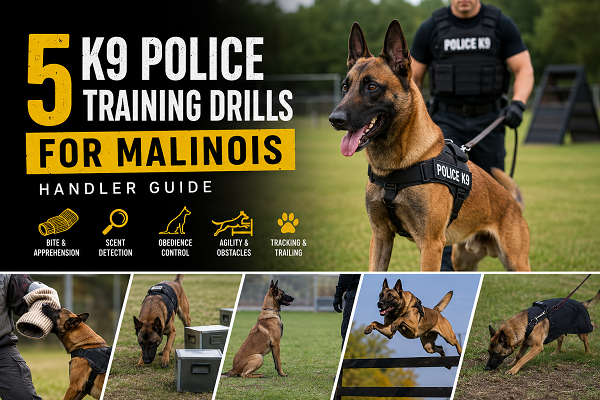
The five core K9 police training drills for a Belgian Malinois are:
- Obedience under distraction
- Controlled bite work with a reliable “out” and call-off
- Scent detection
- Tracking
- Agility and environmental conditioning
Handlers should train them in that order. Control comes before bite work, and every drill needs repeated proofing in new places. Initial police dog training usually takes between eight months and a year, and the real work starts after that, with regular maintenance training. A police Malinois isn’t finished when it graduates. It’s only ready to start learning the job.
Table of Contents
- Introduction: Why Most Malinois Training Plans Fail
- Before You Start: Is Your Malinois Ready?
- Why Police Units Choose the Malinois
- Drill 1: Obedience Under Distraction
- Drill 2: Controlled Bite Work, Out and Call-Off
- Drill 3: Scent Detection
- Drill 4: Tracking
- Drill 5: Agility and Environmental Conditioning
- A Sample Weekly Training Plan
- Pass or Fail: What “Ready” Looks Like
- Safety, Welfare and Legal Risk
- Realistic Timelines and Costs
- My Handler Experience
- FAQs
- Conclusion
Introduction: Why Most Malinois Training Plans Fail
Ever watched a Malinois hit a sleeve at full speed, then let go the moment the handler says “out”? That moment looks simple. It isn’t. It’s the result of hundreds of boring repetitions that nobody films.
Here’s the problem I see again and again. People get a high-drive Malinois, jump straight to the exciting stuff (bite work, mostly), and skip the groundwork. Six months later they have a fast, powerful, frustrated dog that won’t listen when it’s excited. That dog isn’t a police K9. It’s a liability.
In this guide, you’ll learn the five K9 police training drills for Malinois in the order that actually works. For each one, you’ll get what it builds, how to run it step by step, how long it takes, the mistakes that trip people up, and the pass/fail standard to aim for. I’ll also cover what most guides skip: a weekly schedule, handler readiness, welfare and legal risk.
Before You Start: Is Your Malinois Ready?
Skip this section and the rest of the guide won’t help you. Most top-ranking articles skip it.
Check the dog first:
- Working-line breeding. Pet-line Malinois usually lack the nerve strength and drive for patrol work.
- Solid nerves. The dog should recover quickly after a loud noise, a slippery floor or a surprise. Fear is a bad base for bite work.
- Age and growth. Early work should be play-based. Hard grips, jumping and impact work wait until the dog is physically mature.
- A clean vet check. Hips, elbows, spine and heart come first.
Check the handler too. Wikipedia’s summary of police dog programs notes that handlers must first finish police academy training and usually serve one to two years of patrol experience before joining a canine unit. That’s no accident. Reading a dog under pressure is a skill, and you can’t learn it from a video.
If you’re a civilian or a private security handler, the same rule applies in spirit. Work with an experienced trainer and a qualified decoy before you try anything on the list below.
Why Police Units Choose the Malinois
Cairo is the Malinois most people know. He was a seventy-pound Belgian Malinois who flew with SEAL Team Six on the 2011 Abbottabad raid. But the breed’s popularity in police work comes from everyday traits, not one famous mission.
What handlers like about the breed:
- Speed and agility. Malinois are lighter than most German Shepherds, so they accelerate fast and change direction quickly.
- Drive. They work hard for a toy or a bite, which makes reward-based training very effective.
- Sound joints. One large study of breed prevalence listed the Belgian Malinois at 5.2% for canine hip dysplasia, while the German Shepherd came in at 18.9%. That’s a big gap for a dog that jumps, bites and sprints for a living.
- Fast learning. They pick up patterns quickly, which is great and also risky. They pick up your mistakes just as fast.
That last point is the catch. A Malinois punishes sloppy timing. If you’re late with a reward or loose with a command, it won’t “just figure it out.” It will learn the wrong thing.
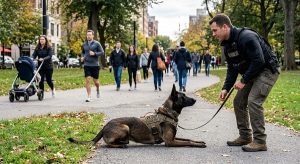
Drill 1: Obedience Under Distraction
I put this first on purpose. Many guides list bite work first because it’s exciting. But a dog that can’t hold a stay near a crowd shouldn’t be anywhere near a decoy.
What this drill builds
Reliable heel, sit, down, stay and recall when the world is loud and busy. It also builds impulse control, which is the dog’s ability to stay calm and wait for your cue when it’s excited.
How to run it
- Teach in a quiet place. Use food or a toy, whichever your dog values more. Keep sessions short, about 5 to 10 minutes.
- Add one distraction at a time. Start with a person walking past at a distance, then a dropped toy, then another dog far away.
- Shorten the distance. Only move closer when the dog gets it right 8 out of 10 times.
- Add noise and movement. Traffic, slamming doors, vehicles, crowds.
- Add gunfire sounds the right way. Start very quiet and far away, and pair it with a reward. Work up slowly over several weeks. Rushing this step is how handlers create a gun-shy dog.
- Build duration and distance. Work toward long stays and recalls from far away.
- Test off-leash in a safe, fenced area only after the earlier steps are solid.
The 3-2-1 proofing rule (my simple trick)
Change one thing at a time: the place, the distraction or the distance. If you change all three, you won’t know why the dog failed.
Common mistakes
- Moving to high distraction before the dog is reliable at low distraction
- Using different words for the same command
- Skipping long stays because they’re boring
Success marker
The dog holds a down-stay while you walk out of sight, and recalls instantly with a distraction nearby.
Drill 2: Controlled Bite Work, Out and Call-Off
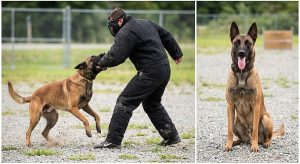
This is the drill everyone pictures. But in police work, bite control matters more than bite power.
What this drill builds
A full, calm grip, a clean release on command (“out”), and the ability to break off a chase on a recall (“call-off”). One agency standard I found, from the South Carolina Criminal Justice Academy’s patrol canine requirements, lists recall and verbal out in a reasonable amount of time as a pass requirement. Notice it doesn’t say “bites hard.”
Also, certifying bodies care about this. The North American Police Work Dog Association (NAPWDA), founded to set a working standard for police work dogs, handlers and trainers, runs workshops where teams practice bite targeting, recall, out/removal and redeployment decisions. napwdaitoa
How to run it
- Build the game first. Start with a tug or a puppy bite rag. The dog should love to chase and grip.
- Teach the out as a game. Say the cue, wait for the release, then give the toy back right away. The dog learns that letting go makes the fun return. Never rip the toy away.
- Move to the sleeve. Work with a trained decoy. Focus on a full, calm grip.
- Add the hold-and-release routine. The dog bites, holds, hears “out,” releases and settles.
- Add suit work and scenarios. Vary the decoys, the places and the pressure.
- Teach call-off before contact. This is the hardest skill and the one with the most legal weight. Start with a decoy running away at a short distance, call the dog off, and reward big.
- Practice “out” when the dog is at its most excited. A release that only works when the dog is calm is a release that won’t work when it matters.
If you want a step-by-step on the grip itself, read our guide on bite sleeve training and how to build a perfect grip.
Common mistakes
- Starting suit work before the out is automatic
- Always letting the dog “win” and never practicing control during the bite
- Using one decoy only, so the dog learns that one person instead of the skill
- Harsh corrections that create fear or conflict instead of confidence
Success marker
The dog releases on the first command, calmly, and recalls from a running decoy without hesitation.
Safety note: Don’t try bite work at home without a qualified trainer and a trained decoy. Poor bite training is how you get an unpredictable dog.
Drill 3: Scent Detection
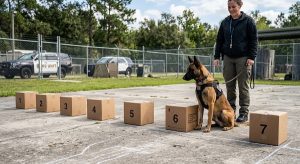
Bite work gets the attention, but detection is where many police Malinois earn their keep every single shift: narcotics, explosives, firearms, currency and more.
What this drill builds
A dog that searches a space in a pattern and gives a clear, consistent final response (usually a sit, down or stare) when it finds the target odor.
How to run it
- Imprint the odor. Pair the target scent with an immediate reward. Most Malinois work best for a toy.
- Teach discrimination. Use several containers. Only one holds the target odor. Reward only that one.
- Shape the final response. Wait for a calm, steady response, not a frantic scratch or a bite at the source.
- Change the environment. Move to cars, bags, rooms, warehouses and outdoor areas. A dog that only works in one room hasn’t learned the odor. It’s learned the room.
- Add distractions. Food, other dogs, people, heat, wind and noise.
- Run blind searches. The handler shouldn’t know where the odor is. Dogs read handlers, so blind tests show what the dog really knows.
- Run “blank” searches. Sometimes there’s nothing to find. This teaches the dog that searching is fun even when it doesn’t pay.
Common mistakes
- Rewarding “close enough” responses
- Always hiding the odor in the same kind of place
- Never running blank searches
- Handlers cueing the dog without realizing it
Success marker
The dog finds odor in new locations, ignores distractions, and gives a clean final response without handler help.
Drill 4: Tracking
Tracking turns a Malinois’s nose and stamina into something useful: finding a missing person, following a suspect or locating dropped evidence.
What this drill builds
The ability to follow one person’s scent along a path, stay on it through distractions, and show the handler what it found along the way.
How to run it
- Start with short, fresh tracks. Lay a short track on grass and put food or a toy at the end. Keep it simple.
- Teach the dog to stay “nose down.” Reward at the end, and also along the track at first.
- Age the track gradually. Let it sit longer before the dog runs it.
- Add turns and length. Straight lines first, then corners, then longer tracks.
- Change the ground. Grass, gravel, pavement, leaves, mud.
- Add cross-tracks. Have another person walk across the path so the dog learns to stay on the right scent.
- Teach article indication. The dog marks a dropped item (a wallet, a keys-sized object) without picking it up.
If you work with missing-person or rescue dogs, our guide on how search and rescue dogs work shows how the same nose skills carry into rescue work.
Heat and fitness warning
Track in the cool parts of the day. Hot weather and hard work are a dangerous mix. One department reported that its 7-year-old Malinois, K9 Draco, suddenly collapsed while conducting a track during a routine training exercise and later died. The report didn’t give a cause, so I won’t guess at one. But it’s a good reminder that tracking is hard physical work. Watch your dog’s breathing, water breaks and recovery every session.
Common mistakes
- Making tracks too old or too long, too fast
- Only ever tracking on grass
- Forgetting to reward the dog during the track
- Handlers pulling on the line and steering the dog
Success marker
The dog follows a stranger’s track across mixed ground, ignores cross-tracks and finds articles.
Drill 5: Agility and Environmental Conditioning
Malinois are famous for scaling walls and clearing obstacles, but real police work isn’t a sports field. This drill builds a confident, careful dog that can handle stairs, slippery floors, narrow gaps, vehicles and unstable ground.
What this drill builds
Body awareness, balance, courage and good judgment around unfamiliar surfaces and structures.
How to run it
- Start low and stable. Ramps, low platforms and wide boards. Reward calm.
- Add instability slowly. Wobble boards, see-saws and uneven ground.
- Teach stairs, catwalks and tunnels. Pair every new surface with a reward.
- Practice vehicle work. Getting in and out of cars, vans and trucks calmly.
- Introduce height only when the dog is ready. Don’t ask for big jumps from a young or tired dog.
- Train the dog when it’s slightly tired. Real jobs don’t happen when the dog is fresh. Do this carefully and only with healthy, fit dogs.
- Vary the course. If the layout never changes, the dog memorizes it instead of thinking.
A good way to start is our post on 5 easy dog agility exercises to start today.
Common mistakes
- Pushing height before confidence
- Too many high-impact jumps, which strain joints
- Never changing the obstacles
- Ignoring recovery days
Success marker
The dog tackles an unfamiliar obstacle calmly, thinks before it moves and doesn’t panic on bad footing.
A Sample Weekly Training Plan
Most competitor guides give you five drills and no schedule. Here’s a simple starting layout for a dog already past the puppy stage. Adjust it for your dog’s age, fitness and job.
| Day | Main Focus | Session Length | Notes |
|---|---|---|---|
| Mon | Obedience under distraction | 20–30 min | Heavy on impulse control |
| Tue | Detection + short tracking | 30 min total | Cool part of the day |
| Wed | Light play / rest | 10–15 min | Active recovery |
| Thu | Bite work + out/call-off | 20 min | With a qualified decoy only |
| Fri | Agility / environmental | 20–30 min | Vary the obstacles |
| Sat | Mixed scenario | 30–45 min | Combine 2–3 skills |
| Sun | Rest | None | Real rest, no hard work |
For a sense of how serious departments keep skills sharp after graduation, one Wisconsin department reported that its K9 team trains twice a month, 16 hours a month, with drug work, tracking and bite work in the mix. Training doesn’t stop when the certificate arrives.
Pass or Fail: What “Ready” Looks Like
Use these as practical benchmarks, not official standards. Your agency or certifying body sets the real ones.
| Drill | “Ready” Looks Like |
|---|---|
| Obedience | Holds stay and recalls with crowds, noise and other dogs around |
| Bite + out | Releases on the first command at peak excitement; breaks off a chase on recall |
| Detection | Finds target odor in new places, gives a clean response, passes blind and blank searches |
| Tracking | Follows a stranger’s track on mixed ground, ignores cross-tracks, indicates articles |
| Agility | Handles unfamiliar obstacles calmly and recovers fast from a slip |
Note on certification: Rules differ by country and agency. In the US, groups like NAPWDA and others test teams for certification. In the UK and Europe, national and force-level standards apply. Always check the rules that apply to your unit.
Safety, Welfare and Legal Risk
This is where good handlers separate from risky ones.
Welfare
- Watch fatigue. Malinois hide tiredness well. Plan rest instead of waiting for the dog to show it.
- Protect joints. Warm up and cool down. Limit repetitive jumping.
- Manage heat. Train early or late in warm climates. Always carry water.
- Keep sessions short and positive. Stop on a win.
Safety
- Never skip the out. A dog that won’t release is a danger to people and to itself.
- Rotate decoys and locations. This stops the dog from learning only one person or one place.
- Use qualified decoys. Bad decoy work ruins dogs.
- Keep training logs. Date, drill, result, weather and the dog’s condition. Logs help you spot problems early and protect you if your work is questioned.
Legal risk
In many places, a police dog bite is treated as use of force, so officers and agencies can face real scrutiny. That’s why call-off and out training carry so much weight. Check your local laws, department policy and legal advice for your area. I’m a trainer, not a lawyer, so treat this as a heads-up and not legal advice.
Know when to stop. If a dog shows real fear, unpredictable aggression or poor nerves, pushing harder makes it worse. Some dogs shouldn’t do patrol work, and a good handler accepts that early.
Realistic Timelines and Costs
Numbers vary a lot by country, agency and dog. Treat these as rough ranges, and check with your own vendor or academy for current prices.
| Stage | Typical Time | Notes |
|---|---|---|
| Foundation obedience | 8–12 weeks | Faster for some dogs, slower for others |
| Detection-only training | Roughly 3–6 months | Depends on odor types |
| Dual-purpose (patrol + detection) | Roughly 8–12+ months | Matches the general “eight months to a year” range for police dogs |
| Maintenance training | Ongoing | Monthly at minimum; many units train weekly |
On cost, working-line Malinois and full training programs can run into the tens of thousands of dollars in many Western countries. Older press reports from 2011 put the cost of a top-tier military counter-terrorism dog at roughly $12,000 to $20,000, and prices have generally gone up since. Always get current quotes.
My Handler Experience
I’m Cpl. Rofiat Muritala, a Nigerian Army military working dog instructor and handler with more than 14 years at the Nigerian Army Dog Centre. My work covers dog selection, foundation training, obedience, detection, protection and performance evaluation. In 2026, I led demonstrations at the Nigerian Army Day Celebration (NADCEL) in obedience, explosive detection, agility and tactical movement.
Here’s what that experience has taught me about these five drills:
- Obedience is the base of everything. Every failed drill I’ve reviewed traced back to weak control.
- Detection and tracking need patience. Dogs rushed through these stages look fine in the yard and fall apart in real conditions.
- Handlers cause more problems than dogs do. Late rewards, mixed commands and poor reading of body language ruin more dogs than any difficult breed trait.
FAQs
1. How long does it take to train a police Malinois?
Most police dogs need eight months to a year of initial training, depending on the role and program. Detection-only dogs can be faster, and dual-purpose patrol dogs usually take longer. After that, training continues for the dog’s whole career.
2. Which drill should I teach first?
Obedience under distraction. A dog that can’t control itself around distractions can’t do bite work, detection or tracking safely or reliably.
3. Can any Belgian Malinois become a police dog?
No. Agencies look for working-line dogs with strong nerves, drive and sound structure. Many dogs wash out. That’s normal and responsible, not a failure.
4. When should a Malinois start bite work?
Start with play and tug games as a puppy, but keep hard, high-impact bite work for when the dog is physically mature and has a solid out and basic control. Ask your trainer and vet to check your dog’s readiness.
5. Can I train a Malinois for police-style work at home?
You can safely do obedience, scent games and basic tracking at home. Leave bite work, suit work and call-off training to a qualified trainer with a qualified decoy.
Conclusion
The five K9 police training drills for Malinois (obedience under distraction, controlled bite work with a reliable out, scent detection, tracking, and agility with environmental conditioning) work best as a team, not as separate skills. Control comes first. Each skill gets proofed in new places. And training never really ends.
Your next steps:
- Check your dog’s readiness and your own before you start.
- Build obedience under distraction first, using the 3-2-1 proofing rule.
- Work bite training only with a qualified decoy, and test the out at peak excitement.
- Use the weekly plan, keep a training log and schedule rest days.
- Plan your first 30 days around the foundation, not the flashy stuff.
Want to build a full program from the ground up? Our guide on how to start a military K9 training program walks you through the planning side. And for a deeper look at reading your dog’s drive and building the right handler habits, grab my e-book, Beyond the Bark: Inside a Pro Handler’s Playbook for Raising the Ideal Dog.
Get a K9 training tip in your inbox every week. Subscribe to our weekly articles roundup at arfsk9team.com.ng/newsletter.

Her work centres on obedience, detection, protection and operational readiness. She favours proven methods built on repetition, consistency and real-world conditioning, so that both dogs and handlers are prepared for high-pressure tasks.
Rofiat represented the Nigerian Army Dog Centre at the Nigerian Army Day Celebration (NADCEL) 2026, where she led demonstrations in obedience, explosive detection, agility and tactical movement. Through articles, training content and documentaries, she shares field-based insight into how structured training, clear communication and trust between handler and dog affect performance and reliability.
She is the author of Beyond the Bark: Inside a Pro Handler's Playbook for Raising the Ideal Dog, a practical guide that helps dog owners and handlers apply professional training principles in everyday situations.
- How to Enter the COBA National Dog Championship - October 20, 2026
- K9 Advantix Dosage Chart & Safety Guide for Dogs - October 19, 2026
- How to Set Up & Use Bousnic Dog Training Collar - October 18, 2026