Best K9 Ear Protection: NRR Ratings, Fit Guide & Reviews
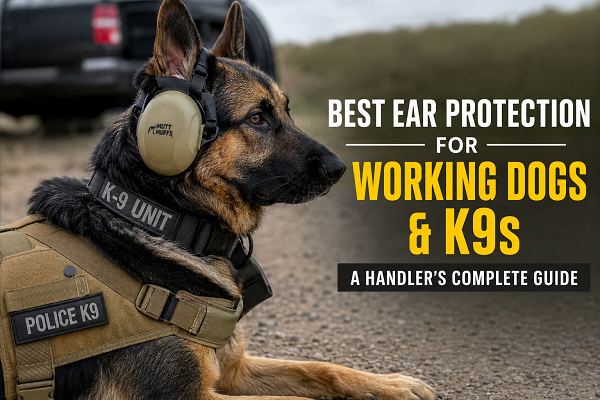
What’s the best ear protection for working dogs? The best K9 ear protection is a snug, well-sealed hearing protector that matches your dog’s job. A low-profile hood or wrap like Rex Specs Ear Pro suits gunfire and tactical work. An over-the-head muff like Mutt Muffs suits helicopters, travel, and hunting. Fit matters more than the number on the box, because a muff that doesn’t seal blocks far less noise than its rating claims.
What NRR do you need? Aim for the highest realistic attenuation you can get with a good seal (roughly 20-28 dB). Treat any rating as a best case. Even then, no muff makes live gunfire safe, so distance and short exposure still matter.
How long does training take? Most dogs accept ear protection within one to three weeks of gradual, reward-based introduction.
Table of Contents
- Why Working Dogs Need Ear Protection
- How Loud Is Too Loud? Decibel Levels by Job
- NRR Explained for Dogs (and Why the Box Number Lies a Little)
- Signs of Hearing Damage in Working Dogs
- Types of Dog Hearing Protection
- Product Reviews: Rex Specs, Mutt Muffs, PROHEAR and More
- Fit Guide: How to Measure and Check the Seal
- How to Train Your Dog to Wear Ear Protection
- Best Ear Protection by Job
- Care, Hygiene and Safety Rules
- What It Costs
- Where to Buy
- FAQs
- Conclusion
Introduction
Picture a Belgian Malinois on a firing line. The handler wears ear muffs rated for 25+ dB, plus the range officer’s electronic headset. The dog wears nothing. Sound a human would never tolerate unprotected hits that dog 50 times in a morning.
I see this more often than I’d like. Handlers treat their own ears as precious and their dog’s ears as invisible. But hearing is a working tool. A dog that misses a recall command or fails to react to a cue isn’t being stubborn. Sometimes it simply can’t hear well anymore.
This guide gives you a working handler’s view. You’ll learn how loud your dog’s world really is, how to read NRR ratings honestly, how the top products compare, how to fit them, and how to train your dog to wear them. I’ll also share what the Army’s own research says, because it changes how you should shop.
Why Working Dogs Need Ear Protection
Dogs hear far higher pitches than we do. People top out around 20,000 Hz, while dogs hear up to roughly 43,000 Hz, according to Mutt Muffs’ own sizing and technical notes. That means a lot of the high-pitched energy in aircraft noise, kennels, and gunfire sits right in a range your dog hears and you can’t.
The damage itself comes from two things: how loud the sound is and how long it lasts. Gunshots range from about 120 to 190 dB depending on the weapon, and hunting, police, and military dogs are the most often affected. A veterinary columnist adds that even a brief exposure to 140 dB can cause permanent damage (source).
It’s not only the range, either. Here’s a stat that surprises most kennel owners:
- One study measured kennel noise averaging 100-108 dB. Dogs boarded there for three to six months all showed hearing loss.
For military dogs, the picture is the same. Hearing thresholds have been found raised in military working dogs after truck and helicopter transport, gunfire and explosives, and in working-dog kennels, where peak noise can reach about 100 dBA. The same research notes that when dogs ride in helicopters, each handler often uses their own method of ear protection, and in many cases no protection device is used at all.
And the real-world cost is practical, not just medical. An animal audiology expert at the American Academy of Audiology describes the consequence of noise-induced hearing loss in working dogs as a failure to respond properly to voice commands and missing critical sound cues on the job. For a detection dog or a protection dog, that’s a safety issue.
How Loud Is Too Loud? Decibel Levels by Job
Here’s how typical working-dog environments compare. Treat these as ballpark figures, since weapons, rooms, and distance all change the numbers.
| Situation | Typical level | What to aim for |
|---|---|---|
| Busy kennel block | 100-108 dB (measured in studies) | Quiet housing first, muffs only as a backup |
| Patrol vehicle / truck cabin | ~90 dB | Light muff or none for short trips |
| Helicopter cabin | ~100-106 dB+ | Over-the-head muff or hood, snug seal |
| Fireworks, crowd events | 120-150 dB | Best seal you can get, short exposure |
| Handgun, near the dog | ~160 dB | Hood/wrap style plus distance |
| Rifle, near the dog | ~163-167 dB | Hood/wrap, in-ear plugs if tolerated, and distance |
| Shoulder-fired / heavy weapons | up to 180-190 dB | Keep the dog far away. Muffs alone won’t solve this. |
Here’s the part most guides leave out. An 18-24 dB reduction on a 165 dB shot still leaves about 140 dB at the ear. Hearing protection reduces damage. It doesn’t erase it. So the smartest handlers do three things together:
- Use the best-fitting protection.
- Keep the dog well away from the muzzle.
- Limit how many shots the dog hears in a session.
NRR Explained for Dogs (and Why the Box Number Lies a Little)
NRR stands for Noise Reduction Rating. It’s the number of decibels a protector is supposed to cut. It was created for human ears, tested on people in labs. So here are four honest caveats before you trust any number.
1. There’s no official canine NRR standard. Brands run their own tests, and the quality varies. Rex Specs says it followed NIOSH best practices to run real-ear testing on dogs, which is the right approach. Mutt Muffs is more cautious. Its makers say the estimated reduction is 21-24 dB with a proper fit and good seal, and that this is only measured in the human hearing range. Both are being straight with you. Be wary of any listing that shows an NRR with no explanation of how it was tested.
2. Real life runs lower than lab life. Safety agencies routinely reduce muff ratings in real-world use. A common rule of thumb from workplace safety guidance (NIOSH) is to knock about 25% off a muff’s lab NRR. So a 24 dB muff may give around 18 dB in practice. A moving dog with a thick coat and a head that tilts all day will rarely hit the lab number.
3. Seal beats rating. This is the big one. A 28 dB muff that gaps at the cheek will lose to a 20 dB hood that seals. Dogs have fur, folds, and ears that move.
4. Gunfire is an “impulse” noise. It’s a sharp spike, not steady noise. NRR is measured on steady noise, so for gunfire it’s only a rough guide.
Here’s a finding from the field that backs up point 3. The maker of the K9 Helm ear covers states plainly that no external helmet-based solution can give an airtight ear seal because the head angle shifts during movement, and that Army data reviewed in 2022 found products that lack seals or allow gaps weren’t effective, even electronic ones. Their recommendation is custom in-ear plugs, with outer covers to hold them in place. That’s a vendor’s view, but it matches what the Army’s research team found when it set out to build better gear.
Signs of Hearing Damage in Working Dogs
Hearing loss in dogs creeps in slowly. Watch for:
- Slower responses to verbal commands the dog used to know cold
- More reliance on hand signals, with you not having retrained anything
- Startling easily, or not reacting to sounds that used to get a head turn
- Waking up only when touched, not when called
- Head tilting or swinging to find where a sound came from
- A “checked out” dog after sessions near gunfire or aircraft
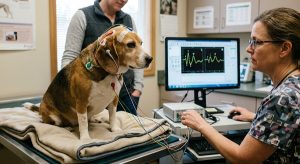
Before you blame training, rule out hearing. The only accepted objective test is the BAER test (brainstem auditory evoked response). It’s described as the only acceptable audiological test for determining baseline hearing in dogs.
My advice to any unit or serious handler: get a baseline BAER test when your dog is young and healthy, then retest every year or two for dogs in loud work. You can’t spot a decline without a starting point. A university animal-audiology clinic or a veterinary neurologist can arrange it.
Types of Dog Hearing Protection
Not all “dog ear protection” is the same. Here are the five types you’ll run into:
1. Over-the-head muffs (Mutt Muffs, PROHEAR). They look like small headphones. They’re easy to fit and clean, and good for travel, helicopters, and hunting. Some dogs with upright ears find the cups tricky to seat.
2. Hood or wrap systems (Rex Specs Ear Pro). A soft, close-fitting hood spreads pressure evenly instead of using hard cups and a head strap. The Army-backed design behind it was built because older systems were rigid, cumbersome, and hard to put on the dog, and the new one uses flexible materials that conform to the head’s shape for a proper seal.
3. In-ear plugs. They sit inside the canal and can give the best seal, but they need custom fitting and training. Many dogs fight them at first. They also need care around ear health and infection risk, so ask your vet before using them. One guide notes plugs are popular and versatile and can suit dogs who won’t accept muffs.
4. Helmet ear covers (K9 Helm and similar). These are mainly for stab and impact protection and cold. The maker is clear that they’re not a direct hearing protection device. They help keep plugs in place and cut wind noise.
5. Calming wraps (Thundershirt-style bands). These ease anxiety but don’t block sound. Don’t use them around gunfire or aircraft.
Product Reviews: Rex Specs, Mutt Muffs, PROHEAR and More
Here’s the honest side-by-side, including the limits of each.
| Rex Specs Ear Pro | Mutt Muffs | PROHEAR | |
|---|---|---|---|
| Style | Hood / wrap | Over-the-head muff | Over-the-head muff |
| Stated protection | 18-24 dB (NIOSH-style real-ear dog testing) | 21-24 dB estimate (human range) | 28 dB NRR (human-rated) |
| Best for | Range work, tactical K9 | Helicopters, travel, hunting, events | Budget first trial |
| Pros | Low profile, works with goggles, flexible seal | Wide foam seals, lightweight, many sizes | Cheap, easy to find |
| Watch out for | Higher price, limited sizes | Can slip on active dogs, upright ears may gap | Built for humans, not dog heads |
| Typical price | check current listing | ~$46-65 (retail) | ~$20-35 |
Rex Specs Ear Pro (best for tactical and range work)
Made by Zeteo Tech and built for military working dogs, it’s the choice for most K9 units. Its foam padding and low profile design are meant to stay protective in tight spaces, and it’s built to work with the Rex Specs V2 goggle. It’s offered in Medium and Large, and the goggle-and-ear kit saves nearly $30 compared with buying them separately.
It came out of Army research with a respected animal-audiology expert. Testing during helicopter operations showed a significant reduction in short-term hearing loss. That’s about as strong a real-world endorsement as this category has.
Limits: It comes in just two sizes, so very small and very large heads may not fit well. And like all products here, a gap means less protection.
Mutt Muffs (best all-round for travel and hunting)
Mutt Muffs are the best-known option and a sensible choice for most dogs. The foam is the same ester resin foam used in many high-end human headsets, and the makers say higher frequencies are absorbed more easily. That suits aircraft noise well.
Sizing varies by retailer. One U.S. store lists Medium for dogs 20-50 lbs with a 13-18 inch head circumference, Large for 50-95 lbs and 18-23 inches, and X-Large for 95+ lbs and 23+ inches. Smaller sizes exist in some markets.
Limits: Some owners of pointy-eared dogs say the cups don’t seat well. A verified buyer on one retailer’s page said it isn’t recommended for dogs with pointed ears. That’s one review, but it matches what I’d expect: stiff cups and upright ears can fight each other. Test the seal carefully on breeds like German Shepherds.
PROHEAR (budget trial option)
This one deserves a straight talk. PROHEAR is a human earmuff with a high advertised NRR (28 dB), and some dog owners use it because it’s cheap. A human NRR number doesn’t tell you how it seals on a dog’s skull, with different ear position and a coat. I haven’t seen independent dog testing for it. Use it as a cheap first trial to see if your dog accepts a muff, not as your primary gunfire protection.
K9 Helm Ear Covers (an add-on, not a stand-alone)
At about $170, these are for dogs already wearing a K9 Helm GoggleHelm. They’re about stab protection and holding in-ear plugs steady, not hearing protection by themselves.
Fit Guide: How to Measure and Check the Seal
Sizing is where most buyers go wrong. A poor fit throws away most of what you paid for. The Mutt Muffs team says it directly: if you pick a size too large, the muffs won’t seal well and you lose their sound-reducing properties.
Measure it right:
- Use a soft tape. Measure the largest circumference of the head, around the skull just behind the eyes and over the base of the ears.
- Note your dog’s weight as a second check.
- Compare both to the brand’s current size chart.
- If you’re between sizes, choose the snugger option, as long as it doesn’t pinch. Gaps ruin protection. (Your old post said to size up for muffs. Manufacturers say the opposite.)
The 5-point seal check (do this before every session):
- Cup or pad covers the whole ear with no ear tip poking out.
- No visible gap at the cheek, forehead, or back of the skull.
- Two fingers can slide under the strap, but no more.
- Shake test: ask your dog to shake its head. The protector should shift slightly at most.
- Sound test: talk at normal volume from two feet away. Your voice should sound clearly dulled to the dog. Watch whether it still reacts (that tells you it’s not total silence, which is intended).
Collar and gear check: put on the collar, harness, goggles, and muzzle you’ll use on the job. Hoods and straps can bunch under gear.
How to Train Your Dog to Wear Ear Protection
Almost every dog fights the first fitting. That’s normal. Rushing is what turns a mild annoyance into a lasting problem. Use this timeline, adjust it to your dog, and reward often.
- Days 1-3: Let the dog sniff the gear. Put it on for 30-60 seconds indoors with treats or a favourite toy, then take it off before the dog tries to.
- Days 4-7: Extend to 5-10 minutes during calm activity like a walk in the yard.
- Week 2: Add mild noise (a vacuum, traffic, a radio). The goal is for your dog to link “muffs on” with “noise, and I’m fine.”
- Week 3 onward: Move to real work settings, starting low-intensity before full gunfire or aircraft exposure.
Most dogs stop pawing at the gear within one to two weeks of steady practice. If yours is still fighting at three weeks, check the fit first. A pressure point is a more common cause than stubbornness.
One more thing: hand signals. Protected dogs hear commands less clearly. I teach every dog I work with solid hand signals and body cues before they wear protection. That way the dog keeps working smoothly when the voice is muffled. If you want a structured way to build that foundation, my book Beyond the Bark covers handler-dog communication in detail. Gear choice for control also matters, so see our guide to the best dog training collars for working dogs.
Best Ear Protection by Job
| Job | Main noise risk | Best fit | Notes |
|---|---|---|---|
| Police / military K9 | Gunfire, helicopter, vehicles | Hood/wrap (Rex Specs Ear Pro); consider custom plugs | Baseline BAER, annual checks |
| Hunting dog | Repeated close shots | Comfortable over-the-head muff or plugs | Make sure it stays on all day |
| Search-and-rescue | Aircraft, machinery | Mutt Muffs-style muff or hood | Must stay comfortable on long deployments |
| Protection / security dog | Occasional events, training days | Well-fitted muff | Introduce early, use for events |
| Detection dog | Kennel noise, transport | Quiet kennel first, muff for transport | Rest in a calm space |
| Show / event / travel dog | Fireworks, air travel | Over-the-head muff | Short wear, supervised |
A quiet kennel beats any muff. If your dog sleeps in a 100 dB kennel block, gear on the range won’t fix the daily damage. Space dogs out, add sound-absorbing surfaces, and give each dog a calm, den-like rest area. Our crate training guide shows how to make a crate a quiet recovery space.
Care, Hygiene and Safety Rules
This is the area competitors almost never cover. Skip it and you create new problems.
Safety rules:
- Always supervise. Mutt Muffs’ retailers themselves note that dogs should always be supervised while wearing them, and that care is needed outdoors where hearing is beneficial. A dog that can’t hear traffic or a hazard is at risk.
- Wear only for the noise, then take it off. Don’t leave protectors on for hours of quiet time.
- Watch for heat. Dark foam and fur trap heat. In hot climates, shorten sessions and check for panting and pressure marks.
- Check the skin under the pads after every use for rubs, redness, or hair loss.
Cleaning and storage:
- Wipe pads with a damp cloth and mild soap, and let them air dry fully.
- Store in a cool, dry place, away from sunlight, which cracks foam.
- Replace foam or the whole unit when it flattens, tears, or no longer seals.
Ear health: if your dog has frequent ear infections, discharge, or a strong smell, see your vet before using anything that covers or enters the ear.
What It Costs
Costs vary by region and retailer, so check the current listing. As a rough guide, budget muffs run about $20-35, mid-range muffs like Mutt Muffs run about $46-65 at the retail example above, and tactical hoods like Rex Specs cost more (the bundle with goggles saves nearly $30). A helmet ear cover can be around $170.
Now compare that to what you lose. Training a military working dog is often estimated at $80,000-$100,000 depending on the program. Even if your own dog cost far less, replacing a dog that can no longer hear commands costs months of retraining. A BAER baseline test plus a good protector is cheap insurance.
Where to Buy
Tip: always check the size chart on the product page against your dog’s measured head circumference before you add to cart.
Handler’s Note: What I’d Do Starting Today
If I were setting up a new dog tomorrow, here’s the order I’d follow:
- Book a baseline BAER test while the dog is healthy.
- Measure the head and pick the snugger size.
- Run the 3-week introduction, with hand signals taught first.
- Use the highest-sealing option the dog will accept for the loudest work.
- Fix the kennel noise problem.
- Retest hearing every year or two.
Want more field-tested gear and training advice like this every week? Subscribe to our weekly articles roundup newsletter.
FAQs
What NRR rating do I need for dog ear protection?
For gunfire, helicopters, and fireworks, look for around 20-28 dB with a proper seal. Remember that real-world protection runs lower than the lab number, and no muff makes close gunfire safe by itself. Distance and limiting exposure still matter.
Which is better for dogs: ear muffs or ear plugs?
Muffs are easier to fit and clean and are the starting point for most dogs. Plugs can seal better, and some research and vendors point to custom in-ear plugs as the best seal, but they need vet advice and careful training. Dogs with ear problems shouldn’t wear plugs without vet approval.
How do I know if my dog’s ear protection fits?
Check that it covers the whole ear, shows no gaps, and barely moves when your dog shakes its head. Two fingers should fit under the strap. If you see gaps or the pad slides off the ear, size down or switch styles.
Can hearing damage in dogs be reversed?
Noise-induced hearing loss is often permanent once it happens, and cochlear implants and hearing aids aren’t practical options for dogs. Some short-term loss can recover, which is why prevention matters. Get a BAER baseline and test regularly.
How long does it take to train a dog to wear ear muffs?
Most dogs accept them within one to three weeks of gradual, reward-based introduction. If your dog still resists after three weeks, check the fit for pressure points before assuming it’s a behavior problem.
Conclusion
Your dog’s hearing is part of its job, and you can’t get it back once it’s gone. Here’s what to take from this guide:
- Working dogs face real hearing risk from gunfire, helicopters, fireworks, and even kennels.
- A good seal beats a high number on the box.
- Pick the style for the job: hoods for tactical work, muffs for travel and hunting, and talk to your vet about plugs.
- Measure carefully, size snug, and run the seal check every time.
- Train slowly, and teach hand signals first.
- Fix kennel noise, supervise, and test hearing regularly.
Start with a BAER baseline and a proper measurement this week. Then choose your gear and give it three weeks of patient training. Your dog will thank you with years of sharp, reliable work.
Disclosure: This article contains affiliate links. As an Amazon Associate, we may earn a commission on qualifying purchases at no extra cost to you.

Her work centres on obedience, detection, protection and operational readiness. She favours proven methods built on repetition, consistency and real-world conditioning, so that both dogs and handlers are prepared for high-pressure tasks.
Rofiat represented the Nigerian Army Dog Centre at the Nigerian Army Day Celebration (NADCEL) 2026, where she led demonstrations in obedience, explosive detection, agility and tactical movement. Through articles, training content and documentaries, she shares field-based insight into how structured training, clear communication and trust between handler and dog affect performance and reliability.
She is the author of Beyond the Bark: Inside a Pro Handler's Playbook for Raising the Ideal Dog, a practical guide that helps dog owners and handlers apply professional training principles in everyday situations.
- How to Enter the COBA National Dog Championship - October 20, 2026
- K9 Advantix Dosage Chart & Safety Guide for Dogs - October 19, 2026
- How to Set Up & Use Bousnic Dog Training Collar - October 18, 2026