Puppy Bloat Signs: 5 Early Warning Signals to Catch
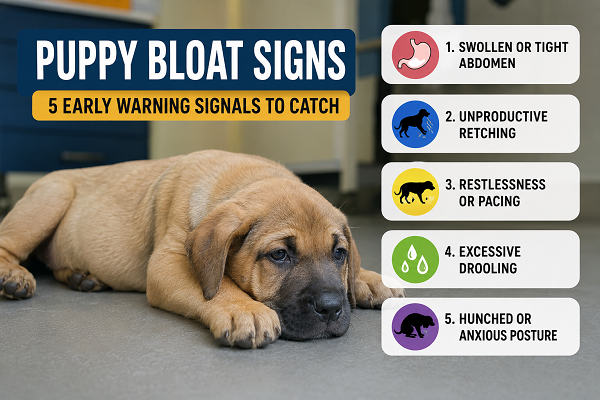
The five earliest warning signs of bloat in a puppy or young dog are: a swollen or tight-feeling abdomen, unproductive retching (trying to vomit but nothing comes up), restlessness or pacing that won’t settle, excessive drooling, and a hunched or anxious “praying” posture. If you see two or more of these together, especially in a large or giant breed dog, treat it as an emergency and get to a vet immediately, bloat can turn fatal within a few hours.
Table of Contents
- Introduction
- What Is Puppy Bloat, Really?
- Puppy Bloat vs. Adult GDV: An Important Distinction
- The 5 Early Warning Signs of Bloat
- Which Breeds Are Most at Risk
- Why Bloat Happens: The Real Risk Factors
- What to Do in the First 30 Minutes
- Treatment and Real Cost Expectations
- How to Actually Prevent Bloat
- FAQs
- Final Thoughts
Introduction
If you’ve ever owned a Great Dane, German Shepherd, Doberman, or any big, deep-chested breed, someone has probably warned you about bloat. Maybe it was your breeder. Maybe it was your vet, tapping the counter for emphasis. Maybe it was another handler at the training field who lost a dog to it and still gets quiet when the subject comes up.
I get it. I’ve worked around working and protection breeds for years, and bloat is the one health emergency that scares experienced handlers more than almost anything else. Not because it’s complicated to understand, but because it moves fast, it doesn’t wait for office hours, and by the time some owners recognize what’s happening, the window for the best outcome has already started closing.
So let’s talk about it properly. What puppy bloat actually is, which signs show up first, why some breeds are wired for this risk, and exactly what to do if you ever see it starting.
What Is Puppy Bloat, Really?
“Bloat” gets used loosely. Sometimes people mean a puppy’s belly looking round and full after a big meal, totally normal and harmless. Other times, they mean the medical emergency vets call gastric dilatation-volvulus (GDV), where the stomach fills with gas and fluid, then twists on itself like a balloon animal.
That twist is what makes it deadly. Once the stomach flips, it seals off both the entrance and exit. Gas can’t escape, blood can’t drain properly from the stomach and spleen, and within hours the dog can go into shock. GDV is an acute, life-threatening condition that primarily affects large- and giant-breed dogs, with a mortality rate of 20–45% even when treated. Without prompt treatment, it’s fatal in nearly every case.
This isn’t a rare, freak occurrence either. GDV shows up at a rate of roughly 2.9 to 6.8 cases per 1,000 canine hospital admissions, and in the highest-risk giant breeds, lifetime risk has been estimated anywhere from about 4% to as high as 37% depending on the breed and body shape.
Puppy Bloat vs. Adult GDV: An Important Distinction
Here’s something most articles on this topic skip over, and it matters if you’re raising a puppy right now.
True GDV is uncommon in very young puppies. It’s a condition that develops as a dog’s chest deepens and matures, which is why most confirmed cases show up in dogs somewhere between 2 and 10 years old, with risk climbing sharply once a large or giant breed hits adolescence (roughly 6 to 18 months). A 9-week-old Rottweiler puppy with a swollen belly is far more likely dealing with something else entirely, most commonly:
- Intestinal worms (roundworms especially cause that classic “pot-bellied puppy” look)
- Overeating or gulping food too fast, which fills the stomach with swallowed air
- Dietary indiscretion, eating something they shouldn’t have
- A food intolerance or sudden diet change
That said, I’m not telling you to relax if your puppy’s stomach looks tight. I’m telling you the cause is usually different at that age, but the warning signs of true GDV are the same in a 7-month-old adolescent as they are in a 7-year-old adult, and once a big-breed puppy is out of the very early puppy stage and growing into that deep chest, the clock on real GDV risk starts ticking. If your puppy has a swollen belly along with lethargy or a change in stool, it’s worth a vet visit to rule out parasites before you assume the worst, but never assume the best either. If you want to rule out worms specifically, our team has a full breakdown on dangerous dog worms and the foods that help fight them, which is worth a read for any puppy owner.
The 5 Early Warning Signs of Bloat
This is the part to actually memorize. Print it, save it, whatever you need to do. When GDV starts, dogs don’t usually show one dramatic symptom, they show a cluster of smaller ones that build fast.
1. A Swollen, Tight, or “Drum-like” Abdomen
The belly looks distended, and if you gently tap it (don’t press hard), it can sound hollow, almost like a drum. This isn’t the soft, round look of a full belly after dinner. It’s tight, firm, and the dog often reacts if you touch it.
2. Unproductive Retching
This is the single biggest red flag vets look for. Classic GDV symptoms include unproductive retching, where the dog tries to vomit but nothing, or very little, comes up. A dog with a normal upset stomach usually manages to bring something up. A dog with GDV can’t, because the twisted stomach has sealed off the exit.
3. Restlessness That Won’t Settle
Pacing, standing up and lying back down repeatedly, circling, or trying to find a comfortable position and failing. Owners often describe it as “acting weird” before they can put a finger on what’s wrong. Trust that instinct.
4. Excessive Drooling or Hypersalivation
Sudden, heavy drooling that wasn’t there an hour ago is a documented sign. Symptoms are not always distinguishable from other kinds of distress, but a dog might stand uncomfortably, show firm distension of the abdomen, weakness, difficulty breathing, hypersalivation, and retching without producing any vomit.
5. A Hunched, Anxious, or “Praying” Posture
Some dogs stretch into a bowing position, front legs down, rear up, almost like a play bow but without the wagging tail or relaxed energy. Others hunch with an arched back. Either way, it signals abdominal pain and discomfort they can’t shake off.
A note from experience: in working and protection dogs especially, handlers sometimes mistake early bloat for a dog just being “off” from training stress or a hard session. Don’t make that assumption. If a normally food-driven dog suddenly won’t touch dinner, is pacing, and has a tight belly, skip the wait-and-see approach entirely.
Which Breeds Are Most at Risk
GDV isn’t random. It clusters heavily in large and giant, deep-chested breeds. A landmark study comparing 11 breeds found the incidence of GDV among large (23–45 kg) and giant (over 45 kg) breeds was 23 and 26 cases per 1,000 dog-years at risk, respectively, and nearly 29% of dogs that developed GDV in the study died.
Breeds most commonly flagged as high-risk include:
- Great Dane
- Weimaraner
- Saint Bernard
- Irish Setter
- Gordon Setter
- Standard Poodle
- Doberman Pinscher
- German Shepherd
- Rottweiler
- Irish Wolfhound
- Akita
- Bloodhound
- Newfoundland
If you handle or own a working-line German Shepherd, this is especially relevant, since these dogs are often fed high-volume, high-protein diets to fuel intense training loads. If you’re raising one, our guide on working line vs. show line GSD training is a good companion read, since feeding and exercise routines for high-drive dogs tie directly into bloat risk.
Genetics play a real role too, not just body shape. Research has identified specific gene variants linked to gastric tone and motility, with the strongest genetic signals showing up in Collies, German Shorthaired Pointers, and Great Danes, suggesting some dogs are wired with a higher baseline risk regardless of how carefully they’re fed.
Why Bloat Happens: The Real Risk Factors
Vets will tell you honestly: the exact trigger for GDV isn’t fully understood. But decades of case studies have narrowed down the risk factors pretty clearly:
- Eating one large meal per day instead of two or three smaller ones
- Fast eating and gulping, which swallows extra air along with food
- Exercise too close to mealtimes, running or playing hard right after eating (or right before)
- Stress and anxiety, including travel, boarding, or big life changes
- Age and family history — older, larger dogs and those with a first-degree relative who bloated
- Raised food bowls, this one surprises a lot of owners
That last point deserves its own paragraph, because it flips a lot of “common sense” advice on its head. Elevated bowls were sold for years as a bloat-prevention tool. The actual research says the opposite: dogs fed from raised bowls have shown a higher rate of GDV in the largest study on the topic, likely because the posture change encourages faster gulping and more air intake, not less. If you’re rethinking your dog’s feeding setup, our piece on maintaining good health in Military Working Dogs covers feeding structure for high-performance dogs and is a useful next step.
What to Do in the First 30 Minutes
If you suspect bloat, this is not a “call the vet in the morning” situation. Here’s the priority order:
- Call your emergency vet or nearest 24-hour animal hospital immediately and describe the symptoms so they can prep for your arrival.
- Do not give food, water, or induce vomiting. None of it helps, and it can waste critical time.
- Do not wait to “see if it passes.” GDV does not resolve on its own.
- Keep the dog as calm and still as possible during transport, no last-minute walks or car rides that jostle them unnecessarily.
- Bring your dog’s weight and recent meal/exercise timeline if you can recall it; vets will ask.
Every hour of delay measurably worsens the odds. This is one of the few true “minutes matter” emergencies in dog ownership.
Treatment and Real Cost Expectations
I think owners deserve the real numbers here instead of vague reassurance, because financial shock in the middle of a crisis is its own kind of danger, some owners hesitate at the front desk, and that hesitation costs time.
- Emergency GDV surgery typically runs $3,000–$8,000, and with 2–3 days of ICU hospitalization afterward, total bills commonly land in the $5,000–$10,000+ range depending on tissue damage and location.
- Preventive gastropexy (a surgery that tacks the stomach in place before any emergency happens, often done at spay/neuter for high-risk breeds) runs far cheaper, typically $800–$2,500.
- Without a gastropexy, dogs that survive a first bloat episode face up to a 75% recurrence rate, according to veterinary surgical literature.
- Mortality even with prompt surgical treatment sits at roughly 20–45%, which is exactly why early recognition (those five signs above) matters so much, the dogs who get to surgery fastest have measurably better odds.
If you’re raising a high-risk breed puppy, ask your vet about a prophylactic gastropexy conversation early, ideally before your dog ever needs an emergency version of the same procedure.
How to Actually Prevent Bloat
There’s no guaranteed prevention, but the following genuinely reduce risk based on current veterinary guidance:
- Feed 2–3 smaller meals a day instead of one large one.
- Slow down fast eaters with a slow-feeder bowl or puzzle feeder, not a raised bowl.
- Avoid strenuous exercise for at least an hour before and after meals.
- Keep your dog calm during and after feeding, no chaotic multi-dog feeding frenzies.
- Watch your dog’s stress levels, especially around travel, boarding, or big schedule changes.
- Discuss prophylactic gastropexy with your vet if you own a Great Dane, GSD, Doberman, or another high-risk breed, particularly if it’s already scheduled for spay/neuter surgery.
- Know your dog’s baseline behavior so you notice the moment something’s off, this is where crate-trained, routine-oriented dogs actually have an advantage, since deviations from routine stand out faster. If you’re still building that foundation with a young dog, our guide on crate training a puppy helps build the kind of predictable routine that makes early symptom-spotting easier.
- Choose training treats and feeding routines carefully. If you’re using treats heavily during training sessions with a large-breed puppy, our list of vet-backed healthy training treats can help you avoid adding unnecessary bulk or air-swallowing habits to your dog’s routine.
- Time training and play sessions around meals properly. For working and high-drive breeds especially, this guide on how often to exercise a working dog is worth reading alongside this article, since exercise timing is a documented bloat risk factor.
If you want a deeper, structured resource that walks through raising a large or giant breed puppy from day one, feeding schedules, growth-stage risks, and the health checkpoints most new owners miss, my e-book Beyond the Bark covers this in more depth than a single article can. Grab it here if you want it on hand before your puppy hits the higher-risk adolescent stage.
FAQs
1. Can a small puppy get bloat, or is it only large breeds?
True GDV is overwhelmingly a large and giant breed condition tied to a deep, narrow chest cavity. Small and toy breeds can experience simple gas bloating or digestive upset, but they’re rarely at risk for the twisting emergency form. If your small breed puppy’s belly is swollen, worms or overeating are far more likely culprits, but a vet check is still the right move.
2. At what age does bloat risk actually start?
Documented GDV cases are uncommon before 6 months of age. Risk climbs through adolescence and into adulthood, with many large and giant breeds showing peak risk between 2 and 10 years old. That said, if you own a high-risk breed, it’s smart to learn the warning signs well before your puppy reaches that window.
3. Is bloat the same as normal gas or a full belly after eating?
No. A soft, round belly after a big meal that settles within an hour or two is normal. Bloat/GDV involves a tight, drum-like abdomen combined with other signs like unproductive retching, restlessness, and drooling. If in doubt, always err toward calling a vet.
4. Do raised food bowls prevent bloat?
No, and this trips up a lot of owners. Multiple studies, including a widely cited breed-comparison study, found raised bowls associated with a higher rate of GDV in large and giant breeds, likely due to faster gulping. Most vets now advise floor-level, slow-feeder bowls for high-risk breeds instead.
5. How fast does bloat progress once symptoms start?
It can move from first symptoms to a life-threatening state within just a few hours. This is why bloat is treated as a true emergency, not an overnight-observation situation and why recognizing the early signs covered in this article matters so much.
Final Thoughts
Bloat is one of those conditions where knowledge genuinely saves lives. You don’t need to memorize veterinary journals. you need to know five things: a tight belly, unproductive retching, restlessness, drooling, and that hunched, uncomfortable posture. See two or more together in a large or giant breed dog, and you move immediately, no waiting, no guessing.
If you’re raising a puppy from a high-risk breed, build good habits now: smaller meals, calm feeding routines, exercise spacing, and a real conversation with your vet about prophylactic gastropexy before you ever need the emergency version. It’s a lot cheaper, in every sense, to prevent this than to treat it.
Your dog can’t tell you something’s wrong in words. Learning to read these signs is how you speak for them when it counts most.

Her work centres on obedience, detection, protection and operational readiness. She favours proven methods built on repetition, consistency and real-world conditioning, so that both dogs and handlers are prepared for high-pressure tasks.
Rofiat represented the Nigerian Army Dog Centre at the Nigerian Army Day Celebration (NADCEL) 2026, where she led demonstrations in obedience, explosive detection, agility and tactical movement. Through articles, training content and documentaries, she shares field-based insight into how structured training, clear communication and trust between handler and dog affect performance and reliability.
She is the author of Beyond the Bark: Inside a Pro Handler's Playbook for Raising the Ideal Dog, a practical guide that helps dog owners and handlers apply professional training principles in everyday situations.
- Australian Cattle Dog vs Blue Heeler: Any Difference? - October 1, 2026
- Bousnic Dog Training Collar Review: Is It Safe? - September 30, 2026
- Gravy Train Dog Food Review: Ingredients & Recalls - September 30, 2026