When Do Puppies Open Their Eyes? Timeline & Warnings
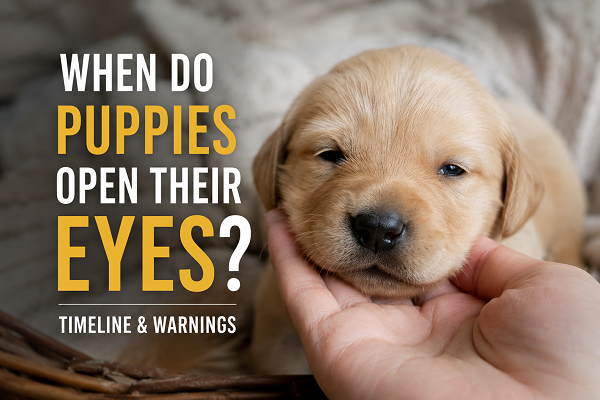
Puppies open their eyes between 10 and 14 days old. It’s common for pups to open their eyes one at a time over several days. Opening is not the same as seeing: vision can take 3 to 4 weeks to fully develop afterward.
The one rule to remember: swollen, bulging, or crusty eyelids on a puppy whose eyes haven’t opened yet are an emergency at any age. Untreated, this infection can cause permanent vision loss. Call a vet the same day.
Table of Contents
- Introduction
- When Do Puppies Open Their Eyes? The Short Answer
- Why Puppies Are Born With Their Eyes Closed
- Day-by-Day Timeline (With What to Do Each Stage)
- Do Breeds Open Their Eyes at Different Times?
- What Can a Puppy See When Its Eyes First Open?
- Warning Signs: Normal vs. Emergency
- Neonatal Eye Infection: Causes, Treatment and What to Do While You Wait
- How to Care for Newborn Puppy Eyes
- Eye Color, Hearing and Eyeshine: The Other Changes
- Early Handling: What Handlers Do and What Research Says
- Note From a Working-Dog Handler
- FAQs
- Conclusion
Introduction
Picture this. It’s day nine, and you’re checking a litter at 6 a.m. One puppy’s eyelids look a little puffy. Is that “almost open,” or is that trouble?
That’s the problem most owners and new breeders face. The usual advice is “eyes open at 10 to 14 days,” and it stops there. It doesn’t tell you what a normal slow starter looks like, or when puffy means “call the vet now.”
In this guide, you’ll learn:
- The exact day-by-day puppy eye development timeline
- Why puppies are born with sealed eyes
- What puppies can actually see once their eyes open
- How to tell a slow starter from an infection
- What to do in the hours before you reach a vet
- What the research really says about early handling
I’m writing this the way I’d explain it to a new handler on the kennel line: plain words, real steps, no panic and no false comfort.
When Do Puppies Open Their Eyes? The Short Answer
Most puppies open their eyes between day 10 and day 14. Vets and pet-care sources agree on this range, though it can shift a little with the individual dog.
A few things are normal and surprise people:
- One eye first. Many puppies open one eye days before the other. A puppy looking like a tiny pirate for 48 hours is fine if both lids look flat and clean.
- A wider window. A healthy puppy may open its eyes a few days early or late.
- A blurry start. The eyes look cloudy and blue-grey at first. That’s normal.
What matters is the trend, not the date. By around day 10, the lids should look flat and clean. By around day 14 to 17, at least one eye should be opening.
Why Puppies Are Born With Their Eyes Closed
Puppies are born with sealed eyelids because their eyes aren’t finished yet. The optic nerve and central nervous system keep developing in the first days, and closed lids shield those immature eyes from debris, infection and damage.
Think of the sealed lid as a bandage over a healing wound. The “wound” is an organ still building itself.
This is also why puppies are called altricial: born very immature, like kittens, and unlike foals or calves who stand within hours. A newborn puppy can’t see or hear. It can nurse, sleep, squirm toward warmth and find its mother by smell and touch.
There’s one downside to the design, and it matters later in this guide. A sealed lid is a closed pocket. If bacteria get in, the pocket can’t drain. That’s why infection under the lid is such a time-sensitive problem.
Day-by-Day Timeline (With What to Do Each Stage)
Here’s the timeline most guides give you, plus the part they leave out: what you should actually do at each stage.
| Age | What’s happening | What you should do |
|---|---|---|
| Days 0–6 | Lids fully sealed. Puppy finds mom by smell and warmth. | Weigh daily. Check that lids look flat. Keep bedding clean and dry. |
| Days 7–9 | Lids may show a faint line or slight moisture as they loosen. | Check eyes morning and evening. Any swelling or crust now = call a vet. |
| Days 10–14 | The typical opening window. Eyes look hazy blue-grey. One may open first. | Keep light soft. Don’t touch the eyes. Note which eye opened and when. |
| Days 14–17 | Slow starters finish opening. Eyes squint and blink a lot. | If both lids are flat and clean, keep watching. Book a routine check if one eye hasn’t started. |
| Days 18–21 | Late but still healthy in some puppies. Hearing begins around now. | A puppy still fully sealed by day 21 needs a vet exam, even with no swelling. |
| Weeks 3–4 | Vision slowly sharpens. Puppy tracks movement. | Start gentle handling and soft household sounds. |
| Weeks 5–8 | Better depth perception. Puppy plays, chases and explores. | Add safe sights, surfaces and people. |
A note on that “routine check” line. Sources differ on when to worry about a closed but otherwise normal eye: Purina says a missed two-week mark could signal a developmental problem, while Nylabone gives it until three weeks. I use a middle path. If a puppy is sealed past two weeks with clean lids, I book a check within a few days. By three weeks, I don’t wait any longer.
Do Breeds Open Their Eyes at Different Times?
You’ll read confident breed claims online. Here’s the honest picture: they contradict each other.
One popular article says big breeds like Great Danes and Mastiffs open earlier. Another says smaller breeds open slightly sooner and some larger breeds a few days later. Both can’t be right, and I haven’t seen solid breed-by-breed data to settle it.
So here’s my take. Litter size, birth weight, the puppy’s own genetics, and general health all seem to matter more than breed label. Whether you’re raising Labradors, German Shepherds or Belgian Malinois, use the 10–14 day benchmark and look at the individual puppy.
Two practical points:
- The runt of the litter. A small, weak puppy often hits every milestone late. If it’s also not gaining weight, the weight is the bigger concern.
- Certain coat patterns. If your puppy comes from two merle parents (a “double merle”), ask your vet to check the eyes early. Eye defects are more common in that pairing.
What Can a Puppy See When Its Eyes First Open?
Almost nothing. Eyes opening is the start of a slow process, not a light switch.
- Days 10–14: Light and vague shapes. Lots of squinting.
- Weeks 3–4: Movement and outlines become clearer. Vision can take 3 to 4 weeks after opening to fully develop.
- Weeks 5–8: Depth perception and detail improve. Puppies now use sight to chase littermates and read people.
Puppies rely more on smell and touch in their first weeks, and their eyes are better at night vision and motion than fine detail or rich color. If you’re curious how dogs see as adults, we cover it in our guide on what colors dogs see and whether they’re really color blind.
So if your two-week-old doesn’t react when you lean over the whelping box, it isn’t being cold. It can’t see you yet.
Warning Signs: Normal vs. Emergency
This is the section to bookmark. A slow-but-healthy eye and an infected one can look alike from a distance, so use this table.
| Normal | Not normal (call a vet) |
|---|---|
| Lids flat and clean while still closed | Lids swollen or bulging, at any age |
| One eye opens before the other | Crusty or sticky lids, or debris at the corners |
| Hazy, blue-grey look after opening | Pus or discharge, or a foul smell from the eye |
| Squinting and blinking in bright light | Redness, or constant pawing at the face |
| Both eyes open by roughly day 14–17 | Still fully sealed at day 21 |
| Haze that gradually clears over weeks | Cloudiness that doesn’t improve by weeks 4–5 |
Swollen or outward-bulging lids and crusty debris sticking the lids together are the classic signs of neonatal ophthalmia. In a puppy whose eyes haven’t opened, the area over the lids should look flat and unremarkable.
Neonatal Eye Infection: Causes, Treatment and What to Do While You Wait
This condition has a few names: neonatal ophthalmia, ophthalmia neonatorum, or neonatal conjunctivitis. It’s an infection behind or around the eyelids of a newborn puppy.
Why it happens
- Bacteria from birth. The most common cause is bacterial transmission during the birth process, and risk rises if the mother has an active vaginal or uterine infection.
- Dirty surroundings. A vaginal infection in the mother and an unclean environment both raise the risk, and all breeds are susceptible.
- The usual bacteria. Staphylococcus and Streptococcus bacteria are usually responsible.
- No drainage. A newborn’s immature immune system struggles to contain infection, and sealed lids stop it draining.
How vets treat it
Here’s something that surprises many owners. Vets sometimes open the lids early on purpose. One veterinary source states that opening the lids prematurely does not damage the puppy’s vision. After opening, the vet washes the eye, then recommends warm (not hot) compresses at home to keep the lids from sticking together again, plus the full antibiotic course.
Two more details from the vet literature:
- Newborn puppies don’t make tears until their eyes open naturally, so a vet may prescribe artificial tear ointment to protect the cornea.
- Vets often ask to examine the mother and the whole litter, since the source may affect more than one puppy.
Delaying treatment can mean corneal damage or loss of sight in the affected eye.
What to do while you wait for the vet
- Call right away. Tell them “newborn puppy, swollen sealed eyelids.” Ask for a same-day slot.
- Keep the puppy warm and nursing. A cold puppy declines fast.
- Wipe the outside only. Use a clean, warm, damp cloth on crust around the lids. Wipe from the inner corner outward, with a fresh cloth for each puppy.
- Don’t pry the lids open at home. Some older articles tell owners to do this. I don’t. Without sterile tools and the right aftercare, you can scrape a cornea that is already inflamed.
- Don’t use human drops or leftover antibiotic ointment. The wrong product can make things worse.
- Wash your hands between puppies. Infection can spread through a litter.
- Check the rest of the litter and the mother. Look at every pup’s eyes, and watch mom for discharge or fever.
How to Care for Newborn Puppy Eyes
For most litters, good care means keeping the environment clean and leaving the eyes alone.
Do:
- Change bedding often and keep it dry.
- Keep light soft and indirect. Newly opened eyes are sensitive.
- Check each puppy’s eyes at the same times every day. Vets advise a daily check of every newborn for signs of illness.
- Weigh puppies daily. A puppy that loses weight or stops gaining needs a vet, whatever its eyes look like.
- Trim your own nails and wash your hands before handling.
Don’t:
- Don’t force an eyelid open to “help.”
- Don’t use flash photography on a puppy whose eyes just opened. Use natural window light.
- Don’t rub or wipe eyes that look fine.
- Don’t assume swelling will pass.
Eye Color, Hearing and Eyeshine: The Other Changes
Eye opening is one step in a chain of changes. Here’s what comes next.
Eye color. All puppies start with milky blue eyes, and permanent color usually begins to show after three or four weeks. The cloud can take longer to clear. One source says up to eight weeks for the cloudy look to fade completely. Some breeds’ eye color keeps shifting after that, so don’t call a final color too early.
Eyeshine. Around the time eye color starts to change, the tapetum lucidum develops behind the retina. That’s the reflective layer that makes dog eyes glow in a flashlight beam and helps them see in dim light.
Hearing. Puppies are deaf at birth. Ear canals take time to open, and puppies start hearing at around 21 days, close to when baby teeth arrive. So the order is smell and touch first, then sight, then hearing.
Early Handling: What Handlers Do and What Research Says
Here’s where I want to clear up a common claim.
Military working dog programs use a routine called Bio Sensor, also known as early neurological stimulation (ENS). It uses short stimulation exercises, about 3 to 5 seconds each, applied to puppies from day 3 to day 16 of life. The AKC describes the routine as once daily, and warns that overstimulation can be harmful.
You’ll see websites say ENS makes calmer, tougher adult dogs. The evidence is thinner than that. A Purdue study followed 76 puppies in a commercial kennel. The results did not support the purported effects of ENS, and handled puppies spent more time on fearful behavior in an isolation test than the control puppies. The researchers did add that early handling may still help by giving puppies positive interactions with people.
So here’s the handler’s take. I wouldn’t promise anyone that a stimulation routine builds a better dog. What I’d do is simple, gentle, daily handling:
- Hold each puppy calmly for a short time once or twice a day.
- Talk softly. Keep sessions brief.
- Stop if a puppy cries hard or goes stiff.
- Never handle a puppy with a swollen eye or a sick litter without washing up first.
Once eyes and ears are open, the real work begins. The socialization window runs from about week 3 into the early months, so it helps to have a plan. Our guide on how to bond with your puppy at each stage walks through it week by week.
If you want the full step-by-step system I use for raising puppies and starting foundation training, I wrote it all down in my book, Beyond the Bark: Inside a Pro Handler’s Playbook for Raising the Ideal Dog.
Note From a Working-Dog Handler
I’m a Nigerian Army military working dog instructor and handler with more than 14 years at the Nigerian Army Dog Centre. In that work, daily checks of young puppies, clean whelping areas and quick vet calls are routine. They’re boring, and they work.
This article blends that hands-on experience with published veterinary guidance. I’m a handler and trainer, not a veterinarian, so for any puppy with swollen lids, discharge, or failure to gain weight, please call your vet. If you’re planning a litter, our guide on how long dogs are pregnant, with stages and due dates will help you prepare before the puppies even arrive.
FAQs
1. Is it normal for one puppy eye to open before the other?
Yes. Puppies commonly open their eyes one at a time over several days. It’s fine as long as both lids look flat and clean, with no swelling or discharge.
2. What should I do if my puppy’s eyelids are swollen but haven’t opened?
Call a vet the same day, even if the puppy is younger than 10 days. Swelling or bulging under a sealed lid can mean infection trapped behind it. Don’t try to open the lids yourself. Keep the puppy warm and nursing until you’re seen.
3. Can I help open my puppy’s eyes if they’re taking too long?
No. The lids open on their own when the eye is ready. If your puppy is still sealed after two to three weeks, a vet can examine it and, if needed, open the lids safely.
4. When can puppies see clearly?
Not right away. Vision can take 3 to 4 weeks after opening to fully develop. Expect much better sight and depth perception between weeks 5 and 8.
5. When do puppies’ eyes change color?
Permanent eye color usually starts showing after three or four weeks. The blue-grey haze can take up to eight weeks to clear. If cloudiness doesn’t improve by weeks 4–5, have a vet look.
Conclusion: What to Do Now
If you remember three things from this guide, make them these:
- 10 to 14 days is the benchmark, not a deadline. A few days either way is normal, and one eye often leads the other.
- Swelling, crust, discharge or a bad smell is never “wait and see.” It’s a same-day vet call at any age, because trapped infection can threaten sight.
- Opening isn’t seeing. Sharper vision builds over weeks 3 to 8, so keep light soft and handling gentle.
Your action list for this week:
- Check every puppy’s eyes at the same times each day from day 7 to day 21.
- Weigh puppies daily and write the numbers down.
- Note the date each eye opens.
- Save your vet’s emergency number where you can see it.
Want more raising-and-training advice like this? Subscribe to our weekly articles roundup newsletter and get new guides in your inbox every week.
References and Further Reading
- Veterinary Vision Center, “Neonatal ophthalmia and other eye infections in puppies and kittens”: veterinaryvisioncenter.com
- Revival Animal Health, Dr. Marty Greer, “Vet Minute: Neonatal ophthalmia”: revivalanimal.com
- Covetrus, “Neonatal conjunctivitis: dangerous eye disease affecting newborn pups”: northamerica.covetrus.com
- PetMD and PetPlace, “Ophthalmia neonatorum in dogs/puppies”: petmd.com, petplace.com
- Purdue University, “Welfare implications of early neurological stimulation for puppies in commercial breeding kennels”: docs.lib.purdue.edu
- AKC, “Puppy socialization series 2”: akc.org
- Nylabone and Purina, “When do puppies open their eyes?”: nylabone.com, purina.ph

Her work centres on obedience, detection, protection and operational readiness. She favours proven methods built on repetition, consistency and real-world conditioning, so that both dogs and handlers are prepared for high-pressure tasks.
Rofiat represented the Nigerian Army Dog Centre at the Nigerian Army Day Celebration (NADCEL) 2026, where she led demonstrations in obedience, explosive detection, agility and tactical movement. Through articles, training content and documentaries, she shares field-based insight into how structured training, clear communication and trust between handler and dog affect performance and reliability.
She is the author of Beyond the Bark: Inside a Pro Handler's Playbook for Raising the Ideal Dog, a practical guide that helps dog owners and handlers apply professional training principles in everyday situations.
- Westminster Dog Show 2026: Winners & Full Results - October 17, 2026
- 10 K9-Approved Tricks to Teach Your Dog (Step-by-Step) - October 16, 2026
- COBA National Dog Championship 2026: Full Guide - October 15, 2026