Can Corgis Be Guard Dogs? Real K9 Trainer Answer
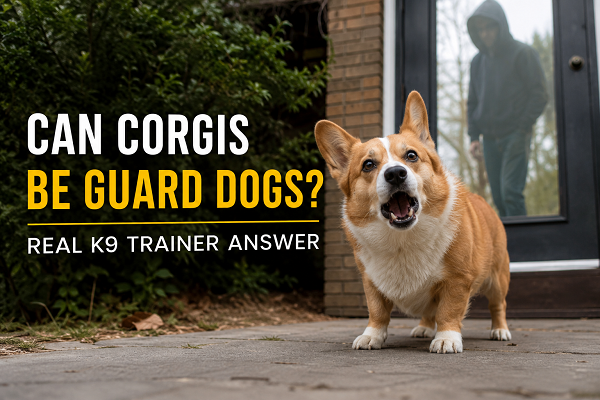
Corgis are not guard dogs, but they’re excellent watchdogs. They were bred in Wales to herd cattle by nipping at heels, which left them alert, vocal, bold, and fiercely loyal to their families. That combination makes them outstanding at detecting and announcing a threat. But at 24-30 pounds and 10-12 inches tall, they physically can’t perform bite work, deter a determined intruder, or provide the bodily protection that dogs like German Shepherds or Cane Corsos are bred for. Think alarm system, not security guard.
Table of Contents
- Watchdog vs. Guard Dog: Why This Distinction Matters
- Where Corgis Actually Come From
- The Temperament Traits That Make Corgis Great Alert Dogs
- Can a Corgi Physically Protect You? The Honest Size Reality
- Real Corgi Owner Stories
- How to Train Your Corgi to Be the Best Watchdog Possible
- Corgi vs. True Guard Breeds: A Side-by-Side Look
- What It Actually Costs to Train a Corgi as a Watchdog
- FAQs
- Final Verdict
Introduction
Corgis have this reputation problem. Between the royal family’s decades-long love affair with the breed and the endless “loaf of bread with legs” memes, people tend to file Corgis under “cute” and stop thinking about them any further. But if you talk to anyone who actually herds cattle with one, or lives with one, you’ll hear a different story: these are working dogs with serious backbone.
So when someone asks me whether a Corgi can guard their home, I never give a flat yes or no. I give them the truth, which is more useful anyway. In this guide, you’ll learn exactly what Corgis were bred to do, which of those instincts translate into home protection, where their limits are, and how to actually train one to be the sharpest watchdog on the block. I’ll also walk you through how Corgis stack up against dedicated guard breeds, what training realistically costs, and a few real stories from owners who’ve tested their Corgi’s nerve in the moment that counted.
Watchdog vs. Guard Dog: Why This Distinction Matters
Here’s the mix-up that trips up almost everyone asking this question: “watchdog” and “guard dog” get used interchangeably, but they’re not the same job.
- A watchdog’s job is to notice something is wrong and tell you about it, loudly, immediately, and without hesitation. That’s it. No physical confrontation required.
- A guard dog’s job goes further. It’s trained (and physically built) to intervene, hold ground, and in some cases physically stop a threat.
Nearly every breed marketed as a “natural guard dog” online is really being praised for watchdog behavior, alertness, barking, territorial instinct, while the actual guarding part (size, bite strength, nerve under physical pressure, and dedicated protection training) gets glossed over. Corgis check every box for watchdog. They fall short on guard dog, and there’s no training program on earth that adds 40 pounds of muscle to a dog that tops out around 30.
If you want to go deeper on this exact distinction and how it plays out across different breeds, I broke it down further in my post on obedience vs. instinct and the two types of working-dog intelligence, which explains why some breeds guard on instinct while others need heavy structured training to get there.
Where Corgis Actually Come From
You can’t understand a Corgi’s protective streak without understanding the job they were bred for.
Pembroke Welsh Corgis trace back to Wales, with some historians linking their ancestry to Viking spitz-type dogs brought to Britain over a thousand years ago. Their entire body plan, short legs, low center of gravity, was purpose-built for one job: driving cattle across open Welsh farmland by nipping at the animals’ heels and then ducking under a kick before it landed. That’s a dangerous job for a small dog. It required fearlessness, split-second reflexes, and zero tolerance for backing down, traits that are still baked into the breed today.
Corgis also had to watch over the farm itself, alerting the family to strangers, predators, or anything out of place. So the “loud bark at the mail carrier” behavior you see in a modern pet Corgi isn’t a quirk. It’s a farm dog’s job description, still running on autopilot generations later.
A few historical checkpoints worth knowing:
- The Pembroke Welsh Corgi was officially recognized by the AKC in 1934.
- King George VI gifted a Corgi named Dookie to his daughters in 1933, kicking off the breed’s 90-year run as the unofficial royal dog of the UK. Queen Elizabeth II owned more than 30 Corgis across her reign.
- The Pembroke and the Cardigan Welsh Corgi look similar but are genetically distinct breeds, the Cardigan is the older of the two, keeps its tail, and tends to run 5-8 pounds heavier.
- As of the most recent AKC breed popularity rankings, the Pembroke Welsh Corgi sits around 11th out of roughly 200 recognized breeds in the United States, a serious jump from where it sat even a decade ago.
The Temperament Traits That Make Corgis Great Alert Dogs
Here’s where Corgis genuinely earn their reputation. A handful of traits show up over and over in this breed, and together they explain why so many owners swear their Corgi “guards” the house.
1. Sharp Alertness
Corgis were bred to notice everything, a shift in the herd, an approaching predator, a gate left open. That same wiring means a modern Corgi picks up on a car pulling into the driveway or a stranger walking past the window long before you do.
2. A Bark Way Bigger Than Its Body
Ask any Corgi owner and they’ll tell you: the bark does not match the dog. It’s deep, sharp, and loud enough that first-time visitors often assume there’s a much larger dog behind the door. That “big dog bark, small dog body” mismatch is genuinely one of the breed’s best deterrent tools, because most intruders are looking for an easy, quiet target, not a house that sounds like it’s got backup.
3. Deep Loyalty and Territorial Instinct
Corgis bond hard with their people, and that loyalty comes with a territorial streak. They notice who belongs in their space and who doesn’t, and they’re not shy about making the distinction known.
4. Fearlessness Out of Proportion to Their Size
This is the trait that surprises new owners most. Corgis genuinely don’t seem to register that they’re small. I’ve heard more than one story of a Corgi standing its ground against a much larger dog or a stranger without flinching. That boldness is a direct inheritance from their cattle-herding days, when hesitation could get you kicked.
5. High Intelligence
Corgis consistently rank among the most trainable herding breeds. That matters because raw instinct without trainability is just chaos, a smart dog is one you can actually shape into a controlled, reliable watchdog instead of a nuisance barker.
Can a Corgi Physically Protect You? The Honest Size Reality
This is the part a lot of articles skip, because it’s the part that disappoints people. But I’d rather give you the truth than a sales pitch.
A male Pembroke Welsh Corgi typically weighs 27-30 pounds and stands 10-12 inches at the shoulder. Females run slightly smaller, around 25-28 pounds. Compare that to a working-line German Shepherd (65-90 pounds), a Rottweiler (80-135 pounds), or a Cane Corso (90-120 pounds), and the gap isn’t close. A Corgi’s bite, while surprisingly firm for its size thanks to a solid jaw structure built for gripping cattle, simply doesn’t carry the force or reach needed to physically stop an adult human intent on entering your home.
There’s also a legal and safety angle most people don’t think about: even if a Corgi could threaten a bite, encouraging bite-level aggression in a 28-pound dog puts the dog at serious risk in a real confrontation, and puts you at legal risk depending on your local dog-bite liability laws. Actual protection-dog training, the kind used on breeds like the Belgian Malinois or Dutch Shepherd, is built entirely around dogs with the mass, drive, and physical resilience to safely absorb contact during bite work. A Corgi’s body simply isn’t built for that job, and no reputable trainer would push one into it.
What a Corgi can do reliably is buy you time. Loud, immediate barking gives you the seconds you need to call for help, grab a phone, or get your family to safety, which, statistically, is exactly what stops most break-ins anyway. Most burglars, according to surveys of convicted offenders, list a barking dog as one of the top deterrents they actively avoid, right up there with visible security cameras and alarm systems.
If you’re weighing a small alert breed like the Corgi against a heavier-bodied natural guardian, it’s worth comparing notes with a breed built for actual protection work. My deep dive on whether the Giant Schnauzer makes a good protection dog lays out the bite-force data and training path for a breed that genuinely can do both jobs, alert and physically intervene.
Real Corgi Owner Stories
Numbers only tell half the story, so here’s a couple of real-world snapshots that show the Corgi temperament in action.
One Cardigan Welsh Corgi owner in Colorado recalls her dog, Biscuit, waking the entire household at 2 a.m. barking nonstop at the back door, refusing to stop even after being told to settle. It turned out a raccoon had gotten into the garbage cans and was working its way toward the back porch. Biscuit never touched the raccoon and never needed to. The barking alone did the job, it scared the animal off and got the family up and alert.
Another handler I know through K9 trainer circles fosters retired herding dogs, and one Pembroke in her care, a nine-year-old named Winston, reportedly refused to let a repair technician near the electrical panel until his owner personally walked the stranger through the door and gave a verbal release. No aggression, no lunging, just a dog planted directly between a stranger and “his” family until given the all-clear. That’s textbook watchdog behavior: assess, alert, hold position, defer to the handler.
Stories like these are common in Corgi ownership circles precisely because the breed’s instincts are so consistent. They notice. They announce. They position themselves protectively. What they don’t do, and shouldn’t be trained to do, is escalate into physical confrontation.
How to Train Your Corgi to Be the Best Watchdog Possible
If you want to get the absolute most out of your Corgi’s natural instincts, structured training makes a real difference. Here’s the approach I recommend, based on what actually works with this breed.
- Start socialization between 8 and 16 weeks old. This is the single biggest factor in whether your Corgi grows up as a confident, discriminating watchdog or an anxious, indiscriminate barker. Expose your puppy to different people, sounds, surfaces, and situations early and often.
- Teach rock-solid obedience basics first. Sit, stay, down, and especially “quiet” and “leave it.” A watchdog you can’t call off is a liability, not an asset. Most Corgis pick up basic obedience within 4-8 weeks of consistent daily training.
- Add a “watch” or “alert” command. Once your Corgi has reliable obedience, you can start reinforcing the behavior of alerting to a specific trigger, like a knock or doorbell, with a clear command word. Reward the first one or two barks, then cue “quiet” so the behavior stays useful instead of becoming nonstop noise.
- Train “quiet” just as hard as “speak.” A Corgi that won’t stop barking is just as frustrating (and far less effective as a genuine alert system) as one that never barks at all. Alarm fatigue is real, for you and your neighbors.
- Reinforce calm confidence, not reactivity. There’s a real difference between a dog that alerts calmly and holds position, and one that spirals into anxious, non-stop barking at everything. Reward the former; redirect the latter with structured obedience and distraction training.
- Keep up mental and physical exercise. Corgis are working dogs at heart, and an under-stimulated Corgi tends to develop nuisance behaviors like excessive barking, digging, or heel-nipping toward family members. Aim for at least 45-60 minutes of active exercise daily, split between physical activity and mental work like scent games or puzzle feeders.
- Consider professional guidance for stubborn streaks. Corgis are smart, but that same intelligence can tip into stubbornness. If you’re struggling with barking control or territorial nipping, a certified trainer experienced with herding breeds can shortcut months of trial and error. For a broader library of command-based groundwork you can apply to any watchdog-in-training, my guide on 10 essential protection dog commands every owner should master is a solid next step once your Corgi has the basics down.
Most owners see a well-mannered, reliably alert Corgi within 3-4 months of consistent daily training, though full maturity in confidence and impulse control often isn’t complete until 18-24 months, which lines up with when most herding breeds hit full mental maturity.
Corgi vs. True Guard Breeds: A Side-by-Side Look
| Trait | Pembroke Welsh Corgi | German Shepherd | Cane Corso |
|---|---|---|---|
| Average weight | 25-30 lbs | 65-90 lbs | 90-120 lbs |
| Primary role | Watchdog / alert | Guard, patrol, service | Guard, protection |
| Bark deterrent | Excellent | Excellent | Excellent |
| Physical intervention capability | Very limited | High | Very high |
| Trainability | High | Very high | High (needs experienced handler) |
| Family-friendliness | Excellent | Very good | Good, needs socialization |
| Best suited for | Apartments, families wanting an alert system | Homes wanting alert + physical protection | Large properties needing serious deterrence |
If your goal is early warning and a loyal, loud companion, the Corgi is genuinely one of the best small-dog choices available. If your goal is physical home defense, you’re looking at a different weight class entirely. For a broader rundown of breeds that split the difference between family-friendly and genuinely protective, I put together a full comparison in Best Family Watchdog Breeds: Top 7 Safe Picks, and if you’re curious why professional K9 units skip small breeds entirely in favor of dogs like the Malinois, my piece on why K9 units use Belgian Malinois explains the exact traits departments look for.
What It Actually Costs to Train a Corgi as a Watchdog
Budgeting for this is simpler than people expect, since you’re investing in obedience and alert-behavior training rather than expensive protection or bite-work programs.
- Basic puppy obedience classes: Typically $150-$300 for a 6-8 week group course.
- Private in-home training (recommended if barking control is your main goal): $75-$150 per session, with most owners needing 4-8 sessions.
- Board-and-train programs: $1,500-$3,500 for 2-4 weeks, though this is optional and not necessary for most Corgi households.
- Ongoing enrichment tools (puzzle feeders, scent-work kits): $20-$60 total, and genuinely useful for keeping a working breed like this mentally satisfied.
Compare that to true protection-dog training, which regularly runs $10,000-$25,000+ for a fully trained personal protection dog from a specialized program, and the Corgi route is not just more realistic for most households, it’s a fraction of the cost for what most families actually need: a reliable early-warning system.
If you want a genuinely comprehensive, field-tested framework for building obedience and structure into any working or family dog, I put together everything I’ve learned from real operational training environments into one resource. You can grab it here: Beyond the Bark: The Handler’s Guide to Obedient, Confident Dogs.
Trainer’s Note: Why I Trust This Answer
I’m part of the ARFS K9 Team, where our day-to-day work centers on military and security working dogs, breeds bred and trained specifically for physical protection. That background is exactly why I’m comfortable telling you plainly that a Corgi isn’t one of them. Handling dogs across the full spectrum, from explosive-detection Malinois to family watchdogs, gives you a clear sense of where genuine protective capability starts and where it doesn’t. A Corgi’s value isn’t in pretending to be something it’s not. It’s in being one of the most reliable, loyal, big-hearted alert systems you can bring into a family home.
FAQs
1. Are Corgis good apartment watchdogs?
Yes. Their small size, moderate exercise needs (compared to larger guard breeds), and naturally alert temperament make them one of the better watchdog options for apartment or condo living, provided their barking is trained and managed for close-quarters neighbors.
2. Will a Corgi actually bite an intruder?
It’s possible but not something to rely on or train for. Corgis have a firm bite for their size (a leftover trait from nipping cattle heels), but at under 30 pounds, they don’t have the size or training background to reliably stop an adult intruder physically. Their real value is in alerting and deterring through noise, not physical confrontation.
3. What’s the difference between a Corgi and a true guard dog breed?
A true guard dog, like a German Shepherd or Cane Corso, is bred and trained for physical intervention: size, bite strength, and nerve under direct confrontation. A Corgi is bred for alertness and vocal deterrence. Both are valuable, but they solve different problems.
4. How long does it take to train a Corgi to be a reliable watchdog?
Most owners see solid, controlled alert behavior within 3-4 months of consistent daily training, with full emotional maturity and impulse control settling in around 18-24 months.
5. Are Corgis too friendly to be good watchdogs?
Not usually. While Corgis are affectionate with their families, their herding heritage gives them a natural wariness toward unfamiliar people and situations. Early socialization is key, an under-socialized Corgi can swing toward excessive, indiscriminate barking rather than discerning alertness.
Final Verdict
So, can Corgis be guard dogs? Not in the true sense of the word, no dog under 30 pounds is built to physically stop a determined intruder, and pretending otherwise does the breed a disservice. But if what you actually need is a dog that notices everything, sounds the alarm the instant something’s wrong, and stands loyally between your family and whatever’s on the other side of that door, a well-trained Corgi is one of the best small-breed choices out there.
The key word is “well-trained.” Left to its own devices, a Corgi’s instincts can tip into excessive barking or nipping. Channeled properly, through early socialization, consistent obedience work, and a dedicated alert command, those same instincts turn into a dependable, big-hearted early-warning system that’s earned its place in farmhouses and family homes for centuries.

Her work centres on obedience, detection, protection and operational readiness. She favours proven methods built on repetition, consistency and real-world conditioning, so that both dogs and handlers are prepared for high-pressure tasks.
Rofiat represented the Nigerian Army Dog Centre at the Nigerian Army Day Celebration (NADCEL) 2026, where she led demonstrations in obedience, explosive detection, agility and tactical movement. Through articles, training content and documentaries, she shares field-based insight into how structured training, clear communication and trust between handler and dog affect performance and reliability.
She is the author of Beyond the Bark: Inside a Pro Handler's Playbook for Raising the Ideal Dog, a practical guide that helps dog owners and handlers apply professional training principles in everyday situations.
- Is K9 Advantix Safe for Dogs? A Handler’s Honest Review - October 2, 2026
- Australian Cattle Dog vs Blue Heeler: Any Difference? - October 1, 2026
- Bousnic Dog Training Collar Review: Is It Safe? - September 30, 2026