Belgian Malinois Police Dogs: Why K9 Units Use Them
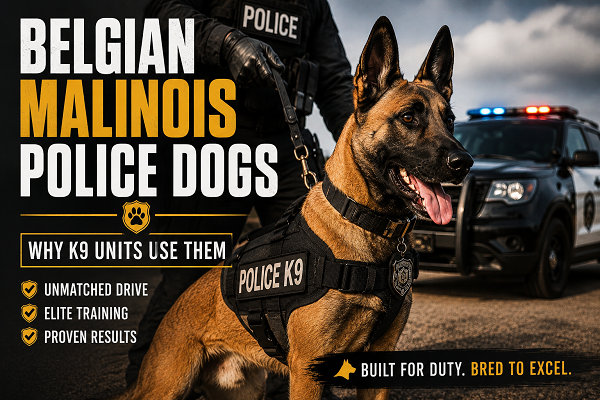
K9 units around the world choose the Belgian Malinois because it combines an unusually high work drive, a lighter and faster frame than a German Shepherd, a working lifespan that holds up under repeated deployments, and a nose good enough to find a person buried under rubble or mud. That combination is why agencies like the U.S. Secret Service, FEMA-certified search and rescue teams, and Navy special operations units all lean on the same breed for very different jobs, patrol, detection, and life-saving search and rescue work.
Table of Contents
- Introduction
- What Makes the Belgian Malinois Different From Other Police Breeds
- A Quick History: From Belgian Farms to Global K9 Units
- Search and Rescue: Where the Malinois Really Earns Its Keep
- The Core Traits That Make Malinois Ideal for SAR and Police Work
- Real-World Cases: Malinois On the Job
- Training Timeline and Costs: What It Actually Takes
- Malinois vs. Other SAR and Police Breeds
- Is a Malinois Right for Your Department or Your Home?
- FAQs
- Conclusion
Introduction
Here’s the problem a lot of agencies and dog owners run into: they see the Malinois everywhere, Secret Service protective details, military raids, disaster response teams and assume it’s simply “the best dog.” That’s not quite right, and it’s not the full story either. The Malinois isn’t better than every other breed at everything. It’s better at a very specific combination of jobs, and worse suited than people expect for others.
In this article, you’ll learn exactly why K9 units keep choosing the Malinois, with a close look at search and rescue (SAR) work specifically, the training timelines, the real costs, the breeds it’s up against, and a handful of documented cases where a Malinois’s nose or drive made the difference between a body recovery and a rescue. Whether you’re a handler, an agency decision-maker, or just someone who loves working dogs, you’ll walk away understanding the “why” behind the reputation, not just the reputation itself.
What Makes the Belgian Malinois Different From Other Police Breeds
Let’s get the obvious comparison out of the way first: the Malinois is often mistaken for a “short-haired German Shepherd,” and that’s doing both breeds a disservice. They’re related, historically, but they were shaped by different priorities.
The German Shepherd Dog was developed as a steady, all-purpose herding and guarding dog, built for endurance and a calm, biddable temperament. The Belgian Malinois, one of four varieties of Belgian Shepherd developed in the farm country around Mechelen, was bred to herd livestock non-stop, all day, in tough conditions. That “never runs out of gas” engine is exactly what modern K9 units are paying for.
A few numbers that explain the appeal:
- Weight: 40–80 lbs, noticeably lighter than a typical 65–90 lb working-line German Shepherd
- Working lifespan: Roughly 8–10 years of active service, compared to a shorter 5–7 years for many Bloodhounds used in tracking
- Speed and agility: Faster over distance and quicker to change direction than a heavier-boned Shepherd, which matters when a dog has to clear a collapsed structure or chase a suspect over broken terrain
None of that means the Malinois is a “better” dog in some abstract sense. It means the breed is a better tool for jobs that reward speed, stamina, and an almost obsessive drive to keep working, which brings us to why search and rescue teams specifically have come to rely on them.
A Quick History: From Belgian Farms to Global K9 Units
The Belgian Shepherd’s move into police and security work started earlier than most people assume. Belgian police forces began using the breed for patrol work in the early 1900s, and the Malinois variety itself wasn’t formally recognized as a separate breed from the other Belgian Shepherds until 1959.
As agriculture in Belgium modernized and fewer dogs were needed for herding, breeders and trainers redirected that same drive toward protection and detection work. American and European police departments took notice, and by the mid-to-late 20th century, the Malinois had become a fixture in military and law enforcement K9 programs across Europe and North America.
Today, you’ll find Malinois working in:
- The U.S. Secret Service’s canine division
- Numerous SWAT and tactical units across the U.S. and Europe
- The Belgian Federal Police
- FEMA-certified urban search and rescue (US&R) task forces
- Military working dog programs, including U.S. Navy special operations
That last one is where the breed picked up its most famous ambassador, more on that shortly.
Search and Rescue: Where the Malinois Really Earns Its Keep
Search and rescue work is a different animal from patrol or detection work, and it’s worth understanding why the Malinois has become such a strong candidate here too.
FEMA’s Urban Search and Rescue (US&R) system, which deploys canine teams after earthquakes, building collapses, and other disasters, relies on a short list of breeds: Labrador Retrievers, German Shepherds, Golden Retrievers, Border Collies, and Belgian Malinois. Every Type 1 task force, a 70-person team ready for the most severe disaster response, deploys with at least four canine search teams, split between live-find search and human remains detection.
What SAR organizations are actually screening for isn’t “which breed is smartest.” It’s a very specific temperament profile:
- Obsessive toy or ball drive — so a dog will keep searching for the reward of play, not food, even after hours of work
- Independent problem-solving — a SAR dog often has to work 100+ yards ahead of its handler, out of sight, and make its own calls
- Nerve stability — unfazed by sirens, generators, unstable rubble, or the smell of smoke and debris
- Physical resilience — able to climb, balance, and squeeze through wreckage for hours at a stretch
Interestingly, groups like the National Disaster Search Dog Foundation (SDF) actively recruit dogs from shelters and breed-rescue groups for exactly this reason. The same high energy and intensity that gets a young Malinois or Lab surrendered to a shelter as “too much dog” is precisely what makes it a strong SAR candidate. SDF has said, in effect, that the traits landing a dog in a shelter are the same traits a search dog needs, the difference is simply giving that dog a job.
The Core Traits That Make Malinois Ideal for SAR and Police Work
Strip away the breed-specific history, and here’s what actually matters operationally:
- Scent drive that doesn’t quit. A Malinois will keep working a scent cone long after a less-driven dog has lost interest, which is critical when a live-find search can take hours in difficult wind conditions.
- Speed and agility over rough terrain. Rubble piles, collapsed buildings, and mudslide debris fields aren’t flat ground. A lighter, more agile dog can cover and search terrain a heavier dog struggles with.
- Handler attachment paired with independence. This sounds contradictory, but it’s the whole trick of the breed: a Malinois bonds intensely with its handler while still being willing to range far out of sight to search, as long as the foundational training and trust are there.
- Recovery speed. Malinois tend to bounce back from a hard physical day faster than heavier breeds, which matters across multi-day disaster deployments.
- Trainability under pressure. High drive can be a liability without discipline. The reason Malinois succeed operationally, and not just in demos, is that professional programs pair that drive with extremely structured, repetition-heavy training from a young age.
One thing worth being honest about: none of these traits make the Malinois a “better pet.” The same qualities that make an elite SAR or patrol dog make an under-stimulated, undertrained Malinois a genuine handful in an average home. This is a working breed first, full stop.
Real-World Cases: Malinois On the Job
Numbers and traits are useful, but real cases are what actually build trust in a breed. Here are a few well-documented examples.
Cairo — Operation Neptune Spear (2011). The most famous Malinois in modern military history, Cairo was part of the Navy SEAL Team Six unit involved in the raid on Osama bin Laden’s compound in Abbottabad, Pakistan. Cairo’s role highlighted just how far military working dog programs had come in trusting the breed with high-stakes tactical operations, wearing specialized protective gear designed for exactly this kind of mission.
Piper — California mudslide response (2018). Following a deadly debris flow in Montecito, California, a Malinois named Piper, working with Ventura County Search and Rescue, helped locate a young boy buried under mud and wreckage. It’s a strong example of civilian volunteer SAR teams, not just military or federal units, getting real, documented results with the breed.
Conan — Explosive detection, Iraq deployment. Another Malinois credited with successfully detecting explosives in an active combat zone while wearing full protective gear, underlining that this isn’t just a “photogenic breed”, it performs under genuinely dangerous, unpredictable conditions.
Ivo — Municipal K9 unit, Fort Collins, Colorado. Not every Malinois story involves a headline-grabbing mission. Ivo served as a dual-purpose patrol and detection dog for a mid-sized U.S. police department for years before his death from cancer, a reminder that most of the breed’s real-world value comes from quiet, day-to-day community policing work, not just dramatic raids.
These cases span military special operations, civilian disaster response, combat detection work, and everyday municipal policing, which is really the point. Few breeds show up credibly across that entire range.
Training Timeline and Costs: What It Actually Takes
This is the part a lot of articles skip, and it matters if you’re an agency budgeting a K9 program or an owner considering the breed.
Puppy foundation (8–16 weeks): Training realistically starts the day a Malinois puppy comes home. The socialization window closes around 16 weeks, and for this breed specifically, missing that window tends to create adult dogs that carry suspicion of strangers into situations where it becomes a real liability rather than a quirk.
Basic obedience and drive channeling (4–12 months): Short, high-frequency sessions, a well-run program will run 3–4 short sessions a day rather than one long one, since Malinois puppies lose focus fast but recover quickly for the next rep.
Professional K9 academy training (roughly 8–10 weeks): Departments that import or purchase started dogs typically send the dog and its assigned handler through an intensive academy program before the team hits the streets. Many U.S. departments send dogs through well-known private K9 training facilities that specialize in law enforcement placement, with training blocks commonly running around 8 weeks for the dog alone, plus additional handler-and-dog team training.
SAR-specific certification (8–10 months): Search and rescue programs like the National Disaster Search Dog Foundation run their own evaluation, socialization, and search-dog training pipeline at dedicated training centers, typically spanning 8 to 10 months from intake to certified search dog.
Costs to expect:
- A started, partially trained working-line Malinois puppy: several thousand dollars, before any professional training
- A fully trained, certified police or protection-ready Malinois from a reputable program: often well into five figures (USD), reflecting the hundreds of hours of specialized training involved
- Ongoing costs: veterinary care, specialized gear (cooling vests, protective “doggles” for tactical or SAR deployments), and continued training maintenance throughout the dog’s working life
For agencies, these costs are usually weighed against the alternative: officer hours and lives potentially saved through faster searches, explosive detection, or suspect apprehension. For private owners considering a Malinois purely as a companion, it’s worth being blunt, this is rarely the most cost-effective or practical choice unless you have the time, experience, and outlet the breed genuinely needs.
Malinois vs. Other SAR and Police Breeds
No single breed wins every category. Here’s a realistic side-by-side of how the Malinois stacks up against the other breeds most commonly used in K9 and SAR programs:
| Breed | Best For | Working Lifespan | Notes |
|---|---|---|---|
| Belgian Malinois | Patrol, apprehension, tactical ops, agile SAR terrain | 8–10 years | Highest drive; needs an experienced handler |
| German Shepherd | General-purpose patrol, steady community policing | 8–10 years | More forgiving of less-experienced handlers |
| Labrador Retriever | Detection (explosives, narcotics), airport/school settings | 8–10 years | Non-threatening public image, strong scenting ability |
| Bloodhound | Missing-person and fugitive tracking | 5–7 years | Unmatched scent discrimination, shorter career |
| Border Collie / Golden Retriever | Wilderness and disaster SAR | 8–10 years | Excellent stamina, strong FEMA US&R track record |
The takeaway: Malinois dominate where speed, agility, and intensity under pressure matter most, tactical entries, apprehension work, and SAR terrain that demands athleticism. Where the job calls for a calmer public-facing presence (airport detection, school visits) or the single sharpest nose for tracking a specific person over miles, other breeds still hold their ground.
Is a Malinois Right for Your Department or Your Home?
If you’re an agency, the Malinois makes sense when your unit genuinely needs the speed-and-drive combination, tactical response, apprehension work, or SAR deployments across difficult terrain. It’s a poor fit if your program lacks the budget or staff time for intensive, ongoing training; an under-worked Malinois in a kennel is a welfare problem, not just an underperformance issue.
If you’re considering one as a personal dog, ask yourself honestly:
- Can you commit to 1–2+ hours of structured activity daily, not just a walk?
- Do you have experience with high-drive working breeds, or access to a trainer who does?
- Is your household set up for a dog that bonds intensely and doesn’t do well left alone for long stretches?
If you answered “no” to any of these, a Malinois is likely to become one of those “too much dog” cases that shelters and rescue groups see regularly, which, ironically, is exactly the pool that programs like the National Disaster Search Dog Foundation pull their best SAR candidates from. If you’re set on the breed but want to go in prepared, our detailed training guide for Belgian Malinois walks through the five steps every owner or handler needs before taking on this breed.
For a closer look at how the Malinois compares against its most common rival breed on temperament and working style, see our breakdown of German Shepherd vs. Belgian Malinois for working roles, and for how the two breeds stack up specifically on trainability and intelligence in security roles, check out Malinois vs. German Shepherd intelligence for security work.
If you want to see how all of this plays out at the department level, our profile of Fort Collins K9 police dogs, breeds, and tactical training gives a real, on-the-ground look at how a mid-sized U.S. agency actually builds and runs its K9 program. And if you’re curious how the Malinois fits into the wider world of working dog careers beyond policing, our guide to what it means for a dog to be a working dog covers everything from SAR to therapy work.
If you’re serious about understanding this breed at a deeper level, whether you’re training your own working Malinois or preparing to bring one into a K9 program, it’s worth pairing this article with a structured, step-by-step resource. This training ebook is a solid next step for handlers who want a proven framework rather than piecing advice together from forums.
FAQs
1. Why do police and SAR units prefer the Belgian Malinois over the German Shepherd?
The Malinois is generally lighter, faster, and holds up better across intense, repeated deployments, thanks to a working drive that was originally bred for all-day herding. The German Shepherd remains a strong general-purpose choice, especially for departments that want a slightly calmer, more forgiving temperament.
2. How long does it take to train a Malinois for search and rescue work?
Full SAR certification typically takes 8 to 10 months of dedicated training at a certified search-dog training center, on top of the foundational obedience and socialization work done in the dog’s first year of life.
3. Are Malinois good family pets, or only working dogs?
They can succeed as family dogs, but only in households ready to give them 1–2+ hours of structured daily activity and consistent, experienced handling. Without that, the same drive that makes them elite working dogs tends to show up as destructive or anxious behavior at home.
4. What breeds compete with the Malinois in FEMA search and rescue programs?
Labrador Retrievers, German Shepherds, Golden Retrievers, and Border Collies are the other most common breeds in FEMA’s Urban Search and Rescue canine program, alongside the Belgian Malinois.
5. How much does a fully trained police or SAR Malinois cost?
A started puppy from working lines can run several thousand dollars, while a fully trained, certified police or protection-ready Malinois from a reputable program often costs well into five figures (USD), reflecting hundreds of hours of specialized training and evaluation.
Conclusion
The Belgian Malinois didn’t earn its spot in K9 units, military programs, and disaster response teams by accident or hype. It’s the product of a very specific set of traits, relentless drive, agility, a fast recovery rate, and a nose that doesn’t quit, lining up almost perfectly with what patrol, tactical, and search and rescue work actually demand.
If you’re an agency evaluating a K9 program, the real question isn’t “is the Malinois the best breed?” It’s whether your unit’s mission and training resources match what this breed needs to thrive. If you’re an individual owner drawn to the breed after seeing dogs like Cairo or Piper in the news, take that as a cue to research seriously, not a reason to bring one home on impulse. Talk to working-line breeders, connect with local Schutzhund or IGP clubs, and be honest with yourself about the daily time commitment before you commit to one of the most capable and most demanding, working breeds on the planet.
Insights from the ARFS K9 Training Team: handlers and trainers working hands-on with Belgian Malinois and other working breeds across police, protection, and search and rescue programs.

Her work centres on obedience, detection, protection and operational readiness. She favours proven methods built on repetition, consistency and real-world conditioning, so that both dogs and handlers are prepared for high-pressure tasks.
Rofiat represented the Nigerian Army Dog Centre at the Nigerian Army Day Celebration (NADCEL) 2026, where she led demonstrations in obedience, explosive detection, agility and tactical movement. Through articles, training content and documentaries, she shares field-based insight into how structured training, clear communication and trust between handler and dog affect performance and reliability.
She is the author of Beyond the Bark: Inside a Pro Handler's Playbook for Raising the Ideal Dog, a practical guide that helps dog owners and handlers apply professional training principles in everyday situations.
- Australian Cattle Dog vs Blue Heeler: Any Difference? - October 1, 2026
- Bousnic Dog Training Collar Review: Is It Safe? - September 30, 2026
- Gravy Train Dog Food Review: Ingredients & Recalls - September 30, 2026