Best Family Watchdog Breeds: Top 7 Safe Picks (2026)
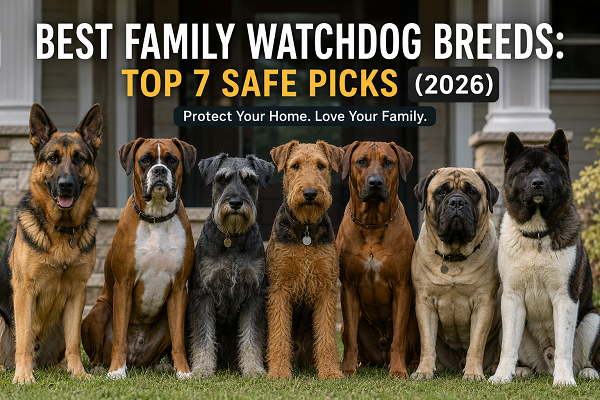
The safest family watchdog breeds, ones that combine strong alerting instinct with stable, kid-friendly temperament, are the German Shepherd, Boxer, Standard Schnauzer, Airedale Terrier, Rhodesian Ridgeback, Bullmastiff, and Akita. Each scores well above the 84% breed-average pass rate on the American Temperament Test Society’s (ATTS) national temperament exam, and each has a documented history of working alongside families rather than just guarding property.
Table of Contents
- Introduction
- Watchdog vs. Guard Dog: Why the Difference Matters
- How We Picked These 7 Breeds
- 1. German Shepherd
- 2. Boxer
- 3. Standard Schnauzer
- 4. Airedale Terrier
- 5. Rhodesian Ridgeback
- 6. Bullmastiff
- 7. Akita
- Comparison Table
- 3 Mistakes Families Make Choosing a Watchdog
- FAQs
- Conclusion
Introduction
If you’ve ever laid awake listening to a strange noise outside and wished you had a dog that would actually do something about it, you’re not alone. That’s the exact question I get asked more than almost anything else at ARFS K9 Team: “What’s a dog that’ll bark at trouble but won’t bite my kid’s friends at the birthday party?”
It’s a fair worry. A watchdog that’s too soft won’t alert you to anything. A guard dog that’s too hard-wired for aggression can turn a backyard barbecue into a liability nightmare. So here’s the thing, the sweet spot between “alarm system with a heartbeat” and “safe around toddlers” is narrower than most breed lists let on, and a lot of the popular “top guard dog” articles online just aren’t written with families in mind.
In this guide, you’ll get the real breakdown: what actually separates a “watchdog” from a “guard dog,” the temperament data behind each pick, training timelines and rough costs, and the mistakes I see families make again and again when they choose a dog based on looks or internet hype instead of fit.
Watchdog vs. Guard Dog: Why the Difference Matters
Let’s clear this up first, because it trips up almost every first-time buyer I talk to.
A watchdog is bred and wired to notice things. Footsteps on the porch, an unfamiliar car in the driveway, a raccoon knocking over the trash can at 2 a.m., the watchdog’s whole job is to make noise and let you know. It doesn’t need to be big or intimidating. A Beagle is technically a decent watchdog. It just needs sharp senses and a willingness to speak up.
A guard dog goes a step further. It’s trained (or bred) to physically intervene, to place itself between a threat and the people it’s protecting, and if needed, to use its body or bite to stop that threat. This is a completely different level of responsibility, liability, and training investment.
What most families actually want, whether they say it or not, is a hybrid: a dog that alerts reliably and has the size, confidence, and bond with the family to back that alert up if things escalate, but one that’s stable enough not to see every mail carrier as an intruder. That’s the category this list focuses on.
How We Picked These 7 Breeds
I didn’t just go with “popular guard dog breeds you’ve heard of.” Every breed on this list had to check three boxes:
- A documented temperament pass rate at or above the ATTS national average (84% across all tested breeds, per the American Temperament Test Society’s ongoing national dataset)
- A working or historical role that involved close contact with families, not just isolated guard duty
- Trainability within a realistic timeline for an average household, not just professional K9 units
I’m leaving a few famous “protection breeds” off this list on purpose. Breeds like the Cane Corso and Doberman Pinscher are phenomenal protectors, but they need handler experience and early, structured socialization that a lot of first-time owners underestimate. If you already have that experience, they’re worth a look, I’ve written more on the Doberman and Rottweiler’s role in the Working Group if you want to go deeper.
1. German Shepherd
Best for: Families who want a dog that can do it all such as alert, protect, and still nap with the kids.
If there’s one breed that shows up on nearly every serious guard-and-family list worldwide, it’s the German Shepherd (GSD). Police departments from Berlin to Los Angeles use them for a reason: German Shepherds combine sharp alertness with a genuinely stable, loyal temperament when they’re bred and raised right.
- Temperament: Steady, analytical, protective without being reactive. GSDs tend to “settle” well once their exercise needs are met, they don’t stay wound up all evening the way some drivier working breeds do.
- Size: 22–26 inches, 50–90 lbs.
- Training timeline: Basic obedience by 4–6 months; reliable off-leash control and a strong “watch” behavior by 12–18 months with consistent daily work.
- Cost: A well-bred GSD puppy from health-tested working or show lines typically runs $1,500–$3,500 in the US; professional obedience or protection-foundation training can add another $150–$300 per session if you go that route.
- Real-world note: GSDs are the most heavily represented breed in K9 units across NATO countries, which tells you something about how consistently trainable and stable the breed is when it comes from good lines.
If you want to understand exactly how a GSD’s mind works compared to its closest working cousin, I broke this down in detail in German Shepherd vs. Belgian Malinois: Which Breed Is Right for You, worth a read if you’re torn between the two for a family setting, since the Malinois is a fantastic working dog but usually too much drive for a first-time family home.
2. Boxer
Best for: Households with young, energetic kids who want a dog that’s more “loving bodyguard” than “aloof protector.”
Boxers get overlooked on guard dog lists because they look goofy and act like clowns half the time. Don’t let that fool you. Boxers were originally bred in Germany as bull-baiting and cattle dogs, then repurposed as police and military dogs before becoming one of the most popular family breeds in the US and UK. They’re naturally wary of strangers, physically strong, and famously patient with children, patient enough that they’re often called a “nanny breed” in the same breath as the Collie.
- Temperament: Playful, high energy, deeply bonded to family, naturally suspicious of unfamiliar people entering the home.
- Size: 21–25 inches, 50–80 lbs.
- Training timeline: Boxers mature slowly (mentally, they’re still puppy-ish until 2–3 years old), so expect basic manners by 6 months but full emotional maturity later than most breeds on this list.
- Cost: $1,200–$2,500 for a reputable breeder puppy; budget for pet insurance early since Boxers are prone to certain heart conditions (boxer cardiomyopathy) that are worth screening for.
- Real-world note: In multiple family-placement surveys, Boxers consistently rank in the top tier for “child tolerance” scores while still scoring well above average for territorial alertness, a genuinely rare combination.
3. Standard Schnauzer
Best for: Families who want a lower-shedding, mid-sized watchdog without the massive food and space bill of a giant breed.
The Standard Schnauzer is the original, the Giant Schnauzer and Miniature Schnauzer were both developed from it. Bred in Germany as an all-purpose farm and ratting dog with serious guarding instinct baked in, the Standard hits a size sweet spot a lot of families overlook: big enough to be a real deterrent, small enough to live comfortably in a normal house.
- Temperament: Alert, intelligent, loyal, wary of strangers without being fearful. Wonderful problem-solvers, which means they need a job or they’ll invent their own (usually redecorating your couch cushions).
- Size: 17.5–19.5 inches, 30–50 lbs.
- Training timeline: Quick learners, basic commands within weeks, but their independent streak means training needs to stay consistent through the first year.
- Cost: $1,000–$2,000 for a puppy; grooming (hand-stripping or clipping every 6–8 weeks) adds $50–$80 a visit if you’re not doing it yourself.
- Real-world note: If you want the same guarding instinct in a bigger, more imposing package, I go deep on the Giant Schnauzer’s protection-work suitability, bite force data, and training costs in Is a Giant Schnauzer a Good Protection Dog? Full Guide, it’s essentially the Standard’s bigger, more intense cousin.
4. Airedale Terrier
Best for: Families who want a versatile, fearless watchdog with a genuine sense of humor.
Nicknamed the “King of Terriers,” the Airedale is the largest of the terrier breeds and has a surprisingly serious working résumé, British and German forces used Airedales as messenger, sentry, and even medic-assistance dogs during World War I. Under all that wiry coat is a dog that’s confident, bold, and quick to notice anything out of place.
- Temperament: Confident, independent, playful with family, naturally protective of “their” people and space without excessive aggression. ATTS data puts Airedale Terriers at a 78.2% pass rate, solidly respectable for a breed with such strong terrier independence.
- Size: 21–23 inches, 40–65 lbs.
- Training timeline: Airedales are smart but stubborn, expect to work harder on consistency than raw teaching. Basic obedience by 4–5 months, but recall and impulse control often take a full year of patient reinforcement.
- Cost: $1,200–$2,000 for a puppy from a health-tested line.
- Real-world note: Airedales were historically used by police in the UK before German Shepherds became the standard-issue breed, a detail that surprises most people, given how the breed is marketed today as a “family dog” first.
5. Rhodesian Ridgeback
Best for: Families in warmer climates who want a low-maintenance coat and a dog with serious physical presence.
Originally bred in Southern Africa to help hunters track and bay lions (yes, really, hence the old nickname “African Lion Hound”), the Ridgeback carries a quiet, dignified confidence that makes it an outstanding watchdog without a lot of unnecessary barking. It’s not a breed that sounds off at every leaf blowing by; when a Ridgeback alerts, it usually means something.
- Temperament: Calm, dignified, deeply loyal, reserved with strangers but rarely aggressive without cause. ATTS pass rate sits at 84.2%, right at the national average and notably strong for a breed with such a serious protective history.
- Size: 24–27 inches, 70–85 lbs.
- Training timeline: Ridgebacks are independent thinkers (a holdover from their hunting past), so early socialization between 8–16 weeks is critical. Reliable obedience typically arrives by 12 months with consistent, positive-reinforcement-based training.
- Cost: $1,500–$2,800 for a puppy from health-tested lines (hip and elbow screening matters here).
- Real-world note: Ridgebacks are famously quiet indoors, many owners describe them as “big cats” around the house, only becoming visibly alert when something genuinely warrants it.
6. Bullmastiff
Best for: Families who want maximum deterrent presence with a surprisingly gentle, low-energy temperament indoors.
The Bullmastiff was purpose-built in 19th-century England for one job: quietly track and pin down poachers on large estates without mauling them. That history matters, because it produced a breed with enormous physical power paired with a naturally controlled, non-aggressive default state. Bullmastiffs consistently score a perfect watchdog rating in breed comparison data, and for good reason, their sheer size alone is often enough to end a confrontation before it starts.
- Temperament: Calm, affectionate, low-energy indoors, fiercely loyal, naturally wary of strangers entering the home.
- Size: 24–27 inches, 100–130 lbs.
- Training timeline: Bullmastiffs are eager to please and pick up house manners fast, but because of their size and strength, early leash and impulse-control training (starting at 8 weeks) isn’t optional, a 120 lb adolescent dog that never learned polite greetings is a real problem.
- Cost: $1,800–$3,000 for a puppy; larger breeds also mean higher food and vet costs long-term, so budget accordingly.
- Real-world note: Bullmastiffs were bred specifically to detain, not attack, historically, gamekeepers wanted the dog to knock a poacher down and hold him there until the handler arrived, not bite. That “hold, don’t harm” instinct is part of why the breed does so well in homes with kids.
7. Akita
Best for: Experienced dog owners who want one of the most naturally protective, one-family-devoted breeds on the planet.
Japan’s national treasure earns its spot here, but with an honest caveat: the Akita is the most intense personality on this list, and it’s not a beginner’s dog. Bred for centuries to guard Japanese nobility and hunt large game, Akitas bond ferociously to their household and are famously reserved, sometimes outright standoffish, with outsiders and other dogs.
- Temperament: Dignified, quiet, intensely loyal to their chosen people, naturally distrustful of strangers. ATTS data shows a 78.6% pass rate across 622 tested dogs, solid, though slightly lower than some breeds here, reflecting the breed’s guarding intensity.
- Size: 24–28 inches, 70–130 lbs.
- Training timeline: Early, extensive socialization (ideally starting at 7–8 weeks and continuing well past a year) is non-negotiable with this breed. Skip it, and you get a dog that’s suspicious of everyone rather than selectively alert.
- Cost: $1,500–$2,500 for a puppy from a reputable breeder.
- Real-world note: I go into the Akita’s full guarding history, insurance considerations, and training approach in Akita Dog: Japan’s National Treasure & Fiercely Loyal Protector, it’s essential reading before you commit to this breed specifically, since Akitas also show notably higher dog-aggression rates than the other breeds on this list, so multi-dog households need extra care.
Comparison Table
| Breed | Size (lbs) | ATTS Pass Rate | Best Trait | Training Timeline |
|---|---|---|---|---|
| German Shepherd | 50–90 | ~85%* | All-around versatility | 12–18 months |
| Boxer | 50–80 | ~85%* | Patience with kids | 18–24 months (slow maturity) |
| Standard Schnauzer | 30–50 | ~85%* | Compact, low-shed guardian | 6–12 months |
| Airedale Terrier | 40–65 | 78.2% | Fearless, versatile | 12 months |
| Rhodesian Ridgeback | 70–85 | 84.2% | Quiet, selective alerting | 12 months |
| Bullmastiff | 100–130 | ~85%* | Sheer deterrent presence | 12–18 months |
| Akita | 70–130 | 78.6% | Intense one-family loyalty | 18+ months |
*Breed-specific ATTS figures for GSD, Boxer, and Bullmastiff fluctuate by test year; all have historically tested at or above the national average of 84%.
3 Mistakes Families Make Choosing a Watchdog
I’ve seen these three mistakes more times than I can count, so let’s head them off:
- Picking size over temperament. A bigger dog isn’t automatically a better protector. Temperament stability, bond with the family, and training consistency matter far more than raw size. A well-trained 50 lb Boxer will out-perform a poorly socialized 120 lb mastiff every time.
- Skipping professional-grade socialization. Every single breed on this list needs structured exposure to new people, sounds, and environments during the 8–16 week critical window. Skip that window, and even the “safest” breed can develop fear-based reactivity. If you want a clear breakdown of the puppy-selection process itself, it’s worth reading through common pitfalls before you even bring a dog home.
- Confusing “watchdog” with “attack dog” in training goals. You do not need bite work or protection sport training for a family watchdog. In fact, pushing untrained owners toward bite work is one of the fastest ways to end up with a liability instead of a companion. Alert training, boundary respect, and calm confidence around strangers get you 90% of what most families actually need.
FAQs
1. What is the safest guard dog breed for a family with small kids?
Based on combined temperament testing data and documented family-placement history, the German Shepherd and Boxer are typically the safest choices for households with small children, thanks to their high ATTS pass rates and well-documented patience with kids.
2. Do watchdogs need special training, or is barking instinct enough?
Instinct alone isn’t reliable, an untrained dog may alert at everything (delivery drivers, wind, the neighbor’s cat) or, just as often, at nothing important. Basic “alert and stop on command” training, ideally starting around 4–6 months, turns raw instinct into something genuinely useful.
3. Are big guard dog breeds automatically dangerous around children?
No. Size has very little to do with bite risk, temperament, training, and socialization are the real predictors. Breeds like the Bullmastiff and Rhodesian Ridgeback were specifically developed with restraint over aggression, and both test well above average for stability.
4. How much does it cost to raise a family watchdog in the first year?
Beyond the $1,000–$3,500 puppy cost, budget roughly $1,500–$2,500 for the first year covering food, vaccinations, basic obedience classes, and gear, more if you pursue professional protection or advanced obedience training.
5. Can a rescue dog make a good family watchdog, or do I need a puppy?
Absolutely, many adult rescues, especially mixed breeds with working-dog ancestry, make excellent watchdogs. What matters most is a temperament evaluation (many shelters now offer this) and a slow, structured introduction period, regardless of whether the dog is 8 weeks or 8 years old.
Conclusion
Here’s the bottom line: the best family watchdog isn’t the biggest, scariest-looking breed you can find. It’s a dog whose natural instincts, alertness, loyalty, a bit of healthy suspicion toward strangers, line up with a temperament stable enough to handle a house full of noise, visitors, and kids without a hair-trigger reaction.
Of the seven breeds here, the German Shepherd and Boxer are the safest starting points for most first-time family-protector owners, the Standard Schnauzer and Rhodesian Ridgeback are excellent options if you want something a little less common, and the Airedale, Bullmastiff, and Akita are fantastic choices for owners ready to put in the extra socialization work these more intense personalities need.
Whichever breed you land on, don’t skip the fundamentals: early socialization, consistent training, and realistic expectations about what “watchdog” actually means. Do that, and you’ll end up with exactly what you were looking for in the first place, a dog that keeps your family safer, and loves them harder, every single day.
A Note From the ARFS K9 Team: These breed recommendations are drawn from combined field experience training and evaluating working and family-protection dogs, alongside published temperament data from the American Temperament Test Society. If you’re weighing a specific breed for your household and want a second opinion, feel free to reach out through our contact page, we’re always happy to talk it through.

Her work centres on obedience, detection, protection and operational readiness. She favours proven methods built on repetition, consistency and real-world conditioning, so that both dogs and handlers are prepared for high-pressure tasks.
Rofiat represented the Nigerian Army Dog Centre at the Nigerian Army Day Celebration (NADCEL) 2026, where she led demonstrations in obedience, explosive detection, agility and tactical movement. Through articles, training content and documentaries, she shares field-based insight into how structured training, clear communication and trust between handler and dog affect performance and reliability.
She is the author of Beyond the Bark: Inside a Pro Handler's Playbook for Raising the Ideal Dog, a practical guide that helps dog owners and handlers apply professional training principles in everyday situations.
- Australian Cattle Dog vs Blue Heeler: Any Difference? - October 1, 2026
- Bousnic Dog Training Collar Review: Is It Safe? - September 30, 2026
- Gravy Train Dog Food Review: Ingredients & Recalls - September 30, 2026