Husky Pitbull Mix Puppies: 7 Facts Before Buying
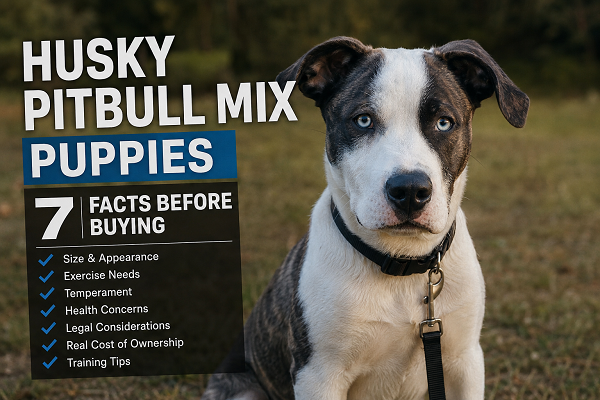
A Husky Pitbull mix, commonly called a Pitsky, is a medium-to-large designer crossbreed weighing 35–75 pounds, standing 16–25 inches tall, and living 12–15 years. Before buying one, you need to know it isn’t a recognized breed, needs 60–90 minutes of daily exercise, can inherit health issues from both parents, and may be affected by breed-specific legislation depending on where you live.
Table of Contents
- Introduction
- What Exactly Is a Husky Pitbull Mix?
- Fact 1: It’s Not a Recognized Breed
- Fact 2: Size and Looks Are a Genetic Lottery
- Fact 3: They Need 60–90 Minutes of Exercise Daily
- Fact 4: The Temperament Is Loving, But Not Beginner-Simple
- Fact 5: Health Problems Come From Both Sides of the Family
- Fact 6: Breed-Specific Legislation Could Affect You
- Fact 7: The Real Cost Is Higher Than the Puppy Price Tag
- Training Tips for a Pitsky Puppy
- Is a Husky Pitbull Mix Right for You?
- FAQs
- Final Thoughts
Introduction
If you’ve spent any time scrolling dog breeder pages or rescue sites, you’ve probably come across a Pitsky, that striking mix of a Siberian Husky’s icy blue eyes and a Pitbull’s block-headed, muscular build. It’s a head-turner, no question. But I’ve fielded enough calls from owners who bought one on impulse and then struggled with the reality of what they brought home, so let’s slow down and actually talk about what you’re signing up for.
This isn’t a “these dogs are perfect” post. It’s the stuff I wish more breeders told people upfront, the real size range, the real training demands, the real costs, and the legal headaches that catch people off guard. By the end, you’ll know exactly what to check before you hand over a deposit, and whether this mix even fits the life you’re currently living.
What Exactly Is a Husky Pitbull Mix?
A Husky Pitbull mix, nicknamed the Pitsky, is what you get when you cross an American Pit Bull Terrier with a Siberian Husky (occasionally an Alaskan Husky). It’s a designer crossbreed, not a purebred, which means there’s no fixed standard for how one is supposed to look, act, or grow. Two puppies from the exact same litter can turn out completely different, one might come out with a Husky’s thick double coat and wolfish face, the other with a Pitbull’s short coat and blocky head. That unpredictability is part of the charm for some owners, and a genuine source of frustration for others who had a specific look or size in mind.
Now let’s get into the seven things I think every potential buyer needs on their radar before they commit.
Fact 1: It’s Not a Recognized Breed
Here’s the thing a lot of sellers gloss over: the American Kennel Club (AKC) doesn’t recognize the Pitsky, and neither does the United Kennel Club (UKC) as a standardized breed. It’s classified as a mixed or “designer” breed, which means there’s no official breed standard, no certified show lineage, and no governing body checking that a breeder’s “Pitsky” is actually 50/50 Husky and Pitbull rather than something else entirely.
Practically, this matters for a few reasons:
- No guaranteed traits. A breeder can’t promise you a specific adult size, coat type, or temperament with real confidence.
- No official pedigree registry, so verifying parentage relies on trusting the breeder (or doing a DNA test yourself once the puppy is home).
- Price and quality vary wildly, since there’s no accreditation system standardizing what a “reputable” Pitsky breeder even looks like.
If you’re used to buying a purebred with generations of predictable traits behind it, this is the biggest mental shift you’ll need to make.
Fact 2: Size and Looks Are a Genetic Lottery
Because the parent breeds differ so much in build, Pitsky puppies grow into a wide range of adult sizes. Most mature to somewhere between 35 and 75 pounds, standing 16 to 25 inches at the shoulder but I’ve personally seen litters where one puppy topped out closer to a lean 40-pound Husky-type build, and its littermate packed on nearly 70 pounds of Pitbull-style muscle.
Coat and coloring are just as much a coin flip:
- Coats range from short and smooth (Pitbull-leaning) to thick, double-coated, and heavy-shedding (Husky-leaning).
- Colors span black, white, brindle, sable, silver, and just about every combination in between.
- Eyes can be brown, blue, or heterochromatic (one of each), the Husky genes are largely responsible for that striking blue-eyed look people search for.
- Ears might stand fully erect like a Husky’s or fold over like a Pitbull’s.
A reputable breeder should be able to show you both parents in person. If you can see mom and dad, you’ll get a much better read on what your puppy is likely to grow into than any online chart can give you.
Fact 3: They Need 60–90 Minutes of Exercise Daily
This is where a lot of Pitsky ownership goes sideways. You’re combining a Husky, a working sled dog bred to travel dozens of miles a day, with a Pitbull, a breed built for muscular, high-drive activity. The result is a dog that gets bored, destructive, and downright miserable on a single lazy 20-minute walk around the block.
Most experienced handlers recommend at least 60 to 90 minutes of vigorous exercise daily, split between structured activity (jogging, hiking, fetch, tug) and mental stimulation (puzzle feeders, scent games, training drills). Without it, expect:
- Chewed furniture and drywall
- Escape attempts (Huskies are legendary fence-jumpers and diggers)
- Excessive barking or howling
- Restless, anxious behavior at night
If your current lifestyle tops out at a short evening stroll, this mix is going to fight you on it. Related to this: if you’re weighing this breed against another high-energy mix, our breakdown of the Mini Husky’s trainability and temperament is worth a look for comparison, since it covers the Husky side of this equation in more depth.
Fact 4: The Temperament Is Loving, But Not Beginner-Simple
Let’s clear something up first: Pitskies are not the aggressive dogs their Pitbull half sometimes gets stereotyped as. In my experience and in what most breed-specific rescues report, well-socialized Pitskies are affectionate, people-oriented, and genuinely great with kids when raised and handled properly. They inherit the Pitbull’s “velcro dog” devotion and the Husky’s playful, mischievous streak.
That said, “friendly” doesn’t mean “easy.” A few temperament quirks show up consistently:
- Independent streak. The Husky side can make them stubborn about commands, especially recall, Huskies are notorious for selective hearing once they catch an interesting scent.
- High prey drive. Both parent breeds can chase small animals, so cats and small pets need careful, supervised introductions.
- Separation anxiety. These dogs bond tightly with their people and don’t do well left alone for long stretches.
- Vocal tendencies. Huskies talk, expect howling, “woo-wooing,” and possibly some Pitbull-style whining mixed in.
None of this makes them bad dogs. It makes them dogs that need an owner who’s ready to put in real training time, especially in the first year.
Fact 5: Health Problems Come From Both Sides of the Family
Mixed breeds sometimes get a “hybrid vigor” reputation, but that doesn’t mean a Pitsky is immune to hereditary issues, it just means the risk pool is drawn from two gene lines instead of one. Conditions to ask breeders about, and to budget for down the line, include:
- Hip dysplasia — common in both parent breeds due to their muscular builds.
- Hypothyroidism — more associated with the Husky lineage.
- Progressive retinal atrophy (PRA) and other eye conditions — again, more common on the Husky side.
- Heart conditions, which is why reputable breeders test for cardiac issues in both parents.
- Skin allergies and hot spots, particularly in dogs that inherit a thicker double coat but live somewhere warm.
Before you put down a deposit, ask to see (or request) these health clearances for both parent dogs:
- OFA hip evaluation
- OFA cardiac exam
- OFA CAER eye evaluation or PRA DNA test (Husky side)
A Pitsky’s expected lifespan runs 12 to 15 years, which is solid for a dog this size but only if the parent lines were screened responsibly. A breeder who can’t produce any health testing paperwork is a red flag, full stop.
Fact 6: Breed-Specific Legislation Could Affect You
This is the fact most first-time buyers never see coming, and it can blow up your plans after you’ve already fallen in love with a puppy. Because a Pitsky is part Pit Bull Terrier, it can fall under breed-specific legislation (BSL) in places that restrict or outright ban “Pit Bull-type” dogs and that includes mixes, not just purebreds.
A few things worth checking before you buy:
- Local and municipal laws. Some cities restrict ownership, require special insurance, or mandate muzzling in public for Pit Bull-type dogs, regardless of exact percentage of ancestry.
- Housing restrictions. Many landlords, HOAs, and rental insurance policies specifically exclude “Pit Bull mixes”, this trips up more new owners than almost anything else on this list.
- International BSL. Restrictions on Pit Bull-type dogs exist in dozens of countries across Europe, parts of Asia, and the Americas, England and Wales, for example, tightened restrictions around bully-type breeds in recent years, and enforcement in other regions varies widely.
- Pet insurance. Some insurers either exclude Pit Bull-type mixes entirely or charge noticeably higher premiums.
None of this means you can’t own a Pitsky responsibly, millions of Pit Bull-type dogs are loved family pets. It just means you need to actually check your local ordinances and your landlord’s pet policy before you fall for a specific puppy, not after.
Fact 7: The Real Cost Is Higher Than the Puppy Price Tag
The sticker price is only the beginning. Here’s a realistic breakdown based on what most Pitsky owners in the US and UK report spending:
| Expense | Typical Cost |
|---|---|
| Puppy purchase price | $500 – $1,500 |
| Initial setup (crate, vaccinations, microchip, spay/neuter, leash, secure fencing) | $500 – $800 |
| Monthly food (large-breed formula) | $55 – $75 |
| Monthly pet insurance | $40 – $65 |
| Annual routine vet care | $200 – $500 |
| Estimated lifetime cost (12–15 years) | $22,000 – $32,000 |
Add to that the possibility of higher fencing costs (Huskies dig and jump), reinforced enclosures, and potential BSL-related insurance surcharges, and this is not a budget breed. If you’re comparing costs across designer mixes before deciding, it’s worth reading our look at Cavalier Cross Poodle puppies and their pros and cons, a very different cost and energy profile that might suit a different type of household.
Training Tips for a Pitsky Puppy
Training a Pitsky isn’t harder than training other high-drive breeds, but it does require consistency from week one. A few field-tested tips:
- Start socialization at 8 weeks. Expose your puppy to new people, dogs, sounds, and surfaces early, this blunts both the Husky’s wariness of strangers and any reactivity that can develop in undersocialized Pit Bull-type dogs.
- Use positive reinforcement, not force. Both parent breeds shut down or push back against harsh corrections. Reward-based training builds trust faster and produces a more reliable dog long-term.
- Nail recall training early. The Husky’s prey drive and wandering instinct make an unreliable recall genuinely dangerous. Practice in a secure, fenced area before ever trusting an off-leash environment.
- Crate train from day one. A properly introduced crate gives your Pitsky a safe den space and speeds up house-training significantly. Our step-by-step crate training guide walks through the exact process we use with high-energy breeds.
- Build a grooming routine early, especially if your puppy leans toward the Husky’s double coat, regular brushing keeps shedding manageable and gets your dog comfortable with handling. Our grooming guide for healthy puppies covers the basics.
If you want a deeper, handler-level breakdown of how to build drive, structure, and real obedience in a strong-willed dog like this, our training team put together a full guide covering exactly that, you can find it in our ebook, Beyond the Bark. It’s the same framework we use with working and protection dogs, scaled down for everyday owners.
Is a Husky Pitbull Mix Right for You?
Before you commit, be honest with yourself about these questions:
- Do you have at least an hour a day for real exercise, rain or shine?
- Is your yard securely fenced (ideally 6 feet, buried at the base, Huskies dig under standard fencing)?
- Have you checked your local laws and landlord’s policy on Pit Bull-type dogs?
- Can you afford $150–$250+ per month in food, insurance, and routine care?
- Are you prepared for 12–15 years of ownership, including the dog’s senior years?
If you answered yes across the board, a Pitsky can be an incredibly loyal, affectionate, and fun companion. If you’re on the fence about the energy commitment, it’s worth reading about the practical differences between working-line temperaments and typical pet dogs in our piece on K9 canine vs. pet dog traits, a lot of the same drive and structure principles apply here.
FAQs
1. Are Husky Pitbull mixes good family dogs?
Yes, when properly socialized and exercised. Pitskies are typically affectionate and playful with children, but their size and energy mean playtime should always be supervised, especially with younger kids.
2. How big does a full-grown Pitsky get?
Most adults land between 35 and 75 pounds and stand 16 to 25 inches at the shoulder, though exact size depends heavily on which parent breed’s genetics dominate.
3. Do Husky Pitbull mixes shed a lot?
It depends on the coat they inherit. Dogs that lean toward the Husky side shed moderately to heavily, especially during seasonal coat blow, while Pitbull-leaning coats shed less and are easier to maintain.
4. Are Pitskies banned anywhere?
Because they’re part Pit Bull Terrier, Pitskies can be affected by breed-specific legislation in certain cities, countries, and rental properties, even though they’re not a purebred Pit Bull. Always check local laws before buying.
5. How much does a Husky Pitbull mix puppy cost?
Puppy prices typically range from $500 to $1,500, but total first-year costs, including setup, food, and vet care, often reach $2,000 to $3,000, with lifetime costs estimated between $22,000 and $32,000.
Final Thoughts
A Husky Pitbull mix isn’t a bad choice, it’s a demanding one. You’re combining two breeds built for stamina, strength, and independent thinking, and that combination rewards owners who show up daily with structure, exercise, and patience. It punishes owners who expected a low-maintenance couch companion.
Before you buy: verify both parents’ health clearances, confirm your local BSL status and housing rules, and be honest about whether you can realistically give this dog 60–90 minutes of exercise every single day. Do that homework upfront, and a Pitsky can turn into one of the most loyal, entertaining dogs you’ll ever own.
Insights from the ARFS K9 Training Team. This article was reviewed by Rofiat Muritala, a working-dog handler with hands-on experience training and placing high-drive breed mixes for security, family, and companion roles. Our advice comes from real handler experience, not just research because these dogs deserve owners who know what they’re actually signing up for.

Her work centres on obedience, detection, protection and operational readiness. She favours proven methods built on repetition, consistency and real-world conditioning, so that both dogs and handlers are prepared for high-pressure tasks.
Rofiat represented the Nigerian Army Dog Centre at the Nigerian Army Day Celebration (NADCEL) 2026, where she led demonstrations in obedience, explosive detection, agility and tactical movement. Through articles, training content and documentaries, she shares field-based insight into how structured training, clear communication and trust between handler and dog affect performance and reliability.
She is the author of Beyond the Bark: Inside a Pro Handler's Playbook for Raising the Ideal Dog, a practical guide that helps dog owners and handlers apply professional training principles in everyday situations.
- Is K9 Advantix Safe for Dogs? A Handler’s Honest Review - October 2, 2026
- Australian Cattle Dog vs Blue Heeler: Any Difference? - October 1, 2026
- Bousnic Dog Training Collar Review: Is It Safe? - September 30, 2026