What Colors Do Dogs See? Are They Really Color Blind?
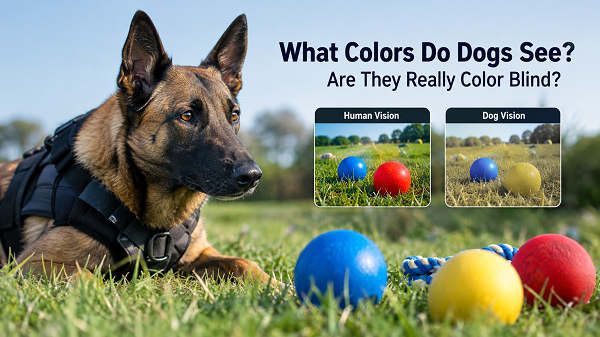
Dogs are not color blind in the way most people imagine. They have dichromatic vision, meaning they see the world mainly in shades of blue, yellow, and gray. They can’t distinguish red from green the way humans do, those colors look more like dull yellow, brown, or gray to a dog. This is scientifically similar to red-green color blindness in humans.
Table of Contents
- Are Dogs Really Color Blind? The Myth vs. The Facts
- What Colors Do Dogs Actually See?
- The Science: How We Know What Dogs See
- Dog Vision vs. Human Vision: Side-by-Side Comparison
- It’s Not Just About Color: Other Ways Dogs See the World Differently
- Why This Matters for Working Dogs and K9 Handlers
- Practical Tips: Picking Toys, Gear, and Training Tools by Color
- Common Myths About Dog Color Vision, Debunked
- FAQs
- Conclusion
Introduction
Ever tossed a red ball into green grass and watched your dog sniff right past it like it wasn’t even there? That’s not a training fail. That’s biology.
For decades, people believed dogs saw the world in grainy black and white, like an old television with the color knob broken. It’s one of the most repeated pet myths out there, and it’s flat-out wrong. But the truth isn’t “dogs see in full color” either. The real answer sits in the middle, and once you understand it, you’ll start making smarter choices about the toys, training markers, and equipment you use with your dog.
I’ve spent years around working dogs, patrol dogs, detection dogs, and family pets in training and the color vision question comes up more than you’d think. Handlers ask why their dog can’t find the orange dummy in the field. New puppy owners ask why their pup ignores the “bright” red chew toy. The answer is the same every time: your dog isn’t seeing what you’re seeing.
In this guide, you’ll learn exactly which colors dogs can and can’t see, the real research behind it (including a 1989 study involving a toy poodle named Retina), how dog vision compares to yours, and because this matters if you train or handle working dogs, how to use this science to pick better gear, toys, and training tools.
Are Dogs Really Color Blind? The Myth vs. The Facts
Here’s the thing, “color blind” is a loaded term. It doesn’t mean “sees no color at all.” Even in humans, someone with red-green color blindness still sees plenty of color. They just can’t separate certain hues the way people with typical vision can.
So when we ask “are dogs color blind?” the honest, science-backed answer is: yes, in the same technical sense that roughly 8% of men and 0.5% of women are color blind. Dogs have a form of color vision deficiency similar to human red-green color blindness (deuteranopia), not total colorlessness.
Where did the “dogs see in black and white” myth even come from? You can trace it back to 1942, when optometrist Gordon Walls published The Vertebrate Eye and Its Adaptive Radiation, a hugely influential book that claimed dogs had little to no color perception. That claim stuck around in pop culture for nearly 50 years, vets, trainers, and pet owners repeated it as fact with almost no hard evidence behind it.
It took until 1989 for someone to actually test it properly. More on that in a minute.
What Colors Do Dogs Actually See?
Dogs see the world through what’s called dichromatic vision, they have two types of color-detecting cone cells in their retinas, compared to the three types humans have (this is called trichromatic vision).
Here’s the breakdown of what that actually looks like:
- Blue — Dogs see this clearly and vividly. It’s one of the most distinct colors in their world.
- Yellow — Also comes through strong and bright for dogs.
- Violet/Purple — Tends to register as a shade of blue.
- Red — Doesn’t register as “red” at all. It likely appears as a dark brownish-gray or even blends into the background.
- Green — Appears washed out, more like a muted yellow, beige, or gray.
- Orange — Often blurs together with yellow.
There’s also something researchers call a spectral neutral point, sitting around 480 nanometers on the light spectrum. Colors that fall in this zone (a range that looks blue-green or green to us) probably appear white, gray, or colorless to a dog. It’s the one true “gap” in their color world.
So next time someone tells you their dog “just doesn’t like” the red chew toy, ask them to try a blue one instead. It’s not preference. It’s contrast.
The Science: How We Know What Dogs See
This is the part most articles skip, and it’s honestly the most interesting bit.
The Study That Changed Everything (1989)
In 1989, vision researcher Dr. Jay Neitz, then at the University of California, Santa Barbara, ran a behavioral experiment that finally put the “dogs are colorblind” myth to rest and replaced it with real data. He used three dogs, including his own toy poodle, appropriately named Retina.
The setup was simple but clever: the dogs were shown three panels of light. Two were the same color, one was different. If the dog correctly picked out the odd one, it got a treat and a click. Wrong pick, no reward. Neitz repeated this daily for about a year.
The results showed dogs have exactly two types of cone photoreceptors, with peak sensitivity at roughly 429 nanometers (blue-violet) and 555 nanometers (yellow-green). That’s the hard data behind everything we now know about canine color vision. Neitz’s full paper, “Colour Vision in the Dog,” was published that year and is still cited in veterinary ophthalmology today.
Confirmed Again, Independently
Science doesn’t stop at one study. In 2013, a research team from the Laboratory of Sensory Processing at the Russian Academy of Sciences repeated similar color-discrimination tests on eight untrained dogs and reached the same conclusion: dichromatic, blue-yellow vision. That’s two separate research groups, 24 years apart, landing on the same answer, which is about as solid as animal vision research gets.
The Cone Density Gap
Here’s a stat that rarely makes it into other articles: a dog’s retina contains only about 10–20% of the cone cells found in a human retina (per veterinary ophthalmology data cited by The Kennel Club’s own vision research summary). Fewer cones means less color intensity and less fine color discrimination, even within the blue and yellow range they can see.
An Easy Way to “See” It Yourself
If you want to actually visualize this, there’s a free simulation tool at dog-vision.com, built by researcher András Péter, that converts any photo into an approximation of canine color perception. Handlers and trainers I know use it to double check whether a piece of gear will actually stand out to a dog, instead of guessing.
Dog Vision vs. Human Vision: Side-by-Side Comparison
| Feature | Dogs | Humans |
|---|---|---|
| Cone types | 2 (dichromatic) | 3 (trichromatic) |
| Colors clearly seen | Blue, yellow, some violet | Full visible spectrum |
| Red/green discrimination | Poor to none | Normal (unless color blind) |
| Visual acuity | ~20/75 (blurrier) | 20/20 (typical) |
| Field of view | ~240–270° (breed dependent) | ~180° |
| Motion detection | Excellent, especially peripheral | Good, but less sensitive |
| Low-light vision | Very strong (tapetum lucidum) | Weak |
| Cone density (color-detecting cells) | 10–20% of human levels | Baseline |
A dog’s visual acuity of roughly 20/75 (a commonly cited estimate from canine vision research, including work referenced by Scientific American) means a dog has to be about 20 feet from an object to see it as clearly as a human standing 75 feet away. So your dog isn’t just missing colors, everything is a bit softer around the edges too.
It’s Not Just About Color: Other Ways Dogs See the World Differently
Color is only one piece of the puzzle, and honestly, it’s not even the piece that matters most to a dog.
- Motion beats color, every time. Dogs are built to detect movement, not hue. A still red ball in green grass might be invisible to your dog. The same ball rolling? Spotted instantly. Their ancestors needed to catch fast-moving prey, not admire a sunset, motion sensitivity was survival.
- Night vision is a superpower. Dogs have a reflective layer behind the retina called the tapetum lucidum (it’s why their eyes glow in photos and flashlights). Combined with a much higher ratio of rod cells to cone cells, dogs can see in roughly one-fifth the light level a human needs to see clearly. Great for a dog bred to hunt at dawn or dusk. Less great for fine color discrimination, since rods don’t process color at all.
- Wider field of view. Most dogs see across roughly 240–270 degrees, compared to about 180 degrees in humans, depending on how far apart their eyes sit and their skull shape (a greyhound sees differently than a pug). More peripheral awareness, less binocular depth perception in the center.
- Possible UV sensitivity. Some more recent research has suggested a dog’s eye lens may let through a bit more ultraviolet light than a human lens does, which raises the intriguing possibility that dogs might perceive some UV wavelengths we can’t see at all. This is still an active, evolving area of vision science, not settled fact, but it’s a fascinating thread if you want to dig deeper.
Why This Matters for Working Dogs and K9 Handlers
This is where the color vision conversation stops being trivia and starts being practical, and it’s honestly underexplored in most of the articles ranking for this topic.
If you handle a patrol dog, detection dog, tracking dog, or protection dog, here’s what the science actually means for your day-to-day work:
- Detection work relies on scent, not sight, but training aids don’t. A narcotics or explosives detection dog isn’t finding the target by looking at it. But the handler often is. That bright orange training aid or marker flag you use in the field? It’s there for your eyes, not the dog’s. To the dog, orange reads as a dull, muted yellow-brown against grass or dirt, so don’t assume a “high-visibility” color is doing double duty for the dog.
- Tracking flags and articles should be chosen for contrast, not just visibility to humans. If you want a dropped article to stand out to the dog visually (in addition to scent), blue is your best bet against most natural backgrounds, green grass, brown dirt, and gray pavement all wash toward yellow-brown-gray in a dog’s vision, making blue objects pop by comparison.
- Bite sleeves, tug toys, and decoy equipment in blue or yellow show up better during low-light building searches or dusk patrol work, when the dog is relying more heavily on rod-dominated vision anyway. Red and green gear blends into shadow and foliage far more than most handlers realize. If you’re outfitting a dog from scratch, our guide to essential K9 training equipment every working dog handler needs covers the full kit list, and our roundup of the best tactical K9 gear for 2026 breaks down specific picks.
- Agility and obstacle conditioning equipment (weave poles, contact ramps, jump bars) shows up more clearly to the dog in blue or yellow than in red or green, which is worth knowing if you’re building or buying gear for conditioning drills.
- Night operations lean on motion and contrast, not color. If you’re running a patrol dog at dusk or in low light, don’t rely on colored gear cues at all, rely on shape, movement, and trained scent or verbal cues. The dog’s rod-heavy vision is doing the heavy lifting there, and rods don’t process color.
- Even the harness you choose plays into this. A dog tracking a handler’s hand signals or leash pressure in low light benefits from high-contrast hardware they can register by shape and motion. Our tactical K9 harness guide breaks down exactly what handlers should check before buying.
I’ve watched new handlers get frustrated when a dog “ignores” a bright red target during early obedience or detection foundation work, when the real issue was contrast, not focus or drive. Once we switched to blue or high-contrast markers, response time noticeably improved. It’s a small adjustment that saves real training hours. This is the same foundational thinking behind how military working dogs are actually trained, small sensory details compound into big performance gains.
If you want a structured, step-by-step approach to foundation obedience and handler technique that also covers gear selection like this, Rofiat Muritala’s e-book, Beyond the Bark: Inside a Pro Handler’s Playbook for Raising the Ideal Dog, walks through it in more depth.
Practical Tips: Picking Toys, Gear, and Training Tools by Color
Whether you’ve got a working dog or a couch companion, here’s how to put this science to use:
- Choose blue or yellow toys over red, orange, or green ones, especially for fetch, since these stand out sharply against grass, sand, and pavement.
- Avoid relying on red training markers, cones, or flags if you want the dog (not just you) to visually track them.
- Use motion, not just color, to grab attention. A dog will notice a moving object of almost any color before a stationary one in their “best” colors.
- Add texture or scent cues to gear, not just color, since dogs will always lean on smell and movement over hue.
- For low-light or dusk training, prioritize contrast (light vs. dark) over specific colors, a dog’s rod-dominant night vision doesn’t process color well anyway.
- Don’t assume “bright” means “visible” to your dog. A neon orange toy is bright to you, dull and yellow-brown to your dog.
If you’re setting up a home or backyard training space, our DIY dog agility equipment setup guide is a good next read, it’ll show you how to build obstacles using the same high-contrast color logic covered above.
Common Myths About Dog Color Vision, Debunked
- “Dogs see in black and white.” False. This myth traces back to a 1942 book with no real behavioral testing behind it. Dogs see blue, yellow, and shades in between.
- “All breeds see color the same way.” Mostly true, actually, research indicates color perception itself doesn’t vary meaningfully by breed, though visual acuity and field of view can differ based on skull and eye shape (think sighthound vs. brachycephalic breeds).
- “A colorblind dog can’t be trained with visual cues.” False. Dogs respond extremely well to visual hand signals and body language, they’re just reading motion and shape more than color.
- “Dogs can’t see TV or phone screens properly.” Partly true. Older TVs refreshed too slowly for a dog’s faster flicker-fusion rate, making the picture look like a strobing mess. Modern high-refresh-rate screens are much easier for dogs to actually perceive as a stable image.
- “Bright red or orange gear is the most visible option for a dog.” False, and probably the most expensive myth on this list if you’re outfitting a K9 unit. Blue and yellow will consistently outperform red and orange for canine visibility.
About the Trainer Behind This Guide
This guide was put together with input from Rofiat Muritala of ARFS K9 Team, a Lagos-based professional dog trainer who works hands-on with Military Working Dogs, including agility, obedience, and tactical movement demonstrations at events like the Nigerian Army Day Celebration (NADCEL) 2026. She’s also the author of Beyond the Bark: Inside a Pro Handler’s Playbook for Raising the Ideal Dog, and writes regularly on K9 training, gear, and handling for ARFS K9 Team. The gear and visibility insights in this article come directly from real training sessions, not just literature review, the kind of detail you only pick up by watching a dog fail to notice a red target a hundred times before someone finally swaps it for blue.
FAQs
1. Can dogs see color at all, or are they totally color blind?
Dogs can see color, they’re not totally color blind. They have dichromatic vision, meaning they see mainly in blues, yellows, and grays, but can’t distinguish reds and greens the way humans do.
2. What color is hardest for dogs to see?
Red and colors near the green-blue “neutral point” (around 480nm) are hardest for dogs to perceive distinctly. These often appear as gray, dull yellow, or brown instead of a true, saturated color.
3. Do all dog breeds see color the same way?
Yes, current research indicates color perception is consistent across breeds, since it’s tied to the same cone structure in the retina. What differs between breeds is visual acuity and field of view, based on eye placement and skull shape.
4. Why does my dog ignore red toys but loves blue ones?
It’s very likely a contrast and visibility issue, not a preference. Red toys blend into green grass and brown dirt in a dog’s vision, while blue toys stand out clearly against almost any natural background.
5. Can dogs see in the dark better than humans?
Yes, significantly better. Dogs have a reflective layer called the tapetum lucidum and a much higher proportion of rod cells in their retinas, letting them see clearly in roughly one-fifth the light a human would need.
Conclusion
So, are dogs really color blind? Not in the way the old myth claims. Your dog sees a real, if narrower, world of color, dominated by blues and yellows, with reds and greens fading into gray and brown. That single fact, backed by real research going back to Jay Neitz’s 1989 study and confirmed again in 2013, should change how you shop for toys, pick training gear, and set up equipment for a working dog.
The practical takeaway is simple: stop chasing “bright” colors and start choosing high-contrast ones. Blue and yellow will beat red and orange almost every time, whether you’re picking a fetch toy for your family dog or outfitting a K9 unit for fieldwork. And remember, color is just one piece of how your dog experiences the world. Motion, contrast, scent, and low-light sensitivity matter just as much, if not more.
Next time you’re picking out a toy, a target, or a piece of training equipment, think like your dog sees, not like you see. It’s a small shift that makes a real difference in training speed and everyday engagement.

Her work centres on obedience, detection, protection and operational readiness. She favours proven methods built on repetition, consistency and real-world conditioning, so that both dogs and handlers are prepared for high-pressure tasks.
Rofiat represented the Nigerian Army Dog Centre at the Nigerian Army Day Celebration (NADCEL) 2026, where she led demonstrations in obedience, explosive detection, agility and tactical movement. Through articles, training content and documentaries, she shares field-based insight into how structured training, clear communication and trust between handler and dog affect performance and reliability.
She is the author of Beyond the Bark: Inside a Pro Handler's Playbook for Raising the Ideal Dog, a practical guide that helps dog owners and handlers apply professional training principles in everyday situations.
- Bousnic Dog Training Collar Review: Is It Safe? - September 30, 2026
- Gravy Train Dog Food Review: Ingredients & Recalls - September 30, 2026
- How to Spot Fake AKC Registered Dogs: 5 Warning Signs - September 29, 2026