Bernedoodle Puppy Biting: Easy Fix Guide
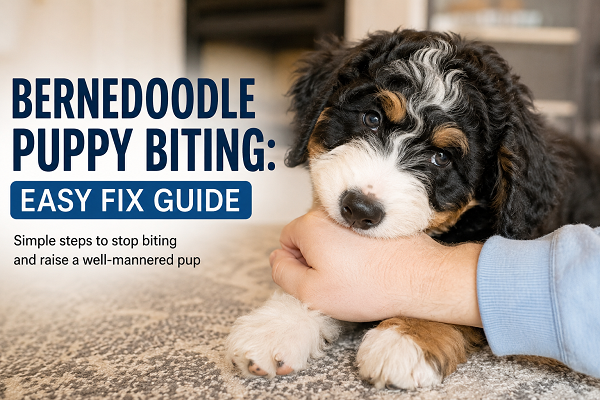
Bernedoodle puppies bite because they’re teething, exploring the world with their mouths, and testing boundaries the way every puppy does between 8 weeks and 6-8 months old. The easy fix is a mix of teaching bite inhibition, redirecting to the right chew toys, meeting the puppy’s physical need to chew, and staying consistent, and most Bernedoodles settle down within a few weeks once owners get the routine right.
Table of Contents
- Introduction
- Why Does My Bernedoodle Puppy Bite So Much?
- The Bernedoodle Teething Timeline: What to Expect Week by Week
- Why Bernedoodles Bite More Than Some Other Breeds
- The Easy 4-Step Fix for Bernedoodle Puppy Biting
- Common Mistakes That Make Biting Worse
- When Puppy Biting Crosses Into a Real Concern
- Trainer Insight: What We See in Real Bernedoodle Puppies
- FAQs
- Conclusion
Introduction
Your Bernedoodle puppy is smart, fluffy, and, right now, kind of a shark. If your ankles, sleeves, and fingers have taken a beating this week, you’re in very good company. This “land shark” phase catches almost every new Bernedoodle owner off guard, mostly because the puppy looks so soft and gentle that the biting feels like a betrayal.
Here’s what you’ll get out of this guide: a clear breakdown of why Bernedoodle puppies bite, exactly what to expect month by month as their teeth come in, and a simple, four-step fix that professional trainers actually use. No fluff, no 15-page training manuals, just what works.
Why Does My Bernedoodle Puppy Bite So Much?
Bernedoodle puppies bite for three overlapping reasons: teething pain, natural exploration (they learn about the world through their mouths the same way human babies do), and play. On top of that, Bernedoodles inherit the Poodle’s high intelligence and the Bernese Mountain Dog’s mouthy, paw-and-nose-forward play style, which means they often use their mouths more, and more forcefully, than a lot of other family dog breeds during puppyhood.
It’s worth saying clearly: biting in a young puppy almost never means aggression. Real aggression in an 8-week-old puppy is extremely rare. What you’re dealing with is a communication and impulse-control problem, and both of those are trainable.
The Bernedoodle Teething Timeline: What to Expect Week by Week
Knowing where your puppy is in the teething process changes everything about how you respond. Biting that would worry you at 5 months is completely age-appropriate at 10 weeks.
2 to 4 Weeks Old
This happens before you even bring your puppy home. The first set of “milk teeth,” also called needle teeth, start pushing through the gums. Breeders will already be seeing early nipping between littermates at this stage.
5 to 6 Weeks Old
By now, your Bernedoodle puppy has all 28 of their baby teeth. These teeth are needle-sharp for a reason: they teach littermates and mom exactly how hard is too hard. This is actually one of the most important lessons of a puppy’s life, called bite inhibition, and it’s why reputable breeders keep puppies with their litter until at least 8 weeks.
8 to 12 Weeks Old (Homecoming Stage)
This is usually when your puppy comes home, and it’s peak nipping season. The baby teeth are fully in, the puppy has lost their built-in “ouch” feedback from littermates, and now you’re the one who has to provide it.
12 to 16 Weeks Old
The real teething discomfort kicks in here. Baby teeth start loosening and falling out to make room for permanent teeth, and the gums get sore and swollen. Expect a noticeable uptick in chewing on furniture, shoes, hands, and anything within reach. You might even find tiny teeth around the house (totally normal, and usually not something to worry about).
4 to 6 Months Old
Most of the 42 permanent adult teeth are in by around 6 months. Biting pressure gets stronger here, which can feel like a step backward, but it’s actually a sign the discomfort is nearly over.
6 to 8 Months Old
By this point, a well-managed Bernedoodle puppy has usually learned soft mouth manners and stopped using teeth on people altogether. If hard biting is still a daily habit past 8 months, it’s time to bring in a certified trainer rather than wait it out.
Why Bernedoodles Bite More Than Some Other Breeds
Bernedoodles are a cross between the Poodle and the Bernese Mountain Dog, and that combination shapes how they bite.
- Poodle intelligence means Bernedoodle puppies learn fast, for better or worse. If nipping gets your attention (even negative attention), they’ll repeat it.
- Bernese size and build means even a young Bernedoodle can deliver a surprisingly strong bite, especially in standard-size lines that can mature to 70-90 pounds.
- High trainability is genuinely good news here. Bernedoodles respond extremely well to positive reinforcement and tend to pick up “no bite” cues faster than many working breeds, often within 3 to 6 weeks of consistent daily practice.
- Sensitivity. Both parent breeds are people-oriented and emotionally responsive, which means harsh corrections tend to backfire, causing fear or avoidance rather than better manners.
If you’re comparing Bernedoodles to other Poodle mixes while deciding whether the breed fits your household, it helps to look at how similar crosses behave as puppies too. Our breakdown of the Bichon Poodle cross covers a smaller, lower-drive Poodle mix that’s a useful comparison point for energy level and mouthiness.
The Easy 4-Step Fix for Bernedoodle Puppy Biting
This is the framework we walk new owners through, and it’s built to work whether your puppy is 9 weeks or 6 months old.
Step 1: Teach Bite Inhibition With the “Ouch and Withdraw” Method
The moment your puppy’s teeth touch your skin too hard, let out a sharp, high-pitched “ouch!” and immediately stop playing. Pull your hand away, turn your body slightly, and ignore the puppy for 10 to 15 seconds. This copies exactly what a littermate would do, and it’s the single most effective tool for teaching bite pressure control.
Do this every single time, not just when it really hurts. Consistency here matters more than intensity.
Step 2: Redirect to the Right Chew Toy, Immediately
The second your puppy’s teeth make contact with skin, swap in a toy. Don’t wait, don’t lecture, just redirect. Over time, this teaches the puppy that mouths belong on toys, not on people.
Look for:
- Textured rubber chews for sore gums (freezing them for 20-30 minutes adds numbing relief)
- Rope toys for tugging energy without hands getting involved
- Frozen washcloths (a cheap, effective teething tool many vets recommend)
- Durable rubber chews rated for medium-to-large breeds, since standard Bernedoodles will outgrow small-breed toys within weeks
Step 3: Meet the Physical Need Behind the Biting
A lot of biting is really just an unmet need wearing puppy teeth. Before you assume it’s a behavior problem, rule out:
- Teething pain — offer a frozen chew before high-bite periods like early morning and evening
- Under-exercise — Bernedoodle puppies typically need short bursts of play and mental stimulation several times a day, not one long walk
- Overtiredness — an overtired puppy bites more, not less; a short nap in the crate often ends a biting spiral faster than any training cue
- Boredom — puzzle feeders and scent games burn mental energy that would otherwise go into chewing on you
Crate time plays a bigger role here than most new owners expect, both for managing overtired biting spells and for giving sore gums a calm place to settle. If you haven’t set up a crate routine yet, our guide on how to crate train a Bernedoodle-style puppy walks through building it as a safe space rather than a punishment.
Step 4: Get Everyone in the House on the Same Page
Bernedoodle puppies are sharp enough to learn that biting is fine with the kids but not with dad, and they’ll happily keep doing it with whoever allows it. Sit down with every family member and agree on the same response, the same phrase, and the same redirect toy. Inconsistent rules are one of the top reasons biting habits drag on past 6 months instead of fading out by 4.
This same principle of family handling also matters during grooming, since a puppy that mouths hands during play often mouths hands during brushing and nail trims too. Our puppy grooming guide has practical tips for getting a mouthy puppy comfortable with being handled.
Common Mistakes That Make Biting Worse
- Yelling or physically correcting the puppy. This raises arousal and can teach the puppy that hands are something to avoid or brace against, not something safe.
- Rough hand-wrestling games. Fun in the moment, but it directly teaches puppies that hands and biting go together.
- Inconsistent responses. Letting biting slide when you’re tired sends mixed signals that undo days of progress.
- Punishing the puppy for teething-related chewing. A sore-gummed puppy chewing on furniture isn’t defiance, it’s discomfort. Redirect, don’t punish.
- Skipping structured exercise. Under-stimulated puppies use biting as an outlet for pent-up energy.
When Puppy Biting Crosses Into a Real Concern
Most Bernedoodle biting is developmental and resolves with consistent handling. That said, contact a certified trainer or veterinary behaviorist if you notice:
- Biting that draws blood repeatedly past 6 months of age
- Growling or stiffening alongside the bite, rather than playful body language
- Biting tied to guarding food, toys, or space
- No improvement at all after several weeks of consistent bite-inhibition training
These signs don’t automatically mean something is seriously wrong, but they’re worth a professional evaluation rather than a wait-and-see approach.
Trainer Insight: What We See in Real Bernedoodle Puppies
Most of our hands-on training background is in working K9s, but Bernedoodles and other family-dog crosses come through our puppy foundation programs constantly, and the pattern is remarkably consistent: owners who redirect calmly and stay consistent for just 3 to 4 weeks see the sharpest drop in biting, almost regardless of how intense it starts out. The households that struggle longest are almost always the ones mixing signals, one person allowing rough play, another scolding for the exact same behavior. If you want a deeper, structured resource for shaping puppy behavior from day one, our Beyond the Bark e-book walks through foundational training principles that apply well beyond working dogs, including the exact bite-inhibition sequencing we use with young puppies.
FAQs
1. At what age do Bernedoodle puppies stop biting?
Most Bernedoodles significantly reduce biting between 4 and 6 months as teething eases, and stop using their mouths on people altogether by 6 to 8 months with consistent training.
2. Is it normal for my Bernedoodle puppy to bite so hard it hurts?
Yes, especially between 8 and 16 weeks. Puppy teeth are needle-sharp specifically to teach bite pressure, and it’s your job to provide the feedback littermates would have given.
3. Should I ignore my Bernedoodle puppy when it bites?
A brief 10-15 second ignore right after a hard bite works well, but pair it with redirecting to a toy afterward rather than ignoring the behavior entirely, or the puppy won’t learn what to do instead.
4. Do Bernedoodles bite more than Goldendoodles or Labradoodles?
Not necessarily more, but standard Bernedoodles often have a stronger bite due to their larger Bernese Mountain Dog heritage, so the same nip can feel more intense than it would from a smaller doodle mix.
5. What toys help the most with Bernedoodle teething?
Frozen rubber chews, frozen washcloths, and rope tug toys tend to work best, since cold temperatures numb sore gums and rubber textures satisfy the urge to chew without damaging teeth.
Conclusion
Bernedoodle puppy biting feels overwhelming in the moment, but it’s one of the most predictable, most fixable stages of raising this breed. Track where your puppy is in the teething timeline, teach bite inhibition with a consistent “ouch and withdraw,” redirect fast to the right chew toy, meet the physical needs driving the behavior, and get everyone in the house using the same rules. Stick with it for 3 to 4 weeks and you’ll likely see real, noticeable change, most Bernedoodles fully outgrow hard biting by 6 to 8 months when handled this way. If biting is still intense past that window, don’t wait it out alone; a certified trainer can help you course-correct quickly before habits set in for the long run.

Her work centres on obedience, detection, protection and operational readiness. She favours proven methods built on repetition, consistency and real-world conditioning, so that both dogs and handlers are prepared for high-pressure tasks.
Rofiat represented the Nigerian Army Dog Centre at the Nigerian Army Day Celebration (NADCEL) 2026, where she led demonstrations in obedience, explosive detection, agility and tactical movement. Through articles, training content and documentaries, she shares field-based insight into how structured training, clear communication and trust between handler and dog affect performance and reliability.
She is the author of Beyond the Bark: Inside a Pro Handler's Playbook for Raising the Ideal Dog, a practical guide that helps dog owners and handlers apply professional training principles in everyday situations.
- Is K9 Advantix Safe for Dogs? A Handler’s Honest Review - October 2, 2026
- Australian Cattle Dog vs Blue Heeler: Any Difference? - October 1, 2026
- Bousnic Dog Training Collar Review: Is It Safe? - September 30, 2026