How Often to Exercise a Working Dog (By Job & Age)
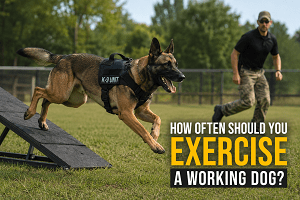
Most healthy adult working dogs need 1 to 2 hours of active time daily, and high-drive breeds like the Belgian Malinois, Dutch Shepherd, and Border Collie can need more. The bigger secret is that the hours aren’t all the same: a good week mixes hard days, skill days, easy days, and at least one true rest day, and it counts brain work as exercise, not just running.
Table of Contents
- The Short Answer: How Much Exercise Does a Working Dog Need?
- Frequency vs. Duration: Why “Every Day” Doesn’t Mean “Every Day the Same”
- Exercise Needs by Type of Working Dog
- How Age Changes the Plan (Puppy, Teen, Adult, Senior, Retired)
- Physical vs. Mental Exercise: How to Tire Out a Working Dog Properly
- Heat, Humidity and Weather: The Part Most Guides Skip
- Too Little vs. Too Much: What to Watch For
- What Professional K9 Teams Actually Do
- Special Situations: Apartments, Busy Weeks, Injuries and Retirement
- Handler’s Notes: What Experience Teaches You
- Common Exercise Mistakes
- Conclusion: Build the Routine Around the Job
- Frequently Asked Questions
Introduction
Ever watched a Belgian Malinois turn a living room into a demolition site after a “long” 30-minute walk? That’s not a bad dog. That’s a dog with a job description and no job.
Working dogs are bred for stamina, focus, and purpose. A patrol dog, a detection dog, a herding dog, and a livestock guardian all need daily movement, but they don’t need the same movement. Get it wrong in either direction and you’ll see it fast. Too little, and you get chewing, pacing, barking, and a dog who ignores commands. Too much, and you get sore joints, burnout, and in hot weather, real danger.
So how often should you exercise a working dog, and what should that exercise look like? In this guide, you’ll learn:
- A realistic daily and weekly target for your dog’s job
- A sample seven-day schedule you can copy and adjust
- How puppies, teens, adults, and seniors differ
- How to use nose work and obedience to tire a dog out faster than running
- Heat and humidity rules that protect high-risk breeds
- Signs you’re doing too little or too much
If you’re still deciding what counts as a working dog in the first place, start with our breakdown of what it means if a dog is a working dog, then come back here.
The Short Answer: How Much Exercise Does a Working Dog Need?
Most healthy adult working dogs need at least 1 to 2 hours of active time every day, split into two or more sessions. High-drive protection, herding, and detection breeds often need up to 2 to 3 hours once you add training and mental work. The right amount is the one that leaves your dog tired, settled, and sound the next morning.
That’s the number you’ll see repeated online. But look at how the big names frame it:
| Source type | What they say |
|---|---|
| UK charity PDSA | Some breeds need 1–2 hours a day, and working breeds need significantly more |
| Vet Help Direct (UK) | Active working breeds usually need at least 2 hours total per day |
| Chewy vet interview | Working, sporting, and herding dogs may need up to 2–3 hours |
| The Farmer’s Dog | At least 45 minutes for most dogs; aim for 60+ for active, healthy dogs |
| PetMD | 30 minutes to 2 hours for dogs in general |
Notice the pattern? Almost every one of these pages is written for pet dogs. They give you a range, then tell you to “ask your vet.” None of them gives you a weekly rhythm, a heat plan, or a way to count mental work. That’s the gap this guide fills.
Why “1–2 hours” is only a starting point
Think of it like a pay grade, not a job. Your dog’s real number depends on five things:
- Breed and lines: Working-line dogs usually have far more drive than show-line dogs of the same breed.
- Age and growth stage: A 9-month-old Shepherd and a 5-year-old Shepherd need very different plans.
- Job type: A dog that patrols all night needs different conditioning than one that sniffs luggage for 20 minutes at a time.
- Fitness level: A dog coming off six weeks of rest can’t jump straight into full workloads.
- Climate: The same run that’s fine at 15°C (59°F) can be dangerous at 32°C (90°F) with high humidity.
A quick honest note about the science
Here’s something most blog posts won’t tell you. A University of Liverpool team studying dog activity noted that no evidence-based exercise guidelines exist for dogs. The common “30 minutes a day” figure traces back to expert opinion and anecdote, and UK Kennel Club activity ratings come from breed club opinion, not controlled studies.
That doesn’t mean the numbers are wrong. It means you should treat any number as a starting point and let your dog’s behavior, recovery, and body condition correct it. That’s exactly what working handlers do.
Frequency vs. Duration: Why “Every Day” Doesn’t Mean “Every Day the Same”
So here’s the thing. The question isn’t only “how long?” It’s “how often, and how hard?”
Working dogs need something every day. But sending a dog out for the same hard, high-impact session seven days in a row is how you get injuries. Athletes don’t train that way, and neither should working dogs.
I like to think in four kinds of days:
- Hard days: high-intensity roadwork, sprint drills, bite work, or advanced obedience under pressure
- Skill days: shorter physical load, more mental work (tracking, detection, precision obedience)
- Easy days: long, slow walks, sniffing, light training
- Rest days: short potty walks, a puzzle feeder, calm bonding, zero impact
Sample seven-day schedule for a fit adult protection or detection dog
Use this as a template, not a prescription. Adjust it for your dog’s age, health, and weather.
| Day | Focus | What it looks like |
|---|---|---|
| Monday | Hard | 40–45 min structured jog or roadwork with heeling, plus 20 min obedience |
| Tuesday | Skill | 30 min walk, then 20–30 min detection, tracking, or task drills |
| Wednesday | Moderate | 45–60 min hike or controlled off-leash time, plus a 10–15 min brain game |
| Thursday | Hard | Intervals, hill work, or agility, plus 15 min obedience |
| Friday | Easy | 30–40 min slow walk with sniffing, light training |
| Saturday | Long and easy | 60–90 min low-intensity outing with environmental exposure and socialization |
| Sunday | Rest | 2–3 short potty walks, one puzzle feeder, quiet time |
Two rules keep this schedule honest. First, never stack two hard days back to back when your dog is new to conditioning. Second, “rest” doesn’t mean the dog sits in a kennel all day. It means low intensity, not zero life.
Exercise Needs by Type of Working Dog
A working dog’s job shapes its workload. The ranges below are practical starting points I’d use, built from the veterinary guidance above and handler experience. Total time includes training, not just walking.
| Dog type | Typical breeds | Daily active time | Emphasis |
|---|---|---|---|
| Protection / patrol | Belgian Malinois, German Shepherd, Dutch Shepherd, Rottweiler | 90–150 min | Structure, obedience, controlled drive work |
| Detection | Labrador, Springer Spaniel, Malinois, Beagle | 60–120 min | Short intense searches plus steady physical conditioning |
| Herding | Border Collie, Australian Shepherd, Kelpie | 90–180 min | Problem-solving, direction work, long-distance movement |
| Sporting / retrieving | Labrador, Golden Retriever, Vizsla, Weimaraner | 60–120 min | Retrieves, swimming, scent work |
| Livestock guardian | Great Pyrenees, Kangal, Anatolian Shepherd | 60+ min spread across the day | Patrol and moderate walking, not sprints |
Protection and patrol dogs
The Malinois, German Shepherd, and Dutch Shepherd sit at the top of the drive scale. They need physical work and clear structure. A protection dog that gets two hours of chaos is worse off than one that gets 75 minutes of disciplined work.
A solid day includes 60–90 minutes of physical activity plus 20–40 minutes of obedience or task work. If you want focus-building drills that work on these breeds, try these 3 advanced focus exercises for high-energy breeds.
Detection dogs
Here’s a surprise for new owners. A detection dog might only work for 10 to 20 minutes at a time, but the concentration is intense. The rest of the day still needs physical conditioning so the dog stays fit and calm enough to focus. Think short, sharp searches on top of steady walking, not a replacement for it.
Herding dogs
Border Collies and Australian Shepherds don’t just want to run. They want to solve something. A herding dog that runs for an hour but never thinks will still bounce off the walls. Add direction commands, puzzle work, and agility or obstacle games.
Sporting and retrieving dogs
Labs, Goldens, and pointing breeds love retrieving and water. Swimming is excellent because it builds fitness with low joint impact. Just keep repetitive ball throwing in check, which I’ll come back to in the mistakes section.
Livestock guardian dogs
Great Pyrenees and Kangals are built for long, slow, watchful days, not hard sprints. They’re calmer than herding breeds, but they still need space to patrol, moderate walking, and something to guard or monitor. A guardian dog stuck in a bare yard with nothing to do often turns to digging or wandering.
How Age Changes the Plan (Puppy, Teen, Adult, Senior, Retired)
This is where a lot of well-meaning handlers get hurt. Applying an adult plan to a young dog can cause damage that lasts a lifetime.
Puppies (up to about 6 months)
Young bones have soft growth plates at the ends of the long bones. In a puppy, muscles and ligaments can be stronger than the growth plate, so a twist or hard landing can injure the plate instead of causing a simple sprain.
You’ve probably heard the “five-minute rule”: about five minutes of structured exercise per month of age, once or twice a day, so a 3-month-old gets around 15 minutes per outing. It’s a decent guardrail. But a canine rehabilitation practice points out that no published studies back the rule up, so treat it as a caution, not a law.
What matters more than the clock is the type of exercise:
- Good: free play at the puppy’s own pace, short training games, socialization, gentle walks on soft ground, confidence-building obstacles at low height
- Avoid: forced jogging, long hikes, repetitive ball chasing, stair repeats, jumping from beds, cars, or sofas, and lots of running on slippery floors or hard pavement
Adolescents (about 6 to 18+ months)
Teenage working dogs are a handful. Energy spikes, drive climbs, and the body still isn’t finished growing. This is the age when many handlers overdo it because the dog looks like an adult.
Growth plate closure depends on size:
| Adult size | Growth plates typically close |
|---|---|
| Toy / small | Around 6–8 months |
| Medium | Around 12 months |
| Large | Around 14–18 months |
| Giant | Up to 18–24 months |
These are averages, and every dog is different. For a dog headed into a hard performance or protection career, many trainers recommend X-rays to confirm plate closure before starting intense conditioning. It’s a small cost compared to a career-ending injury.
During this phase, give more sessions but keep each one shorter and lower in impact. Fill the rest with obedience, impulse control, and scent games.
Adults (about 2 to 7 years)
Healthy adults handle the full schedule from earlier. Consistency matters more than heroics. A steady 90 minutes every day beats one giant weekend session followed by five lazy days.
Seniors (about 7+ years, sometimes earlier in large breeds)
Older working dogs still need daily movement. Veterinary guidance suggests at least 30 minutes a day even for seniors, broken into two or three shorter sessions. Trade sprints and jumps for slow walks, swimming, and nose work.
Retired working dogs
This one gets overlooked. A dog that worked hard for years can’t go from a full schedule to a couch overnight. Sudden inactivity often leads to weight gain, stiffness, and boredom. Taper the workload gradually and keep giving the dog “jobs”: find-the-toy games, short scent trails, and calm walks with purpose.
Physical vs. Mental Exercise: How to Tire Out a Working Dog Properly
If you take one idea from this article, take this one: a working dog’s brain gets tired before its body does.
Two hours of running can leave a dog physically fit but mentally wired. Fifteen minutes of a real search problem can leave the same dog calm and happy to lie down. In my experience with handlers, a short, well-run scent session often settles a dog more than a much longer jog. That’s why the most effective plans split work like this:
- Physical: builds fitness, burns energy, protects joints when done right
- Mental: builds focus, calm, and problem-solving
- Rest: builds the muscle, tendon, and emotional recovery that makes the first two work
Mental exercises that count
- Scent work and hide-and-seek: hide a toy or treat and let the dog search
- Tracking: lay a short trail and let the dog work it out
- Obedience under distraction: precision heeling, recalls, and stays around movement
- Puzzle feeders and snuffle mats: great for rest days
- Agility and obstacle work: combines body and brain
Our guide to 5 simple SAR dog training games to start gives you beginner search games you can run in a yard or park.
Why free running isn’t enough
Letting a working dog run loose in a yard sounds like exercise. It often isn’t. Many dogs settle into pacing or fence running, which builds frustration instead of calm. Purpose beats space every time.
Teach the “off switch”
A balanced working dog does two things well: it works hard, and it relaxes fully afterward. If your dog can’t settle after exercise, more exercise isn’t always the answer. Add a “place” or “settle” command, practice calm time on a mat, and reward quiet behavior. Dogs that never learn to switch off can end up needing more exercise every month, which is a treadmill nobody wins.
Heat, Humidity and Weather: The Part Most Guides Skip
Most pet-dog exercise articles mention heat in a single line. For working breeds, it deserves its own section.
Here’s why. Veterinary research reviewing canine heatstroke found that military working dogs, mostly Belgian and Dutch Shepherds, were significantly over-represented in large studies. The likely reasons are frequent hard exertion in hot environments and, according to some researchers, a possible genetic predisposition in Malinois tied to lower heat-shock protein activity. Other risk factors include obesity, body weight above roughly 15 kg (33 lb), high humidity, and poor fitness or lack of heat acclimation.
In plain English: the dogs that work hardest are often the ones most at risk, because they keep going even when they should stop.
Practical heat rules
A 2021 study on dog heat exposure used heat index categories from the U.S. National Weather Service (Safe under 27°C/80°F, Caution 27–32°C/80–90°F, Extreme Caution 32–39°C/90–103°F, Danger 40°C/103°F and above). Those categories were built for people, and researchers note dogs tolerate heat and humidity worse than humans do. So here’s a conservative way to use them:
| Heat index | What I’d do |
|---|---|
| Under 27°C / 80°F | Normal training, carry water |
| 27–32°C / 80–90°F | Shorten hard work, add shade and water breaks, avoid hot pavement |
| 32–39°C / 90–103°F | Move hard work to dawn or after sunset; do nose work and obedience in shade or indoors |
| 40°C / 103°F and above | No hard exercise; short potty breaks only |
Check the heat index, not just the temperature. Humidity is what stops a panting dog from cooling itself.
Build heat tolerance slowly
Dogs acclimate to heat over days to weeks, not one afternoon. If your climate warms up, start with shorter sessions and increase gradually. Cooling vests have also shown physiological benefits in working dogs during training in moderately hot conditions, though they don’t replace common sense.
Heat stress warning signs
- Heavy drooling and panting that doesn’t settle
- Bright red or very pale gums
- Weakness, stumbling, or confusion
- Vomiting or diarrhea
- Collapse
If you see these: stop immediately, move the dog to shade, cool the body with cool (not ice-cold) water, and get to a vet right away, even if the dog seems to recover. Heatstroke can damage organs after the moment has passed.
Cold weather note
Cold isn’t as dangerous for most working breeds, but check paws for ice and salt, warm up before hard work, and shorten sessions for short-coated dogs.
Too Little vs. Too Much: What to Watch For
Your dog will tell you if the plan is off. You just have to read it.
Signs your working dog isn’t getting enough
- Chewing walls, furniture, or shoes
- Constant pacing or spinning
- Digging or fence running
- Barking at everything
- Ignoring commands or losing focus in training
- Fixating on shadows, lights, or balls
- Weight gain despite the same food
A quick reality check: many owners call this “bad behavior” when it’s usually a need going unmet. Fix the routine before you blame the dog.
Signs you’re overdoing it
- Slower response times and less enthusiasm
- Stiffness or limping the next morning
- Heavy panting that takes a long time to settle
- Lagging behind on walks
- Reluctance to jump or take stairs
- Irritability or restlessness even after rest
Working dogs are famous for pushing through pain. That’s a strength on the job and a risk at home. You have to be the one who says stop.
A simple recovery check
Here’s a rule of thumb I use. In mild weather, a fit dog’s breathing should settle within roughly 10 minutes of stopping. If it takes much longer, or the dog is stiff the next morning, ease off for a day or two. If it keeps happening, talk to your vet about fitness, weight, or hidden pain.
What Professional K9 Teams Actually Do
You can learn a lot from how real K9 units schedule work.
Police K9 units, for example, often train on shift and dedicate whole days to training. One California police department describes daily training on duty, plus a full training day each week that covers detection, searches, apprehension work, and obedience. On days off, the dogs rest at home so they’re ready when called. Other sources describe police teams doing an eight-hour training block every week or two to keep skills sharp.
Notice two things. Training is frequent, and rest is planned. Working dogs on duty aren’t running flat-out all day. They alternate short bursts of intense effort with long stretches of low activity.
Pro handlers also tend to:
- Keep a written training log
- Match intensity to the day’s task and weather
- Watch weight and body condition closely
- Protect joints with proper surfaces and warm-ups
- Treat recovery as part of the program
Proper gear helps too. A well-fitted harness spreads pressure and improves control during structured exercise. Our guide to top tactical K9 gear for 2026 covers what handlers look for.
Special Situations: Apartments, Busy Weeks, Injuries and Retirement
Can a working dog live in an apartment?
Yes, but you have to be all in. A committed apartment owner who trains daily, runs the dog, and gives mental work can have a better-exercised dog than someone with 10 acres and no routine. Space isn’t the requirement. Engagement is.
The 20-minute emergency plan for busy days
Some days go sideways. When you only have 20 minutes, don’t just do a short walk. Do this:
- 5 minutes: brisk heeling with turns and stops
- 10 minutes: scent search in the house or yard
- 5 minutes: settle on a mat with a chew or puzzle feeder
It won’t replace a full day, but it keeps the dog mentally satisfied and the routine alive. Just don’t let “emergency” become “every day.”
Bad weather or injury
If the dog can’t run, don’t skip the brain work. Switch to nose games, obedience refreshers, trick training, and puzzle feeders. If your vet has restricted activity, follow that first and ask for a safe alternative such as controlled leash walks, swimming, or underwater treadmill rehab.
Retirement and downtime
Ease down slowly, keep the daily rhythm, and give the dog small tasks so it still feels useful.
Handler’s Notes: What Experience Teaches You
Cpl. Rofiat Muritala is a Nigerian Army military working dog instructor and handler with more than 14 years at the Nigerian Army Dog Centre. Her training includes advanced obedience, K9 patrol, and advanced explosive detection certification courses. She led obedience, detection, agility, and tactical movement demonstrations at the Nigerian Army Day Celebration (NADCEL) 2026.
Here are the lessons that come up again and again:
- Consistency beats intensity. Steady daily work builds a stronger, calmer dog than weekend heroics.
- Rest is training. Dogs get stronger between sessions, not during them.
- Behavior is data. A dog that suddenly gets destructive is telling you something.
- Protect the joints early. Damage from too much too soon rarely shows up until years later.
- Every dog is an individual. The chart is a starting point. Your dog writes the final plan.
Want the full playbook for building structure, consistency, and calm in everyday dog handling? Our e-book, Beyond the Bark: Inside a Pro Handler’s Playbook for Raising the Ideal Dog, breaks down the same principles handlers use in real operations, written for everyday owners.
Common Exercise Mistakes
Doing one big session and nothing else
A three-hour weekend hike after five quiet days is how you get injuries and a frustrated dog all week. Spread the load.
Repeating ball throws endlessly
Fast turns and sudden stops put stress on joints, and constant fetch can build obsessive behavior. Use structure: a few retrieves, then a command, then calm.
Ignoring surfaces
Hard pavement and slippery floors are tough on young joints. Prefer grass, trails, and soft ground for long sessions.
Starting too hard after time off
If your dog has been rested for weeks, rebuild gradually over two to four weeks rather than jumping to full workloads.
Skipping socialization and environment work
A dog can be physically fit and still fall apart in a busy street or crowded space. Exposure is part of conditioning.
Feeding the same amount no matter the workload
Working dogs need fuel that matches the job: quality protein, healthy fats, and plenty of water. If exercise drops, portions may need to drop too.
Conclusion: Build the Routine Around the Job
So, how often should you exercise a working dog? Daily, with roughly 1 to 2 hours of active time for most adults and more for the highest-drive breeds. But the real skill is in the mix: hard days, skill days, easy days, and rest days, with mental work counted as real exercise.
Here’s what to do next:
- Pick your dog’s job type from the table and start with that time range.
- Copy the seven-day template and adjust it to your dog’s age and fitness.
- Add 15–30 minutes of scent or obedience work most days.
- Watch recovery. Panting, stiffness, and mood tell you when to push and when to pause.
- Check the heat index before every hard session in warm weather.
- Protect young joints. If your dog is under 18 months, keep it low-impact and ask your vet about growth plates.
Get those six things right and you’ll have a dog that works hard, rests well, and stays sound for years.
Want more handler-tested training tips? Subscribe to our weekly articles roundup at https://arfsk9team.com.ng/newsletter/ and get new guides delivered to your inbox.
Frequently Asked Questions
1. How many hours a day should a working dog exercise?
Most healthy adult working dogs need 1 to 2 hours of active time daily. Protection, herding, and other high-drive breeds may need up to 2 to 3 hours once training and mental work are included. Split it into at least two sessions and mix physical effort with brain work rather than relying on walks alone.
2. Can you over-exercise a working dog?
Yes. Working dogs often keep going despite pain or fatigue, so overexertion can lead to joint and muscle injuries, burnout, and heat illness. Watch for stiffness the next day, slow recovery from panting, and loss of enthusiasm. Plan easy and rest days into every week.
3. Do working dogs need a rest day?
Yes. A rest day means low intensity, not doing nothing: short potty walks, a puzzle feeder, and calm bonding, with no hard running, jumping, or intense drills. Rest lets muscles, tendons, and the nervous system recover, and it teaches your dog to settle.
4. How much exercise does a working dog puppy need?
Keep it short, low-impact, and mostly free play. The common guideline is about five minutes of structured exercise per month of age, once or twice a day, though this rule isn’t backed by published studies. Avoid forced jogging, repetitive fetch, stairs, and jumping until your vet confirms growth plates have closed, roughly 12 to 24 months depending on size.
5. What’s the best exercise for a working dog when it’s too hot to run?
Switch to mental work and low-exertion activities: nose work, hide-and-seek, obedience in shade or indoors, puzzle feeders, and swimming if it’s safe. Move harder sessions to dawn or after sunset, and check the heat index, not just the temperature.

Her work centres on obedience, detection, protection and operational readiness. She favours proven methods built on repetition, consistency and real-world conditioning, so that both dogs and handlers are prepared for high-pressure tasks.
Rofiat represented the Nigerian Army Dog Centre at the Nigerian Army Day Celebration (NADCEL) 2026, where she led demonstrations in obedience, explosive detection, agility and tactical movement. Through articles, training content and documentaries, she shares field-based insight into how structured training, clear communication and trust between handler and dog affect performance and reliability.
She is the author of Beyond the Bark: Inside a Pro Handler's Playbook for Raising the Ideal Dog, a practical guide that helps dog owners and handlers apply professional training principles in everyday situations.
- Dog Hotel Prep: 7 Must-Haves Before Boarding - October 21, 2026
- How to Enter the COBA National Dog Championship - October 20, 2026
- K9 Advantix Dosage Chart & Safety Guide for Dogs - October 19, 2026