XL Bully vs Pocket Bully vs Micro Bully: What’s the Difference?
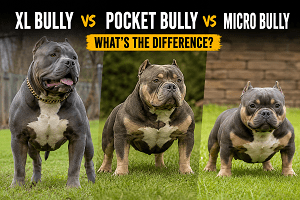
If you’ve ever looked at an XL Bully, Pocket Bully, and Micro Bully side by side, you know the names can be confusing. The real difference comes down to size, official recognition, and how much the dog has been exaggerated by breeders, not just appearance alone.
Table of contents
What is an American Bully?
XL Bully vs Pocket Bully vs Micro Bully
Breed standards and official recognition
Temperament and behavior
Health and breeding risks
Costs and ownership
Why XL Bullies are restricted in the UK
FAQs
Conclusion
What is an American Bully?
The American Bully is a companion breed developed in the United States from bully-type foundation dogs, and the UKC recognizes the breed in size categories that include Pocket, Standard/Classic, and XL. The breed is known for a muscular build, broad head, short coat, and a powerful but compact look.
What matters here is that the breed was created for a specific type, but the labels “micro” and sometimes even “nano” are usually informal breeder terms rather than official registry categories. That distinction is important because many buyers assume they are getting a separate breed when they are really just getting a smaller or more exaggerated version of an American Bully.
XL Bully vs Pocket Bully vs Micro Bully
The simplest way to think about it is this: XL Bullies are the tallest of the three, Pocket Bullies are smaller, and Micro Bullies are usually the smallest informal type. In many cases, “micro” is not a formal standard at all, but a marketing term used for dogs that sit below pocket size.
The biggest mistake I see buyers make is assuming smaller automatically means easier or healthier. In reality, some Micro Bullies are the most heavily exaggerated dogs, and that can come with more structural problems.
Thinking about owning a powerful breed? The biggest factor in a dog’s success isn’t its size, it’s the handler. In Beyond the Bark: Inside a Pro Handler’s Playbook for Raising the Ideal Dog, I break down the same principles professional handlers use to develop stable, obedient, and reliable dogs, regardless of breed. If you’re considering an XL Bully, Pocket Bully, or any strong companion breed, the book will help you avoid many of the mistakes first-time owners make.
Breed standards and official recognition
Official standards matter because they tell you whether a dog is being bred toward a stable type or just toward a trendy look. The UKC recognizes the American Bully and separates it into Pocket, Standard/Classic, and XL categories. ABKC-linked descriptions also put Pocket dogs in a clearly defined height window, while “micro” is commonly described as a smaller-than-pocket dog rather than a separate standard.
For example, one source describes Pocket males as 14 to 17 inches and Pocket females as 13 to 16 inches, while another states the UKC-style Pocket lower limit starts at 36 cm for males and 33 cm for females. That tells you the breed world uses fairly tight size limits for recognized types, but “micro” is much looser and often depends on the breeder’s own wording.
Temperament and behavior
People often ask whether XL Bullies are more dangerous than Pocket or Micro Bullies, but temperament is shaped more by breeding, socialization, training, and handling than by size alone. If you’re evaluating any powerful breed, understanding why proper leadership and discipline matter far more than outdated dominance theories can help you raise a stable, confident dog.
If you’ve worked around bully breeds, you’ll know a confident, well-raised dog can be calm, people-focused, and easy to live with. But a dog with poor nerves, pain issues, or overexcitement can be a very different story, especially when body mass and jaw strength are involved. That is why reputable breeders place so much emphasis on temperament testing and structural soundness. Professional working-dog programs rely heavily on temperament testing and genetic screening before selecting breeding or training candidates, and companion-dog buyers can learn a lot from the same principles.
Health and breeding risks
This is where the differences become more serious. The more breeders chase extreme size reduction or extreme muscle, the more they risk weak joints, respiratory issues, poor mobility, skin problems, and breeding dogs that simply cannot function comfortably. Micro-type dogs are often the most suspect in this respect because “smaller than pocket” can encourage unhealthy selection.
The American Bully is already a heavy, broad-chested dog, and Britannica notes that it is powerful, active, and agile across size varieties. But once you push a dog too far from balanced proportions, you are no longer improving the breed; you are often creating a novelty dog with more vet bills and less athletic ability.
Costs and ownership
American Bully ownership can be expensive, and price often rises with rarity, bloodline, and breeder reputation. One 2025 pricing guide puts American Bully puppies at roughly $1,500 to over $10,000 depending on the class and pedigree, while another cost guide estimates yearly ownership around $1,000 to $2,000, excluding major emergencies. Food, vet care, and insurance can push that higher, especially for larger or more medically sensitive dogs.
A practical way to budget is to expect these broad categories:
Puppy price: can range from the low thousands to well above that for top bloodlines.
Food and supplements: often around $100 to $250 per month for a big, active bully.
Routine veterinary care: roughly $600 to $1,200 per year in some ownership estimates.
Emergency care: can quickly move into thousands of dollars.
If you are buying for companionship, don’t pay premium money just because the breeder uses the word “micro.” In many cases, that label reflects marketing more than a protected breed category.
Why XL Bullies are restricted in the UK
The UK is the biggest reason many people now know the term XL Bully. UK guidance says adult males should be at least 20 inches and females at least 19 inches at the withers for identification purposes, and the breed type became heavily restricted under the Dangerous Dogs Act framework. From 1 February 2024, it became illegal in England and Wales to own an XL Bully without an exemption certificate, and owners must follow lead, muzzle, microchipping, neutering, and public liability insurance requirements.
The reason for the clampdown was concern over severe attacks, with reporting noting that between 2021 and 2023 around half of fatal dog attacks in the UK were linked to American Bully XLs, and other reports citing at least 23 fatal attacks in the UK since 2021 with many involving this type. That does not mean every XL Bully is dangerous, but it does show why regulators treated the type as a public-safety issue.
XL Bully vs Pitbull
This is another area where people mix up labels. The American Bully and the American Pit Bull Terrier are related in origin, but they are not the same type, and the American Bully was developed as a distinct breed with a more companion-focused build. In simple terms, a pitbull-type dog usually refers to more athletic, terrier-based dogs, while an American Bully is typically broader, heavier, and more exaggerated in structure.
Because bully breeds are often confused online, it also helps to understand how dog breeds and groups are classified before comparing American Bullies, Pit Bull Terriers, and other muscular companion breeds.
A useful rule of thumb is this: if the dog looks more compact, wider in the chest, and much heavier through the body, people are usually talking about an American Bully type rather than a pitbull-type terrier. But because the terms are used loosely online, the safest approach is always to ask for pedigree papers and registry details rather than trusting the seller’s description.
How to choose the right type
If you want a family companion, focus on temperament, structure, breeder ethics, and exercise needs first, not just the label on the litter. A Pocket Bully may be easier to house than an XL, but small size does not guarantee better health or easier handling. A Micro Bully may look trendy, but it can also be the most exaggerated and potentially the least sound.
If you want a family companion, focus on temperament, structure, breeder ethics, and exercise needs first, not just the label on the litter. As many experienced handlers will tell you, control and obedience are more important than intimidation when choosing a dog that will live around family members and visitors.
Here’s the practical buyer checklist I would use:
Ask for registry and pedigree information.
Ask for the parents’ health history and temperament.
Avoid dogs bred only for extreme size or extreme width.
Budget for food, vet care, and insurance before you buy.
Choose a breeder who prioritizes function, not just social media hype.
Frequently Asked Questions
1. What makes a dog an XL Bully?
An XL Bully is identified mainly by height, with UK guidance stating adult males should be at least 20 inches and females at least 19 inches at the withers.
2. Are XL Bullies dangerous?
Not all XL Bullies are dangerous, but they are powerful dogs that require responsible breeding, training, and management, and UK authorities tightened regulation after a series of serious incidents.
3. Why are XL Bullies banned in the UK?
They were restricted after public-safety concerns and multiple serious attacks, with the ban taking effect through Dangerous Dogs Act-related measures and exemption rules for existing owners.
4. How much does an XL Bully cost?
Prices vary widely, but recent guides place many XL Bully puppies in the $2,000 to $10,000 range, with some going higher depending on pedigree and breeder reputation.
5. What’s the difference between a Bully and a pitbull?
An American Bully is a separate breed type developed for a stockier, more companion-focused build, while pitbull is a broader term often used for terrier-based dogs such as the American Pit Bull Terrier.
Conclusion
The real difference between XL Bully, Pocket Bully, and Micro Bully is mostly size, standard recognition, and how far the dog has been pushed by breeding trends. XL Bullies are the largest recognized type, Pocket Bullies are smaller and more compact, and Micro Bullies are usually informal, smaller-than-pocket dogs that may fall outside strict breed standards.
Before choosing any bully-type dog, it’s worth understanding what dogs were originally bred to do, because breed purpose often influences energy levels, trainability, confidence, and long-term ownership expectations.
If you are buying or evaluating one of these dogs, don’t get distracted by the name alone. Look at structure, temperament, breeder honesty, health testing, and whether the dog is being bred to live a long, functional life rather than just to look extreme.

Her work centres on obedience, detection, protection and operational readiness. She favours proven methods built on repetition, consistency and real-world conditioning, so that both dogs and handlers are prepared for high-pressure tasks.
Rofiat represented the Nigerian Army Dog Centre at the Nigerian Army Day Celebration (NADCEL) 2026, where she led demonstrations in obedience, explosive detection, agility and tactical movement. Through articles, training content and documentaries, she shares field-based insight into how structured training, clear communication and trust between handler and dog affect performance and reliability.
She is the author of Beyond the Bark: Inside a Pro Handler's Playbook for Raising the Ideal Dog, a practical guide that helps dog owners and handlers apply professional training principles in everyday situations.
- Bousnic Dog Training Collar Review: Is It Safe? - September 30, 2026
- Gravy Train Dog Food Review: Ingredients & Recalls - September 30, 2026
- How to Spot Fake AKC Registered Dogs: 5 Warning Signs - September 29, 2026