Borzoi Dog Breed: Complete Guide to the Elegant Russian Giant
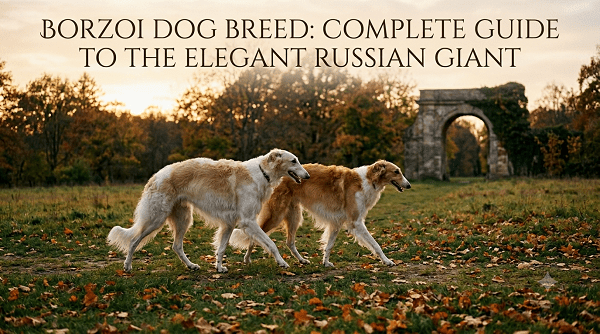
Borzoi Dog Breed: Complete Guide to the Elegant Russian Giant
Suggested meta title (52 chars): Borzoi Dog Breed: Complete Guide (2026 Facts & Care)
Suggested meta description (131 chars): Borzoi dog breed guide: size, temperament, real speed, health tests, costs and care. Learn if the Russian Wolfhound fits your home.
URL: keep your existing slug, /borzoi-dog-breed-complete-guide-to-the-elegant-russian-giant/
[Image: hero shot of a Borzoi standing in profile. Alt text: “Borzoi dog breed standing in a field”]
Quick Summary
The Borzoi, also called the Russian Wolfhound, is a giant, silky-coated sighthound. It stands 26–34 inches tall and weighs about 60–105 lb. It’s quiet and gentle indoors, but it has a strong chase instinct, can’t be trusted off-leash, and makes a poor guard dog. A health-tested puppy usually costs $1,500–$3,000. Plan for a lifespan of roughly 9–12 years.
Borzoi at a glance
- Size: males 28+ inches, females 26+ inches
- Weight: 60–105 lb (27–48 kg)
- Measured sprint speed: about 32–33 mph in AKC Fast CAT runs
- Popularity: #99 of 202 breeds in the AKC’s 2025 rankings
- Best for: calm, experienced owners with a secure fence
Table of Contents
- What Is a Borzoi? Quick Breed Facts
- Borzoi History: The Real Story Behind the Wolf Hunt
- Size, Looks and Coat
- Borzoi Temperament: Are They Good Family Dogs?
- How Fast Is a Borzoi?
- Exercise and Safe Running
- Training a Borzoi
- Grooming and Shedding
- Feeding a Borzoi
- Borzoi Health Problems and Lifespan
- How Much Does a Borzoi Cost?
- Borzoi vs Other Sighthounds
- How to Find a Good Breeder or Rescue
- Is a Borzoi Right for You?
- Why You Can Trust This Guide
- FAQs
- The Bottom Line
Introduction
Ever seen a dog that looks like it walked out of a Russian oil painting? Tall, narrow, silky, and so calm it could pass for a statue? That’s the Borzoi dog breed. It was built to run down wolves for Russian nobles. Today it spends most of the day asleep on your sofa.
Here’s the problem. Most guides repeat the same pretty facts and skip the awkward ones. They don’t tell you that a Borzoi will chase a cat into traffic. They don’t mention that bloat is a real emergency, or that sighthounds react to anaesthesia differently from other dogs. Plenty of buyers fall for the looks and learn the rest the hard way.
I look at every breed with one question: what was this dog built to do, and what does that mean in your home? Working-dog people think this way, and it’s the best way to judge any breed.
In this guide you’ll learn:
- The real history, including how the wolf hunt actually worked
- Size, coat, temperament and true speed
- Exercise, fencing and recall training that works
- The health tests that matter, plus bloat and anaesthesia risks
- Real costs in the US and UK
- How to find a good breeder and decide if a Borzoi fits your life
What Is a Borzoi? Quick Breed Facts
The Borzoi (say “BOR-zoy”) is a Russian sighthound, a dog that hunts by sight and speed rather than scent. The name comes from an old Russian word meaning “fast.” The American Kennel Club recognized the breed in 1891, and the name changed from Russian Wolfhound to Borzoi in 1936.
[Image: breed facts infographic. Alt text: “Borzoi size, weight and lifespan chart”]
| Trait | Details |
|---|---|
| Height | Males 28+ in (up to about 34 in); females 26+ in |
| Weight | Males 75–105 lb; females 60–90 lb |
| Lifespan | 10–12 years stated; closer to 9 in some surveys |
| Coat | Long, silky; flat, wavy or curly |
| Colours | AKC allows any colour or combination |
| Group | Hound (sighthound) |
| Energy | Calm indoors, explosive sprinter outdoors |
| Barking | Low |
| Guard ability | Poor |
Breed standards differ a little between clubs. Check your national kennel club for exact limits.
Borzoi History: The Real Story Behind the Wolf Hunt
Most articles say Borzoi “killed wolves with powerful jaws.” That’s not how it worked.
Russian nobles kept Borzoi in the hundreds and even thousands, handing these kennels down through families. Hunting wasn’t just about food. It was pageantry.
Here’s how a wolf hunt went at the most famous kennel, Perchino. Each huntsman rode with a leashed pair or trio of Borzoi, matched in size and colour. Foxhounds flushed the wolf from a grove. When it bolted, the nearest rider released his dogs, who overtook the wolf and tumbled it. The Borzoi grabbed it by the neck and held on until the hunter arrived. The hunter then finished the wolf with a dagger or muzzled it alive.
So the Borzoi’s job was to catch and hold, not to guard or fight. That one detail explains a lot about the temperament we’ll cover below.
Perchino: The Super-Kennel
In the late 1880s Grand Duke Nicholas Nikolaevich bought Perchino, about 125 miles from Moscow. At its peak it housed 130 adult Borzoi and 60 puppies, plus Greyhounds, other hounds, 87 horses and 78 staff.
Near Extinction and the American Rescue
In 1903 an American breeder, Joseph Thomas, travelled to Russia to improve his stock. He thought the English kennels and even the tsar’s kennel disappointing, then called Perchino “the finest collection of dogs of any one breed” he had seen. The Borzoi Club of America formed that same year. It was founded on November 12, 1903 as the Russian Wolfhound Club of America and adopted its standard in 1905.
The timing mattered. After the Bolshevik Revolution, many Borzoi were given away, killed, or shot by fleeing aristocrats, and the breed was practically extinct in Russia. It thrived in the West, and American exports later helped re-establish it in its homeland.
Borzoi even have a Hollywood side. Disney’s “Lady and the Tramp” and “102 Dalmatians” both feature them.
Size, Looks and Coat
A Borzoi is built like a sprinter in a fur coat: deep chest, tucked waist, long legs, and a long narrow head. The deep chest gives lung room for speed. It’s also linked to the bloat risk we’ll cover later.
Coat and colours. The coat should feel silky rather than woolly. It can be flat, wavy or curly, with a frill at the neck and shorter hair on the face. The AKC allows any colour. The international (FCI) standard is stricter. It allows all colour combinations except blue, brown and their derivatives. Common colours are white, black, cream, red, gold, sable and brindle.
[Image: three Borzoi in different colours. Alt text: “Borzoi coat colours: white, brindle and sable”]
Borzoi Temperament: Are They Good Family Dogs?
Short answer: yes, for the right family. A Borzoi is quiet, dignified and affectionate with its people. Think cat, not Labrador.
- With family: Loyal and gentle, but sensitive. Harsh voices upset them.
- With children: The experts disagree, and both have a point. Orvis says Borzoi aren’t ideal with small children because they dislike curious hands. Canine Journal calls them good siblings for kids of all ages with supervision. My take: great with calm, dog-savvy older children, risky with toddlers.
- With other dogs: Fine with calm dogs. They don’t enjoy bouncy, rowdy ones.
- With cats and small pets: Never assume. A Borzoi raised with a cat may learn to leave it alone indoors, but outside, anything small and fast becomes prey.
- Alone time: Many Borzoi struggle with separation anxiety. Don’t get one if the house is empty for ten hours a day.
Can a Borzoi Protect You?
If you found this site searching for a guard dog, here’s the honest answer: no. Guarding instincts don’t occur naturally in the breed. Canine Journal calls them poor watchdogs that will let anyone walk in.
Here’s why, from a handler’s view. In dog selection we separate drives. A Borzoi has a huge prey drive, the urge to chase movement. Protection work needs defence drive and nerve, the confidence to face a threat. They’re different wiring. Understanding obedience versus instinct helps you see why you can’t train one into the other.
A Borzoi’s size may make a stranger think twice. That’s all. For real protection, choose a breed selected for it.
How Fast Is a Borzoi?
Direct answer: Many sources say a Borzoi can reach 35–40 mph. Measured results are lower. In AKC Fast CAT, a timed 100-yard lure sprint, one top-ranked Borzoi averaged 32.31 mph, with a fastest run of 32.99 mph.
That’s still very fast. A Greyhound, the fastest breed, is usually quoted around 45 mph. The practical point matters more than the number. Your Borzoi can cover a football pitch in under seven seconds. No recall command works at that speed unless you’ve trained it for years.
[Image: Borzoi mid-gallop. Alt text: “Borzoi running at full speed in a field”]
Exercise and Safe Running
A Borzoi needs less exercise than you’d expect, but it needs the right kind.
- Daily walks: About 45–60 minutes. Canine Journal suggests around 45 minutes. The PDSA says at least an hour.
- Sprint time: 2–3 times a week in a secure, fully fenced space.
- Sports: The AKC runs lure coursing for sighthounds, with five levels from Junior Courser to Field Champion. It’s a perfect outlet.
Fencing: The Part Most Guides Skip
- Use a solid, visible fence of at least 5–6 ft. This is my handler’s rule of thumb, not a breed-club number.
- An underground (invisible) fence won’t contain a Borzoi. They need a visible barrier.
- Check gates and gaps. A chasing sighthound finds every weak point.
- Never let one off-leash in an open, unfenced area. Not even a “well-trained” one.
Gear that helps: a martingale collar or well-fitted harness, because narrow heads slip standard collars, and a 30-foot long line for practice.
Hot climates: that long coat isn’t built for heat. Exercise at dawn and dusk, give shade and water, and never run one at midday.
Puppies: avoid forced running and long jogging while they’re still growing. Giant breeds often keep growing until 12–18 months.
Training a Borzoi
Borzoi are smart but independent. They were bred to make quick decisions far from a handler. Training works when you make it worth their while.
What works:
- Positive reinforcement only. VCA notes you can’t use firm leash corrections with this breed.
- Short sessions, 5–10 minutes.
- Chase rewards. Most are motivated by a ball or squeaky toy.
- Early socialization. Without it, these sensitive dogs can become very shy.
- Crate training gives a calm retreat. Our crate training guide shows the steps.
A Realistic Recall Timeline
| Age | Focus |
|---|---|
| 8–12 weeks | Name game, treats for coming indoors, gentle handling, meeting new people |
| 3–6 months | Recall in the garden, then on a long line; start leash manners |
| 6–18 months | Recall with distractions, always on a long line outside fences |
| 18 months+ | Keep practising. Treat off-leash outside fences as a “never” |
Think of recall as a habit you keep topping up, not a skill you finish. If you want a framework for building these habits from puppyhood, our e-book Beyond the Bark: Inside a Pro Handler’s Playbook for Raising the Ideal Dog walks through it.
[Add a short real example here from your own dog-selection or training work. Even two sentences about how a high-prey-drive dog behaved will boost authenticity.]
Grooming and Shedding
| Task | How often |
|---|---|
| Brushing | 2–3 times a week; daily in heavy shedding |
| Bathing | About once a month at most |
| Nails | Every 2–4 weeks |
| Teeth | At least 3 times a week; daily is better |
| Ears | Check weekly |
The Borzoi has a double coat that sheds moderately all year and more in shedding seasons. Use a pin brush and slicker brush, then a metal comb on the feathering. Mats form behind the ears, under the collar and in the “pants.” The good news: Borzoi drool very little.
[Image: grooming map. Alt text: “Borzoi mat-prone areas: ears, neck, hindquarters”]
Feeding a Borzoi
Guides give wildly different amounts, from about 3 cups to 8 cups a day. Don’t trust a cup number. Trust the body: you should feel the ribs easily and see a tucked waist.
- Puppies: use a large- or giant-breed puppy food so calcium and phosphorus support steady bone growth.
- Adults: feed two smaller meals, not one big one.
- Cost: budget about $60–$100 a month on food.
- Bloat: avoid hard exercise right before and after meals.
Borzoi Health Problems and Lifespan
Let’s be honest about lifespan. The stated lifespan is 10–12 years, but a UK Kennel Club survey found a median of 9 years 1 month. Plan for 9–12 and enjoy every year.
The Tests That Actually Matter
Many guides stress hip dysplasia. The breed club’s own list is different. The Borzoi Club of America’s 2024 health statement requires four tests for CHIC certification: a DNA test for degenerative myelopathy, an eye exam by a board-certified ophthalmologist, an echocardiogram by a board-certified cardiologist, and a thyroid test. It also flags concerns with no screening test: bone cancer, hemangiosarcoma, bloat, chylothorax, lung lobe torsion and a late-life laryngeal paralysis condition.
| Condition | What it is | What to do |
|---|---|---|
| Degenerative myelopathy | Spinal disease causing hind-leg weakness | DNA test parents |
| Dilated cardiomyopathy | Enlarged, weak heart | Echocardiogram on parents; regular vet checks |
| Eye disease (PRA, cataracts) | Gradual vision loss | Annual eye exams |
| Hypothyroidism | Low thyroid hormone | Thyroid test; treatable with daily medication |
| Bloat (GDV) | Stomach swells and twists | Know the signs; ask about gastropexy |
| Bone and blood-vessel cancers | No screening test exists | Watch for limping or swelling |
Bloat: Know the Signs
Bloat kills fast. Signs include a hard, swollen belly, pacing, and repeated unproductive retching. Dogs over 100 lb have about a 20% lifetime risk, and Borzoi share the deep-chested build that causes this. If you see these signs, go to an emergency vet immediately.
There’s a prevention option. Gastropexy (tacking the stomach to the body wall) lowers recurrence to 3–5% versus up to 80% without it. It’s often done at spay or neuter for at-risk breeds, and it stops the twist but not the bloating. Ask your vet about it early.
[Image: bloat warning signs infographic. Alt text: “Signs of bloat in deep-chested dogs”]
Anaesthesia and Chemical Sensitivity
This is the point competitors skip. Sighthounds carry roughly 17% body fat versus about 35% in most dogs, so anaesthetic drugs clear more slowly and they chill more easily. Always tell your vet your dog is a sighthound before any dental, spay or surgery.
Chemicals matter too. VCA lists sensitivity to flea powders and collars, fertilizers, insecticides and weed killers. Ask your vet before using any new flea product, and keep lawn chemicals away from your dog.
How Much Does a Borzoi Cost?
| Cost | Typical range |
|---|---|
| Puppy (health-tested breeder) | $1,500–$2,500 in the Northeast; $1,500–$3,000 is a safe planning range, higher for show lines |
| Food | $60–$100 per month |
| Insurance | Roughly $250–$600 per year |
| Group training classes | About $100–$200 |
| UK running costs | At least £80 a month and over £13,000 across a lifetime (PDSA) |
Why so much? Good breeders spend $800–$2,000+ per litter on health screening. A price far below market is a warning sign. A cheap puppy often means skipped tests.
Borzoi vs Other Sighthounds
| Breed | Male height | Weight | Typical lifespan | Best known for |
|---|---|---|---|---|
| Borzoi | 28–34 in | 75–105 lb | 9–12 yrs | Silky coat, calm manners |
| Irish Wolfhound | 32+ in | 120+ lb | 6–8 yrs | Tallest, heaviest |
| Afghan Hound | ~27 in | 50–60 lb | 12–14 yrs | Flowing coat, aloof |
| Greyhound | 27–30 in | 60–70 lb | 10–13 yrs | Fastest (~45 mph) |
| Saluki | 23–28 in | 40–65 lb | 10–14 yrs | Endurance, elegance |
Approximate figures. Confirm with each breed’s national club.
How to Find a Good Breeder or Rescue
- Start with the breed club. In the US, the Borzoi Club of America. In the UK, look for a Kennel Club Assured Breeder.
- Ask for the four tests on both parents: DM, eyes, heart, thyroid.
- Ask the questions most buyers skip. Has bloat or early cancer appeared in the line? How long did relatives live?
- Expect a waiting list. That’s a good sign of a careful breeder.
- Meet the parents and see where puppies are raised.
- Verify the papers. Our guide on how to spot fake AKC registrations shows the red flags.
- Consider rescue. The National Borzoi Rescue Foundation helps Borzoi nationwide. Adults are often calmer and cheaper.
Is a Borzoi Right for You?
A Borzoi fits if you:
- Have a secure fence or a safe sprint spot
- Want a quiet, gentle, cat-like companion
- Are home most of the day
- Can handle a sensitive dog with positive methods
- Can budget for giant-breed vet and emergency costs
Think twice if you:
- Have cats, rabbits or poultry
- Want a guard or protection dog
- Leave a dog alone for long hours
- Want an eager-to-please, obedient breed
- Live somewhere very hot with no cool space
Apartments? It can work. The calm temperament suits it, but only if the dog gets daily walks and regular safe sprints.
Why You Can Trust This Guide
This guide comes from the ARFS K9 Team. It’s written by Cpl. Rofiat Muritala, a Nigerian Army military working dog instructor and handler with more than 14 years at the Nigerian Army Dog Centre. Her background covers dog selection, foundational training and behaviour shaping.
We’re working-dog people, not sighthound breeders. So for Borzoi-specific health and breeding facts, we rely on the Borzoi Club of America, the AKC, Cornell and VCA veterinary resources. We use our handler experience for drive, training and safety. This article is educational and isn’t veterinary advice. Last updated: October 2026.
FAQs
1. Are Borzoi good family pets?
Yes, for the right family. They’re gentle, quiet and loyal. They do best with calm households and respectful older children. Cats and small pets are risky because of their strong chase instinct.
2. How fast can a Borzoi run?
Sources often quote 35–40 mph. In measured AKC Fast CAT runs, top Borzoi hit about 32–33 mph over 100 yards. That’s still fast enough that you should never rely on recall in an unfenced area.
3. Is a Borzoi a good guard dog?
No. They have little natural guarding instinct and rarely bark. Their size may make a stranger hesitate, but they’re not protection dogs.
4. How long do Borzoi live?
The stated range is 10–12 years. A UK Kennel Club survey found a median of 9 years 1 month, so plan for about 9–12.
5. How much does a Borzoi cost?
A health-tested puppy usually costs $1,500–$3,000, and more for show lines. Add roughly $60–$100 a month for food, plus insurance and training. In the UK, the PDSA estimates at least £80 a month in running costs.
The Bottom Line
The Borzoi is one of the most beautiful and misunderstood dogs around. It’s a quiet, loyal sprinter bred to catch and hold, not to guard. It needs a secure fence, gentle training, a breeder who tests, and an owner who knows the signs of bloat.
Your action plan:
- Check your fence height and gates before anything else.
- Contact the breed club, and ask for DM, eye, heart and thyroid results on both parents.
- Talk to a vet about bloat and gastropexy before you bring a puppy home.
- Start recall and socialization from day one.
- Remember to tell any vet your dog is a sighthound.
Want more breed guides and training tips like this? Subscribe to our weekly articles roundup newsletter at arfsk9team.com.ng/newsletter.
Sources and further reading: AKC Borzoi history · Borzoi Club of America health statement (2024) · Cornell on GDV · VCA Borzoi profile · PDSA Borzoi guide · AKC 2025 popularity rankings

Her work centres on obedience, detection, protection and operational readiness. She favours proven methods built on repetition, consistency and real-world conditioning, so that both dogs and handlers are prepared for high-pressure tasks.
Rofiat represented the Nigerian Army Dog Centre at the Nigerian Army Day Celebration (NADCEL) 2026, where she led demonstrations in obedience, explosive detection, agility and tactical movement. Through articles, training content and documentaries, she shares field-based insight into how structured training, clear communication and trust between handler and dog affect performance and reliability.
She is the author of Beyond the Bark: Inside a Pro Handler's Playbook for Raising the Ideal Dog, a practical guide that helps dog owners and handlers apply professional training principles in everyday situations.
- Purina Pro Plan Sport 30/20 Review: Is It Safe for K9s? - October 3, 2026
- Is K9 Advantix Safe for Dogs? A Handler’s Honest Review - October 2, 2026
- Australian Cattle Dog vs Blue Heeler: Any Difference? - October 1, 2026