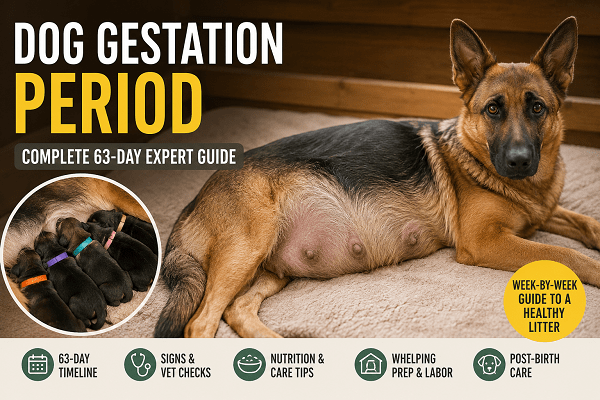
Dog Gestation Period: Complete 63-Day Expert Guide
If you’ve ever planned a litter, whether for working K9s, sport dogs, or family companions, you know that timing is everything. The average dog gestation period is about 63 days from ovulation, with a normal range of roughly 58–68 days depending on when mating occurred relative to ovulation. In this guide, you’ll walk through the full 63‑day timeline week by week, learn how pregnancy is confirmed, understand what’s happening inside your dog’s body, and see exactly what you should be doing at each stage, from nutrition and exercise, to vet visits, to whelping box prep. You’ll also get practical examples, typical litter sizes for popular breeds, warning signs of trouble, and a simple formula you can use to calculate your dog’s due date.
By the end, you’ll be able to answer three key questions confidently: “Is my dog pregnant?”, “When will she likely whelp?”, and “What should I be doing this week to support a healthy litter?”
Table of Contents
Introduction: Why Gestation Timing Matters
How Long Are Dogs Pregnant?
Understanding Ovulation vs. Mating Dates
The 63‑Day Dog Gestation Timeline
Week 1 (Days 0–7): Fertilization
Week 2 (Days 8–14): Embryos Travel
Week 3 (Days 15–21): Implantation
Week 4 (Days 22–28): First Visible Changes
Week 5 (Days 29–35): Puppies Take Shape
Week 6 (Days 36–42): Rapid Growth
Week 7 (Days 43–49): Nesting Begins
Week 8 (Days 50–56): Puppies Position for Birth
Week 9 (Days 57–63): Whelping
Pregnancy Signs: Early, Mid, and Late
Breed Size, Gestation Length, and Typical Litter Sizes
Vet Checks, Ultrasound, and X‑ray Timing
Nutrition, Exercise, and Daily Management
Calculating Your Dog’s Due Date
Whelping Preparation and Stages of Labor
Post‑Birth Care: Dam and Puppies
Common Problems and When to Call the Vet
FAQs
Conclusion and Actionable Checklist
Introduction: Why Gestation Timing Matters
If you’re breeding working dogs, German Shepherds, Malinois, Labs or simply planning a single well‑managed litter at home, knowing the dog gestation period is not optional; it’s the backbone of all your planning. From arranging time off work, to booking vet support, to having a whelping room ready, that 63‑day timeline guides every decision.
In this expert guide, you’ll learn exactly how long dogs are pregnant, how to read the week‑by‑week changes, and how to support your dog through each stage so you don’t miss warning signs or critical milestones. Whether you run a professional kennel or you’re caring for your first pregnant pet, you’ll get clear, practical steps rather than vague theory.
If this is your first experience raising a dog or preparing for a new puppy, you may also find our guide on Mastering the 3-3-3 Rule for Dogs helpful for understanding how dogs adapt to new environments after they leave the litter.
Before we dive in, how familiar are you already with canine heat cycles and basic breeding terms like “estrus” and “ovulation”?
How Long Are Dogs Pregnant?
Most dogs are pregnant for about 63 days from ovulation, which works out to roughly nine weeks. In practice, because mating does not always coincide exactly with ovulation, whelping typically occurs between 58 and 68 days after the first mating.
This gestation period is remarkably consistent across breeds, Chihuahuas, German Shepherds, Labradors, and Malinois all average the same 63 days, even though their litter sizes and puppy weights differ greatly. That consistency is what allows breeders and vets worldwide to rely on a 63‑day gestation when planning litters.
Ovulation vs. Mating Dates (Why Your Numbers May Be “Off”)
One of the biggest frustrations for new breeders is realizing that “63 days from mating” is only a rough estimate. Sperm can survive in the female reproductive tract for up to a week, so if you mate early in her fertile window, actual ovulation may occur several days after the first mating.
Veterinary reproductive specialists often monitor progesterone levels during the heat cycle; once progesterone reaches a specific threshold, ovulation has occurred, and the expected whelping date is about 63 days from that point. If you only know the mating date, most breeders work with a window of 58–68 days from first mating and watch both physical signs and temperature to narrow down the exact whelping day.
The 63‑Day Dog Gestation Timeline (Week‑by‑Week)
You can think of pregnancy in dogs as nine rough weeks, each with its own changes. Below is the practical breakdown most vets and breeders use.
Week 1 (Days 0–7): Fertilization
Right after mating, sperm travel up the reproductive tract and fertilize the eggs within a few days. From the outside, you won’t see any changes, your dog may act completely normal.
During this time, your main job is simple: avoid stress, keep to her normal routine, and don’t change diets or add medications unless your vet recommends it.
Week 2 (Days 8–14): Embryos Travel to the Uterus
Between about day 8 and 14, the fertilized eggs move along the uterine horns toward the uterus where they will later implant. Some handlers notice subtle mood changes, bitches may become more affectionate or, occasionally, a bit moody but these are not reliable pregnancy signs yet.
You still will not see physical pregnancy signs, so don’t expect a belly or mammary changes at this stage.
Week 3 (Days 15–21): Implantation and Early Development
Around days 15–21, implantation in the uterine wall occurs, and the embryos begin early organ development. At this point, some dogs show mild “morning sickness” with decreased appetite or a bit of vomiting as the body adjusts.
If your dog seems mildly off her food but otherwise bright and healthy, this can be normal; however, sustained vomiting or lethargy still warrants a vet check.
Week 4 (Days 22–28): First Visible Changes and Ultrasound
Around day 22–28, embryos are firmly attached in the uterus, and this is the earliest point at which ultrasound can reliably confirm pregnancy. A skilled veterinarian can sometimes feel the fetuses around day 28, but after this, the uterus fills with fluid and palpation becomes harder.
Externally, you may notice slight enlargement of the mammary glands and a small change in waistline, along with increased appetite in many bitches.
Week 5 (Days 29–35): Puppies Take Shape
By days 29–35, the fetuses develop sex organs, toes, and more recognizable puppy features. Your dog’s abdomen starts to look noticeably swollen, especially in smaller or leaner breeds where changes are easier to see.
Because there is less space for large meals, this is a good time to move to smaller, more frequent feedings and begin transitioning to a high‑quality puppy or maternity diet as recommended by your vet.
Week 6 (Days 36–42): Rapid Growth and Discomfort
During days 36–42, puppies grow rapidly, gaining pigmentation and body structure; their eyelids are formed but remain sealed until about ten days after birth. Many bitches become noticeably uncomfortable, may pant more, or vomit occasionally due to abdominal pressure.
A clear, non‑smelly vaginal discharge can be normal, but any foul odor or colored discharge should prompt a vet visit.
Week 7 (Days 43–49): Nesting and Whelping Box Introduction
By days 43–49, puppies are well‑developed and now mainly gaining size in preparation for birth. At this stage, you can often feel puppies moving in the abdomen, and the mammary glands are well developed, often containing colostrum (first milk).
This is when you should introduce the whelping box so your dog can get comfortable with her birthing area, and when vets can use X‑rays to count the number of puppies accurately.
Week 8 (Days 50–56): Puppies Position for Birth
Between days 50–56, puppies develop their coats and become crowded in the uterus, often leading to visible movement as they shift into birth position. Many bitches start nesting, digging bedding, rearranging blankets, and seeking quiet spaces.
Free feeding or slightly increased portions are often recommended now, as energy demands are high, but always follow your vet’s guidance.
Week 9 (Days 57–63): Whelping and the Big Day
By days 57–63, puppies are ready to be born and may be relatively still as labor approaches. A useful tool during this stage is rectal temperature: normal is around 100–101°F (about 37.8–38.3°C), and a sustained drop to around 97–99°F often indicates labor will begin within about 12–24 hours
Behaviorally, your dog may become restless, pant, refuse food, or show intense nesting behavior. These are typical pre‑labor signs and signal that whelping is imminent.
Pregnancy Signs: Early, Mid, and Late
While each dog is different, breeders around the world watch for a cluster of signs rather than a single symptom.
Early pregnancy signs (Weeks 3–4): Mild appetite changes, slight lethargy, subtle mood swings, and minimal mammary enlargement.
Mid‑term signs (Weeks 5–6): Clear abdominal enlargement, more pronounced mammary development, weight gain, and increased appetite.
Late signs (Weeks 7–9): Visible fetal movement, nesting behavior, clear discharge, and pre‑labor restlessness.
Remember that pseudopregnancy (false pregnancy) can mimic many of these signs; ultrasound and, later, X‑ray are the gold standards to confirm puppies.
Breed Size, Gestation, and Typical Litter Sizes
Gestation length is essentially the same across breeds, but litter size varies significantly. Here’s a quick snapshot based on typical averages:
Source: [gestationcalc]
Working lines often produce mid‑to‑larger litters, but individual variation is huge, nutrition, genetics, and the dam’s health all contribute.
Vet Checks, Ultrasound, and X‑ray Timing
To manage a pregnancy responsibly, especially in working or high‑drive dogs, schedule veterinary checkpoints.
Pre‑breeding: Health screening, vaccinations up‑to‑date, and discussion of genetic testing relevant to your breed.
Ultrasound: Usually performed around day 25–30 to confirm pregnancy and assess viability.
X‑ray: Typically done after day 49 to count the number of puppies and evaluate their size relative to the dam’s pelvis.
These visits also give you a chance to discuss any breed‑specific risks, such as higher rates of dystocia in brachycephalic breeds like French Bulldogs.
Nutrition, Exercise, and Daily Management
If you’ve ever watched a high‑drive Malinois slow down halfway through pregnancy, you know how important it is to balance exercise and rest. Most guidelines recommend maintaining moderate exercise during the first two trimesters and then tapering intensity in the final weeks.
Nutritionally, many vets suggest switching to a high‑quality puppy or maternity food around week 5 and increasing total calories by roughly 25–50% by the end of pregnancy, depending on body condition. Always avoid over‑supplementing calcium before whelping, as this can contribute to postpartum complications like eclampsia.
Feeding a pregnant dog isn’t simply about increasing portions; it’s about providing the right balance of protein, fat, vitamins, and minerals without overfeeding. If you’re unsure how to evaluate quality diets or build a proper feeding routine, see our detailed guide on Best Nutrition and Health Tips for Working Dogs, which explains how nutrition supports health, performance, and recovery throughout every life stage.
Calculating Your Dog’s Due Date
You can use a simple formula that many dog pregnancy calculators are built on:
Whelping Date ≈ Mating Date + 63 days (if you only know the mating date).
More accurate: Whelping Date ≈ Ovulation Date + 63 days (if you have progesterone test results).
Because of sperm survival and timing, the real‑world range is about 58–68 days from the first mating, so treat the calculated date as the center of a 10‑day window rather than a fixed appointment.
Whelping Preparation and Stages of Labor
If you’re serious about safeguarding your dam and puppies, start whelping prep no later than day 49.
Whelping Preparation Checklist
Set up a quiet, warm whelping box in a low‑traffic room.
Stock clean towels, puppy ID collars, a scale, disinfectant, and a notepad for recording birth times and weights.
Confirm your 24/7 emergency vet contact and travel time to the clinic.
Begin twice‑daily rectal temperature checks from around day 56.
Stages of Labor
Veterinary references describe three main stages of labor in dogs:
Stage 1 – Uterine contractions and cervical dilation: Restlessness, nesting, panting; can last 6–12 hours or more.
Stage 2 – Expulsion of puppies: Active contractions and delivery of each puppy; usually 0–30 minutes per pup, with up to two hours between puppies considered normal.
Stage 3 – Expulsion of placentas: Placentas follow each puppy or may be expelled after 2–3 pups.
If more than two hours pass between puppies with strong contractions, or your dog shows signs of extreme distress, contact your vet immediately.
Post‑Birth Care: Dam and Puppies
After whelping, your role shifts quickly from “birth assistant” to “nursery manager.” Lochia (post‑birth vaginal discharge) is normal and typically persists for about three weeks, sometimes up to eight weeks, darkening and decreasing over time.
Your key responsibilities include monitoring nursing, ensuring puppies are warm (generally kept around 29–32°C in the first week), tracking weights daily, and watching the dam for signs of infection or mastitis (fever, painful mammary glands, foul discharge).
Once the puppies arrive, nutrition quickly becomes the next priority. Our complete guide on What Do You Feed Puppies from Week 1 to Month 12 walks you through feeding schedules, weaning, and nutritional milestones from birth through the first year, making it an ideal next read for new breeders.
Common Problems and When to Call the Vet
Even with perfect planning, complications can arise. Being prepared to act quickly is part of responsible ownership.
Red‑flag situations include:
Strong contractions for 30+ minutes with no puppy produced.
More than two hours between puppies during active labor.
Foul‑smelling, dark or bloody discharge before any puppies are delivered.
Extreme pain, collapse, or signs of shock in the dam at any point.
In these scenarios, do not wait, seek emergency veterinary care. Many successful working kennels have saved entire litters simply because they recognized these signs and drove to the clinic immediately.
Frequently Asked Questions
1. Is 63 days always exact for dog gestation?
No. While 63 days from ovulation is the standard average, whelping usually happens between 58–68 days from the first mating because ovulation timing varies.
2. Can I tell how many puppies my dog will have without an X‑ray?
Ultrasound can confirm pregnancy and give a rough idea, but accurate puppy counts are best done with X‑rays after about day 49.
3. Do small breeds have shorter pregnancies?
Small breeds like Chihuahuas have the same average gestation length (around 63 days) as large breeds, but they typically have smaller litters.
4. When should I change my pregnant dog’s food?
Many vets suggest switching to a high‑quality puppy or maternity diet around week 5 and increasing food as the pregnancy progresses, guided by body condition and vet advice.
5. How do I know if my dog is going into labor soon?
Common signs include a drop in rectal temperature below about 99°F, restlessness, nesting, panting, refusal of food, and sometimes clingy behavior.
Conclusion and Actionable Advice
When you understand the 63‑day dog gestation period, the entire pregnancy stops feeling mysterious and starts looking like a clear, manageable timeline you can plan around. Whether you’re preparing your first family litter or coordinating multiple working dog pregnancies in a kennel, the same fundamentals apply: know your dates, schedule vet checks at the right time, support your dam’s health, and be ready for whelping with both equipment and an emergency plan.
As you plan your next (or first) litter, you can use the simple “63 days from mating or ovulation” rule, track week‑by‑week changes, and build a checklist for nutrition, exercise, and whelping prep so you’re never caught off‑guard. When you’re choosing breeding stock, especially for working dogs, this level of planning is part of professional responsibility, not just good practice.
Once your puppies are born and ready to begin life with their new families, the next important milestone is early training. Our guide on How to Crate Train a Puppy: K9 Trainer Tips for Faster Results explains how to introduce crate training correctly and build positive habits from the very beginning.

Her work centres on obedience, detection, protection and operational readiness. She favours proven methods built on repetition, consistency and real-world conditioning, so that both dogs and handlers are prepared for high-pressure tasks.
Rofiat represented the Nigerian Army Dog Centre at the Nigerian Army Day Celebration (NADCEL) 2026, where she led demonstrations in obedience, explosive detection, agility and tactical movement. Through articles, training content and documentaries, she shares field-based insight into how structured training, clear communication and trust between handler and dog affect performance and reliability.
She is the author of Beyond the Bark: Inside a Pro Handler's Playbook for Raising the Ideal Dog, a practical guide that helps dog owners and handlers apply professional training principles in everyday situations.
- Dog Agility Course Layout: Easy DIY Setup - October 7, 2026
- Local Dog Breeds: Temperament, Health & Training Guide - October 6, 2026
- How Long Do Military Working Dogs Serve? Full Guide - October 5, 2026