In-Home Dog Training Schedule: 4 Steps to Success
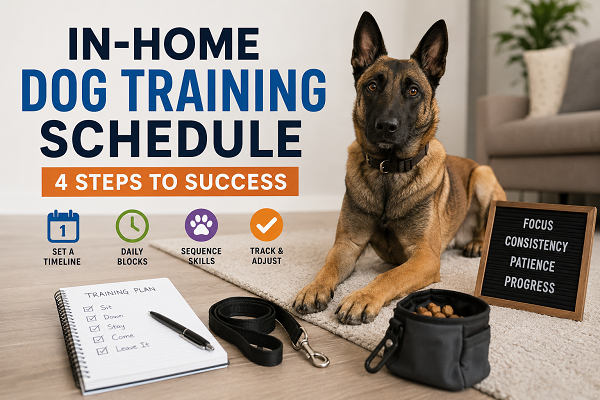
A good in-home dog training schedule uses two or three short sessions a day (3 to 15 minutes each, depending on age), teaches skills in a fixed order, raises difficulty one notch at a time, and tracks results in a simple log. Most dogs reach reliable basic obedience in 8 to 12 weeks, then need another 2 to 4 months to stay reliable around real-world distractions.
This guide gives you the 4-step system I use, session lengths by age, three sample daily schedules for different lifestyles, a 12-week calendar, a troubleshooting table, honest cost numbers and the research behind it all. It works for puppies, adolescents, rescues and dogs you’re raising toward future security or detection work.
Table of Contents
- What Is an In-Home Dog Training Schedule?
- Why Most Home Training Plans Fail (What the Research Says)
- Step 1: Match the Schedule to Your Dog’s Age and Stage
- Step 2: Build Your Daily Training Blocks
- Step 3: Sequence Skills and Raise the Difficulty the Right Way
- Step 4: Track, Test and Adjust Every Week
- Sample 12-Week In-Home Dog Training Schedule
- Troubleshooting: When the Schedule Stops Working
- What Does Dog Training at Home Cost?
- How Working-Dog Handlers Build Schedules
- FAQs
- Conclusion
Introduction
“How long should I train my dog every day?” I hear that question more than any other, and the honest answer surprises people. Time matters less than structure. An in-home dog training schedule built on three focused five-minute sessions a day will beat one scattered hour on Saturday almost every time.
Here’s the problem. Most online advice hands you a list of commands but never shows you how to fit them into a real week, with a real job, real kids and a dog who’d rather chase the cat. So you end up with a dog who sits perfectly in the kitchen and goes deaf at the front door.
I’ve spent more than 14 years instructing and handling military working dogs at the Nigerian Army Dog Centre, where obedience has to hold up under noise, crowds and pressure. The idea behind that work is the same one your family dog needs: build skills in order, repeat them in short bursts, and make things harder only when the dog is ready.
In this guide, you’ll learn:
- How long to train your dog each day at every age
- How to build daily training blocks that fit your lifestyle (office, remote work or shifts)
- The order professional handlers teach skills, and why it matters
- How to track progress and know exactly when to move on
- What to do when you miss days, hit a plateau or your dog just won’t cooperate

What Is an In-Home Dog Training Schedule?
An in-home dog training schedule is a fixed weekly plan that sets when you train, for how long, which skill you work on and how hard each session is. It turns “I’ll train him when I have time” into short daily appointments with clear goals.
That’s different from a daily dog routine (feeding, walks, naps), though the two work together. Dogs Trust, the UK’s largest dog welfare charity, points out that dogs thrive on routine and that days at home should look as similar as possible to days you’re out. Your training schedule sits inside that routine and gives it a purpose.
Why bother writing it down? Three reasons:
- You stop guessing. Every session has a goal, so you always know what to practice.
- Your dog learns faster. Predictable timing helps dogs settle and focus.
- Everyone in the house stays on the same page. A written plan stops three family members teaching three different versions of “down.”
Why Most Home Training Plans Fail (What the Research Says)
If you’ve ever downloaded a “21-day plan,” followed it for four days and then forgot it existed, you’re in good company. Most people fall into one of two traps.
- The marathon. One 45-minute session on Saturday, nothing until next weekend. Skills fade between sessions, and a tired dog stops learning after the first 10 minutes anyway.
- The random approach. A few minutes whenever you remember, with no goal. Your dog never learns that training has a pattern, and progress crawls.
So what does science say about the ideal rhythm? It’s more interesting than the usual “short and often” advice.
In 2011, researchers at the University of Copenhagen (Demant and colleagues) tested four groups of dogs. Two groups trained once or twice a week, and two trained daily. Within each pair, one group did a single session while the other did three sessions in a row. The dogs trained once or twice a week learned better per session than daily-trained dogs, and dogs given one session a day beat dogs given three back to back. When the researchers retested four weeks later, the dogs remembered what they’d learned no matter which schedule they’d followed.
A related 2008 study by Meyer and Ladewig found that dogs trained once a week needed fewer sessions to learn a task, while dogs trained five times a week got there in fewer days.
Here’s what I take from that, as a handler:
- Don’t cram. Ten repetitions back to back give you less than ten repetitions spread out. Stop while your dog is still keen.
- Daily gets you there sooner on the calendar. If you want results in weeks rather than months, short daily work still wins on speed.
- Learned skills stick. A missed week won’t wipe out your progress, so don’t panic when life gets in the way.
One honest note: those studies tested three sessions in a row, not three sessions spread across the day. The blocks in this plan sit hours apart, which is a different thing. But the lesson holds. Short, spaced and stopped early beats long and tiring.
Step 1: Match the Schedule to Your Dog’s Age and Stage
The biggest mistake I see is using one plan for a 9-week-old puppy, a 14-month-old adolescent and a 6-year-old rescue. Their attention spans, bodies and habits are completely different.
Use this table as your starting point, then adjust to your own dog.
| Dog’s stage | Session length | Sessions per day | Daily total | Main focus |
|---|---|---|---|---|
| Puppy, 8 to 12 weeks | 3 to 5 min | 3 to 4 | 10 to 20 min | Name response, handling, potty cues, gentle socialization |
| Puppy, 3 to 6 months | 5 to 8 min | 3 | 15 to 25 min | Sit, down, recall, first leash skills |
| Adolescent, 6 to 18 months | 8 to 12 min | 2 to 3 | 20 to 30 min | Reliability, impulse control, proofing |
| Adult or rescue | 10 to 15 min | 2 to 3 | 15 to 35 min | Replacing old habits, building focus |
| Senior, 8+ years | 5 to 10 min | 2 to 3 | 10 to 20 min | Low-impact skills, scent games, mobility checks |
Puppies (8 to 16 weeks). Keep it tiny and cheerful. Fear Free’s sample puppy routine uses just a 3 to 5 minute training session in the morning and again in the evening, with 30 to 50 small treats per session. That sounds like a lot, but each treat is pea-sized and the whole session is over in a couple of minutes. This is also when socialization matters most. Most vets and behaviorists say the key window runs from about 3 weeks to roughly 12 to 16 weeks, so safe, positive exposure to new people, surfaces and sounds belongs in your schedule too. If you’re also working on toilet training, our 7-day puppy potty training schedule slots straight into the morning and evening blocks below.
Adolescents (6 to 18 months). This is your prime training window, and also the most frustrating. Hormones rise, independence kicks in and your once-perfect puppy “forgets” everything. That’s normal. Drop the difficulty a notch, keep sessions upbeat and stay consistent. In my experience, many dogs make their biggest reliability gains somewhere between months 6 and 10 if the schedule doesn’t stop.
Adult dogs and rescues. Adult dogs learn just as well as puppies. The difference is that they often arrive with habits you need to replace, not build from scratch. If your dog is newly adopted, wait before pushing precision work. Our guide to the 3-3-3 rule for dogs explains why the first days, weeks and months in a new home need a gentler pace.
Seniors. Keep sessions short, skip jumping and long holds on slippery floors, and ask your vet about joint comfort. Nose work and “find it” games are excellent for older dogs.
Working and high-drive breeds. Belgian Malinois, German Shepherds, Dutch Shepherds and Border Collies need real exercise alongside training, not instead of it. A dog with unspent energy will treat your five-minute session like a starting gun. We break down the numbers in our guide on how often to exercise a working dog.
A realistic timeline. On a structured daily schedule, most healthy adult dogs reach reliable performance on five core cues (sit, down, stay, come and loose-leash walking) in about 8 to 12 weeks. Reliability around real distractions, like other dogs or food on the ground, usually needs another 2 to 4 months. So when someone promises a “fully trained dog in two weeks,” ask what they mean by trained. It rarely means reliable.
Step 2: Build Your Daily Training Blocks
Once you know your dog’s stage, give training a place in your day. I recommend three short blocks, each with a different job. Spacing them out gives your dog’s brain time to settle what it learned.
Morning Block: Teach (5 to 10 minutes)
Run it right after the first potty break and before breakfast. Your dog is alert and hungry, which makes this the best time to introduce something new. Use part of the breakfast ration as treats.
Midday Block: Proof (5 to 10 minutes)
Here you don’t teach anything new. You test the morning skill in a slightly harder setting: a different room, a different family member, a toy on the floor. This is where skills start to travel.
Evening Block: Real Life (5 to 15 minutes)
Use it for loose-leash walking, waiting at doors, settling on a mat and ignoring the doorbell. Evenings are usually the busiest, noisiest part of a household, which is exactly the distraction level you want to train through.
That adds up to 15 to 35 minutes of focused training a day, on top of normal walks and play. Treats count as food, so keep them to about 10 percent of your dog’s daily calories and trim meals to match.
Three Sample Schedules for Real Lifestyles
Most schedules online assume you’re home all day. Here are options for everyone else.
| Lifestyle | Morning block | Midday block | Evening block |
|---|---|---|---|
| Working from home | 7:00 am, before breakfast | 12:30 pm, after lunch break | 6:30 pm, before dinner |
| Office job (9 to 5) | 6:30 am, after potty break | Skip, or a 3-minute check-in with a dog walker or neighbor | 6:00 pm, then a longer proofing session on weekends |
| Shift worker | Before your shift or on waking, whichever comes first | Any quiet gap, even 5 minutes | Before the dog’s main meal |
Office workers, don’t feel guilty about skipping the midday block. Two solid sessions beat three rushed ones. Whatever your pattern, keep the order the same each day so your dog learns what comes next.
Four Rules That Protect Your Schedule
- Keep the routine steady on all days. Dogs Trust advises making days at home look like days when you’re out, so your dog doesn’t struggle when your pattern changes.
- One handler teaches, everyone proofs. Let one person introduce each new skill. Once the dog understands it, the rest of the family practices it in the proofing block.
- Write down the cue words. If one person says “down” and another says “lie down,” you’ve just taught two commands.
- Mind the heat. In hot climates, train in the cool of early morning or evening, or indoors. A panting dog isn’t learning.
Step 3: Sequence Skills and Raise the Difficulty the Right Way
This is where most home plans go sideways. Owners teach commands in the order they found them online, not the order a dog’s brain needs.
Military and police programs follow a strict sequence, and it works beautifully at home:
- Engagement and name response. Before any command means anything, your dog must check in with you.
- Static obedience. Sit, down and stay in a quiet room.
- Movement obedience. Loose-leash walking, heel position and recall.
- Impulse control. Leave it, wait at doors and settle on a mat. These are the brakes everything else depends on.
- Distraction proofing. Other dogs, food, visitors and new places.
- Real-world generalization. Parks, the vet, busy streets and guests.
Skip ahead and you’ll plateau. I’ve watched owners try “stay” at a crowded dog park in week one, watch the dog fail again and again, then decide the dog is stubborn. The dog wasn’t stubborn. The schedule asked for a skill he hadn’t earned yet.
The 3 Ds: Change Only One at a Time
Every skill gets harder in three ways:
- Duration: how long the dog holds the behavior
- Distance: how far you are from the dog
- Distraction: how much is going on around you
Here’s the rule I teach every client: raise one D at a time, and drop the other two when you do. If you add distance, shorten the duration. If you add a distraction, step closer. Mix them all at once and you’ll confuse the dog.
The 4-Level Distraction Scale
Give each location a score so you can plan your proofing.
| Level | Setting | Example |
|---|---|---|
| 0 | Quiet, empty room | Hallway with the door shut |
| 1 | Mild | TV on, one family member nearby |
| 2 | Moderate | Garden, doorbell, another pet in view |
| 3 | High | Park, other dogs, food on the ground |
A skill is only “finished” at Level 3. Most owners stop at Level 0 and wonder why it falls apart outside.
The UK Kennel Club gives similar advice for training at home: once your dog gets the idea, move to a different room or the garden and repeat, then build up the chain. When a distraction causes a mistake, go back to the basic level so the dog can win again.
Example in practice. Teaching “stay”: Level 0 for 3 seconds at one step away. Then 10 seconds. Then three steps away for 3 seconds. Then Level 1 with the TV on, back at 3 seconds and one step. Slow? Yes. Reliable? Absolutely.
If your goal is protection or security work later, this foundation is non-negotiable. Protection behavior sits on top of rock-solid obedience and impulse control, and rushing it is unsafe. Our guide on training a dog for security and protection explains why.
Step 4: Track, Test and Adjust Every Week
Nearly every home schedule skips this step, and it’s the one that tells you whether the plan is working. “It feels like it’s going okay” isn’t data.
Keep a simple log. A notes app is enough:
| Date | Skill | Level (0 to 3) | Result | Notes |
|---|---|---|---|---|
| Mon | Stay, 10 sec | 1 | 7 of 10 first try | Better with treat held low |
| Tue | Stay, 10 sec | 1 | 8 of 10 | Ready to test Level 2 |
The 80 Percent Rule
Here’s a rule of thumb I use with every dog. If your dog isn’t succeeding about 8 out of 10 times at a given level, don’t move up. Push on anyway and you’ll spend two weeks untangling a habit of failing instead of building one of winning.
Your 10-Minute Sunday Review
Once a week, read your log and ask three questions:
- Which skills hit 80 percent? Move those up one level.
- Which skills stalled for 5 to 7 sessions? Make them easier, shorten the session or upgrade the reward.
- Is the same problem showing up again and again, like growling at the food bowl or lunging at other dogs? Pause the schedule and deal with that first. Our guide to training reactive and aggressive dogs is a good next stop, and a qualified trainer is even better.
What If You Miss Days?
You will. Everyone does. Here’s how to restart without guilt:
- Missed 1 to 3 days: Pick up exactly where you left off.
- Missed about a week: Go back one level on each skill for two sessions, then move on.
- Missed 2 weeks or more: Restart the current phase at Level 0 and rebuild quickly. Dogs usually relearn faster than they learned the first time.
- Dog is sick, injured or in heat stress: Pause completely and check with your vet.
Build in one lighter day a week, too. Play, sniff walks and a single two-minute refresher keep your dog keen and give you a break.
Sample 12-Week In-Home Dog Training Schedule
This is the simplified version I give new clients. Move faster or slower based on age and temperament, and always use the 80 percent rule before moving on.
| Week | Focus | Daily time | Success benchmark |
|---|---|---|---|
| 1 to 2 | Name response, sit, hand targeting | 10 to 15 min | Responds to name 8 of 10 times indoors |
| 3 to 4 | Down, stay (5 seconds), crate or mat comfort | 15 to 20 min | Holds stay 15 seconds with mild distraction |
| 5 to 6 | Loose-leash walking, recall indoors | 20 to 25 min | Walks 10 minutes without pulling |
| 7 to 8 | Impulse control: leave it, wait at doors | 20 to 25 min | Waits at an open door until released |
| 9 to 10 | Distraction proofing in the garden or a quiet park | 25 to 30 min | Holds cues with one Level 2 distraction |
| 11 to 12 | Real-world generalization | 25 to 35 min | Performs 5 core cues in 3 or more locations |
After week 12, keep one short block a day. Maintenance is cheap, and this is also the time to have fun with tricks and games.
Want the full version? I wrote down my complete method, including breed and drive-level troubleshooting, in my e-book Beyond the Bark: Inside a Pro Handler’s Playbook for Raising the Ideal Dog. It’s handy if you’d rather follow a step-by-step playbook than build your own plan from scratch.
Troubleshooting: When the Schedule Stops Working
| What you see | Likely cause | Fix |
|---|---|---|
| Dog ignores you outdoors but obeys indoors | Skipped distraction levels | Drop to Level 1 or 2 and rebuild |
| Dog loses focus after 3 minutes | Session too long or reward too weak | Shorten sessions, upgrade to a higher-value treat |
| Dog is wild at session start | Too much pent-up energy | Add a short sniff walk first |
| Dog fails the same cue for a week | Moved up too fast | Go back one level, aim for 80 percent |
| Dog is better with one family member | Mixed cues or handling | Agree on cue words, let everyone do proofing blocks |
| Dog suddenly “forgets” everything at 7 to 10 months | Adolescent regression | Stay calm, lower the difficulty, keep sessions upbeat |
And a few more habits that quietly derail a plan:
- Training only on weekends. Two sessions a week isn’t enough repetition for most dogs to build solid habits.
- Ending on a failure. Always finish on something your dog can do, even if it’s easy.
- Training a worn-out dog. After an hour of zoomies, there’s no brainpower left.
- Changing the plan every few days. Give any change 5 to 7 sessions before judging it.
- Chasing minutes instead of quality. Twenty focused minutes beat two distracted hours.
What Does Dog Training at Home Cost?
If you’re weighing a DIY plan against hiring help, here’s roughly what the market looks like in the US, UK and similar countries. Prices vary widely by region and trainer, so treat these as ballpark figures and check local rates.
- Private in-home trainer: around $50 to $150 per session in the US, or £40 to £100 in the UK, often sold in packages of 4 to 8 sessions
- Board-and-train: commonly $1,500 to $6,000 or more, depending on length and specialty
- Group classes (including puppy classes): usually $100 to $300 for a 6 to 8 week course
- DIY with this schedule: mostly free, apart from treats, a leash and a bit of your time
Even if you hire a trainer, you still need a home schedule. A dog who practices only once a week with a professional will plateau fast. The best results I see come from a pro-guided plan plus daily home practice.
How Working-Dog Handlers Build Schedules
People sometimes ask whether military working dogs learn differently from pets. They don’t. The difference is that their schedule never leaves training to chance.
At the Nigerian Army Dog Centre, I’ve worked through dog selection, foundation obedience, behavior shaping and performance evaluation. A few habits from that world carry straight into your living room:
- Training is a fixed appointment, not a mood. The session happens whether the handler feels like it or not.
- Records beat memory. Handlers write down how each dog performed so decisions come from results, not hunches.
- Fundamentals never stop. Even advanced dogs keep running basic obedience, because everything else is built on it.
- Handlers train themselves too. Your timing, calm voice and consistent cues decide how fast your dog learns.
If you’ve seen military working dogs in demonstrations, including obedience and agility displays like those at the Nigerian Army Day Celebration (NADCEL) 2026, you’ve seen the result of this approach. Obedience, detection and tactical movement all look effortless because the schedule behind them was relentless and well ordered.
FAQs
How long should I train my dog each day?
Most dogs do best with 15 to 30 minutes of total training a day, split into two or three short sessions. Puppies need only 3 to 5 minutes per session, while adult dogs can handle 10 to 15 minutes once they have some foundation.
How many times a day should I train my dog?
Two to three times a day works well for most dogs. Space the sessions out by several hours rather than stacking them back to back, and stop while your dog is still eager.
How long does it take to train a dog at home?
Expect 8 to 12 weeks for reliable basic obedience on a consistent daily schedule. Reliability around real distractions usually takes another 2 to 4 months, so plan on roughly 4 to 6 months for a dependable, well-rounded dog.
What if I miss a few days of training?
Missing 1 to 3 days is fine, so just continue. After a week off, go back one level for a couple of sessions. Research shows dogs keep what they’ve learned for at least four weeks after practice, so one missed week rarely undoes your progress.
Can I use this schedule for an older dog or rescue?
Yes. Older dogs and rescues learn well with structure. They may need extra sessions to replace old habits, and rescues often need a few weeks to settle before precision work starts. Keep sessions short for seniors and check with your vet about physical limits.
Conclusion
A good in-home dog training schedule doesn’t need more hours in your day. It needs the hours you already have organized into short, spaced and well-ordered sessions.
Match the plan to your dog’s age. Build three small training blocks that fit your lifestyle. Teach skills in order and raise only one difficulty at a time. Track your results and move up only when your dog hits that 80 percent mark.
Do that for 8 to 12 weeks and you’ll have a dog who listens not just in the living room, but out in the real world where it counts.
Your next step today: pick one skill, set a five-minute timer, and book your first block in your phone calendar for tomorrow morning. Then come back to the 12-week table and keep going.
Want weekly training tips like this in your inbox? Subscribe to the ARFS K9 Team weekly articles roundup.
Sources and Further Reading
- Demant, H., Ladewig, J., Balsby, T.J.S., Dabelsteen, T. (2011). The effect of frequency and duration of training sessions on acquisition and long-term memory in dogs. Applied Animal Behaviour Science. DOI: 10.1016/j.applanim.2011.05.010
- Meyer, I. and Ladewig, J. (2008). The relationship between number of training sessions per week and learning in dogs. Applied Animal Behaviour Science, 111, 311 to 320.
- Fear Free Happy Homes. Daily Routine: Puppy.
- Dogs Trust. How to get your dog into a routine.
- The Kennel Club (UK). Training your dog at home.

Her work centres on obedience, detection, protection and operational readiness. She favours proven methods built on repetition, consistency and real-world conditioning, so that both dogs and handlers are prepared for high-pressure tasks.
Rofiat represented the Nigerian Army Dog Centre at the Nigerian Army Day Celebration (NADCEL) 2026, where she led demonstrations in obedience, explosive detection, agility and tactical movement. Through articles, training content and documentaries, she shares field-based insight into how structured training, clear communication and trust between handler and dog affect performance and reliability.
She is the author of Beyond the Bark: Inside a Pro Handler's Playbook for Raising the Ideal Dog, a practical guide that helps dog owners and handlers apply professional training principles in everyday situations.
- How to Enter the COBA National Dog Championship - October 20, 2026
- K9 Advantix Dosage Chart & Safety Guide for Dogs - October 19, 2026
- How to Set Up & Use Bousnic Dog Training Collar - October 18, 2026