Dog Training Whistle Guide: Tips for Reliable Recall
A dog training whistle gives your dog one clear, identical signal that carries across wind, noise and distance, which your voice can’t do. To train it, pick one fixed-pitch whistle, pair the sound with a high-value treat for a week before asking for anything, then add distance and distractions one at a time. Most dogs respond in two to three weeks. Reliable off-leash recall around real distractions usually takes three to six months. Blow once, reward every early response, and never use the whistle to call your dog to something unpleasant.
Table of Contents
- Introduction
- What Is a Dog Training Whistle?
- Why a Whistle Beats Your Voice
- How Dogs Hear a Whistle (and the Silent Whistle Myth)
- How to Choose the Right Dog Training Whistle
- Whistle Signals: What Each Blast Should Mean
- How to Blow the Whistle Properly
- The Step-by-Step Whistle Training Plan
- Common Whistle Training Mistakes
- Whistle Training for Working and Security Dogs
- Troubleshooting: When the Whistle Stops Working
- Keeping the Whistle Sharp for Life
- Handler Notes From the Training Field
- FAQs
- Conclusion
Introduction
Ever shouted your dog’s name across a park while it sprinted the other way, deaf to everything but a squirrel? You’re not alone, and it’s rarely a “stubborn dog” problem. It’s a signal problem. Your voice changes with your mood, drops off with distance and vanishes in wind. A dog training whistle fixes all three.
But here’s what most guides skip. Owning a whistle doesn’t train your dog. Plenty of people buy one, blow it five times at a busy dog park, and decide whistles don’t work. The tool is simple. The method is what matters.
In this guide, you’ll learn how whistle training for dogs really works, how to choose a whistle (including the pitch mistake many articles repeat), which signals to teach, and how to blow it consistently. You’ll also get a week-by-week plan, the mistakes that wreck recall, and how professional handlers use whistles with working and security dogs.
What Is a Dog Training Whistle?
A dog training whistle is a handheld whistle that produces a fixed, repeatable tone you pair with a specific command, such as come, stop or turn. Dogs learn to link that tone to a behavior and a reward. Because the sound is the same every time, the signal stays clear at long distances and in noisy places.
The idea comes from gundog and herding work, where handlers signal dogs far out of voice range. Today, pet owners, gundog trainers and working K9 handlers all use the same principle.
Why a Whistle Beats Your Voice
Your voice works well up close. Past that, it has three weaknesses a whistle doesn’t share:
- Consistency. A whistle blast sounds the same whether you’re calm, tired or panicking because your dog is heading for a road. Your voice never does.
- Range. Manufacturers rate popular training whistles to carry up to about 1.5 km in ideal conditions. Real-world range is shorter, depending on wind, terrain and cover, but it’s still far beyond a shout.
- Cut-through. A sharp, single-pitch tone stands out from wind, rain and traffic much better than speech does.
There’s a fourth benefit people overlook: a whistle is a “special” sound. You say “sit” and “come” all day in normal conversation, so your dog learns to tune those words out. A whistle blast means one thing, and your dog knows you’re talking to them. It also frees your hands for treats and hand signals.
How Dogs Hear a Whistle (and the Silent Whistle Myth)
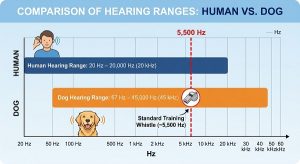
Dogs hear sounds up to roughly 45,000 Hz. Humans top out around 20,000 Hz (Coren, 2004). That’s where the myth starts: people assume whistles work because they’re ultrasonic.
They don’t. The most popular training whistles, such as the Acme 211.5, produce a tone of around 5,400 to 5,700 Hz according to manufacturer listings. You can hear that tone too. It works because it’s sharp, clean and easy for a dog to pick out of background noise.
What about “silent” whistles? They sit above human hearing, so you can’t hear them. That creates three problems for training:
- You can’t tell whether your blast was consistent or whether it was too short or soft.
- You can’t tell if wind carried it away.
- Output varies between cheap models, so your cue changes without you knowing.
For command training, I almost always recommend an audible, fixed-pitch whistle. Save ultrasonic whistles for simple attention-getting, if you use them at all.
How to Choose the Right Dog Training Whistle
Pick one whistle, learn its tone and stay with it. Dogs learn a specific sound, not a general “whistle noise.”
| Whistle type | Best for | Watch out for |
|---|---|---|
| Fixed-pitch, pealess (e.g., Acme 210.5 or 211.5) | Recall, stop and turn signals. The favorite of most gundog trainers. | You can’t change the pitch. That’s a feature, not a flaw. |
| Adjustable or dual-tone | Handlers who want two distinct tones for two commands | Tone can drift if you adjust it. Mark your setting. |
| Whistles with a pea (cork ball) | Warbling or trilled signals | The ball can freeze or stick in cold or wet weather |
| Ultrasonic (“silent”) | Light attention-getting only | You can’t monitor your own consistency |
210.5 or 211.5? Both are pealess, single-frequency whistles. The 210.5 is the slightly higher, sharper pitch. The 211.5 is a touch lower and softer. Makers suggest the 211.5 for retriever breeds and the 210.5 for work at longer range. Either is fine. Choose one, and keep it.
A few buying tips from the field:
- Buy two identical whistles. Whistles get lost in grass and mud. A backup with the exact same tone saves your training.
- Wear it on a lanyard. A whistle in a drawer trains nobody.
- Budget about $8 to $20. Popular models run roughly £10 to £12.50 in UK shops. There’s no reason to buy a cheap, unbranded copy with an unpredictable tone.
- Don’t switch models mid-training. A new whistle means a new sound, and you may need to repeat part of the conditioning.
Whistle Signals: What Each Blast Should Mean
Before you blow a single note, decide what each signal means. Keep it simple. Most handlers use three signals at most.
Gundog trainers worldwide follow a common pattern:
- One long blast = stop (sit or stand still). A long, steady tone has a calming, freezing effect.
- A series of short, rapid pips = recall (come to me). Quick pips are exciting and pull the dog toward you.
- Two short pips = turn or change direction. This one matters mostly in field work.
Notice that this is the opposite of what many pet-owner articles teach (long blast for recall). Your dog doesn’t care which pattern you pick. Consistency is what counts. But if you ever work with other handlers, or plan to run a gundog, following the gundog convention makes life easier. The long-blast-stops, short-pips-call logic also makes sense: one pattern calms, the other energizes.
If you’re training a family pet, you probably only need one signal: recall. Add a stop signal later, once recall is solid. Never add a second signal before the first one works.
How to Blow the Whistle Properly
This is the section almost every competitor skips, and it’s where a lot of training quietly fails.
Practice without the dog first. Blow your recall pattern ten times in a row and check that it sounds identical. Same number of pips, same rhythm, same length. If you’re inconsistent, your dog hears ten different cues.
Use a short, crisp breath. Think of saying “tu-tu-tu” into the whistle. Don’t puff it out like blowing out a candle. Pealess whistles in particular change tone if you blow too hard.
Keep volume sensible. Some training whistles are rated around 110 dBA at the source. That’s loud. Don’t blast it near your dog’s head, especially indoors during Week 1 and 2. Blow softly at close range. You only need full volume at real distance.
Learn a mouth-whistle backup. If you lose the whistle, you want a similar pattern you can whistle with your lips. It won’t match the tone, but it gives you something in an emergency. Practice it separately, and don’t mix it into early training.
Mind the wind. Blow with the wind at your back when you can. Sound carries downwind and fades upwind. If your dog is upwind and not responding, it may not have heard you at all.
The Step-by-Step Whistle Training Plan
This plan comes from the same conditioning approach I use with working dogs, adapted for everyday owners. Treat the timeline as a guide, not a deadline. Some dogs move faster. Some need extra weeks at each stage.
Before You Start: Gather Your Gear
- A fixed-pitch whistle on a lanyard
- A high-value treat (small pieces of chicken, cheese or liver, not your dog’s everyday kibble)
- A 10 to 15 meter (30 to 50 foot) long line for outdoor work
- A treat pouch, so rewards come fast
Week 1: Pair the Sound With the Reward
Indoors, no distractions. Blow your recall pattern softly, then immediately hand over a treat. Do this whatever the dog is doing. You’re not asking for any behavior yet. You’re building a simple link: whistle means something great.
Do it: 10 to 15 times per day, in short sessions of a minute or two. By day five to eight, most dogs look up or move toward you the second they hear it.
Week 2: Short-Distance Recall
Call from a few feet away in a quiet room. Blow once. Reward heavily the moment your dog arrives. Add a small “party” (praise, a second treat) so coming to you feels amazing.
Week 3: Add Distance and Mild Distraction
Move to a fenced yard or quiet outdoor space. Use the long line. Build distance to about 20 to 30 feet. If your dog doesn’t respond, don’t blow again. Gently guide them in with the line, then reward when they arrive.
Weeks 4 to 6: The Real World
Practice in parks, near other people and, later, near other dogs. Always use a long line until recall is reliable. This is where most people quit too early.
The golden rule: change one thing at a time. Add distance or distraction or duration. Never all three at once. If you move to a busier park, shorten the distance. If you lengthen the distance, pick a quieter spot.
Months 2 to 6: Proof It
Practice in new places, at different times, with different distractions. A recall that works only in your garden isn’t a recall. It’s a garden trick. Dogs don’t automatically carry learning from one place to another, so you have to teach it everywhere.
A Realistic Timeline
| Stage | What to expect |
|---|---|
| Weeks 1 to 2 | Dog orients to the whistle indoors |
| Weeks 3 to 6 | Reliable in low-distraction places on a long line |
| Months 2 to 3 | Good response in moderate distraction |
| Months 3 to 6 | Dependable off-leash recall around real distractions, for many dogs |
Breed drive, age and training frequency all change these numbers. A working-line Spaniel often moves faster than an independent hound.
Common Whistle Training Mistakes
I’ve watched the same handful of errors wreck whistle training again and again.
- Blowing repeatedly. Five blasts teach your dog that the first four are optional. Blow once, then go and get the dog or use the long line.
- Only whistling when your dog is in trouble. If the whistle always means “fun is over,” your dog will learn to avoid it. Use it for good things most of the time.
- Poisoning the cue. Never call your dog by whistle to give a bath, trim nails or end a great game without a reward. One bad experience can cost you weeks.
- Skipping rewards once the dog “knows it.” Reliability fades fast without reinforcement.
- Training in only one place. See above: dogs don’t generalize automatically.
- Changing whistle types. A different tone resets part of your conditioning.
- Whistling at a moving target. If your dog is mid-sprint after a rabbit, don’t blow. You’re teaching your dog the whistle can be ignored. Wait for a moment they can succeed, or use the long line.
- Using the whistle while frustrated. Your dog reads the energy behind it. Take a breath first.
Whistle Training for Working and Security Dogs
In working-dog programs, a whistle is rarely a stand-alone tool. Handlers layer it with voice commands and hand signals, so the dog can respond reliably through any channel. Gunfire, vehicle noise, radio chatter, darkness and distance can all block one signal while another still gets through. That redundancy is the same principle behind how professional K9 training programs are structured, with multiple command channels built in from day one.
A few points apply to working dogs in particular:
- Teach each signal on voice first, then pair the whistle, then fade the voice. Hepper and others suggest the same, and it works well for dogs that already know basic obedience.
- Keep whistle signals for distance work. Close up, use voice or hand signals. Save the whistle for when you truly need range.
- Don’t rely on the whistle alone for protection work. Safety-critical commands need to work on voice, hand and whistle.
- Fitness and health affect response. A tired, overheated or unwell dog responds slower. Our guide to maintaining peak health in military working dogs explains how conditioning feeds directly into obedience.
If you’re building obedience for a family dog and want fun ways to use your new signals, our 10 K9-approved tricks to teach your dog makes a great next project. Tricks are a low-pressure way to keep your dog responding to cues.
Want the complete framework professional handlers use to build this kind of reliability, covering obedience, timing and leadership, not just whistle work? I put it all into Beyond the Bark: Inside a Pro Handler’s Playbook for Raising the Ideal Dog. It’s the same approach I use with working dogs, adapted so any owner can apply it at home.
Troubleshooting: When the Whistle Stops Working
My dog ignores the whistle around other dogs. Go back a stage. Practice at a distance from the other dog where your dog can still succeed, then close the gap over several sessions.
My dog responds slowly outdoors. That’s normal. The behavior hasn’t generalized yet. Add more outdoor reps with higher-value treats.
My dog was reliable, then suddenly isn’t. Check these in order: (1) Have rewards quietly stopped? (2) Did something unpleasant follow a recent recall? (3) Is there a health issue?
My older dog stopped responding. Hearing loss often shows up first at higher frequencies, so a whistle can fade before voice does. Ask your vet to check, and add hand signals while your dog still sees you. Dogs with hearing loss can still do well with visual cues and vibration-based tools.
The whistle sounds different each time. That’s on you, not the dog. Practice your pattern without the dog until it’s identical. Pealess whistles change tone with blowing pressure.
The neighbors complain about the noise. Blow softer at close range, train away from homes when you can, and save full volume for real distance.
Keeping the Whistle Sharp for Life
A trained whistle recall isn’t finished. It’s maintained.
- Reward at random, for life. You don’t need a treat every time, but dogs that are never rewarded slowly stop prioritizing the cue.
- Whistle randomly on walks, when your dog is doing something easy, then reward and release. This keeps the cue strong without making it mean “end of fun.”
- Refresh after breaks. After a long gap or an injury, drop back a stage for a week.
- Carry the whistle everywhere. The day you leave it at home is the day you’ll need it.
Handler Notes From the Training Field
I’ve spent more than 14 years as a military working dog instructor and handler at the Nigerian Army Dog Centre, with advanced certifications in obedience, K9 patrol and explosive detection. I also led obedience, detection, agility and tactical movement demonstrations at the Nigerian Army Day Celebration (NADCEL) 2026.
Here’s what that experience has taught me about whistles:
- Consistency beats cleverness. The handlers who get the best response aren’t the ones with the fanciest whistle. They’re the ones who blow the same pattern, every time.
- Most “disobedient” dogs are untrained dogs. The dog was never taught that the cue means a reward in that place, with that distraction.
- Redundancy saves lives. In high-pressure work, we never rely on one channel. Voice, hand and whistle all carry the same command.
- Rewards matter more than the whistle. A whistle only amplifies what the dog already believes the cue means.
Sources and further reading: Coren, S. (2004), How Dogs Think, on canine hearing range; ACME Whistles manufacturer specifications; UC Davis School of Veterinary Medicine, “Recall Training in Dogs.”
FAQs
1. What is the best dog training whistle?
For most people, a fixed-pitch, pealess whistle like the Acme 210.5 or 211.5 is the best choice. The tone stays consistent, it works in cold and wet weather, and handlers can hear it to check their own timing. Pick one and stick with it.
2. How long does it take to train a dog to a whistle?
Most dogs start responding in two to three weeks of daily short sessions. Dependable off-leash recall around real distractions usually takes three to six months, depending on age, breed and how often you train.
3. Are silent dog whistles better for training?
Usually not. You can’t hear them, so you can’t check that your blasts are consistent, and output varies between models. An audible whistle at around 5,000 to 6,000 Hz gives you better control and works just as well for dogs.
4. Can I use a whistle and verbal commands together?
Yes. Many handlers teach a command by voice first, add the whistle, then fade the voice for distance work. Keep the whistle pattern distinct for each command so the signals don’t blur together.
5. Will a dog whistle hurt my dog’s ears?
Normal use at sensible distances won’t, but whistles are loud at the source. Some are rated near 110 dBA. Don’t blast one next to your dog’s head, and blow softly at close range, especially with puppies and older dogs.
Conclusion
A dog training whistle isn’t a shortcut. It’s a tool that rewards consistency more than almost anything else in dog training. Here’s the short version:
- Choose one fixed-pitch whistle and keep it for life. Buy a spare.
- Pick clear signals, and practice your pattern without the dog until it’s identical every time.
- Pair the whistle with a high-value reward for a full week before you ask for anything.
- Build distance, distraction and duration one at a time, using a long line.
- Blow once. Then go and get your dog if needed.
- Keep rewarding, and keep the cue positive for life.
Stick with that, and most owners see a reliable recall within a few months, the kind that holds up when a squirrel, another dog or an open gate tests it.
If you want to build that reliability across every command, not just recall, take a look at Beyond the Bark: Inside a Pro Handler’s Playbook for Raising the Ideal Dog. And if you’d like fresh training tips every week, subscribe to our weekly articles roundup newsletter.

Her work centres on obedience, detection, protection and operational readiness. She favours proven methods built on repetition, consistency and real-world conditioning, so that both dogs and handlers are prepared for high-pressure tasks.
Rofiat represented the Nigerian Army Dog Centre at the Nigerian Army Day Celebration (NADCEL) 2026, where she led demonstrations in obedience, explosive detection, agility and tactical movement. Through articles, training content and documentaries, she shares field-based insight into how structured training, clear communication and trust between handler and dog affect performance and reliability.
She is the author of Beyond the Bark: Inside a Pro Handler's Playbook for Raising the Ideal Dog, a practical guide that helps dog owners and handlers apply professional training principles in everyday situations.
- How to Enter the COBA National Dog Championship - October 20, 2026
- K9 Advantix Dosage Chart & Safety Guide for Dogs - October 19, 2026
- How to Set Up & Use Bousnic Dog Training Collar - October 18, 2026