When Do Puppies Open Their Eyes? Timeline & Warnings
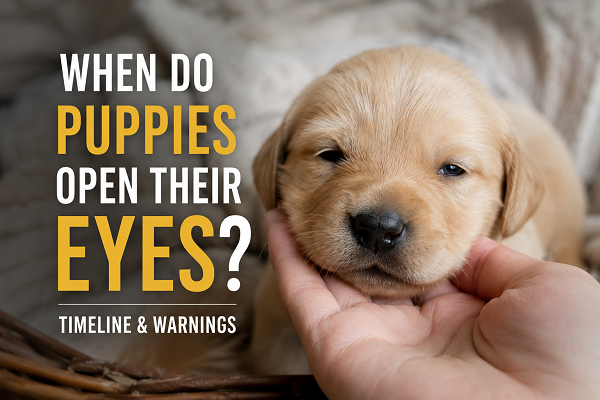
Most puppies open their eyes somewhere between 10 and 14 days old, though it’s completely normal to see it happen anywhere from day 7 to day 21. Their eyelids stay sealed shut at birth because the optic nerve and retina are still forming, and even after the eyes open, real vision doesn’t kick in for another few weeks. If a puppy’s eyes are still closed past day 16-17, or if you notice swelling, bulging, or discharge under the lid, it’s time to call a vet, that’s not “just taking a little longer,” that’s usually an infection.
Table of Contents
- Introduction
- The Short Answer: When Do Puppies’ Eyes Open?
- Why Are Puppies Born With Their Eyes Closed?
- The Newborn (Neonatal) Stage: Birth to 2 Weeks
- The Eye-Opening Timeline, Day by Day
- Do Different Breeds Open Their Eyes at Different Times?
- What Can a Puppy Actually See Once Its Eyes Open?
- Warning Signs: When Delayed Eye-Opening Is a Vet Emergency
- How to Care for a Puppy’s Eyes During This Stage
- From First Blink to Full Vision: Weeks 3-8
- A K9 Trainer’s Perspective: Why This Window Shapes the Dog Your Puppy Becomes
- FAQs
- Conclusion & Actionable Advice
Introduction
If you’ve ever raised a litter, or even just adopted a puppy young enough to remember those first blind, wobbly days, you know how nerve-wracking this window can be. So let’s walk through exactly what’s happening inside that tiny skull, when you should expect those eyes to pop open, and just as important what’s not normal.
By the end of this article, you’ll know the exact day-by-day timeline for puppy eye development, why nature keeps those eyes sealed at birth, which breeds tend to open theirs earlier or later, what a newborn puppy can actually see once the lids do open, and the specific red flags that mean “call the vet now” instead of “just wait.” I’ll also share what over a decade of raising and evaluating working-line puppies has taught me about why this early window matters far more than most new owners realize, even for family pets who’ll never see a training field.
The Short Answer: When Do Puppies’ Eyes Open?
Here’s the number you came here for: 10 to 14 days. That’s the window most veterinarians and breed clubs cite, and it lines up with what I’ve personally watched happen across dozens of litters, from working-line German Shepherds to family Labradors.
But “usually” isn’t “always.” Some puppies crack an eye open as early as day 5. Others, perfectly healthy ones, don’t fully open both eyes until day 19 or 20. And here’s a detail a lot of articles skip: it’s completely normal for one eye to open days before the other. Don’t panic if your puppy is walking around looking like a tiny pirate for a couple of days. Litters aren’t synchronized clocks, and neither are individual puppies.
What matters isn’t hitting some exact calendar date. It’s the trend. Eyes should be visibly working toward opening by around day 10, and fully open (even if squinty) by day 16 or so. Past that, you’re in “check with the vet” territory, which we’ll get into below.
Why Are Puppies Born With Their Eyes Closed?
Ever wonder why nature didn’t just finish the job before birth? It’s not laziness on evolution’s part, it’s protection.
A newborn puppy’s optic nerve, retina, and the light-sensitive rod and cone cells inside the eye are still under construction at birth. If the eyelids opened too soon, the puppy would be exposing an unfinished, hypersensitive structure to light, dust, and bacteria before it’s ready to handle any of it. The sealed lid acts like a bandage over a wound that’s still healing, except here, the “wound” is an organ that hasn’t finished building itself.
This is actually part of a broader pattern in canine development called altriciality, puppies (like kittens, and unlike, say, foals or calves) are born in a very immature state and do most of their physical development after birth rather than in the womb. That’s why a newborn puppy can’t see, can’t hear, can barely regulate its own body temperature, and can only really do three things well: nurse, sleep, and squirm toward warmth.
The Newborn (Neonatal) Stage: Birth to 2 Weeks
Before we get into the eye-opening timeline itself, it helps to understand the stage it sits inside. Canine behaviorists generally break early puppy development into five recognized stages, and eye-opening happens right at the boundary of the first two:
- Neonatal period (birth–2 weeks): Blind, deaf, and almost entirely dependent on the mother. Relies on smell and touch alone.
- Transitional period (roughly 2–3 weeks): Eyes and ears open, first wobbly steps, baby teeth start coming in.
- Socialization period (3–12 weeks): The critical window for learning what’s “safe” in the world, people, other animals, sounds, surfaces.
- Juvenile/adolescent period (3–6 months onward): Continued physical and behavioral development.
- Adulthood.
During the neonatal weeks, a healthy puppy should be gaining weight steadily (roughly doubling its birth weight by day 7-10), nursing every couple of hours, and spending almost all its time in a warm “puppy pile” with its littermates. If a puppy in this stage seems weak, isn’t gaining weight, or is crying persistently, that’s a bigger concern than the eyes, but it’s also often connected, since a puppy that’s struggling overall tends to hit every milestone late, eyes included.
The Eye-Opening Timeline, Day by Day
Let’s get specific, because vague ranges don’t help you much when you’re staring at a squirming, blind puppy at 6 a.m. wondering if today’s the day.
Days 0-6: Eyes Sealed Shut
The eyelids are fused. You genuinely cannot force them open (and you should never try, more on that below). The puppy is navigating entirely by scent and the warmth of its mother and littermates.
Days 7-10: The Countdown Begins
This is when I start checking litters closely twice a day. You may notice a thin sliver of movement under the lid, or a tiny crack of moisture. Nothing to see yet, usually, but the machinery is starting up.
Days 10-14: The Typical Opening Window
Most puppies will have at least one eye partially or fully open somewhere in this window. Expect a milky, bluish-grey haze over the eye rather than the puppy’s adult eye color, that’s completely normal and temporary. The eye will look unfocused because, frankly, it is. Don’t expect eye contact yet.
Days 14-21: Late Bloomers (Still Normal)
A meaningful minority of healthy puppies, in my experience, maybe 1 in 5, don’t finish opening both eyes until closer to day 18-20. As long as there’s no swelling, bulging, or discharge, this is typically just individual variation, not a problem.
Day 21 and Beyond: Time to Call the Vet
If both eyes are still fully sealed past three weeks with no sign of opening, or if one eye is still closed while the puppy is otherwise three weeks old and active, get a veterinarian to look. This is uncommon but does happen, and it’s rarely something you can fix by waiting it out.
Do Different Breeds Open Their Eyes at Different Times?
There’s less hard data on this than you’d expect, most veterinary sources give one blanket range for all dogs. But anecdotally, after handling litters across multiple working breeds, I’ve noticed brachycephalic (flat-faced) breeds like Bulldogs and Pugs, along with some giant breeds, trending very slightly later, closer to day 12-16, compared to the leaner-skulled sporting and herding breeds, which often open closer to day 9-12.
If you’re raising or researching a working breed specifically, German Shepherds, Belgian Malinois, Dutch Shepherds, and similar dual-purpose lines, eye-opening is really just the first of many developmental checkpoints breeders track from day one. We go into how those checkpoints connect to later training readiness in our breakdown of working line vs. show line German Shepherd development, which covers what happens from birth all the way through formal obedience work.
The honest answer, though: litter size, individual genetics, and even how much handling the mother tolerates seem to matter more than breed alone. Don’t lose sleep over a day or two of variation.
What Can a Puppy Actually See Once Its Eyes Open?
Here’s something that surprises a lot of first-time puppy owners: eyes opening does not mean vision arrives. It’s the start of a slow process, not a light switch.
- Days 10-14 (eyes just opened): Essentially light and vague shapes only. The puppy can’t focus and may squint or blink a lot.
- Weeks 3-4: Vision sharpens gradually. The puppy starts recognizing movement and outlines, enough to find its mother and littermates by sight, not just smell.
- Weeks 5-8: Depth perception and detail improve significantly. This is roughly when puppies start reliably using sight to navigate, chase littermates, and react to visual cues from people.
- Around 8 weeks: A puppy’s true adult eye color usually starts to show through, that newborn blue-grey haze fades. (Fun fact: this is also roughly when most reputable breeders release puppies to new homes, and it’s not a coincidence, by then, sight, hearing, and basic mobility are all functional.)
So if a two-week-old puppy doesn’t seem to react much to your face hovering over the whelping box, that’s not a rejection, it genuinely can’t see you clearly yet.
Warning Signs: When Delayed Eye-Opening Is a Vet Emergency
This is the section I’d bookmark if I were you. Most of the time, eye development is uneventful. But there are specific red flags that mean “don’t wait and see”, because a delayed but otherwise normal eye and an infected one can look nearly identical from a distance.
Watch for:
- Swelling or bulging under a still-closed eyelid, this is often a sign of a condition sometimes called neonatal conjunctivitis (or “ophthalmia neonatorum”), where infection builds up behind the sealed lid because it can’t drain.
- Discharge, pus, or a wet/crusty area at the corner of a closed eye
- A foul smell coming from the eye area
- One eye open, one eye still sealed and swollen past day 16-17
- Redness or visible irritation once the eye does open
- Cloudiness that doesn’t fade after a few weeks (some initial haze is normal; persistent cloudiness at 4-5 weeks is not)
- A puppy pawing repeatedly at its face or seeming distressed around the eye
If you see swelling before the eye has opened, resist the urge to try to pry the lid apart yourself, you risk damaging a cornea that isn’t ready for exposure. A vet can safely and gently open a swollen lid, flush the area, and start treatment (usually antibiotic drops) before it causes lasting damage. Left untreated, this kind of infection can genuinely threaten the puppy’s eyesight. This is one of the few “wait and see” situations in puppy raising where waiting is the wrong call.
How to Care for a Puppy’s Eyes During This Stage
Good news, for the vast majority of puppies, “care” mostly means “don’t interfere.”
Do:
- Keep the whelping area clean, dry, and free of dust or debris that could irritate developing eyes.
- Keep lighting soft and indirect for the first couple of weeks. Newly opened eyes are genuinely light-sensitive; a dim, calm room is kinder than bright overhead lighting.
- Handle gently and briefly once eyes are open, this is a great early socialization opportunity, but keep sessions short.
- Check eyes visually once or twice a day during the 7-21 day window so you catch any swelling early.
Don’t:
- Never try to physically pry open a sealed eyelid. If it’s not ready, forcing it can cause real damage.
- Don’t use human eye drops, saline, or any product on a puppy’s eyes without veterinary guidance.
- Don’t panic over minor color-matched, non-swollen haze, that’s just the eye finishing its development.
- Don’t assume “she’ll grow out of it” applies to swelling or discharge. It doesn’t.
From First Blink to Full Vision: Weeks 3-8
Once the eyes are open and hearing kicks in (usually a few days to a week behind vision, around day 14-21), puppies enter what’s genuinely the most important stretch of their entire behavioral development: the socialization window, roughly weeks 3 through 12-16.
This is the period where a puppy’s brain is unusually receptive to new experiences, sounds, surfaces, people, other animals and where those experiences get “filed” as either normal-and-safe or scary-and-avoid. It’s also, not coincidentally, when breeders and trainers who know what they’re doing start layering in gentle, age-appropriate stimulation. If you want a deeper walk-through of how to actually use this stage, what to do week by week, not just what to avoid, it’s worth reading through a proper puppy bonding and stage-by-stage development guide rather than winging it.
I’ll be honest: this is the part of raising a puppy that most new owners underinvest in, because the puppy still looks “too little to do anything.” But a puppy that can now see and hear is already learning, whether you’re intentionally teaching it or not.
A K9 Trainer’s Perspective: Why This Window Shapes the Dog Your Puppy Becomes
I’ve spent over a decade around military and security working dogs, evaluating litters, running foundational training, and watching which puppies grow into confident, stable adults versus which ones struggle. And here’s the thing most pet owners never get told: breeders producing serious working dogs treat the neonatal-through-transitional window as the start of training, not the warm-up before it.
Programs built on early neurological stimulation, brief, mild handling exercises done in the days right around eye-opening, are used specifically because puppies exposed to gentle, controlled stress in this window tend to show better stress tolerance, faster learning, and more confident temperaments as adults. You don’t need to run a formal protocol to benefit from the principle: calm, brief, positive handling right as your puppy’s senses are switching on sets a tone that carries forward.
This matters even if your puppy is destined for a couch, not a K9 unit. If you’re bringing home a breed with real working drive, a Malinois, GSD, Dutch Shepherd, or similar, it’s worth understanding what structured early development actually looks like before you’re three months in and wondering why your puppy is more intense than the golden retriever next door. Our guide to training a Belgian Malinois puppy the right way picks up right where this newborn stage leaves off, and if you’re building out a more structured program from the ground up, whether for a family dog or a future working prospect, I put everything I’ve learned across 14+ years of hands-on handling into a step-by-step guide that walks you through it: check out the full training breakdown here.
For readers specifically raising or considering a working-line prospect, our piece on what actually goes into a military K9 training program shows just how far back professional programs trace developmental readiness, often to these exact first few weeks of life.
FAQs
1. Is it normal for one of my puppy’s eyes to open before the other?
Yes, completely normal. Puppies don’t develop symmetrically, and it’s common for one eye to open a day or two, occasionally longer, ahead of the other. As long as neither eye shows swelling or discharge, there’s no cause for concern.
2. Why does my puppy’s eye look blue or hazy right after it opens?
That bluish-grey haze is standard for newly opened puppy eyes. It’s related to the eye still finishing its development and typically clears up over the following weeks as the eye matures and true adult eye color emerges, usually by around 8 weeks.
3. Can I gently help open my puppy’s eyes if they’re taking a while?
No, never try to physically pry a sealed eyelid open. If the eye isn’t ready, the tissue underneath can be damaged. If eyes are still closed well past day 16-17, or if you see any swelling, contact a veterinarian rather than intervening yourself.
4. When can puppies actually start seeing clearly?
Vision develops gradually after the eyes open. Puppies have only blurry light-and-shape perception for the first couple of weeks post-opening, with meaningfully sharper vision by weeks 5-8 and continued fine-tuning of depth perception into early adolescence.
5. What’s the difference between normal eye-opening and an eye infection in newborn puppies?
Normal development involves a gradual opening with no swelling, discharge, or odor. An infection (often called neonatal conjunctivitis) typically shows up as visible swelling or bulging under a still-closed lid, sometimes with pus or a foul smell. This needs prompt veterinary attention, it won’t resolve on its own and can affect the puppy’s eyesight if left untreated.
Conclusion: What to Actually Do With This Information
If you take one thing away from this guide, let it be this: 10 to 14 days is the benchmark, not the deadline. A few days early or late is normal biology, not a red flag. What actually matters is watching for the specific warning signs, swelling, discharge, odor, or a total lack of movement past three weeks and getting a vet involved quickly if you see them.
Beyond the eyes themselves, this early window is worth paying attention to for a bigger reason: it’s the start of everything else. The puppy that’s calmly, gently handled through this transitional stage tends to become the dog that handles new experiences with more confidence later, whether that “later” means a busy household, a dog park, or a training field. You don’t have to run a professional program to benefit from that principle. Just be present, be gentle, and be observant during those first few critical weeks.
Insights from the ARFS K9 Team: written with input from Rofiat Muritala, a veteran military K9 handler and certified dog trainer with over 14 years of hands-on experience raising, evaluating, and training working dogs from birth through operational readiness. This article reflects direct, field-based observation of litter development alongside established veterinary guidance, not secondhand theory.

Her work centres on obedience, detection, protection and operational readiness. She favours proven methods built on repetition, consistency and real-world conditioning, so that both dogs and handlers are prepared for high-pressure tasks.
Rofiat represented the Nigerian Army Dog Centre at the Nigerian Army Day Celebration (NADCEL) 2026, where she led demonstrations in obedience, explosive detection, agility and tactical movement. Through articles, training content and documentaries, she shares field-based insight into how structured training, clear communication and trust between handler and dog affect performance and reliability.
She is the author of Beyond the Bark: Inside a Pro Handler's Playbook for Raising the Ideal Dog, a practical guide that helps dog owners and handlers apply professional training principles in everyday situations.
- Is K9 Advantix Safe for Dogs? A Handler’s Honest Review - October 2, 2026
- Australian Cattle Dog vs Blue Heeler: Any Difference? - October 1, 2026
- Bousnic Dog Training Collar Review: Is It Safe? - September 30, 2026