Dog Pulling on Walks? Here’s the Real Fix
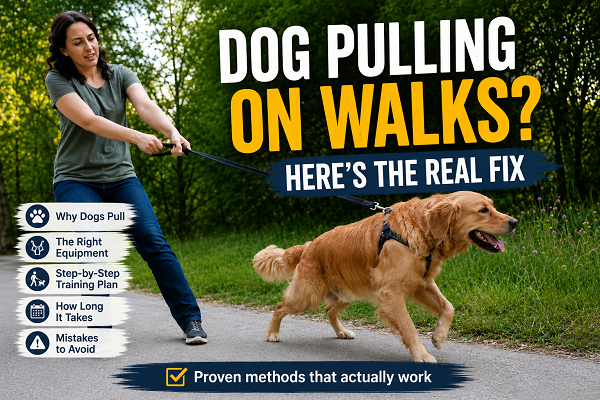
Dog pulling on walks happens because pulling gets rewarded, it gets your dog to the smell, the squirrel, or the other dog faster. To fix it, stop moving the instant the leash goes tight (“be a tree”), reward loose-leash walking with treats or praise, and switch to a front-clip harness while you train. Most dogs show real improvement in 2 to 6 weeks with 10-15 minutes of daily practice, according to certified trainers and multiple published leash-training studies.
Table of Contents
- Why Do Dogs Pull on the Leash? The Real Reason
- How Common Is This Problem? (It’s Not Just You)
- The Right Equipment for the Job
- The Step-by-Step Fix: How to Stop Leash Pulling
- How Long Does It Actually Take?
- 5 Mistakes That Keep Dogs Pulling
- Breed and Age Differences You Should Know
- When to Call in a Professional Trainer
- Trainer’s Take
- FAQs
- Conclusion
Introduction
If you’ve ever come home from a walk with a sore shoulder and a dog that’s somehow more wound up than when you left, you’re not alone and you’re definitely not doing anything wrong. This is, hands down, one of the most common complaints I hear from dog owners, whether they’ve got a 9-week-old puppy or a 90-pound adult dog who’s been dragging them down the sidewalk for years.
This guide breaks down exactly why dogs pull on the leash, what the research actually says about collars vs. harnesses, and a step-by-step training plan you can start using today, the same core methods used by professional K9 trainers and reward-based behaviorists. You’ll also get a realistic timeline, common mistakes that stall progress, and answers to the questions owners ask most.
Why Do Dogs Pull on the Leash? The Real Reason
Here’s the thing most owners get wrong: your dog isn’t pulling because he’s “dominant,” stubborn, or trying to be the pack leader. He’s pulling because it works. Dogs are, at their core, incredibly efficient learners, if leaning into the leash gets him to the fire hydrant two seconds faster, he’s going to keep doing it. Every single time you let the leash stay tight and keep walking forward, you’re accidentally rewarding the pull.
Researchers who study lead-pulling behavior found that owners themselves most often blame it on excess energy and excitement in their dogs and honestly, that lines up with what I see out in the field every week. A dog that hasn’t had a chance to burn off energy is going to treat the entire walk like Christmas morning. Add in the sensory overload of smells, other dogs, cars, and squirrels, and you’ve got a nervous system that’s completely maxed out and a leash that’s the only thing standing between “excited” and “gone.”
There are a few other drivers worth knowing:
- Opposition reflex — dogs instinctively push back against pressure on their neck or chest, which is why yanking back on the leash often makes pulling worse, not better.
- Under-exercised dogs — a dog that hasn’t had adequate physical or mental stimulation before the walk arrives at the door already over-threshold.
- Lack of leash training reps — many dogs simply haven’t been taught what a loose leash feels like, especially if they were adopted as adults or never went through structured puppy classes.
- Breed drive — working and sporting breeds (think Belgian Malinois, Siberian Huskies, Beagles) are bred to move forward with purpose, which makes loose-leash walking a harder skill for them to acquire without consistent reps.
How Common Is This Problem? (It’s Not Just You)
If it feels like literally everyone’s dog is dragging them around the block, that’s because they basically are. A survey of UK and Irish dog owners found that “82.7% of dogs pulled on the lead during walks”. A separate, earlier study found that “69% of UK dog owners considered leash pulling to be a genuine problem”, not just a minor annoyance, but something that affected their ability to enjoy walking their dog at all.
One veteran dog trainer and writer put it bluntly after spending an afternoon watching dogs at a busy off-leash park entrance: roughly “85% of the dogs she observed were either pulling steadily or dragging their owner in short bursts”. Only a small handful walked calmly on a loose leash and most of those were older dogs who simply couldn’t move any faster.
This isn’t just an annoyance, either. It’s a real physical risk. A U.S. study of emergency department visits found that dog leashes were linked to an estimated “356,746 injuries over an 18-year period, with over half of those caused directly by a dog pulling”. Separate biomechanical research measured that “half of dog walkers experienced leash tension of 125 Newtons or more during normal walks, that’s roughly 28 pounds of force yanking on your shoulder, wrist, or lower back”. Falls, shoulder injuries, and even fractures from leash pulling are common enough that orthopedic clinics see them regularly, especially among older adults.
So if you’ve been feeling like a failure every time your dog hauls you past the mailbox, take a breath. This is a training gap, not a character flaw, yours or your dog’s.
The Right Equipment for the Job
Before you touch a single training technique, get the equipment right. The wrong gear can undo weeks of good training, and the right gear gives you an immediate mechanical advantage while you build the habit.
Front-Clip Harness
This is my go-to recommendation for the vast majority of pulling dogs. When the leash clips at the chest instead of the back, a pulling dog gets gently redirected sideways instead of gaining forward momentum, it interrupts the behavior mechanically, not painfully. Research comparing a chest harness to a standard flat collar found that the collar produced significantly less pulling force overall, but the harness caused noticeably less strain on the dog’s neck, which matters a lot for brachycephalic breeds (Pugs, French Bulldogs) and small dogs prone to tracheal collapse.
Head Halters (like a Gentle Leader)
These give you a huge amount of steering control since where the head goes, the body follows. They take a few days for most dogs to get used to, expect some pawing at the nose at first but they’re excellent for very strong dogs or reactive dogs that lunge.
Flat Collar
Fine for dogs who already walk reasonably well, but a poor choice for a determined puller, since all that pressure lands directly on the trachea.
What to Skip (Or Use With Real Caution)
Prong collars and choke chains can suppress pulling through discomfort, but a 2024 peer-reviewed comparison of leash equipment found no clear welfare advantage over a front-connection harness, and aversive tools carry real risk of fallout, increased anxiety, redirected aggression, or a dog that shuts down rather than actually learning. If you’re already using one and it’s not working, that’s usually a sign to switch strategy rather than tighten the correction. Retractable leashes are also worth avoiding entirely during training, they teach dogs that pulling extends their range, which is the exact opposite of what you want.
Curious about the full range of options and which fits your dog’s size and strength? I break down every collar type, including when a martingale makes sense, in Dog Training Collar Types: How to Choose the Right One.
The Step-by-Step Fix: How to Stop Leash Pulling
This is the exact framework I use with clients, built on positive reinforcement, the same approach most modern trainers and behaviorists recommend because it builds a dog that wants to stay close, not one that’s just afraid to pull.
Step 1: Burn Off the Edge First
Don’t start training on a dog that’s been cooped up all day. A short game of fetch in the yard or five minutes of a flirt pole session takes the “zoomies” out of the equation so your dog can actually focus. If your dog’s baseline energy needs are higher than you’re currently meeting, this guide on how often you should exercise a working or high-drive dog is worth a read, under-exercised dogs are some of the hardest to leash train, simply because they’ve got nowhere to put all that energy except into the leash.
Step 2: Load Up on High-Value Treats
Use something your dog genuinely loves, small pieces of chicken, cheese, or freeze-dried liver work well. Kibble usually isn’t exciting enough to compete with a squirrel.
Step 3: Teach “Be a Tree”
The moment the leash goes tight, stop walking completely. Don’t pull back, don’t say anything, just stand still like a tree. Wait for your dog to turn back toward you or create slack in the leash on their own. The second that happens, mark it (“Yes!”) and reward, then take a step. If the leash tightens again, repeat. This teaches your dog, through hundreds of small repetitions, that a tight leash makes the world stop and a loose leash makes it move, which is exactly the lesson you want to land.
Step 4: Add the 180-Turn (Penalty Yards)
For dogs who plant their feet and refuse to budge during “be a tree,” add a turn. Calmly pivot and walk the opposite direction, encouraging your dog to catch up. This removes the reward of forward progress altogether and teaches your dog to actually track your movement instead of charging ahead on autopilot.
Step 5: Reward Position, Not Just Compliance
Every few steps, drop a treat right at your side (by your leg, not up high) while your dog is in a loose-leash position. This teaches your dog that being near you is where good things happen, not just that pulling gets punished.
Step 6: Practice the “Watch Me” Cue
Teaching eye contact on cue gives you a tool to reset your dog’s focus before a distraction (another dog, a jogger) becomes a full pull. This pairs really well with basic obedience foundations, if your dog hasn’t got a solid sit, stay, or focus command yet, these 5 dog obedience commands that actually work will speed up your leash training considerably, since a dog who already checks in with you is halfway to loose-leash walking already.
Step 7: Practice Short, Then Stack Distance
Start in your driveway or hallway, somewhere boring, with zero distractions. Once your dog nails 10 straight loose-leash steps indoors, move to the yard, then a quiet street, then a busier one. Skipping this progression is the single biggest reason training stalls; you’re essentially asking your dog to do calculus before they’ve learned to count.
How Long Does It Actually Take?
Realistically? Most trainers, including myself, tell owners to expect “4 to 6 weeks of consistent daily practice, in short 10-15 minute sessions, before loose-leash walking becomes a reliable habit rather than a fluke”. Puppies and dogs with less pulling history can show noticeable change within 2 weeks. Adult dogs who’ve been practicing pulling for years, sometimes literally thousands of repetitions of “pulling gets me where I want to go”, take longer, and that’s completely normal. I’ve worked with rescue dogs who took a full three months to walk consistently loose on a busy city block, and that’s not a failure on the owner’s part; it’s just how many reps some dogs need to unlearn a well-rehearsed habit.
One thing that genuinely speeds things up: consistency between everyone who walks the dog. If one family member lets the dog pull to the next tree “just this once,” you’ve reset the clock, because dogs are essentially gamblers, if pulling paid off even once out of 20 tries, they’ll keep testing it.
5 Mistakes That Keep Dogs Pulling
- Letting the dog sniff while pulling. If your dog pulls toward a smell and gets there anyway, you just paid them for pulling.
- Only training on “good” walks. Training only happens on the actual walk. You need dedicated, short practice sessions with no real destination, purely focused on the skill.
- Inconsistent corrections. Stopping five times, then letting the sixth pull slide because you’re in a hurry, teaches your dog that persistence works.
- Using a retractable leash during training. These physically reward forward movement by extending the dog’s range the moment they pull.
- Skipping the “boring” environment phase. Trying to fix pulling for the first time in a park full of squirrels sets your dog up to fail. Master it in low-distraction settings first.
Breed and Age Differences You Should Know
Not every dog starts from the same place, and it helps to set realistic expectations based on your dog’s build and history.
- High-drive working and sporting breeds (German Shepherds, Belgian Malinois, Labradors, Huskies) are bred to move forward with purpose and often need more structured mental engagement, not just physical tiring, before they can settle into a loose-leash pace. Enrichment activities like beginner agility work can help channel that drive productively between walks, giving your dog a legitimate outlet so the leash doesn’t become the only place their energy goes.
- Brachycephalic breeds (Pugs, Bulldogs, Boston Terriers) should avoid neck pressure altogether, a harness is non-negotiable here, since even moderate collar pressure can restrict their already-narrow airway.
- Senior dogs who suddenly start pulling more, or pulling less predictably, are worth a vet check, sudden changes in leash behavior can signal joint pain, vision loss, or hearing decline rather than a training regression.
- Puppies under 6 months shouldn’t be expected to walk perfectly. Focus on short, positive sessions and let leash manners develop gradually alongside their attention span.
When to Call in a Professional Trainer
Most pulling issues respond well to consistent home training. But it’s worth bringing in a certified trainer if:
- Your dog lunges aggressively at people, dogs, or cars (not just excited pulling, but reactive behavior)
- You’ve been consistent for 6+ weeks with zero improvement
- The pulling is strong enough that you’ve been pulled off your feet or injured
- Your dog shows signs of fear or anxiety on walks, not just excitement
A good trainer can also help you troubleshoot equipment fit and body mechanics that are hard to self-diagnose. If you’re weighing your options locally, this guide on choosing the right dog trainer walks through the questions to ask before you commit, the core vetting criteria (credentials, methods used, trial sessions) apply no matter where in the world you’re searching.
Trainer’s Take
I’ve spent years working hands-on with working and protection dogs, animals bred specifically for drive, focus under distraction, and controlled forward movement, which, believe it or not, makes them some of the hardest dogs to leash train and some of the best teachers of what actually works. A high-drive K9 that’s learned loose-leash manners has usually gone through the exact framework above, just with more reps and higher-value rewards. If it works on a dog bred to pull toward a target, it’ll work on your Labrador who just really, really wants to say hi to the mail carrier.
The biggest shift I’ve seen in owners who succeed versus those who give up isn’t talent, it’s patience with the “boring” phase. The dogs that learn fastest are the ones whose owners committed to short, dedicated sessions rather than trying to fix years of pulling during a single rushed evening walk.
FAQs
1. Why does my dog pull more on some walks than others?
Arousal level changes day to day based on energy, new smells, weather, and what’s happening in the environment. A walk right after a long nap, past an unfamiliar dog, will almost always involve more pulling than a walk after a play session in a quiet neighborhood.
2. Will a harness make my dog pull more?
Some studies show slightly higher pulling force with a standard back-clip harness compared to a flat collar, because it removes neck discomfort. That’s exactly why a front-clip harness is recommended instead, it keeps the comfort benefit while adding steering control that redirects pulling sideways.
3. Is it ever too late to fix leash pulling in an older dog?
No. Dogs of any age can learn loose-leash walking; it just takes longer to override a well-established habit. Senior and adult rescue dogs typically need 6 to 12 weeks of consistent practice rather than the 2 to 6 weeks a puppy might need.
4. Should I use treats forever, or will my dog always need them?
No, treats are a teaching tool, not a permanent requirement. As loose-leash walking becomes a reliable habit, you gradually fade the frequency of treats and rely more on praise, though most trainers recommend keeping a few in your pocket for high-distraction environments indefinitely.
5. What’s the fastest way to stop a dog from pulling toward other dogs specifically?
This is usually reactivity or over-excitement rather than plain pulling, and it benefits from the “watch me” focus cue practiced at a distance where your dog can still see the other dog without reacting, then gradually decreasing that distance over multiple sessions. If lunging or barking is involved, this crosses into reactivity training and is worth working with a professional trainer.
Conclusion
Leash pulling isn’t a sign of a “bad dog”, it’s an unlearned skill, and it’s one of the most fixable behavior problems out there. Get the right equipment (a front-clip harness is the safest starting point for most dogs), commit to short daily practice using the “be a tree” and 180-turn methods, and stay consistent across everyone who walks your dog. Give it 4 to 6 weeks of real effort, and you’ll likely notice the difference well before then.
If you want a deeper, structured system for building obedience and calm walking manners from the ground up, the same kind of foundational work used in professional K9 handling, my e-book Beyond the Bark walks through it step by step and makes a solid next read once you’ve got the basics from this guide down.
Sources: 1) Frontiers in Veterinary Science, UK/Irish owner survey; 2) Blackwell et al., 2008, UK dog owner survey; 3) Whole Dog Journal field observation; 4) ScienceDirect, dog leash-related ED injuries 2001–2018; 5) Annals of Biomedical Engineering, leash tension study; 6) Frontiers in Veterinary Science, collar vs. harness restraint study; 7) PeerJ, leash equipment welfare comparison, 2024; 8) Aggregated trainer guidance on loose-leash training timelines.

Her work centres on obedience, detection, protection and operational readiness. She favours proven methods built on repetition, consistency and real-world conditioning, so that both dogs and handlers are prepared for high-pressure tasks.
Rofiat represented the Nigerian Army Dog Centre at the Nigerian Army Day Celebration (NADCEL) 2026, where she led demonstrations in obedience, explosive detection, agility and tactical movement. Through articles, training content and documentaries, she shares field-based insight into how structured training, clear communication and trust between handler and dog affect performance and reliability.
She is the author of Beyond the Bark: Inside a Pro Handler's Playbook for Raising the Ideal Dog, a practical guide that helps dog owners and handlers apply professional training principles in everyday situations.
- Dog Hotel Prep: 7 Must-Haves Before Boarding - October 21, 2026
- How to Enter the COBA National Dog Championship - October 20, 2026
- K9 Advantix Dosage Chart & Safety Guide for Dogs - October 19, 2026