Dog Therapist in the US: The Real 2026 Guide
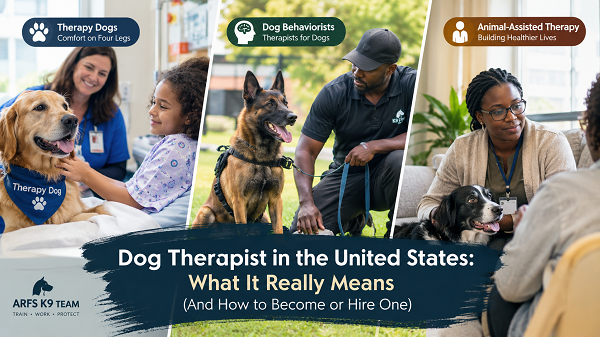
“Dog therapist” isn’t one job, it’s three completely different careers that people mix up constantly. It can mean a therapy dog (a pet trained to comfort people in hospitals and schools), a dog behaviorist (a professional who treats a dog’s anxiety or aggression, basically a “therapist for dogs”), or an animal-assisted therapy specialist (a licensed counselor who uses a dog as a co-therapist in sessions). Each has its own training path, certification body, and cost, which we break down below.
Table of Contents
- Why “Dog Therapist” Confuses Almost Everyone
- Meaning #1: Therapy Dogs, Comfort on Four Legs
- Meaning #2: Dog Behaviorists — “Therapists” For Dogs
- Meaning #3: Animal-Assisted Therapy Specialists
- How Much Does a Dog Therapist Cost?
- Real Numbers: What the Research Actually Shows
- How to Become a Dog Therapist (Any Track)
- How to Choose the Right One for Your Situation
- Trainer’s Notes: What I’ve Learned in the Field
- FAQs
- Final Thoughts
Introduction
Type “dog therapist” into Google and you’ll get three different worlds crashing into each other on the same results page: fluffy Golden Retrievers visiting hospital wards, stern-looking behavior consultants working with a snarling Rottweiler, and licensed psychologists who bring a dog into a counseling room. Nobody stops to explain why the same phrase covers all three.
That mix-up costs people real money and real time. I’ve had clients call my office asking for a “dog therapist” because their dog bit the mail carrier, when what they actually needed was a certified behavior consultant, not a friendly lap dog with a bandana. I’ve also had people assume their anxious dog could just “become a therapy dog” to fix its own anxiety, which is backwards; therapy dogs need to be rock-solid calm before they ever start the job, not the other way around.
So here’s what you’ll get in this guide: a clear breakdown of all three meanings of “dog therapist” in the U.S., what each one actually costs and takes to become, the real statistics behind each field (not recycled blog fluff), and a simple way to figure out which one you actually need. Whether you’re a dog owner looking for help, someone considering this as a career, or a mental health professional exploring animal-assisted work, you’ll walk away knowing exactly where you fit.
Why “Dog Therapist” Confuses Almost Everyone
Ever wonder why a Google search for “dog therapist near me” pulls up hospital volunteer programs, dog trainers, AND psychotherapists? It’s because the term is a linguistic accident. “Dog therapist” is grammatically ambiguous, it can mean a therapist for dogs, or a dog that does therapy, and English doesn’t give us an easy way to tell the two apart just from the phrase itself.
In the industry, we don’t actually use “dog therapist” as a formal title. Nobody hands out a certificate that says “Dog Therapist” on it. Instead, professionals use much more specific terms:
- Therapy dog handler — the human half of a certified therapy dog team
- Certified Dog Behavior Consultant (CDBC) or Applied Animal Behaviorist — the “therapist for dogs” role
- Board-Certified Veterinary Behaviorist (DACVB) — a licensed vet who specializes in behavior medicine
- Animal-Assisted Therapy (AAT) practitioner — a licensed counselor, social worker, or psychologist who incorporates a dog into treatment
Search engines and casual writers collapse all of this into “dog therapist” because it’s what people type. That’s exactly why most articles on page one of Google only cover one slice of the topic, usually just therapy dog certification and leave the other two meanings unexplained. We’re covering all three, properly, in one place.
Meaning #1: Therapy Dogs, Comfort on Four Legs
This is the most common meaning people search for, and it’s the one most articles focus on. A therapy dog is a well-mannered pet dog (not a service dog) that’s trained and registered to visit hospitals, nursing homes, schools, courtrooms, and disaster sites to provide comfort.
Therapy Dog vs. Service Dog vs. Emotional Support Animal
This trips up almost every new owner, so let’s settle it here:
| Type | Legal Access Rights | Training Required | Works For |
|---|---|---|---|
| Service Dog | Full public access under the ADA | Extensive task-specific training | One specific disabled handler |
| Therapy Dog | Only where invited (hospitals, schools), no public access rights | Certification + evaluation | Groups of strangers, alongside a handler |
| Emotional Support Animal (ESA) | No public access rights; housing protections only | None required, no certification | One individual’s emotional wellbeing |
A therapy dog doesn’t get to fly free in the cabin or walk into a restaurant, it only goes where a facility has specifically invited the team in. That’s a detail a lot of pages skip, and it matters if you’re picturing your dog accompanying you everywhere.
How Many Therapy Dogs Are There in the U.S.?
There are more than 50,000 certified therapy dog teams currently active across the country, working through organizations recognized by national bodies like the American Kennel Club. Pet Partners alone registers teams involving nine different species, though dogs make up the overwhelming majority.
Step-by-Step: Getting Your Dog Certified
- Basic obedience first. Your dog should already be comfortable with strangers, loud noises, wheelchairs, and unpredictable movements before you even think about testing.
- Pass the AKC Canine Good Citizen (CGC) test. Many therapy organizations require or strongly recommend this as a baseline.
- Take a therapy dog prep course. These typically run 6–8 weeks and cost $100–$300.
- Register with a recognized organization. The big three in the U.S. are:
- Pet Partners — the most widely accepted by hospitals and schools; online handler course (~$75) plus an in-person evaluation; registration includes $2 million in liability insurance.
- Alliance of Therapy Dogs — the fastest entry point: complete three supervised visits with a current member, then pass an evaluation.
- Therapy Dogs International (TDI) — long-established, widely recognized in hospital and school systems.
- Pass the team evaluation. The evaluator tests your dog’s reaction to medical equipment, wheelchairs, sudden noises, and strangers touching it unexpectedly.
- Start logging visits. Facilities usually want proof of insurance and current registration before you walk through the door.
Total cost: roughly $200–$600. Timeline: 3–6 months from a standing start to your first supervised visit.
A Real Example
I’ve watched a rescued Beagle mix, a dog nobody wanted because he was “too mellow” for a working home, become one of the most requested therapy dogs at a regional children’s hospital. Low energy, which is a liability in a protection or sport dog, turned out to be exactly what made him perfect for sitting quietly next to a scared eight-year-old before surgery. Temperament, not breed or pedigree, is what actually decides whether a dog succeeds in this role.
Where Therapy Dogs Work
- Hospitals and hospice care units
- Elementary schools (reading programs, testing weeks)
- Courtrooms (helping child witnesses testify)
- College campuses during exam season
- Airports (a growing trend at major U.S. hubs)
- Disaster response sites, alongside organizations like the American Red Cross
Meaning #2: Dog Behaviorists — “Therapists” For Dogs
This is the meaning people usually intend when they say something like “my dog needs a therapist” after a bite incident, severe separation anxiety, or a fear response that basic training hasn’t fixed. This is genuinely a “therapist for your dog,” and it’s a distinct profession from dog training.
Trainer vs. Behaviorist: The Difference That Actually Matters
A dog trainer teaches skills, sit, stay, loose-leash walking. A behaviorist digs into why a dog is reacting the way it is and builds a treatment plan around the root emotional cause. If your dog fails to respond to normal positive-reinforcement training, or the problem involves aggression, severe phobia, or compulsive behavior, that’s usually the signal to move up to a behaviorist. If you’re still not sure your current trainer is the right fit, our guide to finding a qualified dog trainer in the US breaks down which credentials actually matter.
The Credential Ladder (From Most to Least Specialized)
- Board-Certified Veterinary Behaviorist (DACVB) — a licensed veterinarian with a full behavior residency who can prescribe psychiatric medication. There are only about 90 to 100 of these in the entire world, most based in the U.S. Getting this credential requires supervising hundreds of clinical cases, publishing peer-reviewed research, and passing a two-day board exam. Think of them as the psychiatrist equivalent for dogs.
- Certified Applied Animal Behaviorist (CAAB) — typically holds a master’s or PhD, certified through the Animal Behavior Society. Fewer than 100 exist nationwide. They’re the closest equivalent to a human clinical psychologist, they don’t prescribe drugs but design in-depth behavior modification plans, often alongside a vet.
- Certified Dog Behavior Consultant (CDBC) — certified through the International Association of Animal Behavior Consultants (IAABC). Requires a minimum of 300 hours of hands-on behavior consulting experience plus coursework in learning theory and desensitization protocols.
- Certified Professional Dog Trainer (CPDT-KA) — a strong general trainer credential, but not the same depth as the above for serious behavior cases.
What a Behaviorist Actually Treats
- Fear-based and owner-directed aggression
- Resource guarding and food aggression
- Separation anxiety and noise phobias (storms, fireworks)
- Compulsive behaviors (tail-chasing, excessive licking)
- Reactivity toward other dogs or strangers
What It Costs
- Initial consultation: $60–$150 (45–90 minutes)
- Aggression-specific consult: $100–$200 per hour, since these sessions take longer and require more careful handling
- Package deals (4–10 sessions): $300–$900
- A DACVB consultation (often done via referral from your vet) can run higher, but many will consult with your regular veterinarian by phone, which keeps costs down
Behavioral problems are also the number one reason dogs are surrendered to shelters in the U.S., a statistic the veterinary behavior field has been citing for over two decades. That’s the real-world stake behind getting the right kind of help early, instead of assuming a dog will “grow out of it.”
A lot of what looks like “aggression” to an owner is actually a dominance-vs-discipline mixup, or a dog whose drive was never given a proper outlet. Our piece on dominance vs. discipline in professional K9 training unpacks that distinction in more depth, and our breakdown of obedience vs. instinct and the two types of dog intelligence is worth reading before you assume a behavior problem needs a full clinical workup. If you’re raising or training a personal protection dog from the ground up, our field-tested handler’s manual, BEYOND THE BARK — Inside a Pro Handler’s Playbook for Raising the Ideal Dog, walks through the temperament and drive-management work that prevents most behavior problems before they start.
Meaning #3: Animal-Assisted Therapy Specialists
The least discussed meaning, and honestly the one most people don’t even realize exists: a licensed human therapist, psychologist, counselor, social worker, or occupational therapist, who incorporates a trained dog directly into treatment sessions. This is called Animal-Assisted Therapy (AAT) or Animal-Assisted Intervention (AAI).
Here, the dog isn’t the patient, and the dog isn’t just “visiting”, it’s a working tool inside an actual clinical treatment plan, used to help patients regulate emotions, build trust, or practice social interaction. This is different from a therapy dog visit at a hospital, which is a comfort visit, not clinical treatment.
How This Actually Works in Practice
A licensed therapist might use a trained dog to:
- Help a trauma survivor practice grounding techniques by focusing on the dog’s breathing or heartbeat
- Encourage a child with autism to initiate communication by directing the dog to do a trick
- Give a PTSD patient a lower-stakes way to build trust before opening up verbally
- Support physical rehabilitation by having a patient throw a ball or walk the dog to rebuild motor skills
Certification Path
Unlike therapy dog registration, AAT requires the human to already be a licensed mental health or medical professional. The dog then needs a separate handler-team certification, most commonly through Pet Partners’ Animal-Assisted Therapy track, which adds clinical-context training on top of the standard therapy dog evaluation. Some universities and continuing-education providers, including through the International Society for Animal-Assisted Therapy, offer formal coursework specifically for clinicians who want to add this to their practice.
A Case Worth Knowing
Programs like K9s For Warriors, a nonprofit that pairs veterans with PTSD to service dogs (a related but distinct model from AAT), have documented measurable reductions in PTSD symptom severity among veteran participants in independent research partnerships with universities. It’s one of the more well-documented real-world examples of how structured, clinically-informed dog partnerships can move the needle on serious mental health conditions, not just anecdotally, but in published outcome data.
How Much Does a Dog Therapist Cost? (Full Comparison)
| Type | Typical Cost | Timeline |
|---|---|---|
| Therapy dog certification | $200–$600 total | 3–6 months |
| Basic behavior consultation | $60–$150/session | Ongoing, case-dependent |
| Aggression-specific behaviorist | $100–$200/hour | Often 3–12 sessions |
| Veterinary behaviorist (DACVB) | Varies by clinic, often $300+ initial exam | Can include ongoing medication management |
| Animal-Assisted Therapy (as part of clinical care) | Billed as part of therapy session fee, varies by provider and insurance | Ongoing, integrated into treatment plan |
Real Numbers: What the Research Actually Shows
- Fewer than 100 Certified Applied Animal Behaviorists exist in the entire United States, despite huge nationwide demand for behavior help.
- The American College of Veterinary Behaviorists has grown from just 8 charter members in 1993 to roughly 90–100 diplomates today, showing how new and specialized this field still is.
- Behavioral issues remain the number one reason dogs are surrendered to U.S. shelters, according to multi-year tracking by veterinary behavior organizations.
- Therapy dog teams must typically complete 50 supervised visits to earn even the entry-level AKC Therapy Dog (THD) title, scaling up to 600 visits for the Therapy Dog Supreme title, showing this isn’t a one-and-done certification but an ongoing volunteer commitment.
- Pet Partners’ registration includes $2 million in liability coverage per team, which is a major reason hospitals and schools require registration through a recognized body rather than accepting an untrained “friendly dog.”
How to Become a Dog Therapist (Whichever Track Fits You)
If you want the therapy dog route: Start with obedience training and the CGC test, then register through Pet Partners, Alliance of Therapy Dogs, or TDI. No formal degree required, just a stable, well-socialized dog and your own commitment to regular volunteer visits.
If you want the behaviorist route: Expect a multi-year path. Most CDBCs spend 1–3 years accumulating the required 300 hours of supervised consulting experience before certification. CAABs and DACVBs require graduate-level or veterinary education, this is a genuine academic and clinical career, not a weekend course. Realistic salary range for a working canine behavior consultant in the U.S. sits roughly between $35,000 and $70,000+ depending on caseload, location, and whether you also run a training business alongside consulting. Veterinary behaviorists, as licensed DVMs with specialty certification, earn considerably more, often in line with other veterinary specialists.
If you want the AAT route: You need your primary license first (LCSW, LPC, PsyD, OT, etc.), then add animal-assisted training as a specialty. This is the slowest path since it’s built on top of an existing multi-year clinical education, but it opens the door to combining a genuine passion for dogs with a full mental health career.
How to Choose the Right One for Your Situation
Ask yourself these questions in order:
- Is the problem about my dog’s behavior? → You need a behaviorist, not a therapy dog program.
- Do I want my well-behaved dog to help other people? → Look into therapy dog certification.
- Am I a licensed clinician wanting to add a dog to my practice? → Look into Animal-Assisted Therapy certification specifically, not general therapy dog registration.
- Is my dog aggressive or has it bitten someone? → Skip general trainers and go straight to a CDBC, CAAB, or DACVB, this isn’t a DIY situation, and waiting usually makes the behavior harder to modify.
- Do I just want comfort or emotional support at home? → An ESA doesn’t require certification at all, just documentation from your own mental health provider.
Trainer’s Notes: What I’ve Learned in the Field
Working with protection and security dogs for years teaches you something that translates directly here: temperament assessment always comes before task training, in every single one of these three fields. A therapy dog candidate that startles at a dropped tray, a protection dog that can’t distinguish a real threat from a delivery driver, and a dog being considered for clinical AAT work that gets overstimulated around wheelchairs all fail for the exact same underlying reason, the assessment step got rushed. If you take one thing from two decades of working dogs, let it be this: never skip the temperament evaluation to save time, no matter which of these three paths you or your dog are on.
Frequently Asked Questions
Is a “dog therapist” the same as a dog behaviorist?
Sometimes, but not always. People often use “dog therapist” to mean a behaviorist who treats anxiety or aggression in dogs, but the term is also commonly used for therapy dogs (dogs that comfort people) and for licensed clinicians who use dogs in human therapy sessions. Always clarify which one you mean before booking a service.
How long does it take to become a certified therapy dog?
Most teams complete certification in 3–6 months, assuming the dog already has solid basic obedience. The timeline stretches longer if your dog needs additional socialization work first.
Can any breed become a therapy dog?
Yes. Temperament matters far more than breed. Calm, confident, people-focused dogs of any breed or mix, including rescues, can qualify, as long as they pass the required evaluation.
How much does a dog behaviorist cost in the U.S.?
Expect $60–$150 for a standard consultation and $100–$200 per hour for aggression-specific work, with full treatment plans often running $300–$900 across multiple sessions.
Do I need a license to call myself a dog behaviorist?
No formal license is legally required in most U.S. states for non-veterinary behavior consultants, which is exactly why credentials like CDBC, CAAB, and DACVB matter, they’re the industry’s way of verifying real expertise in an otherwise unregulated field.
Final Thoughts
“Dog therapist” sounds simple until you actually need one, then you realize you have to figure out which of three very different professionals you’re actually looking for. A therapy dog comforts other people. A dog behaviorist treats your dog’s own emotional and behavioral problems. An animal-assisted therapy specialist is a licensed human clinician who happens to use a dog as part of treatment.
If you’re a dog owner: match the problem to the profession before you spend money. Behavior issues need a behaviorist, not a therapy dog program. If you’re considering this as a career: pick your track early, since the education paths (volunteer certification vs. graduate degree vs. veterinary residency) diverge completely. And if you’re already dealing with a dog showing aggression, severe anxiety, or a bite history, don’t wait it out, reach out to a certified behavior consultant now, since these problems rarely resolve on their own and typically get harder to treat the longer they’re left unaddressed.
For readers specifically managing working, protection, or security-line dogs where drive and temperament decisions carry higher stakes, check out our related posts on the best dog breeds for security and family life and stopping puppy biting before it becomes an adult behavior problem.

Her work centres on obedience, detection, protection and operational readiness. She favours proven methods built on repetition, consistency and real-world conditioning, so that both dogs and handlers are prepared for high-pressure tasks.
Rofiat represented the Nigerian Army Dog Centre at the Nigerian Army Day Celebration (NADCEL) 2026, where she led demonstrations in obedience, explosive detection, agility and tactical movement. Through articles, training content and documentaries, she shares field-based insight into how structured training, clear communication and trust between handler and dog affect performance and reliability.
She is the author of Beyond the Bark: Inside a Pro Handler's Playbook for Raising the Ideal Dog, a practical guide that helps dog owners and handlers apply professional training principles in everyday situations.
- Bousnic Dog Training Collar Review: Is It Safe? - September 30, 2026
- Gravy Train Dog Food Review: Ingredients & Recalls - September 30, 2026
- How to Spot Fake AKC Registered Dogs: 5 Warning Signs - September 29, 2026