Blue Heeler Training Guide: Stop Nipping & Fix Drive
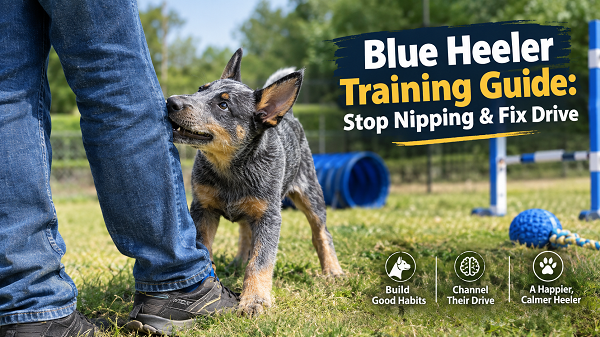
Blue Heeler nipping is a genetic herding behavior, not aggression or dominance, and it responds fastest to bite-inhibition games, an instant “game over” consequence, and 60-90 minutes of daily structured outlets that satisfy the dog’s drive to gather and control movement. Most puppies show real improvement within 3 to 6 weeks when owners are consistent, and full impulse control is usually solid by 12 to 18 months.
Table of Contents
- Why Blue Heelers Nip: It’s in the Blueprint
- How Bad Is the Bite, Really? Using the Dunbar Scale
- The Nipping Timeline: What’s Normal at Each Age
- Step-by-Step: How to Stop the Nipping
- Fixing Drive: Giving That Herding Brain a Job
- A Sample Weekly Structure for a High-Drive Heeler
- Mistakes That Make Nipping Worse
- When to Bring in a Professional (And What It Costs)
- Trainer’s Notes
- FAQs
- Conclusion & Next Steps
Introduction
If you’ve ever had a Blue Heeler puppy clamp onto your ankle mid-stride, or watched your dog try to “collect” your kids like loose cattle, you already know this isn’t an ordinary puppy problem. Ever wonder why every generic “just redirect to a toy” article never quite works for this breed? It’s because most of them are written for dogs in general, not for a breed built, on purpose, from a dingo. This guide is different. I’ve spent years working with cattle dogs and other high-drive herding breeds, and I’m going to walk you through exactly why Heelers nip, how to shut it down without breaking their spirit, and just as important, what to do with all that drive once the nipping stops. Because a Blue Heeler with nowhere to put its energy will always find a new outlet, and it’s usually one you didn’t sign up for.
By the end of this article, you’ll have an age-by-age nipping timeline, a bite-severity scale so you know when to worry (and when not to), a weekly drive-channeling plan, and real cost numbers for herding tests, board-and-train programs, and professional help if you need it. If you’re still deciding whether this breed’s temperament fits your household, our companion piece, the Blue Heeler Guide: Intelligence, Temperament & Care Tips, is worth reading alongside this one.
Why Blue Heelers Nip: It’s in the Blueprint
So here’s the thing most Blue Heeler articles skip: this breed was engineered, quite literally, to bite. Not people, cattle. In the 1840s, an Australian cattleman named Thomas Hall crossed smooth blue merle Collies with tamed dingoes to create a dog that could silently nip the heels of half-wild cattle to move them, then duck away before getting kicked. Those dogs, later nicknamed “Hall’s Heelers,” were crossed again with Dalmatians and Black and Tan Kelpies to add loyalty and stamina, and by the late 1800s the breed we now call the Australian Cattle Dog (ACD) or Blue Heeler, was standardized in New South Wales.
That history matters because it explains everything you’re dealing with today. Your puppy’s instinct to dart in, nip, and retreat isn’t a training failure on your part. It’s several generations of selective breeding for exactly that behavior, just aimed at your ankles instead of a steer.
A few numbers worth knowing:
- The Australian Cattle Dog was accepted by the American Kennel Club in 1980 and moved into the Herding Group in 1983.
- As of the AKC’s most recent breed popularity rankings, the ACD sits around 49th out of roughly 200 registered breeds, solidly popular but nowhere near as common as a Labrador, which means fewer trainers in your area will have deep breed-specific experience. Ask about that when you call around.
- Blue Heelers typically live 13 to 15 years, one of the longer lifespans in the working-dog world, which is exactly why getting the nipping and drive issues sorted early pays off for over a decade of daily life together.
- Interest in the breed has spiked again thanks to the animated series Bluey, whose entire family is Australian Cattle Dogs, cute on screen, but it’s led to a wave of new owners who had no idea what a real Heeler’s energy level looks like off-camera.
Here’s the part that trips people up: nipping and herding drive are not two separate problems. They’re the same engine. If you only suppress the nip without giving the drive somewhere to go, you’ll trade nipping for barking, spinning, shadow-chasing, or obsessive fence-running instead. We’ll fix both, in order.
How Bad Is the Bite, Really? Using the Dunbar Scale
Before you panic (or before you ignore something you shouldn’t), it helps to have an objective way to measure what’s actually happening. Veterinary behaviorist Dr. Ian Dunbar developed a six-level bite scale that professional trainers still use today to judge severity and prognosis:
- Level 1 — Teeth never touch skin; growling, snapping in the air, obnoxious behavior.
- Level 2 — Teeth touch skin but don’t puncture it. This is where the overwhelming majority of puppy nipping and herding-style ankle grabs land.
- Level 3 — A single bite, shallow puncture wounds, some bleeding.
- Level 4 — Deep punctures, at least half the length of a canine tooth, bruising.
- Level 5 — Multiple deep-bite wounds.
- Level 6 — Fatal.
Here’s the number that should actually reassure you: Levels 1 and 2 account for well over 99% of dog bite incidents, according to Dunbar’s own data. A Blue Heeler puppy nipping at your heels during play or while “herding” your kids across the yard is almost always a Level 2 at worst. That’s a training and management issue, not a red flag for aggression. If you’re ever seeing Level 3 or higher from a young puppy, that’s the point to call in a certified professional rather than keep troubleshooting solo.
The Nipping Timeline: What’s Normal at Each Age
One thing most Blue Heeler articles get wrong is treating “puppy nipping” as one blob of a problem. It isn’t. It changes shape as the dog matures, and your response needs to change with it.
8–16 Weeks (Teething + First Herding Sparks)
This is classic mouthing mixed with teething discomfort. It’s usually softer and more random, chewing on hands, sleeves, shoelaces. Bite inhibition training (teaching the dog how hard is too hard, not that biting is forbidden entirely) does its most important work in this window, and getting your crate and household routine solid early makes everything else easier, our step-by-step crate training guide covers exactly that foundation.
4–7 Months (Adolescent Herding Instinct Switches On)
This is when a lot of owners message me saying “he was fine, then suddenly he’s obsessed with heels.” The herding drive genuinely intensifies here. You’ll see targeted nipping at moving feet, bikes, joggers, kids running in the yard, even the vacuum cleaner. This is instinct, not a behavior regression.
6–18 Months (Peak Drive, Testing Boundaries)
Physical maturity plus a still-developing brain (the prefrontal cortex in dogs isn’t considered mature until roughly 2 to 3 years old, depending on breed size) means you get strength and drive without full impulse control. This is the danger zone for owners giving up on the breed, and it’s also exactly when consistent structure pays off the most.
18 Months and Beyond
With consistent training and enough outlets, most Blue Heelers settle into a dog that still has drive but channels it, into fetch, agility, treibball, or actual stock work, rather than into your ankles.
Step-by-Step: How to Stop the Nipping
Here’s the actual process I use, broken into a sequence rather than a random list of tips.
1. Stop reinforcing the game
The instant teeth touch skin, freeze. No yelling, no yanking your hand away dramatically, no pushing the dog off. Movement is the reward a herding brain is chasing, take it away and the nip stops paying off.
2. Give a clear, boring consequence
Turn your body away, fold your arms, and go still for 10-15 seconds. This isn’t punishment; it’s information. You’re telling the dog, in a language it actually understands: “Teeth on skin ends the fun immediately.”
3. Redirect to a legal outlet before the nip happens
Watch for the “wind-up”, the crouch, the fixed stare, the slight forward creep and hand over a tug toy or flirt pole a beat before the nip lands. Redirecting after the bite has already happened teaches far less than redirecting before it.
4. Teach “leave it” and “that’ll do” as real cues, not suggestions
“Leave it” stops the fixation before it becomes a nip. “That’ll do” (borrowed straight from working stockmen) is a release cue that tells the dog the herding task is over, useful for ending an obsessive nipping session at the dinner table or the kids’ soccer game. The same impulse-control principle applies on leash: if your Heeler nips at your hand or lunges toward moving joggers and cyclists mid-walk, our guide on dog pulling on walks and the real fix tackles the leash side of this exact drive.
5. Match consequence to intensity
A soft mouth touch gets a pause and redirect. A hard nip that leaves a mark gets a longer time-out (leave the room for a minute) and a harder look at whether the dog is overtired or under-exercised that day, cattle dogs get mouthier, not calmer, when they’re overstimulated and exhausted.
6. Track progress weekly, not daily
Nipping frequency will look erratic day to day. What you want to see is a downward trend over a 2-3 week window. Most owners who stay consistent see a noticeable drop in 3 to 6 weeks, though full reliability around kids and guests can take a few months longer.
Fixing Drive: Giving That Herding Brain a Job
This is the piece almost every other guide leaves out, and it’s the one that actually keeps the nipping gone long-term. You can perfectly train away the ankle-nipping and still end up with a dog that’s miserable, destructive, or fixated on something else, because you never gave the underlying drive anywhere to go.
Herding balls. Large, durable exercise balls the dog can nose, chest-bump, and push around the yard. This gives a Heeler the “gather and control a moving object” job its brain is wired for, without a living target.
Treibball (“urban herding”). Invented in Germany in 2005 by dog trainer Jan Nijboer specifically so herding breeds in cities could get real outlet without livestock, Treibball has the dog push a set of large balls into a goal using nothing but handler cues. It’s become genuinely popular in the US and UK for exactly this reason, it scratches the herding itch on a suburban lawn.
AKC Herding Instinct Tests. If you’ve got access to a local herding club, an Instinct Test lets your untrained dog interact with real sheep or ducks in a controlled arena so a judge can assess natural ability, no prior training required. Typical cost runs about $50 per test, and you’ll need to pass under two different judges (roughly $100 total) to earn the official Herding Instinct Certified (HIC) title. For a dog with strong drive, this is often the single most satisfying thing you can do together.
Flirt poles and structured tug. A flirt pole (essentially a giant cat toy for dogs) lets the dog chase, “catch,” and release on your command, which builds the same impulse-control muscle as bite inhibition work while burning serious energy in a small space.
Advanced obedience and directional work. Teaching left/right/stay-at-a-distance commands mimics the handler-dog communication used in real stock work and gives the dog a job during ordinary walks, heeling at your side, holding a down-stay while a jogger passes, that kind of thing.
Nose work and search games. A Heeler’s drive to track movement translates well into scent-based problem-solving. If your dog has real focus and stamina, our guide on how to start Search and Rescue (SAR) dog training at home shows how to build the foundational skills, even if you never go on to formal SAR work.
Real trainers agree on the exercise floor, too: 60 to 90 minutes of combined physical and mental work daily is a realistic minimum for an adult Blue Heeler, not the 20-minute walk that works for a lower-drive breed.
A Sample Weekly Structure for a High-Drive Heeler
- Daily (every day, non-negotiable): 20-30 minutes of structured obedience or trick training, plus one off-leash or long-line sniff/explore session.
- 3-4x per week: 15-20 minutes of flirt pole, tug, or fetch with clear start/stop cues.
- 2-3x per week: Treibball or herding-ball sessions in the yard.
- Weekly: One “big” outlet, agility class, a hike somewhere new, a herding club visit, or a long structured play session with another dog.
- As needed: Puzzle feeders or scent-work games on rest days or bad-weather days.
Mistakes That Make Nipping Worse
- Yelling or physically correcting the nip. This escalates arousal in a breed that’s already highly reactive to movement and sound, you’ll often get a harder, faster nip in response, not less biting.
- Waving hands or running away. To a herding brain, fast-moving limbs are exactly what it’s built to chase and control. This is the single most common mistake I see.
- Assuming exercise means “tired out physically” only. A Heeler that’s had a two-hour walk but zero mental work will still nip out of boredom. Problem-solving tasks matter as much as mileage.
- Inconsistent household rules. If one family member allows heel-nipping during play and another shuts it down instantly, the dog gets mixed signals and the behavior takes far longer to fade.
- Skipping the “why.” Punishing the nip without addressing the drive behind it just relocates the problem, often to something harder to manage, like fence-fighting with a neighbor’s dog or obsessive shadow/light chasing.
When to Bring in a Professional (And What It Costs)
Most Blue Heeler nipping resolves with consistent owner effort. Call in help if you’re seeing Level 3+ bites on the Dunbar scale, if nipping is aimed at strangers or unfamiliar kids rather than just family, or if you’ve been consistent for 6+ weeks with no improvement at all.
Rough cost ranges to budget for:
- Group obedience classes: $150-$300 for a 6-week course.
- Private in-home sessions with a certified trainer: $75-$200 per session in most US/UK/EU markets.
- Board-and-train programs geared toward working and herding breeds: often run around $700-$900 per month, with structured video updates from the trainer.
- AKC/AHBA herding instinct test: roughly $50-$60 per attempt.
Look for a trainer with a recognized credential, CPDT-KA, IACP-CDT, or CCPDT certification are good signals and ideally one with actual herding-breed or working-dog experience, not just general pet obedience. That distinction matters more with Heelers than almost any other breed. For a full breakdown of what to check before you hire anyone, see our guide on how to choose a dog trainer (2026 guide).
Trainer’s Notes
I’ve worked hands-on with working and protection breeds, including high-drive herding dogs, watching the same pattern play out over and over: owners who treat the nipping and the drive as one problem, not two, get lasting results. Owners who only suppress the nip end up back at square one within a few months because the underlying drive never found a home. If your household is weighing a Heeler against another herding breed, our honest look at whether Corgis are easy to train covers a lot of the same drive-and-nipping dynamics from a different breed’s angle. And for owners who want a structured, print-it-and-follow system rather than piecing advice together from forums, our complete K9 training e-book walks through bite inhibition, drive-building, and obedience drills in one place.
FAQs
1. At what age do Blue Heelers stop nipping?
Most puppies show a clear drop in nipping frequency by 6 months with consistent training, and the majority of adult Heelers are reliably past it by 12-18 months. Some drive-driven nipping toward joggers, cyclists, or livestock can resurface without ongoing outlets, even in adult dogs.
2. Is Blue Heeler nipping a sign of aggression?
Almost never. It’s rooted in herding instinct, not aggression, the goal is to move you, not to hurt you. Using the Dunbar bite scale, the vast majority of Heeler nips fall at Level 1 or 2, which trainers consider low-severity and highly responsive to training.
3. Do Blue Heelers grow out of high drive?
No, and that’s the point most owners miss. Drive doesn’t disappear with age, it either gets channeled into structured outlets like treibball, herding, or advanced obedience, or it leaks out sideways into nipping, barking, or obsessive behaviors.
4. How much exercise does a Blue Heeler actually need?
Plan on 60-90 minutes a day combining physical exercise with mental work, puzzle feeders, obedience drills, or herding-style games. A tired body with a bored brain is one of the most common causes of “sudden” nipping regressions in otherwise well-trained Heelers.
5. Should I use a prong or e-collar to stop a Blue Heeler from nipping?
Most certified trainers recommend starting with reward-based bite inhibition and drive-redirection methods first, since aversive tools can raise arousal in an already high-drive breed and sometimes worsen nipping. If a professional recommends a training collar for a specific, serious case, it should be introduced under direct guidance, not as a first-line fix.
Conclusion & Next Steps
Blue Heeler nipping isn’t a character flaw, and it isn’t something you can out-yell or out-muscle, it’s a working dog’s instinct showing up in a living room instead of a cattle yard. The fix has two halves: stop rewarding the nip with movement and attention, and give that same drive a legitimate job through herding balls, treibball, flirt pole work, or real herding instinct testing. Do both, stay consistent for 6 weeks, and track progress weekly rather than day to day, you’ll see it change faster than you expect.
If you’re just getting started, pick one management change (the freeze-and-turn-away response) and one drive outlet (a herding ball or flirt pole session) and run both this week. That combination alone resolves the majority of nipping cases I see in young Blue Heelers. And if you’re still not seeing progress after six weeks of real consistency, that’s your cue to bring in a certified professional rather than keep troubleshooting alone, with a breed this smart and this driven, a few good sessions with the right trainer can save you months of frustration.

Her work centres on obedience, detection, protection and operational readiness. She favours proven methods built on repetition, consistency and real-world conditioning, so that both dogs and handlers are prepared for high-pressure tasks.
Rofiat represented the Nigerian Army Dog Centre at the Nigerian Army Day Celebration (NADCEL) 2026, where she led demonstrations in obedience, explosive detection, agility and tactical movement. Through articles, training content and documentaries, she shares field-based insight into how structured training, clear communication and trust between handler and dog affect performance and reliability.
She is the author of Beyond the Bark: Inside a Pro Handler's Playbook for Raising the Ideal Dog, a practical guide that helps dog owners and handlers apply professional training principles in everyday situations.
- Australian Cattle Dog vs Blue Heeler: Any Difference? - October 1, 2026
- Bousnic Dog Training Collar Review: Is It Safe? - September 30, 2026
- Gravy Train Dog Food Review: Ingredients & Recalls - September 30, 2026