How Long Are Dogs Pregnant? Stages & Due Dates
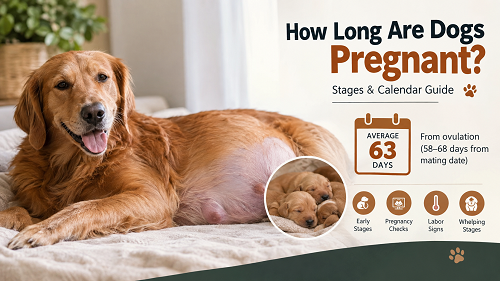
A dog’s pregnancy (gestation) lasts an average of 63 days from ovulation, though the range most vets and breeders work with is 58 to 68 days from the last mating date. Breed size doesn’t change this, a 4 lb Chihuahua and a 150 lb Great Dane are both pregnant for roughly the same nine weeks. What does shift is the due-date math, because the day you saw your dogs tie is almost never the day conception actually happened.
Table of Contents
- How Long Are Dogs Pregnant? The Straight Answer
- The Canine Reproductive Cycle (Why the Due Date Is So Hard to Pin Down)
- Dog Pregnancy Calendar: Week-by-Week Stages
- How to Confirm Pregnancy and Build Your Due-Date Calendar
- Signs Labor Is Near: The Temperature Drop and Pre-Labor Checklist
- The 3 Stages of Whelping
- Does Breed or Litter Size Change Gestation Length?
- Feeding and Care Through Each Trimester
- When to Call the Vet: Dystocia and Red Flags
- Trainer’s Notes: Real Whelping Experience
- FAQs
- Conclusion
Introduction
Ever had someone tell you “dogs are pregnant for two months” and then watch their dog blow past day 63 with no puppies in sight? It happens constantly, and it’s rarely a medical problem, it’s a counting problem. Dog gestation is short, tightly wound, and measured from a moment (ovulation) that almost nobody actually witnesses.
In this guide, you’ll get the real gestation window, why the range spans a full ten days, a stage-by-stage calendar broken into trimesters, the labor signs that actually predict delivery (not old wives’ tales), and the warning signs that mean you need a vet on the phone immediately, not in the morning. I’ll also flag the couple of things most of the pregnancy articles on page one of Google leave out, like how progesterone testing actually narrows the due date, and why your dog’s individual temperature baseline matters more than the “100°F rule” everyone quotes.
How Long Are Dogs Pregnant? The Straight Answer
The average canine gestation period is 63 days measured from the day of ovulation, and this number is essentially the same across every breed, size, coat, and temperament have no meaningful effect on it. When people quote a wider range (58 to 68 days), they’re almost always measuring from the mating or tie date instead, which is a different and less precise, starting point.
Where the 63-Day Number Comes From
Progesterone research on canine reproduction shows that once a female ovulates, embryo implantation and fetal development follow a remarkably consistent timeline: implantation around day 17–20, organ formation through day 35, and skeletal calcification visible on X-ray by day 45. Whelping reliably follows within a day or two of the 63-day mark when it’s counted from ovulation.
Why Estimates Range From 58 to 68 Days
Here’s the part most articles skip: mating and ovulation are not the same event. A female dog’s eggs stay fertile for up to 48 hours after release, and a male’s sperm can survive inside her reproductive tract for up to a week. That means if a pair ties on day one of a three-day breeding window, but she doesn’t actually ovulate until day four, your “day one” count is off by three full days before the pregnancy has even started. Multiply that kind of drift across a handful of matings and you get the 58–68 day spread you see quoted everywhere.
The fix: if you’re breeding intentionally, don’t count from the tie date. Ask your vet about a progesterone test around the time of the first mating, it pinpoints ovulation directly and turns a 10-day guess into a 1–2 day due-date window.
The Canine Reproductive Cycle (Why the Due Date Is So Hard to Pin Down)
An intact female dog cycles through four reproductive stages roughly every six months, and only one of them makes pregnancy possible.
The Four Stages of Heat
- Proestrus (about 9 days): Vulvar swelling and bloody discharge appear. Males are interested, but she isn’t receptive yet.
- Estrus (about 5–9 days): Discharge lightens, she becomes receptive to mating, and ovulation happens somewhere in this window, usually a few days in, not on day one.
- Diestrus (about 60–90 days): The window where pregnancy, if it occurred, plays out. Whether she’s pregnant or not, her hormones behave almost identically during this stage, which is why early pregnancy is so hard to spot from behavior alone.
- Anestrus (about 4–5 months): A resting phase with no reproductive activity before the cycle restarts.
Because ovulation happens somewhere inside a multi-day estrus window rather than on a fixed calendar date, “day 1 of gestation” is genuinely an estimate unless it’s confirmed with hormone testing.
Dog Pregnancy Calendar: Week-by-Week Stages
Dogs go through three “trimesters” just like humans do, but each one is compressed into about three weeks instead of three months. Here’s what’s happening internally and what you’ll actually notice from the outside.
Trimester 1 — Days 1 to 21
- Days 1–7: Fertilization occurs in the fallopian tubes. Fertilized eggs begin migrating toward the uterus. No visible or behavioral signs yet.
- Days 8–16: Embryos implant along the uterine wall (around days 17–20 in many dogs, sometimes slightly earlier). You may notice mild lethargy, a subtle appetite dip, or occasional morning nausea, the canine equivalent of morning sickness, caused by rising progesterone and uterine stretching.
- Days 17–21: This is the earliest a vet can reliably confirm pregnancy, an abdominal ultrasound can detect gestational sacs starting around day 20–21, and a skilled vet may be able to palpate distinct fetal swellings between roughly day 21 and day 35 (after which the sacs lose their firm, individually palpable shape).
Trimester 2 — Days 22 to 42
- Days 22–28: Organogenesis is underway, the puppies’ major organs and skeletal structure begin forming. This is when a relaxin hormone blood test becomes reliable (relaxin is produced only during pregnancy, so testing after day 28–30 avoids false negatives).
- Days 29–35: The belly starts to visibly round out, especially in dogs carrying a larger litter. Nipples enlarge and darken. Appetite typically increases now as the puppies’ nutritional demands ramp up.
- Days 35–42: X-rays become useful from around day 42–45 onward, once the skeleton has calcified enough to show clearly, this is also the point where your vet can start giving you a reasonably accurate puppy count.
Trimester 3 — Days 43 to 65
- Days 43–50: Rapid fetal growth. More than half of a puppy’s total birth weight is put on during this final stretch, so your dog’s calorie needs climb sharply here, this is the window most breeders switch to a calorie-dense puppy or performance-dog formula.
- Days 51–58: You’ll likely feel and sometimes see, puppies moving under the skin, especially in the evening when the dam is resting. Nesting behavior often starts here: shredding bedding, seeking out quiet corners, or hovering near a whelping box if you’ve introduced one.
- Days 58–65: The final countdown. Appetite frequently drops in the last 24–48 hours as the abdomen runs out of room and hormonal shifts kick in. This is when you start twice-daily temperature checks (more on that below) because labor is now genuinely imminent.
How to Confirm Pregnancy and Build Your Due-Date Calendar
Guessing is stressful for you and risky for her. Here’s the actual diagnostic timeline vets use, and how to turn it into a working calendar.
Confirmation Methods and Timing
| Method | Earliest Reliable Window | What It Tells You |
|---|---|---|
| Abdominal palpation | Days 21–35 | Presence of distinct fetal swellings (skill-dependent) |
| Ultrasound | Days 20–30 (heartbeats visible by ~day 25) | Confirms pregnancy, estimates fetal viability |
| Relaxin blood test | Day 28–30 onward | Confirms pregnancy hormonally; avoids false negatives from early testing |
| X-ray (radiograph) | Day 42–45 onward | Confirms puppy count once skeletons calcify |
Build Your Own Due-Date Calendar
- Note every mating date, not just the first one, if there were multiple ties over several days, write them all down.
- Ask about a progesterone test at the first mating if you’re serious about pinning down the date; it identifies the LH surge and ovulation window directly.
- Count 63 days from the estimated ovulation date (not the first mating date) for your target whelping day.
- Build in a 5-day buffer on either side, start watching closely from day 58 and don’t panic if she goes to day 68, provided she’s showing no distress.
- Mark day 42 on your calendar as your vet visit for an X-ray puppy count, and day 58 as the day you start twice-daily temperature checks.
If you also want to track her weight and the puppies’ expected sizes once they arrive, our puppy growth calculator is worth bookmarking now, you’ll want it the day the litter is born.
Signs Labor Is Near: The Temperature Drop and Pre-Labor Checklist
This is the section every breeder needs memorized, because it’s the single most reliable predictor of delivery timing, far more dependable than counting days alone.
The temperature drop: A pregnant dog’s normal resting temperature runs about 101–102.5°F (38.3–39.2°C). In the 8 to 24 hours before active labor begins, progesterone collapses and her temperature drops, commonly to somewhere between 97°F and 99.5°F (36.1–37.5°C). Once you see two consecutive readings below roughly 99°F, taken at the same time of day with the same thermometer, expect the first puppy within about 24 hours, often sooner.
How to monitor it properly:
- Start twice-daily rectal temperature checks (morning and evening) from around day 55–58, so you have a genuine baseline for this dog before you start looking for a drop.
- Use the same thermometer and roughly the same time each day, temperature can naturally swing by up to 1°F over the course of a day.
- Don’t panic over a single low reading. Confirm with a second reading a few hours later before you assume labor is imminent.
A reliable digital rectal thermometer earns its keep here, most general-purpose human thermometers aren’t rated for this and won’t give you the fast, consistent readings you need overnight. The Pavia Rectal Temp Veterinary Thermometer is a straightforward option bred to handle exactly this kind of repeated, fast-turnaround use.
Other pre-labor signs (usually appearing 6–24 hours before whelping, occasionally up to 36 hours):
- Restlessness, pacing, or clinginess, some dogs go the opposite way and withdraw
- Nesting: digging at bedding, rearranging blankets, seeking a secluded spot
- Loss of appetite, sometimes with mild vomiting
- Panting and shivering as contractions begin building
- A clear, stringy vaginal discharge as the cervix starts to open
If you haven’t already set up a dedicated whelping area, now’s the time, a proper birthing setup with clean bedding, a heat source for the pups, and basic emergency supplies (cord clamps, bulb aspirator, clean towels) removes a lot of the 2 a.m. scrambling. A kit like the SHEFFIELD SS SHOP 64-Piece Puppy Whelping Kit covers most of what you’ll reach for in the first hour after each puppy arrives.
The 3 Stages of Whelping
Once the temperature drop resolves and labor actually starts, it unfolds in three distinct stages.
Stage One — Cervical Dilation (6 to 24 hours): The cervix dilates and mild uterine contractions begin, but you won’t see a puppy yet. This is the restless, panting, nesting phase. Red flag: if it’s been more than 24 hours since the temperature drop with no progression to Stage Two, call your vet.
Stage Two — Active Delivery (typically 30–60 minutes per puppy, sometimes longer between pups): Visible abdominal contractions, straining, and puppy delivery. The dam normally breaks the amniotic sac herself, severs the cord, and begins cleaning and stimulating the puppy to breathe. Red flag: hard straining for more than 30 minutes with no puppy delivered, or more than 2–4 hours between puppies with no sign of active labor resuming.
Stage Three — Placental Passage (minutes after each puppy): One placenta should follow each puppy. Some dams alternate between Stage Two and Three with each pup rather than delivering all puppies first and all placentas after. Red flag: if your placenta count doesn’t match your puppy count once whelping is finished, that’s a retained placenta and needs a vet visit, it’s a real infection risk (pyometra-adjacent complications) if left unaddressed.
Does Breed or Litter Size Change Gestation Length?
Not meaningfully, this is one of the most consistent facts in canine reproduction, and it surprises a lot of new owners. A Yorkshire Terrier carrying two puppies and a Cane Corso carrying twelve are both working on essentially the same 63-day internal clock.
What can shift the number by a day or two:
- Litter size: Very large litters occasionally deliver a day or so early, since there’s less physical room for continued growth. Very small litters (one or two puppies) sometimes run a day or two past 63, since the single puppy can grow larger before the hormonal trigger for labor kicks in.
- First-time mothers (primiparous dams): Can show slightly more variability in timing and slightly longer Stage One labor than experienced mothers.
- Individual hormonal variation: Just like women don’t all deliver exactly at 40 weeks, individual dogs have some natural variance around the 63-day average.
If you’re comparing working and guardian breeds specifically, our Anatolian Shepherd puppy growth chart and care guide shows just how differently a giant-breed litter develops after birth compared to a toy or small breed, even though the pregnancy itself ran the same length.
Feeding and Care Through Each Trimester
Nutrition needs shift dramatically over 63 days, and this is one of the most common places well-meaning owners get it wrong by overfeeding too early or too late.
- Weeks 1–3 (Trimester 1): No change to her regular adult diet is needed yet. Overfeeding here just adds unnecessary weight before the puppies are actually demanding extra calories.
- Weeks 4–6 (Trimester 2): Begin gradually transitioning toward a calorie-dense diet, many breeders switch to a high-quality puppy formula around week 5, since it’s built for rapid growth and mirrors what the developing litter needs. Split meals into 3 smaller portions a day as the growing uterus crowds her stomach.
- Weeks 7–9 (Trimester 3): Caloric needs can run 25–50% above her normal maintenance intake by the final week, depending on litter size. Continue smaller, more frequent meals, 4 times a day is common by week 8, since a single large meal may be physically uncomfortable.
- Throughout pregnancy: Fresh water access at all times, continued light-to-moderate exercise (short leash walks, no strenuous training drills), and no new medications, dewormers, or supplements without a vet’s sign-off, several common products aren’t safe during pregnancy.
If you’re managing a litter alongside a puppy from a previous pairing, our core puppy vaccine schedule guide is worth reading now so you’re not scrambling to figure out the newborn litter’s shot timeline once they arrive.
When to Call the Vet: Dystocia and Red Flags
Most whelping happens without incident, but dystocia (difficult or obstructed labor) is a genuine emergency for both the dam and the puppies still waiting to be born. Call your vet immediately if you see:
- No labor by day 68–70 after a confirmed mating window
- Green or black discharge before the first puppy arrives (normal after a puppy is born, but a warning sign beforehand, it can indicate placental separation)
- Strong contractions for over 30 minutes with no puppy delivered
- More than 2–4 hours between puppies when you know more are still inside
- Visible fetal distress, a partially delivered puppy that isn’t progressing
- Fever, foul-smelling discharge, or the dam seeming disoriented or collapsed
- A mismatch between placenta count and puppy count after whelping appears finished
- Known risk factors, brachycephalic breeds (French Bulldogs, English Bulldogs, Boston Terriers) and very small toy breeds carrying oversized single puppies have meaningfully higher dystocia rates and often need a planned C-section discussion with your vet well before the due date.
Trainer’s Notes: Real Whelping Experience
I’m Rofiat Muritala, and I’ve spent over 14 years handling and training working dogs, including time supervising litters bred for military and security-line temperament and structure, not just companion breeding. Whelping a working-line German Shepherd or Belgian Malinois isn’t fundamentally different biologically from whelping a family pet, but the stakes of getting the calendar right are higher: a miscounted due date means missing the window to plan structured early neurological stimulation, correct socialization timing, and health screening before puppies go to handlers or families. Every timeline in this guide reflects what I actually track on a whelping calendar with my own dogs and litters I’ve supervised, cross-checked against veterinary reproduction literature, not just generic advice repeated from other pet sites.
FAQs
1. How many days exactly is a dog pregnant?
Dogs are pregnant for an average of 63 days from ovulation, with a practical range of 58–68 days when counted from the mating date instead, due to the gap between mating and actual ovulation.
2. Can I tell how many puppies my dog is having before she gives birth?
Yes, an X-ray after day 42–45, once the puppies’ skeletons have calcified enough to show clearly, gives vets a reliable puppy count. Earlier ultrasounds confirm pregnancy but are less accurate for counting.
3. What’s the first physical sign of pregnancy in dogs?
Often it’s subtle: mild appetite changes, slight lethargy, or nipple enlargement starting around 3–4 weeks in. Visible belly rounding usually doesn’t show until 5–6 weeks.
4. Is a temperature drop always followed by labor?
In the vast majority of cases, yes, a confirmed drop below about 99°F, held for several hours, predicts labor within roughly 24 hours. It’s considered one of the most reliable single indicators available to breeders without lab equipment.
5. Do smaller dog breeds have shorter pregnancies than large breeds?
No. Gestation length is essentially the same across all breeds and sizes, a Chihuahua and a Mastiff are both pregnant for roughly 63 days. What differs after birth is how fast the puppies grow, not how long the pregnancy itself lasts.
Conclusion
The short version: dogs are pregnant for about 63 days from ovulation, or 58 to 68 days if you’re counting from a messier mating-date estimate. The real skill isn’t memorizing that number, it’s building an accurate calendar (ideally backed by a progesterone test), watching the confirmation windows at days 21, 30, and 45, and treating the temperature drop around day 58–65 as your genuine labor alarm rather than the calendar date alone.
If you’re gearing up for a litter, start your temperature log now, keep your vet’s number somewhere faster to reach than your phone’s contact list, and have your whelping supplies ready a full week before the earliest possible due date, not the week of. For hands-on groundwork on raising the litter once it arrives, from crate-training the puppies to early structure, my e-book Beyond the Bark covers what I actually do with new litters and young puppies in the weeks that follow whelping, and our crate training guide is a natural next stop once the puppies are weaned and heading to new homes.
This article is for educational purposes and does not replace veterinary care. If your dog shows any signs of labor complications, contact your veterinarian immediately.

Her work centres on obedience, detection, protection and operational readiness. She favours proven methods built on repetition, consistency and real-world conditioning, so that both dogs and handlers are prepared for high-pressure tasks.
Rofiat represented the Nigerian Army Dog Centre at the Nigerian Army Day Celebration (NADCEL) 2026, where she led demonstrations in obedience, explosive detection, agility and tactical movement. Through articles, training content and documentaries, she shares field-based insight into how structured training, clear communication and trust between handler and dog affect performance and reliability.
She is the author of Beyond the Bark: Inside a Pro Handler's Playbook for Raising the Ideal Dog, a practical guide that helps dog owners and handlers apply professional training principles in everyday situations.
- Australian Cattle Dog vs Blue Heeler: Any Difference? - October 1, 2026
- Bousnic Dog Training Collar Review: Is It Safe? - September 30, 2026
- Gravy Train Dog Food Review: Ingredients & Recalls - September 30, 2026