K9 Advantix II for Working Dogs: Full Tick Care Guide
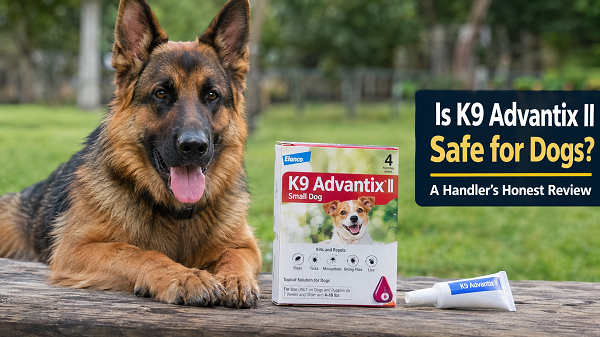
K9 Advantix II is a monthly topical treatment that repels and kills ticks, fleas, mosquitoes, and biting flies on dogs, using a three-ingredient formula (imidacloprid, permethrin, pyriproxyfen) that starts working within hours and lasts about four weeks. For working dogs, K9s, SAR dogs, farm and security dogs that spend hours a day in tick habitat, it’s one of the few over-the-counter products that actually repels ticks before they bite, not just kills them after they’ve already attached.
Table of Contents
- Why Tick Prevention Is a Real Operational Issue for Working Dogs
- What Is K9 Advantix II and How Does It Work
- Which Ticks (and Diseases) It Actually Protects Against
- K9 Advantix II vs Other Tick Preventives
- How to Apply It Correctly by Weight Class
- Special Considerations for K9 Units and Working Dogs
- Safety, Side Effects, and Red Flags
- What It Actually Costs
- Real Cases: When Tick Prevention Fails
- Trainer’s Notes (Experience Signal)
- Frequently Asked Questions
- Conclusion and Action Plan
Introduction
If you handle a working dog, you already know fleas are the least of your worries. It’s the ticks that keep you up at night, the ones you find behind an ear after a five-hour field exercise, or the one you missed that shows up three weeks later as a limping, feverish dog at the vet’s office.
I’ve had that conversation with a vet before. It’s not a fun one. And it’s exactly why so many K9 handlers, SAR teams, and working-dog owners keep coming back to the same question: does K9 Advantix II actually hold up for a dog that works outdoors all day, every day, not just a couch companion that takes a 20-minute walk?
This guide answers that properly. We’ll go through what’s actually in the tube, how it performs against the tick species your dog is most likely to meet, how to dose and apply it correctly for a working animal, where it falls short, and what real handlers and vets say about using it in multi-dog units. By the end, you’ll know exactly whether it belongs in your kit and how to use it so it actually works.
Why Tick Prevention Is a Real Operational Issue for Working Dogs
Most tick-prevention articles are written for family pets that spend 30 minutes a day in a backyard. That’s not your dog. A patrol K9, a SAR dog working a wooded search grid, a livestock guardian, or a private security dog on rural acreage can spend six, eight, sometimes ten hours a day moving through the exact terrain ticks love, tall grass, brush lines, leaf litter, and forest edges.
The numbers back up why this matters. IDEXX Laboratories, one of the largest veterinary diagnostics labs in the US, reported that nearly 1.8 million dogs in the U.S. were diagnosed with vector-borne diseases in 2024. Even more concerning for long-serving working dogs: research cited by IDEXX found that tick-borne disease exposure can raise a dog’s risk of developing chronic kidney disease by up to 112%. That’s not a short-term illness, that’s a working dog’s career and lifespan on the line.
Law enforcement and detection dogs face this risk constantly. As one K9 equipment supplier put it, dogs searching wooded areas or thick brush consistently risk picking up tick-related diseases, and in climates with sandy soil or hardwood cover, ticks can attach and hide beneath a dog’s coat undetected.
This isn’t theoretical. It’s happened to real K9 teams, something we’ll come back to later in this guide.
What Is K9 Advantix II and How Does It Work
K9 Advantix II is manufactured by Elanco (formerly Bayer Animal Health) and sold over the counter, no prescription needed. It’s built around three active ingredients working together, not one single chemical:
- Imidacloprid (8.8%) — kills adult fleas and chewing lice by disrupting their nervous system
- Permethrin (44.0%) — the ingredient that repels and kills ticks, mosquitoes, and biting flies
- Pyriproxyfen (0.44%) — an insect growth regulator that stops flea eggs and larvae from maturing into adults
Applied correctly, the product spreads through the dog’s natural skin oils within about 24 hours, and adult fleas start dying within 12 hours of application. For ticks, already-attached ticks begin dying within 24 hours, and one of the biggest advantages over many competitor products is that Advantix repels up to 98.5% of ticks within two hours of application, meaning most ticks never get the chance to bite in the first place.
That repellent action is the whole point for a working dog. A tick that’s repelled off the coat before it ever bites has zero chance of transmitting disease. A tick that has to bite and then die (which is how some competitor products work) has already had contact and in rare cases, that’s enough time for pathogen transmission.
Which Ticks (and Diseases) It Actually Protects Against
K9 Advantix II’s label specifically covers the four tick species most likely to cause problems in the US and comparable temperate regions:
| Tick species | Disease it carries | Protection window |
|---|---|---|
| Deer tick (black-legged tick) | Lyme disease | Up to 4 weeks |
| American dog tick | Rocky Mountain spotted fever | Up to 4 weeks |
| Brown dog tick | Ehrlichiosis | Up to 4 weeks |
| Lone Star tick | Ehrlichiosis | Up to 4 weeks |
The manufacturer’s own product literature confirms it repels and kills these four tick species for up to four weeks, and it also repels and kills all life stages of fleas, eggs, larvae, pupae, and adults, which matters if your dog kennels or works alongside other animals.
A note for handlers outside North America: if your working dog operates in Europe, the UK, or elsewhere, be aware that regional tick species differ (castor bean ticks and Ixodes ricinus are more relevant across much of Europe, for example). Always check the label registered for your country, K9 Advantix II’s exact formulation and approved claims can vary by market.
K9 Advantix II vs Other Tick Preventives
Handlers often ask how it stacks up against other common options. Here’s the honest breakdown:
- K9 Advantix II vs Frontline Plus: Frontline kills ticks after they bite and attach; Advantix repels most ticks before they ever attach. For working dogs in heavy tick country, that repellent action is a meaningful edge.
- K9 Advantix II vs Seresto collar: Seresto offers up to 8 months of protection in a collar, which some handlers prefer for convenience, but a collar can be a liability around a working dog’s harness, bite work, or water operations. A topical avoids that snag risk entirely.
- K9 Advantix II vs oral chewables (NexGard, Bravecto): Oral products kill ticks systemically after they bite, there’s no repellent effect, and the tick has to feed first. For a dog that’s constantly exposed, many vets recommend pairing an oral product with a topical repellent rather than choosing one exclusively.
- K9 Advantix II vs Advantage Multi: Advantage Multi adds heartworm and intestinal parasite coverage but has no tick repellency at all. If your dog needs both, some K9 units rotate or combine products under veterinary guidance rather than relying on one product for everything.
None of these is a flat “better” or “worse”, it depends on your dog’s job, environment, and whether cats share the facility (more on that below).
How to Apply It Correctly by Weight Class
Getting the dose right matters more for working dogs than pets, because sweating, swimming, and heavy coat conditions can all affect how well the product spreads and holds.
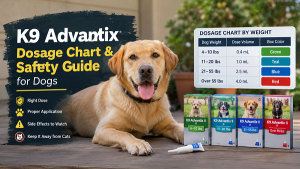
Dosing by weight
- 4–10 lbs: apply in 2–3 spots along the back
- 11–20 lbs: apply in 3 spots
- 21–55 lbs: apply in 3–4 spots, shoulder to base of tail
- Over 55 lbs: apply in up to 6 spots to ensure even coverage across a larger back
Step-by-step application
- Part the coat down to the skin at each application point, putting it on top of the fur instead of the skin is the single biggest reason handlers report the product “not working.”
- Apply the full tube’s contents in even small amounts, moving from the shoulder blades to the base of the tail.
- Avoid pooling too much solution in one spot; it can run off the side of the dog and reduce effectiveness.
- Keep the dog from being bathed or getting into water for the first 24 hours, the product needs that window to become waterproof.
- Separate treated dogs from cats and from each other (to prevent licking) for at least 30 minutes.
- Reapply on a strict 30-day cycle. Don’t stretch it to 5 or 6 weeks to save money, protection genuinely drops off toward the end of the window, and that’s exactly when a working dog is still out in the field every day.
Special Considerations for K9 Units and Working Dogs
This is the section most consumer-facing articles skip entirely, and it’s the part that actually matters for handlers.
Cats in the facility. This is the single most important warning for any K9 unit, kennel, or multi-species household. K9 Advantix II’s permethrin content is toxic to cats. A vet-reviewed guide is blunt about this: households with cats should avoid K9 Advantix II entirely and use a cat-safe alternative instead, and treated dogs should be kept separate from cats for at least 30 minutes after application to prevent grooming-related transfer. If your facility runs detection cats, barn cats, or any feline housemates, this single fact should decide your product choice.
Water-working dogs. SAR, water rescue, and dogs that swim regularly need the full 24-hour dry window respected before any submersion. Reapplication timing should also account for how often the dog swims or is bathed, frequent water exposure can shorten the real-world protection window even on a “waterproof” product.
Multi-dog kennels. Because K9 Advantix II kills all life stages of fleas, it’s genuinely useful for units housing several dogs together, where one infested dog can seed an entire kennel. But it also means dosing every dog in the facility on the same schedule matters, partial coverage lets fleas persist in the gaps.
High-exposure terrain. If your dog works dense brush, tall grass, or wooded search areas daily, pair the monthly application with a physical tick check after every shift, hands running along the ears, between toes, the groin, and under the collar line. The product dramatically cuts the odds of a bite, but it isn’t a 100% guarantee, and daily inspection catches the rare tick that slips through.
If you’re building out a full field kit for a working dog, it’s worth reading our guide to tactical K9 gear alongside this one, tick prevention is just one part of keeping a working dog field-ready.
Safety, Side Effects, and Red Flags
Most dogs tolerate K9 Advantix II well, but as a handler you should know what to watch for:
- Mild, temporary irritation at the application site (redness, itching) is the most commonly reported side effect
- Vomiting or lethargy can occur, particularly if a dog licks the application site before it dries, supervise the dog for the first hour after application
- The product is harmful if swallowed and should never contact eyes or broken skin
- Never use on cats, and keep cats away from treated dogs for at least 30 minutes
- Puppies must be at least 7 weeks old and 4 lbs before use
- If you see excessive drooling, tremors, or difficulty walking after application, contact a vet immediately, these aren’t typical and shouldn’t be dismissed as “settling in”
Safety testing on the product has been fairly extensive: safety has been evaluated at up to five times the recommended label dose in dogs 10 to 11 months old with no adverse effects reported, which is reassuring, but individual dogs can still react differently, especially those with known sensitivities to pyrethroids.
What It Actually Costs
Pricing varies by retailer and dog-size tier, but as of current retail listings, expect to pay roughly:
- Small dogs (4–10 lbs): around $15–$18 per monthly dose
- Medium/large dogs (21–55 lbs): around $13–$17 per monthly dose, cheaper per-dose in 6-packs
- Extra-large dogs (55+ lbs): around $13–$14 per monthly dose in bulk packs
For a K9 unit running multiple dogs year-round, buying 6-month supply packs rather than single tubes cuts the per-dose cost noticeably, often by $3–$5 per application compared to buying single doses. If your department or kennel budgets for consumables annually, that adds up fast across a multi-dog roster.
Real Cases: When Tick Prevention Fails
It’s worth being honest about what happens when tick protection lapses, because it’s not an abstract risk for working dogs, it’s ended careers and lives.
In early 2026, a Polk County Sheriff’s Office K9 named Rex, a 7-year-old Belgian Malinois/German Shepherd mix trained in narcotic detection, apprehension, and tracking, was euthanized after being diagnosed with Lyme disease and going into kidney failure. Rex had served with the department since 2021.
It’s not a new problem, either. Decades earlier, K-9 Bruno, an East Hartford, Connecticut police dog who assisted in over 1,100 arrests and won the state police Canine Olympics four times, was euthanized after becoming crippled by arthritis and Lyme disease complications, unable to stand without assistance in his final week.
These aren’t outliers. They’re the reason tick prevention for a working dog isn’t a “nice to have” line item, it’s operational readiness and welfare, full stop.
Trainer’s Notes (Experience)
I’ve handled and trained working dogs across search-and-rescue, agility, and protection contexts, including dogs that log serious hours in brush and forest terrain during demonstrations and field exercises, the same conditions where tick exposure is highest. The pattern I see over and over with handlers who skip a consistent tick-prevention routine isn’t dramatic illness right away, it’s small, easy-to-miss stuff first: a dog that’s slightly less driven on a hot afternoon, a bit more head-shy about being touched near the ears, subtle things that get written off as “just tired” until a vet visit turns up something more serious.
My rule with every working dog I’ve handled: tick prevention goes on the same recurring calendar as vaccinations and vet checks, never “whenever I remember.” If you want a deeper look at how conditioning and daily routine affect a working dog’s resilience in the field, our piece on how search and rescue dogs work covers the physical demands these dogs handle day to day, and this one on how military working dogs are trained gives more context on the operational standards these animals are held to.
If you’re building out a fuller health and handling routine for your dog, our e-book, Beyond the Bark, goes deeper into daily care practices that keep a working dog mission-ready.
Frequently Asked Questions
Is K9 Advantix II safe for working dogs that swim frequently?
Yes, but give it the full 24 hours to become waterproof before the first swim after application, and consider reapplying slightly earlier than the 30-day mark if your dog swims or is bathed weekly, since frequent water exposure can shorten real-world protection.
Can K9 Advantix II be used alongside an oral tick preventive?
Many vets do recommend combining a topical repellent like Advantix with an oral product for dogs in high-exposure environments, since the topical repels before biting and the oral kills systemically as a backup. Always confirm the combination with your vet first.
How long does K9 Advantix II take to start working?
Fleas start dying within 12 hours, and the product begins repelling ticks within about two hours of application, though full effectiveness builds over the first 24 hours as it spreads through the coat.
Is K9 Advantix II dangerous to cats?
Yes, this is one of the most important warnings on the label. The permethrin content is toxic to cats, so it should never be used in a household or facility where cats and dogs interact closely, and treated dogs should be kept separated from cats for at least 30 minutes after each application.
How often should a working dog be checked for ticks even while using K9 Advantix II?
Daily, ideally after every shift or field session. The product significantly cuts bite risk but isn’t a substitute for a physical hands-on check, especially around the ears, groin, and between the toes where ticks are easiest to miss.
Conclusion
K9 Advantix II earns its reputation for a reason: it’s one of the few over-the-counter options that actually repels ticks before they bite, not just kills them afterward, and it’s been tested against the tick species that matter most for dogs working outdoor terrain. For a working dog, police K9, SAR dog, security or farm dog, that repellent action, combined with monthly consistency and a daily hands-on check, is one of the simplest ways to cut your dog’s risk of a career-ending or life-threatening tick-borne illness.
The action plan is straightforward: apply it correctly (on the skin, not the coat), stick to the 30-day schedule without stretching it, keep it away from any cats in the facility, and never treat it as a replacement for physically checking your dog after every field session. Do those four things consistently, and you’ve closed off most of the risk that ends working-dog careers early.
If you found this useful, subscribe to our weekly newsletter for more practical, field-tested guides like this one straight to your inbox.

Her work centres on obedience, detection, protection and operational readiness. She favours proven methods built on repetition, consistency and real-world conditioning, so that both dogs and handlers are prepared for high-pressure tasks.
Rofiat represented the Nigerian Army Dog Centre at the Nigerian Army Day Celebration (NADCEL) 2026, where she led demonstrations in obedience, explosive detection, agility and tactical movement. Through articles, training content and documentaries, she shares field-based insight into how structured training, clear communication and trust between handler and dog affect performance and reliability.
She is the author of Beyond the Bark: Inside a Pro Handler's Playbook for Raising the Ideal Dog, a practical guide that helps dog owners and handlers apply professional training principles in everyday situations.
- K9 Advantix Dosage Chart & Safety Guide for Dogs - October 19, 2026
- How to Set Up & Use Bousnic Dog Training Collar - October 18, 2026
- Westminster Dog Show 2026: Winners & Full Results - October 17, 2026