Crate Training a Pug: Fast 7-Day Plan That Works
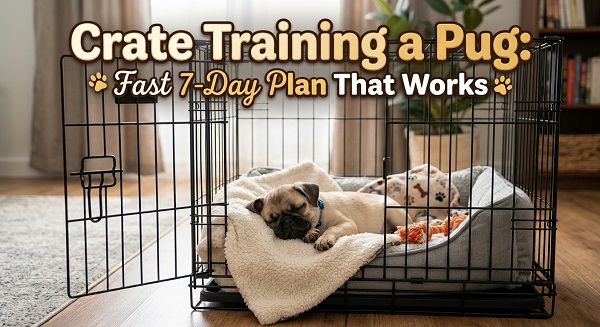
How do you crate train a pug fast? Pick a 24-inch wire crate (with a divider for a puppy), make it a rewarding place with food and chews, and build up time inside it in tiny steps over about 7 days. Keep the crate cool and well ventilated, because pugs overheat easily. Most pugs settle into the crate within 1 to 2 weeks, and most are reliable for short stays within 4 to 8 weeks.
Key points:
- Never rush or force. Fast comes from short, frequent sessions, not long ones.
- Crate time limits for pug puppies are short: roughly 1 hour per month of age.
- Heat safety matters more for pugs than for most breeds.
- Don’t open the door when your pug is crying. Wait for a short pause first.
Table of Contents
- Why Crate Training a Pug Is Different
- Is Crate Training Good for Pugs?
- What You Need Before Day One
- Pug Crate Size Guide
- The 7-Day Fast Crate Training Plan
- How Long Can a Pug Stay in a Crate?
- Night-Time Crate Training for Pugs
- Pug-Safe Crate Rules: Heat and Breathing
- Fixing Common Pug Crate Problems
- Trainer Experience and Trainers Notes
- 7 Mistakes That Slow Everything Down
- FAQs
- Conclusion
Introduction
Your pug puppy just spent his first evening screaming in his crate. You’re tired. Your neighbors may be too. And a little voice in your head asks if you’re being cruel.
You’re not. But I get it. Pugs make this harder than most breeds. They were bred for centuries to sit in laps and follow people around, so being alone in a box feels like a disaster to them. Add a flat face that struggles in the heat, and you can’t just copy a generic crate training guide.
So here’s what you’ll learn in this article. You’ll get the right crate size for a pug, a simple 7-day plan, safe time limits by age, and a night routine that works. You’ll also get the heat-safety rules most guides skip, and fixes for crying, accidents and refusing to enter.
If you want the general version for any breed, we also wrote a guide on how to crate train a puppy. This one is built specifically for pugs.
Why Crate Training a Pug Is Different
Pugs are small, but that doesn’t make them a simple breed to train. The AKC lists the adult Pug at roughly 14 to 18 pounds and 10 to 13 inches tall. That compact body brings three training quirks.
1. They’re “velcro dogs.”
Pugs were bred as companions, so most hate being left out of sight. That makes separation stress a real risk. Slow, gentle crate steps matter more here than with an independent breed.
2. They’re food-driven.
This is your biggest advantage. Pug breeders interviewed by the AKC describe pugs as very responsive to food-based training. That means treats can build a love of the crate quickly. It also means pugs gain weight fast, so you have to watch calories.
3. They overheat easily.
Flat-faced (brachycephalic) dogs have shorter airways and can’t cool down as well. Dogs with shorter, flatter faces often struggle more to manage heat, and being confined in a small, poorly ventilated space raises heatstroke risk. A crate is exactly that kind of space if you set it up badly. We’ll fix that in the heat-safety section.
Pugs also tend to be a little stubborn and have small bladders. If you’ve ever struggled with house training a toy breed, our guide on the hardest toy dog breeds to housebreak explains why small dogs need so many potty trips.
Is Crate Training Good for Pugs?
Yes, when you do it kindly and don’t overuse it. A crate gives your pug a safe, quiet place to sleep. It also stops chewing accidents and keeps your pup out of trouble when you can’t watch him. It makes vet visits, travel and recovery after surgery much less stressful.
Crate training also speeds up potty training. Dogs naturally avoid soiling where they sleep. But that only works if the crate time matches what your puppy can hold. Leaving a puppy crated longer than he can manage can force him to go in the crate, which wears down that natural instinct.
The crate should never be a punishment. If your pug links the crate with being in trouble, you’ll fight it every day.
What You Need Before Day One
You don’t need a lot. Here’s a short, pug-friendly shopping list with rough costs in US dollars.
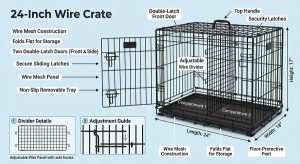
- A 24-inch wire crate with a divider: about $30 to $70
- A thin, washable crate pad: about $15 to $30 (skip thick, hot bedding)
- Soft, small treats: pea-sized pieces, or part of your pug’s daily kibble
- Two safe chew toys: a stuffable rubber toy works well
- An enzyme cleaner for accidents: about $10 to $20
- A small fan or an air-conditioned room if you live somewhere warm
- A treat pouch or small container so rewards are always ready
Tip: Count treats as part of your pug’s daily food. Vets generally advise keeping treats to about 10% of daily calories. Pugs gain weight easily, and extra weight also makes breathing harder.
Pug Crate Size Guide
Most guides say “big enough to stand, turn around and lie down.” That’s right, but it doesn’t help when you’re staring at a shopping page. Here’s what works for pugs.
| Pug age | Crate size | Notes |
|---|---|---|
| 8 to 16 weeks | 24-inch crate with divider | Block off the back so there’s no room to potty |
| 4 to 12 months | 24-inch crate, divider moved back | Give a little more room as he grows |
| Adult (14 to 18 lb) | 24-inch crate (30-inch for a big pug) | Enough room to stretch out, not run laps |
Why wire beats plastic for pugs: Wire crates let air flow from every side. That matters for a breed that overheats. A plastic airline-style crate holds heat in, so use one only for travel and keep a close eye on temperature.
Why a divider matters: If the space is too big, your pug will use one corner as a toilet and sleep in the other. A divider keeps the crate “den small” while he’s learning. Many trainers suggest buying a crate for the dog’s adult size and blocking off the extra space during training.
The 7-Day Fast Crate Training Plan
Let’s talk about the word “fast.” You can’t speed up a puppy’s brain, but you can skip wasted effort. The secret is lots of short sessions, rewards for calm behavior, and changing only one thing at a time. Best Friends Animal Society advises changing only one factor at a time, and going back a step if the dog seems unhappy.
This plan assumes an 8 to 12 week old pug puppy. For an adult pug, use the same steps but move more quickly.
Before You Start
- Put the crate in a busy room, like the living room, at first. Pugs hate being isolated.
- Keep the room cool and out of direct sun.
- Use a cue word like “bed” or “crate” every time. Pick one and stick with it.
- Do each session after a potty break and some play. A pug who’s slightly tired learns faster.
Day 1: Make the Crate the Best Place in the House
Open the door and leave it that way. Toss treats inside. Let your pug walk in, grab one and leave. Don’t shut the door yet.
- Do 5 to 6 short sessions of about 2 minutes each.
- Feed one meal beside the crate door.
- Praise quietly when he goes in.
At night, your pug sleeps in the crate beside your bed. See the night section below for how.
Day 2: Meals Inside the Crate
Move the food bowl just inside the crate. Once he’s eating happily, shut the door while he eats. Open it the moment he’s done, before he has time to fuss.
- Add your cue word as he steps in.
- Hand him a stuffed chew toy for a few minutes inside the crate.
- Keep the door closed for no more than a minute or two beyond mealtime.
Day 3: Door Closed While You Sit Beside
Ask him in, close the door, and sit next to the crate. Reward calm moments with a treat through the bars. Start with 1 minute, then build to 5.
- Open the door while he’s calm, not while he’s whining.
- If he whines, wait for a 3 to 5 second pause, then open the door.
Day 4: Start Moving Around
Keep the door closed for 10 to 15 minutes. Walk around the room, sit down again, and go back to your pug. Step out of sight for 10 to 30 seconds, then return and reward.
- Mix up where you go so he can’t predict it.
- Return before he starts to panic.
Day 5: Short Naps in the Crate
Pugs sleep a lot, so use that. After play and a potty trip, put him in the crate with a chew toy. Let him drift off. Aim for 20 to 30 minutes while you stay in the room.
- Wait until he’s calm to let him out.
- Use a quiet voice. No big greetings.
Day 6: Leave the Room for Longer
Step out for 3 to 5 minutes, then build up. Keep sessions inside your pug’s age limit (see the time table below). Exercise him gently beforehand.
- Don’t make a fuss when you leave or return.
- Practice leaving the house for a minute or two, too.
Day 7: Test and Repeat
Do a mix of everything: a short stay while you’re in another room, a nap, and a short departure. If he does well, great. If he cries or struggles, drop back to Day 5 for a couple of days. That’s not failure. It’s smart training.
Reality check: After 7 days, most pugs will walk into the crate calmly and rest for short periods. Longer stays take more weeks. Every pug is different, and a rescue or older pug may need extra time.
How Long Can a Pug Stay in a Crate?
A pug puppy can’t hold his bladder like an adult. Use these limits as a ceiling, not a target.
A common rule is about one hour per month of age, up to a maximum of eight hours. The Whole Dog Journal suggests puppies shouldn’t be kept in a crate for more than two to four hours at a stretch during the day, and adult dogs no more than six to eight.
For small, flat-faced pugs I stay on the low side:
| Pug age | Daytime crate limit | Night-time |
|---|---|---|
| 8 to 10 weeks | 1 to 2 hours | 1 to 2 potty trips |
| 3 months | 2 to 3 hours | About 1 potty trip |
| 4 to 5 months | 3 to 4 hours | Often sleeps 5 to 6 hours |
| 6 months and up | 4 hours | 6 to 8 hours |
| Adult pug | 4 to 6 hours | Full night |
Do you work a full day? Then a crate alone isn’t enough. Get a dog walker, a friend, or doggy daycare for the midday break. A pug in a crate for 9 hours isn’t being trained. He’s being stored.
Night-Time Crate Training for Pugs
Night one is usually the hardest. Here’s how to survive it.
- Last meal 2 to 3 hours before bed. Take up water about an hour before.
- Take him out for one last potty trip, even if he’s sleepy.
- Put the crate beside your bed. He’ll hear and smell you, which calms him.
- Add something with your scent, like an old T-shirt. Make sure he can’t swallow it.
- Keep the room cool. A fan helps.
- If he wakes and cries at night, take him out quietly, let him pee, and go straight back. No play, no talking.
Young puppies can’t last all night, so expect one or two trips at first. Best Friends advises being ready for one or two nighttime trips outside, and not allowing extra play or water when you come back in.
Over a couple of weeks, you can move the crate a little further from the bed, and finally to where you want it.
For potty timing around the crate, our 7-day potty training schedule pairs well with this plan. If you’d like the whole system in one place, my ebook Beyond the Bark: Inside a Pro Handler’s Playbook for Raising the Ideal Dog walks through puppy potty training step by step.
Pug-Safe Crate Rules: Heat and Breathing
This is the section I wish every guide included. Pugs aren’t just “warm” in a crate. They can get into real danger.
Brachycephalic breeds like pugs can show signs of heat stroke even when the outside temperature and humidity are only moderately high. In a UK study of heat-related illness in dogs seen by vets in 2016, pugs had about three times the odds of heatstroke compared with the comparison group.
Know the numbers. A normal dog temperature is roughly 99.5 to 102.5°F, and heat stroke begins above about 105.8°F. You can’t check this at home without a thermometer, but it shows how little room there is for error.
My crate safety rules for pugs:
- Never crate a pug in a hot room, car, garage or sunny spot.
- Keep air flowing. Use a fan or air conditioning in warm weather. In Lagos-like heat, that’s not optional.
- Don’t cover the whole crate. A light cover over the top and one side is fine. Leave the front and one more side open.
- Skip thick bedding. It traps heat.
- Remove collars and harnesses in the crate. They can snag.
- Cut exercise before crate time. A pug who has just run around is already hot.
- Learn the warning signs: loud, harsh panting, drooling, bright red or pale gums, wobbling, vomiting, collapse. If you see any, move your pug somewhere cool, wet him with room-temperature water, and call your vet right away.
Ice packs and rubbing alcohol are no longer recommended for cooling a dog with heat stroke. Use cool, not freezing, water.
Pugs can also be loud breathers, with snorting and snoring. That’s common. But struggling, blue or gray gums, or gasping isn’t normal. That’s an emergency.
For hot climates and walks, check our guide on dog cooling vests and which ones actually work.
Fixing Common Pug Crate Problems
Here’s the troubleshooting table most guides leave out.
| Problem | Likely cause | Fix |
|---|---|---|
| Won’t go in | Crate feels unfamiliar or scary | Go back to Day 1. Toss treats and feed meals near the door. |
| Cries nonstop | Too much, too soon | Shorten the time. Reward quiet. Wait for a pause before letting him out. |
| Pees or poops in crate | Crate too big or left too long | Add the divider. Take him out more often. Clean with enzyme cleaner. |
| Barks when you leave | Separation stress | Do tiny absences. Give a stuffed toy. Don’t make a big goodbye. |
| Chews bedding | Boredom or teething | Use a thin pad. Add safe chew toys. |
| Panting heavily | Too warm | Move to a cooler spot right away. Check airflow. |
| Cries at night | Needs potty or feels lonely | Quiet potty trip, then straight back. Keep the crate near you. |
Handling the Crying
Crying is the biggest stress for owners. Here’s the simple rule: don’t open the door while he’s crying. Open it when he pauses. Even 3 seconds counts. If you let him out mid-cry, you teach him that noise opens the door. Many trainers say not to let a puppy out until there’s at least a short break in the noise.
But there’s a catch. A puppy who needs to pee will cry. So rule out potty first. If it’s been longer than his limit, take him out quietly. If it hasn’t, wait for the pause.
If your pug panics, drools, shakes or tries to hurt himself, stop. That isn’t normal fussing. That’s distress, and you should talk to a vet or a qualified trainer about separation anxiety.
Trainer Experience and Notes
I work with working dogs, like military and security K9s, and I’ve seen the same lesson over and over. Structure builds confidence. A K9 that knows his crate is his safe place settles faster in vehicles, kennels and new places. That same logic works for a pug on your sofa.
Here’s what I’ve learned that applies to pugs:
- Short and happy beats long and tough. A police K9 handler doesn’t hold a long session on a stressed dog. They stop on a win.
- Consistency matters more than the method. Same cue, same routine, same reward.
- Exercise comes before the crate, calm comes inside it. A dog who’s had a walk, play and a potty break rests better.
- Different breed, same rules. Our crate training guide for any puppy uses the same foundation. The pug version just adds heat and calorie care.
Training your pug also goes beyond the crate. The AKC notes that pugs are good candidates for its S.T.A.R. Puppy program, and that a pug is generally ready for puppy classes using positive reinforcement at around 16 weeks. A pug who’s crate trained and socialized is the easiest kind to take to class.
Always check with your vet if your pug has breathing trouble, heart problems or a medical condition before crate training. This guide is general training advice, not veterinary advice.
7 Mistakes That Slow Everything Down
- Using the crate as punishment. Your pug will start to fear it.
- Buying a crate that’s too big. He’ll toilet in one corner.
- Letting him out while crying. That teaches him to cry louder.
- Leaving him too long. That causes accidents and anxiety.
- Skipping heat checks. A warm crate can be dangerous for a pug.
- Overfeeding treats. Use part of his meals instead.
- Pushing too fast. If he struggles, step back. Never force a dog into the crate.
FAQs
1. How long does it take to crate train a pug?
Most pugs learn to enter and relax in the crate within 1 to 2 weeks if you train several times a day. Reliable behavior for longer stays often takes 4 to 8 weeks. A rescue or adult pug may take a little longer.
2. What size crate does a pug need?
A 24-inch wire crate suits most pugs, both puppy and adult. Use a divider while your pug is young so he can’t use half the crate as a toilet. A very large pug may need a 30-inch crate.
3. Should a pug sleep in a crate at night?
Yes, it’s a good idea, especially for puppies. Put the crate beside your bed at first so he feels safe, and take him out for potty trips as needed. Keep the room cool, and move the crate away from you gradually.
4. Is it okay to leave a pug in a crate while I’m at work?
Not for a full workday. A young puppy should stay in a crate for only a couple of hours at a time, and adults shouldn’t spend long, hot or hungry stretches there. Arrange a midday break with a walker, sitter or daycare.
5. Why does my pug cry in the crate, and what should I do?
He may need to pee, feel lonely, or not be used to the crate yet. Take him out if he’s due a potty trip. If not, wait for a short pause in the crying, then open the door and reward calm. Keep sessions short and build up slowly.
Conclusion
Crate training a pug works best when you stay calm, keep sessions short and keep safety first. Pick a 24-inch wire crate with a divider. Use food to make the crate a happy place. Follow the 7-day plan, and don’t be afraid to go back a step. Respect the time limits for your pug’s age, and protect him from heat at all times.
Here’s your action list for today:
- Set up a 24-inch wire crate with a divider in a cool, busy room.
- Do three short Day 1 sessions with treats.
- Plan tonight’s routine: last potty trip, crate beside your bed.
- Arrange a midday potty break if you work away from home.
Want more training tips like this every week? Subscribe to our weekly articles roundup newsletter: https://arfsk9team.com.ng/newsletter/

Her work centres on obedience, detection, protection and operational readiness. She favours proven methods built on repetition, consistency and real-world conditioning, so that both dogs and handlers are prepared for high-pressure tasks.
Rofiat represented the Nigerian Army Dog Centre at the Nigerian Army Day Celebration (NADCEL) 2026, where she led demonstrations in obedience, explosive detection, agility and tactical movement. Through articles, training content and documentaries, she shares field-based insight into how structured training, clear communication and trust between handler and dog affect performance and reliability.
She is the author of Beyond the Bark: Inside a Pro Handler's Playbook for Raising the Ideal Dog, a practical guide that helps dog owners and handlers apply professional training principles in everyday situations.
- Food Aggression Dog Training: Pro K9 Guide - November 21, 2026
- DIY Dog Scent Training: Easy 4-Week Home Guide - November 20, 2026
- Buckeye Puppies Review: 5 Red Flags to Check - November 19, 2026