Dog GPS Tracker: How to Pick One That Actually Lasts

A dog GPS tracker that lasts has four things. It has an IP68 waterproof rating if your dog swims (IP67 if not), and a battery that holds up in live-tracking mode, not just on the box. It needs a signal type that fits where your dog runs: cellular for towns, radio or satellite for remote land. And it needs a company likely to still exist in three years. Check the 3-year cost, the collar fit and your country’s coverage before you buy.
Table of Contents
- Why Most Dog GPS Trackers Don’t Last
- Pick Your Signal Type First
- Waterproof Ratings Without the Marketing
- Battery Life: Claimed vs. Tested
- The Real 3-Year Cost
- Does It Work in Your Country?
- Size, Fit and Attachment
- Best Dog GPS Trackers by Situation
- Match It to Your Dog (and Test It in 7 Days)
- Care Habits That Extend Lifespan
- If Your Dog Goes Missing: The First-Hour Plan
- How I Researched This Guide
- FAQs
- Final Thoughts
Introduction
Here’s the thing nobody tells you at the pet store. A dog GPS tracker almost never fails because the GPS chip is bad. It fails because of boring stuff. A seal wears out. The battery quits on day three. The trail has no signal. The strap lets go. Or the company shuts down.
Ever notice the tracker that worked fine in your backyard “loses” your dog the one day he bolts after a deer? That’s not bad luck. That’s a mismatch between the device and the dog’s real life.
In this guide, I’ll show you how to choose a dog GPS tracker that survives mud, swimming and years of use. You’ll learn what the specs really mean, what battery life looks like in real testing, and what a tracker truly costs over three years. You’ll also see which signal type fits your dog and what to do in the first hour if your dog goes missing.
1. Why Most Dog GPS Trackers Don’t Last
The numbers show why tracking matters. In a large ASPCA-linked survey, about 14% of dog owners lost their dog at least temporarily over five years, and 93% of lost dogs came home. Most dogs make it back. The question is how fast and how stressfully.
That same research found 49% of dogs were found by owners searching the neighborhood, while only 15% were recovered thanks to an ID tag or microchip. In plain English, searching quickly and in the right direction does most of the work. A live GPS tracker gives you that direction.
So what quietly kills trackers? Five things:
- Water getting in. Seals age. Mud and charging ports make it worse.
- A dead or fading battery. Box claims assume perfect conditions.
- A signal gap. A cellular tracker needs a tower. Forests and valleys block it.
- A loose attachment. The tracker falls off and your dog keeps running.
- A company that disappears. This one surprises people.
The Whistle lesson
Whistle was a big name in dog trackers. Then Tractive acquired it, and Whistle trackers stopped working on August 31, 2025. Owners got roughly six weeks’ notice, and the free replacement offer closed on September 30, 2025.
Owners who’d paid for good hardware were left holding a dead gadget. Most “best tracker” lists skip this, but longevity includes the company’s staying power. A cellular tracker is really a service. If the service ends, so does the tracker.
2. Pick Your Signal Type First
Choose the signal type before you look at brands. It decides whether the tracker works on your dog’s worst day.
| Signal type | How it works | Best for | Main catch |
|---|---|---|---|
| Cellular (LTE) + GPS | Collar finds its position by GPS and sends it over cell networks to your phone | Towns, suburbs, most hikes | Dead zones; subscription |
| Radio/satellite + handheld | Collar talks to a handheld unit you carry | Hunting, remote land, no-signal areas | Bulky; costly; limited range |
| Bluetooth tags | Relies on nearby phones to relay location | Dense cities only | Useless in empty areas |
Cellular trackers dominate for good reason. They’re light, have simple apps and no range limit as long as there’s a signal. LTE collars have no set range, so you could track a dog from miles away, as long as there’s cell service.
Radio and satellite systems work without towers. The Garmin Alpha T 20 is one example. It was the only collar in Treeline’s test that worked with zero cell service, with a nine-mile range. The price is bulk. The same review says it feels too big for dogs under 30–40 pounds and needs a separate handheld.
Bluetooth tags are the trap. Apple’s own marketing executive said AirTags were designed to track items, not people or pets. They only update when someone’s phone passes nearby. In a city, that might be fine. In open country, you get silence.
Quick test: Picture the day your dog actually bolts. Where would it happen? Streets, forest, farmland, a campsite? That one answer tells you which row of the table to shop in.
3. Waterproof Ratings Without the Marketing
IP ratings look scientific, but they’re simple once you break them down. The first digit covers dust. The second covers water.
- IPX7 / IP67: Survives submersion up to one meter for about 30 minutes. This is fine for rain, puddles and the odd creek wade.
- IPX8 / IP68: Goes deeper than one meter, and the maker sets the exact depth. Treeline notes IP68 collars are often quoted at around 1.5 meters for 30 minutes. Choose this for regular swimmers.
- 1 ATM: Treeline puts this at roughly 10 meters of water pressure. Garmin uses it.
- “Water-resistant” or “splash-proof”: Not the same thing. Don’t let a swimmer wear it.
The AirTag is a good example of why the label isn’t the whole story. Reviewers treat it as splash-resistant rather than fully waterproof, so if you use one, buy a waterproof holder.
Handler’s rule: An IP rating is a day-one result from a clean lab. Seals age, and sand, salt and mud speed that up. Treat the rating as a starting point, not a lifetime promise. Choose IP68 if your dog swims, works near water or lives somewhere wet. Rinse the device after salt or mud.
4. Battery Life: Claimed vs. Tested
Battery claims come from best-case settings. Your dog’s worst day is the opposite. Live tracking, the mode you’ll use most during a search, drains power fastest. The Treeline tester noted live tracking killed battery life faster on every collar she tried.
Here’s how claims compare with testing. These tests came from one US trainer-reviewer, so results vary with signal and settings.
| Tracker | Claimed battery | Tested battery |
|---|---|---|
| Tractive DOG 6 | Up to 14 days | 25 days |
| Tractive DOG 6 XL | Up to 30 days | ~35 days |
| Fi Series 3+ | Up to 3 months | ~10 weeks |
| Fi Mini | Up to 6 weeks | ~6 weeks |
| Petcube GPS | Up to 30 days | 12 days |
| Garmin Alpha LTE | 11–75 hours (depends on update rate) | ~10–11 hours at 10-second updates; 45 at 2-minute |
| Garmin Alpha T 20 | Up to 68 hours | 2.5–3.5 days |
| Fi Ultra (satellite) | — | 5 days |
Figures from Treeline Review’s August 2026 update: Treeline Review’s testing.
Notice the spread. Tractive’s DOG 6 beat its claim in one test, while another reviewer saw real-world use of about 6–8 days, dropping to 4–5 days with frequent live tracking. Both can be true. The difference is settings and signals.
The setting that matters most
Tractive’s own figures show why. The DOG 6 lasts up to 14 days with Power Saving Zones but about 6 days without. You can set up to five zones, like your home and a friend’s house. If you buy this brand, set the zones on day one. Many owners never do.
Battery rules I follow
- Read the live-mode number, not the headline. Garmin’s LTE collar shows how brutal it gets: roughly 10–11 hours at 10-second updates.
- Budget less in the cold. Winter shortens runtime for every lithium battery.
- Charge before every outing, not when it hits 10%.
- Expect fade. Rechargeable batteries slowly lose capacity over years. That’s my rule of thumb, not a manufacturer figure. Plan to reassess at around two to three years.
5. The Real 3-Year Cost
The sticker price misleads. Most cellular trackers act like a phone line for your dog. Subscriptions typically run $60 to $200 per year.
Here’s a 3-year estimate using US prices on annual plans from Treeline’s data:
| Tracker | Upfront | Plan | 3-year total |
|---|---|---|---|
| Petcube GPS | $53 | $84/yr basic | ~$305 |
| Tractive DOG 6 | $79 | $108/yr basic | ~$403 |
| Tractive DOG 6 XL | $89 | $108/yr basic | ~$413 |
| Garmin Alpha LTE | $300 | $4.99/mo | ~$480 |
| Fi Series 3+ | Free with plan | $189/yr | ~$567 |
| Garmin Alpha T 20 (+ handheld) | $300 + $400+ | None | $700+ |
| AirTag + holder | ~$29 + holder | None | ~$40–60 |
Prices from Treeline Review’s plan listings*. Prices change, and multi-year plans lower the yearly rate, so check current offers.*
What does this tell you? Subscription trackers often cost two to four times their hardware price over three years. A tracker that’s cheap today can be pricey by year three.
No-subscription options
If monthly fees are a dealbreaker, you have real choices:
- Radio/satellite systems: Garmin Alpha. A budget-ish radio option is the Dogtra Pathfinder 2 at around $430, while a Garmin Alpha 300i plus collar runs around $1,200.
- PitPat: listed at $159 / £149 with lifetime cellular included, though other retailers list it near $199, so confirm before buying.
- AirTag: no fee, but only suited to crowded areas.
One caution. Some of these comparison pages come from brands selling the product. I used them only for prices, not for verdicts.
6. Does It Work in Your Country?
This is the section most US-written guides skip. Coverage depends on the network the tracker uses, and some trackers only work in certain places.
- Fi Series 3+: works in the US, Canada and Mexico, on a single carrier network (AT&T LTE-M), so local coverage matters.
- PetLinkGPS: advertises live tracking throughout the USA. If you live in the UK or Europe, skip it.
- Tractive: uses multiple carriers. Treeline says it works in over 175 countries on the premium plan. In Europe, subscriptions start from around €5 a month, and UK hardware typically sells for roughly £36–£52.
- Garmin Alpha LTE: works in the US, Canada, Mexico and several European countries.
Before you buy, check the maker’s coverage map for your exact country, and for the trails you actually walk. If you travel with your dog, check roaming rules too.
7. Size, Fit and Attachment
A tracker only helps if it stays on the dog. This is where real-world gear fails.
Treeline’s testing shows how common the problems are:
- The Fi Series 3+ included collar doesn’t hold its adjustment well, so the tester bought a separate attachment.
- The Garmin Alpha LTE doesn’t fit plastic buckle collars.
- The Petcube’s silicone case slid off belt-buckle-style collars too easily.
Size matters too. The Tractive DOG 6 suits dogs from about 4 kg (9 lb), while the XL feels bulky under 50 pounds. For toy breeds, the Fi Mini weighs just 0.56 oz.
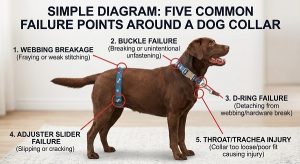
A tracker is only as secure as what it’s clipped to. Our guide on the hidden dangers of cheap dog collars explains why a weak buckle puts both collar and tracker at risk. For working or strong dogs, pairing the tracker with a solid harness helps too. See what military handlers look for in a K9 harness.
Attachment checklist:
- Does it fit your collar type (buckle, prong, rolled)?
- Is there a secure case or strap, not just a clip?
- Can your dog wear it comfortably all day?
- Does it fit a harness ring if your dog wears a harness?
8. Best Dog GPS Trackers by Situation
No tracker wins every category. Here’s my honest breakdown. These picks lean on independent testing, and I note the catches.
Best overall (worldwide): Tractive DOG 6. Treeline’s tester called it the most accurate cellular tracker she tested, with fast connection and multiple carriers. Catch: it doesn’t track walks unless you start one in the app.
Best battery and daily-life tracking (US/Canada/Mexico): Fi Series 3+. About ten weeks in testing, plus automatic walk tracking. Catches: it costs more, and Treeline found location slightly less accurate than Tractive.
Best for large dogs: Tractive DOG 6 XL. Longer battery, but heavier.
Best for small dogs: Fi Mini or an AirTag in a safe, waterproof holder if you live in a city.
Best for remote land and hunting: Garmin Alpha T 20 or Dogtra Pathfinder. No cell service needed. Expect bulk and cost.
Best for no-signal adventures with a phone: Fi Ultra. It’s a newer option that uses Starlink satellite connectivity with about five days of battery in testing, at $199 plus $189 per year. It’s newer, so I’d watch long-term reviews.
Budget city option: AirTag in a waterproof holder. Only for dogs that rarely leave crowded areas.
🛒 Recommended Dog GPS Trackers
If you want to skip the spec-sheet marathon, here are three worth considering. Read the notes, because I’ve flagged the catches.
🔹 Fi Series 3+ Smart Dog Collar — Long battery life and slim design, but US/Canada/Mexico only. 👉 Check the Fi Series 3+ on Amazon
🔹 Tracki Dog GPS Tracker — Clips onto most collars. The catch: reviews report 2–5 days of battery with frequent updates, and the Chewy listing for its pet model averages 2.4 out of 5 stars, with some owners complaining about support. Fine as a budget backup, not my first pick for long-term reliability. 👉 Check the Tracki GPS Tracker on Amazon
🔹 PetLink GPS Dog Tracker — IP67 and affordable, but built for live tracking in the USA, and some user reviews report short battery life while others praise it. Check it’s supported where you live. 👉 Check the PetLink GPS Tracker on Amazon
Disclosure: Some links are affiliate links. If you buy through them, we may earn a small commission at no extra cost to you.
9. Match It to Your Dog (and Test It in 7 Days)
Quick decision guide
- City or suburb, medium dog → Cellular tracker with multi-carrier coverage.
- Hiking, camping, farmland → Cellular with a strong plan, or radio/satellite if there’s no signal.
- Hunting or working dog off-grid → Radio/satellite with a handheld.
- Toy or small dog → Lightweight cellular (Fi Mini) or a Bluetooth tag in a city.
- Dog that swims → IP68 or 1 ATM, no exceptions.
- Escape artist at home → Any cellular tracker with fast boundary alerts.
The 7-day test (do this before your return window closes)
Never trust a tracker you haven’t tested. Here’s my routine:
- Day 1: Charge fully. Set up the app. Add Power Saving Zones or safe zones.
- Day 2: Walk a known route. Check the map against where you actually went.
- Day 3: Walk somewhere with weak signal. See what happens.
- Day 4: Test the escape alert. Leave the safe zone with your phone in your pocket.
- Day 5: Run live tracking for 15 minutes. Note the battery drop.
- Day 6: Give it a real splash or rinse test (if your dog swims, a shallow dip).
- Day 7: Shake the collar and tug the tracker. Does it hold?
Fail any step? Return it. That week is cheaper than a lost dog.
10. Care Habits That Extend Lifespan
These take five minutes and cost nothing.
- Rinse after mud or salt. Salt corrodes seals and contacts.
- Dry fully before charging. Charging a wet tracker can damage the battery.
- Check seals and straps monthly. Hairline cracks are where water gets in.
- Update the app and firmware. Updates often fix battery and accuracy bugs.
- Charge on a schedule. Make it part of your Sunday routine.
- Replace the strap before it fails. Worn straps are a common failure.
11. If Your Dog Goes Missing: The First-Hour Plan
A tracker helps most in the first hour. Here’s what to do.
- Open the app and start live tracking immediately. Don’t wait.
- Head toward the dot, and call the dog calmly. Don’t chase.
- Use the light or sound feature if your tracker has one.
- If the signal drops, go to the last known location and widen your search from there.
- Call local shelters, vets and animal control, and post in local lost-dog groups.
Layer your ID
A tracker shouldn’t be your only safety net. Microchips matter, but only when they’re registered. In the best-known US shelter study, microchipped dogs were returned to owners 52.2% of the time, versus 21.9% without a chip. Most chipped pets that didn’t get home had wrong or missing owner details in the registry. And a microchip is not a GPS device and can’t track a pet in real time.
So use three layers: a tracker for speed, a registered microchip for permanence, and a clear ID tag for any stranger who finds your dog. Not sure what to put on a tag? Our military dog tag format guide shows what to engrave.
12. How I Researched This Guide
I’m Cpl. Rofiat Muritala, a military working dog instructor and handler with more than 14 years at the Nigerian Army Dog Centre. My work covers obedience, detection and protection training. I’ve seen how much a dog’s gear matters when conditions get rough. I also represented the Centre at the Nigerian Army Day Celebration (NADCEL) 2026.
I haven’t field-tested every tracker in this article. Where I cite battery numbers or accuracy results, they come from independent testers, and I’ve named the source. I compared page-one reviews, manufacturer figures and owner complaints, and I flagged where they disagree.
13. FAQs
How long does a dog GPS tracker last?
It depends on what you mean. Battery per charge ranges from about 10 hours (fast live tracking) to several months. The device itself can last years, but long-term data is thin. Treeline notes dog GPS collars haven’t existed long enough to call any one future-proof. I’d plan to reassess at two to three years, as batteries fade.
Do dog GPS trackers need a subscription?
Most cellular trackers do, because they use their own cell connection. Typical plans run roughly $5 to $20 per month. Radio/satellite systems and Bluetooth tags don’t need a plan.
What waterproof rating should a dog GPS tracker have?
IP67 handles rain and shallow wading. Choose IP68 or 1 ATM if your dog swims regularly.
Can I use an Apple AirTag as a dog tracker?
You can, but it’s a weak fit. It relies on nearby phones, so it works best in crowded areas and poorly in open country. Apple’s marketing executive said it was built for items, not pets.
How far can a GPS dog tracker track?
Cellular trackers have no set range if there’s coverage. Radio systems have limits: the Garmin Alpha T 20 reaches about nine miles, and terrain can shorten that.
14. Final Thoughts
There’s no indestructible dog GPS tracker. But there is the right one for your dog’s life. Match the signal type to where your dog actually runs. Choose IP68 if there’s any chance of swimming. Read the live-mode battery number, not the headline. Check the 3-year cost, your country’s coverage and whether the company is likely to stick around.
Then do the 7-day test, set up your safe zones, and layer on a microchip and ID tag. Do that and you’ll be ready for the one day it matters.
Want more gear and training advice from a working handler? Subscribe to our weekly articles roundup. And if you want the professional training principles behind this, my book Beyond the Bark: Inside a Pro Handler’s Playbook for Raising the Ideal Dog is a practical place to start.

Her work centres on obedience, detection, protection and operational readiness. She favours proven methods built on repetition, consistency and real-world conditioning, so that both dogs and handlers are prepared for high-pressure tasks.
Rofiat represented the Nigerian Army Dog Centre at the Nigerian Army Day Celebration (NADCEL) 2026, where she led demonstrations in obedience, explosive detection, agility and tactical movement. Through articles, training content and documentaries, she shares field-based insight into how structured training, clear communication and trust between handler and dog affect performance and reliability.
She is the author of Beyond the Bark: Inside a Pro Handler's Playbook for Raising the Ideal Dog, a practical guide that helps dog owners and handlers apply professional training principles in everyday situations.
- K9 Advantix Dosage Chart & Safety Guide for Dogs - October 19, 2026
- How to Set Up & Use Bousnic Dog Training Collar - October 18, 2026
- Westminster Dog Show 2026: Winners & Full Results - October 17, 2026