Best Working Dog Toys for Focus & Drive (2026 Guide)
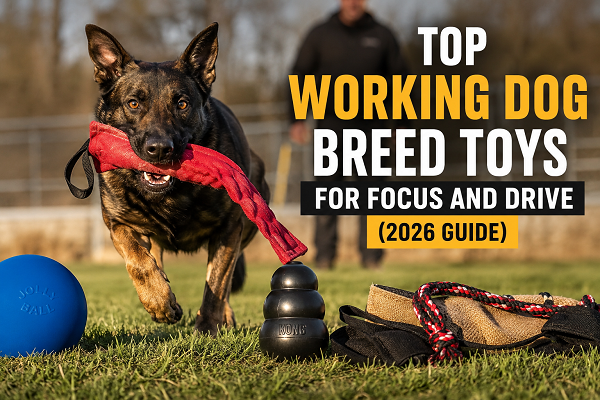
What are the best working dog toys for focus and drive? The best working dog toys for focus and drive are handler-controlled tools that trigger the chase, grab and hold sequence: a flirt pole, a quality tug (jute, leather or fire hose), a ball on a rope, and a tough rubber chew like KONG Extreme for downtime. Pick the toy that matches your dog’s drive type, keep high-value toys under your control, and always teach a clean “out” cue. Used this way, toys turn raw energy into focus you can train.
Table of Contents
- Why Toys Matter More for Working Dogs Than Pets
- What “Drive” Really Means (and the 3 Types That Pick Your Toy)
- What Real K9 Programs Teach Us About Toy Reward
- The 4 Toy Categories Every Working Dog Needs
- Our Top Picks for Focus and Drive
- Match the Toy to the Job (Quick Comparison Table)
- Breed-by-Breed Toy Guide
- How to Use a Toy as a Training Tool: Step by Step
- Toy Safety Rules Most Guides Skip
- Common Mistakes (and Fixes)
- When Your Dog Has Low Toy Drive
- Why You Can Trust This Guide (Handler Experience)
- FAQs
- Final Thoughts
Why Toys Matter More for Working Dogs Than Pets
If you have ever held the leash of a Belgian Malinois, German Shepherd or Dutch Shepherd that seemed to vibrate with energy, you already know the problem. These dogs were bred to work. When they have no job, they invent one. That usually means your sofa, your shoes or your neighbour’s cat.
So the best working dog toys are not about entertainment. They are tools. A good toy gives a high-drive dog a legal outlet for chasing, biting and holding. It also teaches the dog to focus on you in order to get that reward.
In this guide, you will learn:
- What drive really is, and how to read it in your dog
- Which toys build focus, and which ones just make a mess
- How professional K9 programs use toys as the main reward
- A step-by-step method to build toy drive and a reliable “out”
- Safety rules and toy retirement signs that most blogs never mention
- What to do if your dog doesn’t care about toys at all
I’m writing this the way I’d explain it to a new handler at the dog centre. No fluff. Just what works.
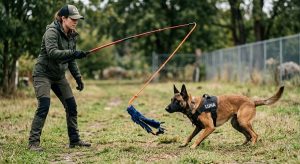
What “Drive” Really Means (and the 3 Types That Pick Your Toy)
Ask ten owners what “drive” means and you’ll get ten answers. In working dog circles, drive is not just energy. It’s a set of inborn instincts that trainers sort into groups.
The three that matter most when you pick toys:
- Prey drive: The urge to notice movement, chase it, grab it and hold it. Flirt poles, balls and tugs target this.
- Food drive: How hard a dog will work for a meal or a treat. Puzzle feeders and treat-stuffed chews fit here.
- Play drive: How much a dog enjoys a game with you, even when no real prey is involved. This is the one many handlers forget. A dog can have decent prey drive and still not want to play with you.
Defense drive and fight drive also exist, but toys don’t build them. Trainers handle those through structured protection work with an experienced decoy.
Here’s something that surprises new handlers. Drive is not the same as nerve strength. A dog with huge drive and weak nerves can be harder to train than a moderate-drive dog with rock-solid nerves. Many respected trainers, including the team at Leerburg, make this point often. So if your dog shuts down or runs from the toy, don’t add more intensity. Slow down and build confidence first.
Here’s a quick self-test you can try today:
- Roll a ball or drag a rag across the floor. Does your dog chase it right away? (Prey drive)
- Does your dog grab it and bring it back, or run off with it? (Retrieve and handler focus)
- If you hide the toy, how long does the dog search before giving up? (Hunt drive and persistence)
That last test is not just a home trick. Military handlers at Davis-Monthan Air Force Base have described a similar check during dog selection: they watch how long a dog hunts for a lost toy and whether it gives up quickly or stays determined.
What Real K9 Programs Teach Us About Toy Reward
Most articles on this topic jump straight into products. I’d rather show you why toys sit at the centre of serious K9 work.
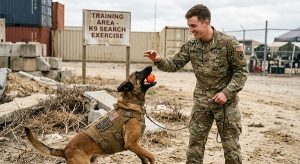
- The U.S. Military Working Dog program trains most of its dogs at Joint Base San Antonio-Lackland in Texas, through the 341st Training Squadron. Public program material describes the system as one built on positive rewards, usually a ball or a rubber toy, instead of food.
- Lackland began its own breeding program in 2005, and Belgian Malinois are the only breed in that programme. That tells you something about which dogs hold toy drive and nerve strength together.
- Handlers who select dogs for detection work look for very high toy drive. The reasoning is simple: a dog that wants the toy badly will search harder, work longer and learn faster.
- Only about half of potential military working dogs finish their training. Drive alone doesn’t carry a dog through. Nerve, health and focus on the handler matter just as much.
- Reported figures from older U.S. military sources put the accuracy of explosive detection dogs near 98 percent. A big reason is that the work feels like a game with a prize at the end.
What does this mean for you? Even if you never plan to enter a police or military programme, you can copy the idea. Find the thing your dog wants most. Make the dog earn it through focus. Then deliver it the second the job is done.
The 4 Toy Categories Every Working Dog Needs
Most older guides list three toy types. In my experience, a complete kit has four. The fourth one, the search toy, is the one other websites leave out.
- Drive-building toys (flirt poles, tugs, bite rags): These trigger the chase, grab and hold sequence. You use them in short, handler-led sessions.
- Focus and reward toys (one special ball or tug used only for training): This toy never appears at any other time. Because it stays rare, the dog works hard to earn it.
- Search and scent toys (a ball or towel on a rope, hidden or planted for the dog to find): These turn hunt drive into nose work. They are the base of detection training and a great mental workout for any breed.
- Independent enrichment toys (rubber chews, stuffed toys, puzzle feeders): These let the dog work alone during crate time, recovery days and quiet evenings.
A dog with only chew toys has no handler engagement. A dog with only tugs has nothing to do when you leave the room. You need both.
Our Top Picks for Focus and Drive
I’m often asked which toys are worth the money and which fall apart in a week. These three have a clear job, and they cover three of the four categories above.
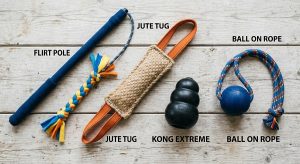
1. KONG Extreme Dog Toy: Best for Independent Chew Focus
This is the toy I recommend most for solo enrichment. The black rubber is KONG’s toughest formula, made for power chewers. You can stuff it with kibble, wet food or peanut butter (check it has no xylitol) and freeze it for longer sessions.
Use it for crate time, recovery days and the moments when you need thirty quiet minutes. It’s tough enough for German Shepherds, Malinois and Cane Corsos, though no toy is indestructible. Check it before every use.
Typical price range: roughly $12 to $25 depending on size and store.
2. Jolly Pets Push-n-Play Ball: Best for Herding and Chase Drive
Some dogs don’t want to bite and hold. They want to control and push. Border Collies, Australian Shepherds and many Malinois fall into this group. This ball bounces unpredictably, floats, and lets the dog push it with the nose and chest.
It’s a great outlet for the “herding” instinct. It also works well for dogs who get frustrated with tug games.
One warning: use it with supervision, and take it away when the session ends.
3. RedLine K9 Puppy Prey Drive Building Flirt Pole: Best for Building Prey Drive and Impulse Control
This is a real training tool, not a repackaged cat toy. The leather lure on a flexible pole starts the chase sequence in a way you fully control. Professional decoys and trainers use similar setups to build prey drive in young dogs before any bite work starts.
Ten minutes of structured flirt pole work can tire a high-drive dog more than a long walk, because it demands sprints, sharp turns and constant eye contact.
Keep two rules. First, play catch and release, not a tug-of-war. Second, never let the dog keep the lure afterward. That is what keeps the drive tied to you.
(As an Amazon Associate, purchases through these links may earn a small commission at no extra cost to you. It helps keep guides like this free.)
Also Worth Adding to Your Kit
I haven’t linked these because every handler’s budget and region differ, but they appear in most K9 toy kits:
- A jute, leather or fire hose tug with handles. Jute and fire hose are loved for building grip and drive. Many trainers use leather bite pillows for strong, confident biters. Specialist suppliers such as Leerburg list tugs from around $12 to $45, depending on material.
- A ball on a rope or a rope-covered ball. It gives you something to swing, throw and reel in. It also keeps your hands away from your dog’s teeth.
- A hard rubber ball sized correctly for your dog’s mouth. Pick one that’s too large to swallow or lodge in the throat.
Match the Toy to the Job (Quick Comparison Table)
| Your Goal | Best Toy Type | Why It Works | Typical Session |
|---|---|---|---|
| Build prey drive in a young dog | Flirt pole with soft lure | Triggers chase safely, you control speed | 5 to 10 minutes |
| Sharpen focus in obedience | Reserved tug or ball (training only) | Dog works to earn a rare reward | 1 to 3 minutes per reward |
| Prepare for detection or search work | Ball or towel on a rope | Links the hunt to the prize | 5 to 15 minutes |
| Improve grip and confidence | Jute, leather or fire hose tug | Builds full, calm bites | 5 to 10 minutes |
| Calm a restless dog at home | Stuffed rubber chew (KONG Extreme) | Gives a long, quiet outlet | 20 to 40 minutes |
| Satisfy herding instinct | Push ball (Jolly Pets style) | Allows control and chase without biting | 10 minutes |
| Mental work on a rest day | Puzzle feeder or scent game | Tires the brain, not the joints | 10 to 20 minutes |
Breed-by-Breed Toy Guide
Different working lines show drive in different ways. Pick toys that suit the way your dog is wired, not just the breed’s reputation.
- Belgian Malinois: Very high prey and play drive. Thrives on flirt poles, a ball on a rope and structured tug. Needs a job. Keep sessions crisp and end them while the dog still wants more. Many Malinois also have intense frustration when games stall, so keep the rhythm fast.
- German Shepherd: Strong prey drive plus a natural wish to work with people. That’s one reason the breed stays so common in police and military units. Ball-on-rope games and tug as an obedience reward work well. Pay attention to hips and joints during hard turns.
- Dutch Shepherd: Similar to the Malinois but often steadier. Loves tug and bite pillows. Needs early channelling to avoid frustration behaviour.
- Labrador Retriever: Bred to retrieve. Soft-mouth ball work and search games work better than rough tug. A high food drive makes puzzle feeders very effective. Labs are also the classic detection breed, so search toys suit them well.
- Border Collie and Australian Shepherd: Eye, stalk and chase dominate. Push balls and flirt pole games beat tug for most of them. Teach a calm “down” between rounds.
- Doberman and Rottweiler: Strong defence and fight drive with moderate prey drive. Tug builds confidence and teaches control. Keep games structured and finish with obedience.
- Cane Corso and other guardian breeds: Usually lower toy drive than the herding breeds. Use rope tugs, rubber chews and short, calm sessions. Don’t push a guardian breed to behave like a Malinois.
For a deeper look at how instinct and obedience fight and cooperate inside your dog, read our guide on Dog Obedience vs. Instinct: How to Balance Drive and Control.
How to Use a Toy as a Training Tool: Step by Step
Buying the right toy is maybe 30 percent of the job. How you use it is the rest. Here’s the routine I’d teach a new handler.
Step 1: Pick one reward toy and make it rare (Days 1 to 3)
Choose one ball or tug. Keep it in a cupboard or bag. It comes out only for training. After a few days, you’ll notice your dog watching that cupboard.
Step 2: Build excitement (Week 1)
Move the toy low and fast, away from the dog, like fleeing prey. Let the dog catch it often at first. Success builds confidence. Never poke or tease the dog’s face.
Step 3: Teach the “out” (Weeks 1 to 2)
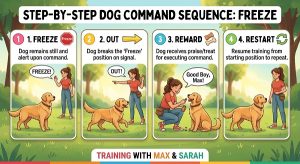
When the dog has a firm grip, stop moving and freeze. Wait. When the dog loosens, say “out” and reward with a treat or a restart of the game. Most dogs learn the basic idea within 1 to 2 weeks if you practise daily. Never rip the toy away. A fight over the toy teaches the opposite lesson.
Step 4: Add one simple command (Weeks 2 to 4)
Ask for a short “sit” or “look” before the toy comes out. Then release the dog to the toy with a clear word such as “get it.” Now the toy rewards focus, not chaos.
Step 5: Add distance and duration (Weeks 4 to 8)
Heel for a few steps, then reward. Build up slowly. Short rounds and many repetitions beat one long session.
Step 6: Add distractions (Month 2 onward)
Practise in a quiet garden, then a park, then a busier place. Drop back a step when the dog loses focus. This is where the real strength shows.
These timelines aren’t fixed. A confident adult Malinois can move fast. A shy young dog may need double the time. Go at your dog’s pace.
For how often a working dog should exercise to match this training, see our guide on how often to exercise a working dog.
Toy Safety Rules Most Guides Skip
This is the section I wish more blogs wrote. Drive toys are intense, so safety needs a plan.
- Inspect before every session. Look for frayed seams, loose threads, cracks in rubber and torn leather. A shredded tug is a swallowing risk.
- Retire worn toys. If a piece could break off, throw the toy away. Don’t wait for it to fall apart.
- Size the ball properly. A ball must be too big to fit at the back of your dog’s throat. When in doubt, go larger.
- Watch tennis balls. They’re popular, and yes, many detection programmes use them as rewards. But the rough felt can wear teeth down over years of heavy use, and dogs can tear the cover. Supervise, and swap to rubber balls for heavy chewers.
- Protect growing puppies. Puppies are teething from roughly 3 to 6 months. Keep tug gentle and level with the dog’s body. Don’t lift a puppy off the ground by a toy or yank up and down. Large breeds can have open growth plates until around 12 to 18 months or longer, so avoid hard jumps and sharp turns on slippery floors. Ask your vet about your own dog.
- Mind the surface. Flirt pole play on tile, wet grass or concrete causes slips and torn ligaments. Choose firm, non-slip ground.
- Never leave drive toys lying around. Store them out of reach. This protects the toy’s value and prevents guarding.
- Keep children out of the game. High-drive dogs can bite when they’re excited, even by accident.
- Clean and dry toys. Wash fabric and rubber toys regularly. Damp jute and rope can grow mould.
- Know your dog’s limits. If your dog pants hard, limps or loses interest, stop. A good session ends early.
Want to move from toy work into real bite work later? Read our guide on choosing the right bite sleeve for K9 protection training. Do not start bite work without an experienced trainer.
Common Mistakes (and Fixes)
- Leaving high-value toys out all day. Fix: Store them. Bring them out only for sessions.
- Turning tug into a power struggle. Fix: Keep it a game. Let the dog “win” often, then ask for the out.
- Skipping the out cue. Fix: Teach it in week one. Dogs that never learn to release often start guarding toys.
- Using the same toy for house play and serious training. Fix: Keep a separate training toy so “work mode” stays clear.
- Ignoring nerve strength. Fix: If your dog looks stressed, retreat to easier games. More intensity won’t fix a confidence problem.
- Ending the game when the dog is bored. Fix: End it while the dog still wants more. A good trainer always leaves the dog hungry for the next round.
- Buying a toy that’s too hard or too soft. Fix: Match the material to your dog’s chewing style (see the table above).
When Your Dog Has Low Toy Drive
Not every working breed arrives with a roaring toy drive. Maybe your dog is a shy rescue, a calm Cane Corso or an older dog that never learned to play. Here’s what I’d try.
- Start with movement, not the toy. Run away from your dog. Most dogs follow movement.
- Try different textures. Some dogs prefer fur, some prefer jute, some love a squeaky ball. Offer one or two at a time.
- Use food to create excitement. Pair the toy with treats. Slowly shift to the toy alone.
- Keep sessions very short. One minute of fun beats five minutes of boredom.
- Raise value by rarity. The less often the dog sees the toy, the more it wants it.
- Rule out health or stress. A dog in pain or anxious won’t play. See your vet if the change is sudden.
Be patient. Many dogs open up once they realise the game is safe and fun. If after a few weeks nothing works, use food as the main reward. Not every great dog is a toy-crazy dog, and that’s fine.
Why You Can Trust This Guide (Handler Experience)
Good advice needs real experience behind it. Here’s mine.
I’m Cpl. Rofiat Muritala, a Nigerian Army military working dog instructor and handler with more than 14 years at the Nigerian Army Dog Centre. My work covers dog selection, foundation training, behaviour shaping and performance evaluation in real operational settings. I’ve completed advanced obedience, K9 patrol and advanced explosive detection courses. In 2026, I represented the Nigerian Army Dog Centre at the Nigerian Army Day Celebration (NADCEL), leading demonstrations in obedience, explosive detection, agility and tactical movement.
I also wrote Beyond the Bark: Inside a Pro Handler’s Playbook for Raising the Ideal Dog, a practical guide for owners and handlers. If you want the full framework for building focus, obedience and drive control from the ground up, grab the e-book here.
Note: Toy and training advice here is general guidance. Every dog is different. Talk to a qualified vet or professional trainer, especially for puppies, injured dogs or dogs showing aggression.
FAQs
1. What is the best toy for building prey drive in a working dog?
A flirt pole is the best single tool for most handlers. It copies fleeing prey, triggers the chase and grab sequence, and lets you control the whole game from start to finish. Pair it with a quality tug for the grip and hold stage.
2. Are KONG toys good for Malinois and German Shepherds?
Yes, especially the KONG Extreme, which is made for powerful chewers. It works best for independent enrichment and calm time. It doesn’t build handler engagement, so use it alongside tugs or flirt poles, not instead of them.
3. How long should a toy drive session last?
Five to fifteen minutes is plenty for most adult dogs, because the intensity tires them faster than duration does. Puppies need shorter sessions of a few minutes to protect growing joints. Stop while the dog still wants more.
4. Can toys alone fix a dog with too much energy?
No. Toys are one part of the answer. A high-energy dog also needs structured obedience, mental work, proper exercise and rest. A dog with behaviour problems needs training, not just more play.
5. What should I do if my dog won’t give back the toy?
Stay calm and stop moving. Don’t pull or chase. Freeze the toy, wait for the dog to loosen its grip, then say “out” and reward with a treat or restart the game. Practise daily. If your dog growls or tenses over the toy, talk to a professional trainer.
Final Thoughts
Here’s what I hope you take away. Working dog toys are not about fun alone. They’re tools for building focus, control and a strong bond between you and your dog.
The quick action plan:
- Find your dog’s drive type with the simple tests above.
- Build a kit with all four categories: drive-building, focus and reward, search, and independent enrichment.
- Keep high-value toys under your control and bring them out only for training.
- Teach a clean “out” in the first two weeks.
- Inspect and retire toys before they become a danger.
- Go at your dog’s pace. Nerve and confidence come before intensity.
Get these basics right and you’ll see changes in a few weeks: a calmer dog at home, sharper focus in training and a partnership built on real engagement.
Get More Handler Tips in Your Inbox
Liked this guide? Subscribe to our weekly articles roundup newsletter and get new K9 training, gear and breed guides delivered every week.

Her work centres on obedience, detection, protection and operational readiness. She favours proven methods built on repetition, consistency and real-world conditioning, so that both dogs and handlers are prepared for high-pressure tasks.
Rofiat represented the Nigerian Army Dog Centre at the Nigerian Army Day Celebration (NADCEL) 2026, where she led demonstrations in obedience, explosive detection, agility and tactical movement. Through articles, training content and documentaries, she shares field-based insight into how structured training, clear communication and trust between handler and dog affect performance and reliability.
She is the author of Beyond the Bark: Inside a Pro Handler's Playbook for Raising the Ideal Dog, a practical guide that helps dog owners and handlers apply professional training principles in everyday situations.
- How to Enter the COBA National Dog Championship - October 20, 2026
- K9 Advantix Dosage Chart & Safety Guide for Dogs - October 19, 2026
- How to Set Up & Use Bousnic Dog Training Collar - October 18, 2026