How to Potty Train a Puppy in 7 Days: Expert Schedule
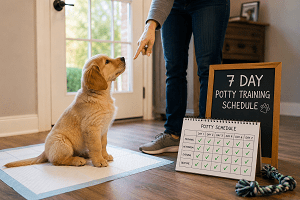
Bringing a puppy home is exciting, but potty accidents can quickly turn that excitement into frustration. The fastest way to potty train a puppy in 7 days is by following a strict schedule, supervising constantly, rewarding every successful potty break, and preventing mistakes before they happen. While every puppy learns at a different pace, many owners are surprised at how much progress can be made within a week when they use a structured training plan.
As a professional dog trainer, I have worked with puppies from various breeds, temperaments, and backgrounds. The biggest mistake most new owners make is expecting their puppy to somehow “know” where to eliminate. Puppies do not understand our expectations. They need consistency, repetition, and clear guidance.
This 7-day potty training schedule is based on proven dog behavior principles and real-world experience. Follow it closely, and you’ll create a strong foundation for lifelong house training success.
Table of Contents
- Set Your Puppy Up for Success Before Starting
- Understanding How Often Puppies Need to Go
- Day 1: Start the Daily Pattern
- Day 2: Add a Potty Signal
- Day 3: Understanding What Your Puppy Is Trying to Say
- Day 4: Slightly Extend Break Intervals
- Day 5: Building Stronger Crate Habits
- Day 6: Practice Across Locations
- Day 7: Check In and Tweak
- How to Handle Unexpected Accidents
- The Importance of Enzymatic Cleaners
- Common Potty Training Mistakes
- Nighttime Potty Training Made Simple
- How Long Full Potty Training Takes
- Expert Tips for Faster Results
- Final Thoughts
Set Your Puppy Up for Success Before Starting
Before beginning the training schedule, gather the essentials:
- A properly sized crate
- High-value training treats
- Enzymatic cleaner for accidents
- Leash
- Designated potty area
- A puppy enclosure might be useful, though it is not required
A well-sized crate lets a young dog rise up fully, pivot easily, then settle down without tightness, yet stays compact enough to discourage separating toilet space from rest area.
Puppies tend to keep their resting spots clean, this habit supports learning quickly inside a confined space. Because they dislike mess where they sleep, using a crate often speeds up housebreaking success.
If you’re new to crate training, our detailed guide on How to Crate Train a Puppy: K9 Trainer Tips for Faster Results explains how to introduce the crate properly, avoid common mistakes, and help your puppy see it as a safe resting place rather than a punishment area.
Understanding How Often Puppies Need to Go
Puppies cannot control their bladders well because the system isn’t fully grown yet. Forcing extended waits goes against how young bodies work.
As a general guideline:
| Puppy Age | Maximum Holding Time |
|---|---|
| 8–10 weeks | 1 hour |
| 10–12 weeks | 2 hours |
| 3–4 months | 3–4 hours |
| 5–6 months | 5–6 hours |
However, during intensive potty training, take your puppy out more frequently than these limits.
Always take your puppy outside:
- Immediately after waking up
- After meals
- After drinking water
- After play sessions
- After training sessions
- Before bedtime
- Throughout daylight hours, pauses occur every half to full hour
Day 1: Start the Daily Pattern
The first day is about creating predictability. If your puppy has only recently arrived home, understanding the 3-3-3 Rule for Dogs can help you manage expectations during the adjustment period and reduce stress-related potty accidents.
Your pup needs to move straight out of:
Crate → Potty Area → Reward → Supervised Freedom
Puppies need frequent trips outdoors, roughly every half hour or so. Timing shifts slightly depending on age, but sticking close to thirty minutes helps avoid accidents inside.
Once elimination starts, stay silent. Right after it ends, cheer brightly while giving a reward, no later than two seconds pass.
Timing matters.
Once people come back inside, that is when most give a treat. Yet the dog might already have forgotten which action led to it.
Day One Sample Plan
6:00 AM
- Wake up
- Immediate potty trip
6:15 AM
- Breakfast
6:30 AM
- Potty trip
7:00 AM
- Supervised play
7:30 AM
- Potty trip
Repeat this process again later in the day.
The main aim is to prevent accidents entirely.
Day 2: Add a Potty Signal
When your puppy begins going outside every time, start using a word to signal it. A consistent habit opens space for spoken hints. After repetition takes hold, sound follows action. Each successful trip offers chance to name the moment. Timing matters once behavior settles into pattern. With routine established, voice enters the process naturally.
Pick one expression, for example:
- “Go potty”
- “Do your business”
- “Quick quick”
Once, when your puppy begins to go, speak then.
Do not repeat it constantly.
Over time, repeating the words will link them to the action in your puppy’s mind.
When storms roll in, journeys stretch long, or darkness falls, such moments reveal its quiet value.
Day 3: Understanding What Your Puppy Is Trying to Say
On day three, signs begin to show themselves.
Watch for signs that your puppy needs to go:
- Sniffing intensely
- Circling
- Suddenly stopping play
- Wandering away
- Heading toward corners
- Whining
- Pacing
Many owners miss these signals because they are distracted by phones, television, or household chores. Learning to read subtle dog signals is one of the most valuable skills a dog owner can develop. Our guide on Understanding Dog Body Language explains the small behaviors dogs use to communicate discomfort, stress, excitement, and bathroom needs.
A key guideline I share frequently with people I work with goes like this:
Should your puppy be awake, supervision becomes necessary. Watchfulness matters whenever the young dog is alert. When eyes are open, attention must follow. The moment it stirs, observation starts. Awake time means someone needs to pay close attention.
Supervision without gaps cuts accident rates fast.
Day 4: slightly extend break intervals
Should your puppy manage well across three consecutive days, start extending the gaps slightly.
For example:
- Extend the time from half an hour to forty-five minutes
- Move from 45 minutes to 60 minutes
Do not rush this process.
A single avoidable incident might spark disorder, then delay momentum.
Stick with praise each time your dog goes outside correctly. Still, keep expectations realistic, mistakes happen even during progress. Over weeks, consistency builds routine without force. Each small win counts more than perfect outcomes.
Stopping rewards too soon happens more often than expected.
The little dog hasn’t quite figured it out yet.
Early on, rewards need to happen often, offering real worth each time. What matters at the start is consistency, paired with clear benefit. Over those opening weeks, people respond when appreciation shows up regularly. Value builds momentum; frequency keeps it going. Moments of recognition land best when they are both expected and meaningful.
Day 5: Building Stronger Crate Habits
Puppies learn outdoor habits faster when a crate guides their routine.
On Day 5:
- Encourage short crate sessions
- Use the crate for naps
- When you cannot watch, place them in the crate
Besides discipline, a crate serves no role. When treated poorly, it loses its purpose entirely.
A space built for calm might feel like shelter. Comfort often shows up quietly there. Rest settles in when boundaries stay clear.
When a puppy trusts its crate, fear-driven messes happen far less often.
Crate Training Formula
- Potty break
- Short play session
- Crate nap
- Potty break
- Repeat
Throughout the day, this setup leads to regular chances for bathroom breaks.
Day 6: Practice Across Locations
Puppies often pick up good habits in a single space, yet struggle to carry them into other areas of the home.
Slowly increase the amount of oversight they receive over time.
Allow access to:
- Living room
- Hallway
- Backyard
- Kitchen
Start by limiting entry to certain areas only. Gradually allow more space over time instead of opening everything at once. Let trust build before offering full freedom inside. Jumping too fast creates confusion rather than comfort.
If accidents begin occurring, reduce the available space and rebuild success gradually.
Day 7: Check In And Tweak
Puppies usually start looking better after seven days.
You may observe:
- Fewer accidents
- Better bladder control
- Stronger potty signals
- Faster elimination outdoors
- Increased understanding of the potty cue
A single week without accident might feel like progress, yet it doesn’t signal completion. Success over seven days can be misleading when judging readiness. Just because spills stop briefly does not imply mastery has arrived. Moments of calm often appear before new challenges emerge. Completion remains distant even after consistent behavior. Lasting change takes longer than seven rotations of the clock.
It takes many young dogs a stretch of weeks, sometimes even months, before they settle into consistent behavior. Not every pup adjusts quickly, patience often shapes the outcome. A few handle routines sooner; others need extra time to adapt. Progress tends to unfold gradually, marked by small shifts rather than sudden change.
The first seven days simply establish the foundation.
How to Handle Unexpected Accidents
Mistakes might still happen, though everything is handled well.
When they do:
Never:
- Yell
- Hit
- Rub the puppy’s nose in it
- Punishment comes later, once things have already happened
Punishment-based methods often create fear and confusion rather than learning. Even in more challenging behavior cases, positive reinforcement and consistency produce better long-term results than harsh corrections.
Instead:
If You See Them During a Crash
- A sudden clap may pause the moment gently. Or perhaps a word slips in without force.
- Right away, get them outdoors.
- Finish outside earns a reward.
If You Find It Later
Give it a proper scrub, then walk away. After that, leave it be, no need to look back.
No punishment.
No lectures.
No anger.
Staying alert helps avoid accidents.
The Importance of Enzymatic Cleaners
Most everyday cleaning products deposit scent particles people fail to notice. Though invisible, these traces linger after wiping surfaces. What seems fresh might still carry unseen aromas. Clean does not always mean odor-free.
Your puppy picks up their scent even now.
Accidents tend to happen again because of this smell.
Use an enzymatic cleaner specifically designed for pet accidents.
Breaking down odor-causing substances entirely, it lowers chances of repeated marking. Completely transformed, the compounds no longer trigger revisits. Less residue means less reason to return.
Common Potty Training Mistakes
1. Giving Too Much Freedom
A young dog left without watch tends to seek out secret spots for bathroom breaks.
2. Inconsistent Schedules
Occasionally stopping for the restroom causes uncertainty.
Consistency creates learning.
3. Waiting too long between trips
Many accidents happen because owners overestimate bladder control.
4. Punishing Accidents
Puppies frequently learn to conceal themselves while needing to go after being punished. Sometimes discipline leads them to sneak away rather than signal. When corrected harshly, they begin avoiding notice during potty times. This hiding behavior can develop quickly following negative reactions. Instead of understanding, they start seeking privacy out of fear.
5. Missing Rewards
Every successful potty trip should be celebrated during early training.
Nighttime Potty Training Made Simple
Young puppies typically need nighttime bathroom breaks.
Before bed:
- Stop drinking fluids two hours prior to sleep, unless a healthcare provider recommends differently
- One last bathroom break before leaving
- Use the crate near your bed
If the puppy wakes and cries:
- Outside they go, straight away
- Let them use the bathroom
- Put them back in the crate without delay
Keep bathroom visits calm during the night instead of letting them become moments of activity.
Stay quiet, act unremarkable.
How Long Full Potty Training Takes?
Though designed around a week, full consistency demands more time.
Most puppies achieve:
- Initial understanding: 1 week
- Most people see steady results within three to six weeks
- Reliable house training: 4–6 months
Some big dogs gain bladder control sooner than tiny ones, yet personal traits weigh heavier than size tags. What a pup learns early can shape habits more than genetics ever does.
Breed characteristics can also influence training speed. Some dogs naturally pick up routines faster than others, although consistency remains the biggest factor in success.
Want Faster Results With Your Puppy?
Potty training is only one piece of raising a well-behaved dog. If you want to build obedience, confidence, proper socialization, and a stronger bond with your dog from the start, check out Beyond the Bark: Inside a Pro Handler’s Playbook for Raising the Ideal Dog.
Inside, you’ll discover the same practical training principles professional handlers use to develop reliable, confident, and responsive dogs while avoiding the mistakes that slow progress for many owners.
👉 Get your copy here: Beyond the Bark: Inside a Pro Handler’s Playbook for Raising the Ideal Dog
Expert Tips for Faster Results
Through years of working with dogs, these strategies consistently produce the best results:
Track Toilet Habits
Record:
- Feeding times
- Water intake
- Potty breaks
- Accidents
Patterns become obvious quickly.
Feed on a Schedule
Bathroom routines grow irregular when food is always available.
Mealtimes set on a routine lead to consistent bathroom habits later in the day.
Use High-Value Rewards
Small bits of chicken work better than standard pellets, sometimes even more so when mixed with liver rewards or preferred munchies.
Use the same potty spot every time
Pulling in that known smell speeds things up when it is time to go.
Be Patient
Potty learning focuses on progress, yet mistakes happen along the way.
Repetition shapes routines, yet steady effort keeps them alive. What matters most shows up when actions repeat without pause. Consistency turns small steps into patterns almost by accident.
Frequently Asked Questions
Can a puppy really be potty trained in 7 days?
A puppy can make significant progress in seven days, but complete house training usually takes several weeks or months. The first week focuses on building routines, preventing accidents, and teaching the puppy where to eliminate. Consistency after the initial seven days is what creates lasting results.
What is the fastest way to potty train a puppy?
The fastest approach combines a strict schedule, crate training, close supervision, frequent outdoor trips, and immediate rewards for successful potty breaks. Preventing accidents is often more effective than correcting mistakes after they happen.
How often should I take my puppy outside to potty?
Most young puppies should go outside every 30 to 60 minutes while awake. You should also take them out immediately after waking up, eating, drinking water, playing, training sessions, and before bedtime.
Should I use puppy pads during potty training?
Puppy pads can be useful in certain situations, such as apartment living or when outdoor access is limited. However, if your goal is outdoor potty training, relying heavily on puppy pads may slow the transition because the puppy learns that eliminating indoors is sometimes acceptable.
What should I do if my puppy keeps having accidents indoors?
First, review your schedule and supervision. Most accidents happen because puppies are given too much freedom or are not taken outside often enough. Clean all accident areas with an enzymatic cleaner and continue rewarding successful outdoor potty breaks.
Is crate training necessary for potty training?
While not absolutely required, crate training is one of the most effective tools for house training. Puppies naturally avoid soiling their sleeping area, making a properly sized crate valuable for teaching bladder control and establishing a consistent routine.
At what age are most puppies fully potty trained?
Most puppies begin understanding potty training within a few weeks, but reliable house training often takes between four and six months. Some puppies learn faster, while others need more time depending on breed, temperament, consistency, and previous experiences.
Why does my puppy pee inside right after coming indoors?
Some puppies become distracted outdoors and forget to eliminate. Once they return inside and relax, they realize they need to go. If this happens, spend a few extra minutes outside after your puppy goes, reward successful elimination immediately, and supervise closely once back indoors.
Final Thoughts
Potty training a puppy within seven days isn’t focused on flawless results, it centers on building a dependable pattern for bathroom habits. Following a clear timetable, watching your pup without constant hovering, using a crate as intended, offering a reward right after success, while reducing accidents through planning, these steps often lead to faster improvement than what most see over four weeks. Consistency matters. Patience helps. Each time your dog eliminates in the correct spot, they move closer to being reliably trained.

Her work centres on obedience, detection, protection and operational readiness. She favours proven methods built on repetition, consistency and real-world conditioning, so that both dogs and handlers are prepared for high-pressure tasks.
Rofiat represented the Nigerian Army Dog Centre at the Nigerian Army Day Celebration (NADCEL) 2026, where she led demonstrations in obedience, explosive detection, agility and tactical movement. Through articles, training content and documentaries, she shares field-based insight into how structured training, clear communication and trust between handler and dog affect performance and reliability.
She is the author of Beyond the Bark: Inside a Pro Handler's Playbook for Raising the Ideal Dog, a practical guide that helps dog owners and handlers apply professional training principles in everyday situations.
- Is K9 Advantix Safe for Dogs? A Handler’s Honest Review - October 2, 2026
- Australian Cattle Dog vs Blue Heeler: Any Difference? - October 1, 2026
- Bousnic Dog Training Collar Review: Is It Safe? - September 30, 2026