Best Tactical K9 Harness Guide: What Handlers Check

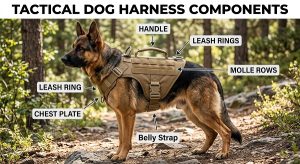
A good tactical K9 harness has three things. First, hardware with published strength ratings far above your dog’s weight, on every buckle and ring. Second, a handle sewn into the main load-bearing webbing, not stitched onto a thin patch. Third, a fit that spreads force across the chest while leaving the shoulders free. Check the weakest part first, which is usually a plastic belly buckle, then confirm the fit with a two-finger test, a trot test and an escape test.
Table of Contents
- What Makes a Harness “Tactical”?
- The Weakest-Link Rule: How to Read Strength Ratings
- The 8 Checks Handlers Run Before Buying
- Match the Harness to the Job
- Sizing and Fit: Breed Ranges, Measuring and the 3 Tests
- Handle Types: Control Grip vs. Lift Handle
- 8 Red Flags in a Product Listing
- What a Tactical Harness Costs (and Our Pick)
- Care, Inspection and When to Retire a Harness
- What the Research and Real Teams Tell Us
- FAQs
- Conclusion
Introduction
Here’s a story I hear all the time. Someone buys a harness with camo webbing and a row of MOLLE loops. It looks like the real thing in the photos. Then, on day three, the handle tears off when the dog lunges, or the belly buckle pops open mid-pull. Their question afterwards is always the same: “Isn’t a harness just a harness?”
No, it isn’t. A tactical K9 harness is a piece of safety gear, and most listings online hide the facts that matter. After more than a decade working with military and security dogs, I check the same short list before I trust any harness with a dog. This guide gives you that list, with real numbers, so you can tell duty-grade gear from a costume.
You’ll learn how to read strength ratings (and spot the tricks), which parts fail first, how to fit a harness to a Malinois, German Shepherd or Lab, what to pay, and how to inspect your gear so it doesn’t fail when it counts. This works whether you handle a patrol dog or you just own a strong dog that pulls.
What Makes a Harness “Tactical”?
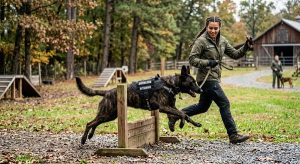
A tactical K9 harness is a full-body dog harness built to control, restrain and sometimes lift a working dog safely. It spreads force over the chest and ribs instead of the throat, has a load-bearing handle, and uses hardware with real strength ratings. Looks, colors and patches don’t make a harness tactical.
The word “tactical” now gets stamped on everything, so here’s how I sort harnesses into three honest tiers:
- Tactical-look: Good for walks and light training. Plastic buckles, thin handle, no published ratings. Nothing wrong with it, as long as you don’t ask it to do a working dog’s job.
- Duty-grade: Metal or aluminum buckles, reinforced handle, 1000D-type nylon, MOLLE panels. Most patrol, protection and detection dogs work in this tier.
- Life-safety rated: Sewn and tested like human climbing gear, with rated webbing, rings and buckles. Needed for helicopter, rappel and technical rescue work.
Most owners need the middle tier at most. The mistake is paying duty-grade money for a tactical-look product.
The Weakest-Link Rule: How to Read Strength Ratings
A harness fails at its weakest part, not its strongest. So the number that matters is the lowest rating on the harness. Many listings brag about one heavy-duty D-ring while the belly buckle is plastic.
Here’s a real example. One 2026 gear roundup lists a harness with shoulder buckles tested to 1,100 lbs but plastic belly buckles rated at just 250 lbs. That 250 lb figure is the real ceiling of that harness, because the belly strap holds the whole thing on the dog.
Why do the ratings need to be so high for a 70 lb dog? Because a lunge, a fall or a sudden stop doesn’t load the harness with the dog’s weight. It loads it with the dog’s weight multiplied by the speed of the stop. Gear shouldn’t be the weak link in those moments.
Tensile vs. loop ratings: the trick most guides miss
The AustriAlpin COBRA Pro Style buckle is a favorite on professional gear. Its official datasheets list two figures: 9 kN tensile strength and 18 kN in loop configuration. One kilonewton is about 225 lbs of force, so that’s roughly 2,000 lbs straight pull and 4,000 lbs in the loop test.
See the problem? A seller who quotes “4,000 lbs” without saying which test may be quoting the bigger number. Both figures are very strong for a dog. But when you compare two harnesses, compare the same type of rating, and ask if the number is for the buckle alone or for the finished harness.
| Part | What to look for | Red flag |
|---|---|---|
| Plastic side-release buckle | Fine for walks. Often rated around 200-250 lbs when a rating exists | Used on the belly strap of a “military” harness |
| Metal quick-release buckle | A published number. Mid-tier examples list roughly 1,000+ lbs | “Heavy-duty metal” with no figure |
| Aluminum safety buckle (e.g. COBRA Pro Style) | 9 kN straight pull, 18 kN loop, per the maker’s datasheet | Unbranded copy with the same look but no datasheet |
| D-ring / V-ring | Welded or forged metal, rating in the thousands of lbs on pro gear | Thin, open or stamped rings |
| Webbing | Mil-spec or parachute-grade nylon, rated in kN | “Strong nylon” and nothing else |
Rule of thumb: if a listing gives no strength number for the buckles, rings and handle, assume the worst one.
The 8 Checks Handlers Run Before Buying
When a new harness lands on my table, I run these eight checks in order. Most bad harnesses fail by the third.
1. Find the weakest buckle
Start with the hardware rule above. Press, pull and flex every buckle. Cheap plastic flexes and creaks. Real aluminum or steel doesn’t.
2. Follow the load path
Pick the harness up by the handle. Does the force travel through strong webbing down to the chest plate and belly strap? Or does it just pull one panel away from the rest? The handle should connect to webbing that runs under the harness body, not just through the top fabric.
3. Inspect the stitching
Look at the stress points: where the handle joins, around the rings, at buckle anchors. You want dense box-X stitching or bar-tacks, with heavy bonded thread. A single line of stitches at a handle is the first thing to rip.
4. Check the fabric and webbing
Good duty harnesses use 1000D to 1050D nylon (or Cordura) on the outside. “Denier” is just thread thickness. Higher means it resists scraping on concrete, brush and gravel. Thin fabric is fine for a yard. It’s not fine for a patrol shift.
5. Check shoulder freedom
This is the check owners skip, and it matters for the dog’s body. A 2019 study in Veterinary Record by Lafuente, Provis and Schmalz measured dogs walking and trotting in two harness types. Both reduced shoulder extension, and the restrictive design (a strap across the shoulder) reduced it more. Later research on pet dogs shows the effect depends a lot on fit and on the individual dog’s build. So don’t trust a harness shape on its own. Watch your dog move in it (see the trot test below).
6. Check padding and heat
Unpadded straps rub the chest and armpits raw, and dark, dense harnesses trap heat. Look for breathable mesh lining and padding where straps cross the chest and behind the front legs. If your dog works in hot or humid climates, read our guide to dog cooling vests that actually work and plan for rest breaks and water.
7. Test for escape resistance
A harness a dog can back out of is a failed harness. Look for several adjustment points (neck, chest and belly) so you can lock the fit down. A chest plate that doesn’t gap when you pull the leash backward is a good sign.
8. Check the MOLLE rows and what you’ll carry
MOLLE webbing is handy for ID panels, a small medical kit or a patch. But every pouch changes the dog’s balance. Many handlers keep carried weight to about 10% of body weight or less, and build up slowly. For most pet owners, a few light attachments are plenty.
Match the Harness to the Job
The best tactical dog harness for a SAR dog isn’t the best one for a family guard dog. Use this table to decide what you actually need.
| Job | Must-have features | Usually skip |
|---|---|---|
| Patrol / protection | Strong handle, metal hardware, snug chest plate, wide padded straps | Heavy pouches that slow the dog |
| Detection (explosives, narcotics) | Light weight, breathable lining, quiet fabric, easy on and off | Big MOLLE loads |
| Search and rescue | Reflective trim, strong lift handle, quick on/off, water-resistant fabric | Fancy patches |
| Helicopter / rappel work | Life-safety rated, documented ratings, leg-strap options | Anything without rated hardware and test data |
| Personal protection or strong pullers (pet owners) | Duty-grade handle, front and back leash points, good fit range | Rappel-grade rigs (overkill) |
| Growing puppies and young dogs | Many adjustment points, soft padding | Expensive harness they’ll outgrow in months |
A note for hot, humid countries: Lagos, Singapore, Miami and Dubai all share the same problem. Dense harnesses plus heat can mean heat stress fast. Choose mesh lining, avoid black fabric in direct sun, pre-wet the dog’s belly area before work if your vet agrees, and take breaks in shade.
For the rest of a working dog’s kit, see our guide to the top tactical K9 gear for 2026.
Sizing and Fit: Breed Ranges, Measuring and the 3 Tests
Breed charts give you a starting point. Your own tape measure gives you the answer.
| Breed | Typical weight | Fit notes |
|---|---|---|
| Belgian Malinois | 40-65 lbs (18-29 kg) | Lean, narrow chest. Needs a snug taper, not a boxy cut |
| German Shepherd | 50-90 lbs (23-41 kg) | Deeper ribcage. Many harness patterns are built around this breed |
| Dutch Shepherd | 42-75 lbs (19-34 kg) | Similar to the Malinois, often slightly stockier |
| Labrador Retriever | 55-80 lbs (25-36 kg) | Barrel chest, needs extra girth room. Common detection breed |
| Doberman | 60-100 lbs (27-45 kg) | Deep chest, narrow waist. Watch for gapping at the belly strap |
| Rottweiler | 80-135 lbs (36-61 kg) | Heavy-boned. Prioritize top-rated hardware |
How to measure
- Neck: measure at the base, where a collar sits.
- Chest girth: measure the widest part of the ribcage, just behind the front legs. A soft tailor’s tape works. So does string held against a ruler.
- Chest plate length (front to back): helpful with Y-front styles. Some makers list it.
- Weight: record it. If your dog sits near the top or bottom of a size band, size by girth.
The 3 fit tests
- Two-finger test. You should slide two flat fingers under every strap, no more and no less.
- Trot test. Run your dog on a flat surface at a trot. Stride length should look the same as without the harness, with no skipping, stiffness or short steps. Look for the strap touching the armpit on each stride.
- Escape test. With the leash clipped on, step back gently. The harness shouldn’t ride up the neck or slip off a shoulder.
Re-check fit every 8 to 12 weeks for a dog in active training, and after any weight or muscle change. A harness that fit perfectly in January can be loose by summer.
Handle Types: Control Grip vs. Lift Handle
A handle isn’t automatically a lift handle. That distinction causes more injuries than almost anything else.
- Control handle: A grip for short moments of control, such as crossing a road, moving through a crowd or loading a vehicle. If the maker doesn’t say it’s rated for lifting, treat it this way.
- Lift handle: Built into the structural webbing, tested and rated by the maker, with the harness designed to carry the dog’s whole body weight evenly.
Before you ever need a handle in an emergency, test it at home on a sturdy table with your dog standing, and not lifting. Pull firmly upward on the handle with your dog’s feet on the ground and look for stitch movement, panel tearing or the harness riding up.
A harness gives you control points, but good control also comes from a leash that gives you a second grip close to the dog. Our Carhartt dual handle leash review shows how that works for strong pullers.
8 Red Flags in a Product Listing
Most best-harness lists focus on ranking products. Few teach you how to judge them yourself. Watch for these:
- No strength rating for buckles, rings or the handle.
- “Military grade” with no standard named. There’s no single official “military grade” label for dog harnesses.
- Plastic belly buckles on a “heavy-duty” harness.
- One “adjustable” size covering a huge weight range, for example 40 to 110 lbs.
- Handle photos that only show the front. Ask to see how it’s sewn on the inside.
- Rings that look thin or open.
- All 5-star reviews, and none mention long-term use. Look for reviews six months or more after purchase.
- No spare parts or return policy. Good makers sell replacement buckles and stand behind sizing.
What a Tactical Harness Costs (and Our Pick)
Prices change by brand and country, but these ranges are typical in 2026:
| Tier | Typical price | Who it suits |
|---|---|---|
| Tactical-look | $25-$50 | Walks, basic training, short trips |
| Duty-grade | $60-$150 | Patrol, protection, serious home use |
| Professional / operator-grade | $270-$700 | K9 units, SAR teams, documented ratings and repairs |
| Rappel / heli-rated | $150-$400+ | Aerial and technical rescue work |
Buying cheap isn’t wrong if the job is light. Buying cheap for a hard job is the expensive option, because you pay twice and risk an injury.
Our Recommendation for Most Handlers and Serious Owners
For strong or high-drive dogs, I point people to a duty-grade harness with a reinforced handle, MOLLE panels, metal hardware, multiple leash points and breathable padding. This tactical K9 harness fits that profile and is the one our team keeps returning to for training and everyday handling.
Before you buy it (or any harness): open the listing, find the buckle and ring ratings, and run the red-flag list above. Manufacturers change hardware between versions, so confirm the current specs. If you can’t find a rating, ask the seller.
 Check current price and specifications here
Care, Inspection and When to Retire a Harness
No competitor guide I reviewed covers this, and it’s the part that keeps dogs safe over the years.
The 60-second check (before every work session)
- Run a hand along every strap for fraying, cuts or fuzzy, worn patches.
- Squeeze each buckle open and shut. It should click cleanly.
- Tug the handle and each ring firmly.
- Look for loose threads at stress points.
- Check the skin under the harness after work for redness, rubbing or hair loss.
Monthly
Rinse off sand, salt and dirt. Hand wash with mild soap, no bleach, and air dry in shade. UV and heat slowly weaken nylon, and grit grinds away stitching from the inside.
Retire it if
- Webbing is frayed, cut or glazed hard from heat.
- Stitching is cut or pulled at the handle, rings or buckles.
- A buckle is cracked, bent or doesn’t lock firmly.
- A ring is bent or deformed.
- The harness took a severe shock load, such as a hard fall or a big lunge where the handle or ring took the full force. Climbing gear follows this rule, and so should dog gear built on climbing standards.
Keep a spare for working dogs. A broken buckle halfway through a shift shouldn’t end the day.
What the Research and Real Teams Tell Us
The research: The Lafuente study above is the most cited piece of evidence on harness design. It tells us two things. Harnesses can limit shoulder movement. And fit matters more than a marketing label, so test the harness on your own dog.
Real teams: Special operations dogs have shown how important protective gear is. Cairo, the Belgian Malinois reported to have taken part in the 2011 raid on Osama bin Laden’s compound, is widely described as having worn protective gear. Units rarely publish the exact harness specs, which is why you shouldn’t copy a famous dog’s kit by looks alone. Copy the principles instead: tested hardware, proper fit and regular inspection.
My experience: In my years as a military working dog instructor and handler at the Nigerian Army Dog Centre, the same three failures show up again and again: handles that were never load-tested, belly buckles that were weaker than the rest of the harness, and harnesses that no longer fit after a training cycle changed the dog’s muscle. Every one of them is preventable with the checks above.
Author credentials: Cpl. Rofiat Muritala has more than 14 years of experience as a Nigerian Army military working dog instructor and handler, with advanced obedience, K9 patrol and explosive detection certification. She represented the Nigerian Army Dog Centre at NADCEL 2026 and wrote Beyond the Bark: Inside a Pro Handler’s Playbook for Raising the Ideal Dog.
FAQs
What is the best tactical K9 harness for a Malinois or German Shepherd?
The best one is the harness that passes the checks: published ratings on every buckle and ring, a handle sewn into structural webbing, and a snug fit on a lean chest. Malinois need a tapered fit with careful girth measurement. German Shepherds need room in a deeper ribcage. Choose by measurements, not by name.
How strong should a tactical dog harness be?
Aim for hardware rated at many times your dog’s weight. Duty-grade harnesses often use metal buckles rated around 1,000 lbs or more, and professional gear uses hardware rated in the thousands of pounds. What matters most is that the lowest rated part, usually the belly buckle, is strong, and that the maker publishes the figure.
Can I lift my dog by the harness handle?
Only if the manufacturer rates the handle for lifting. A control handle is for brief guidance and close control. Always test any handle at home with the dog standing on the ground before you ever rely on it.
Is a tactical harness safe for everyday walks?
Yes, if it fits well and doesn’t restrict your dog’s shoulders. Use the trot test to check. Heavy duty gear can be hot and bulky for casual use, so pick breathable padding, and remove pouches you don’t need.
How often should I replace a tactical dog harness?
There’s no fixed date. Inspect it before every session and retire it when you see frayed webbing, cut stitching, damaged buckles or bent rings, or after any severe shock load. For hard-working dogs, many handlers replace duty harnesses every one to two years, and sooner in harsh conditions.
Conclusion
A tactical K9 harness isn’t a fashion choice. Handlers check three things before anything else: the weakest buckle and its published rating, whether the handle is truly load-bearing, and whether the harness fits without blocking the shoulders. Everything else, from MOLLE rows to color, comes second.
Here’s your action plan:
- Measure your dog’s chest and neck properly, and note the weight.
- Match the tier to the job. Don’t overpay, and don’t underbuy.
- Find the weakest rating on the listing, and skip anything that doesn’t publish one.
- Run the two-finger, trot and escape tests the day it arrives.
- Inspect it for 60 seconds before every session, and retire it when it shows damage.
Want to go deeper into how professional handlers think about control, bonding and training? My book, Beyond the Bark: Inside a Pro Handler’s Playbook for Raising the Ideal Dog, turns what I teach on the training field into practical steps for everyday owners.
And if you’d like new gear guides, training tips and K9 news every week, subscribe to our weekly articles roundup newsletter. No spam, just useful K9 content.

Her work centres on obedience, detection, protection and operational readiness. She favours proven methods built on repetition, consistency and real-world conditioning, so that both dogs and handlers are prepared for high-pressure tasks.
Rofiat represented the Nigerian Army Dog Centre at the Nigerian Army Day Celebration (NADCEL) 2026, where she led demonstrations in obedience, explosive detection, agility and tactical movement. Through articles, training content and documentaries, she shares field-based insight into how structured training, clear communication and trust between handler and dog affect performance and reliability.
She is the author of Beyond the Bark: Inside a Pro Handler's Playbook for Raising the Ideal Dog, a practical guide that helps dog owners and handlers apply professional training principles in everyday situations.
- K9 Advantix Dosage Chart & Safety Guide for Dogs - October 19, 2026
- How to Set Up & Use Bousnic Dog Training Collar - October 18, 2026
- Westminster Dog Show 2026: Winners & Full Results - October 17, 2026