Cheap Dog Collars: Hidden Dangers & Safe Buying Guide

Are cheap dog collars safe? Not always. Bargain collars fail in predictable places: thin webbing, plastic buckles, bent D-rings, and unknown dyes and metals. A cheap collar isn’t unsafe because of its price tag. It’s unsafe when nobody can tell you what it’s made of or what force it can hold. Check the buckle, the D-ring, the stitching, and the fit before you buy, and expect to spend roughly $15–$45 for a collar you can trust on a medium or large dog.
Table of Contents
- Are Cheap Dog Collars Safe? The Honest Answer
- 9 Hidden Dangers of Cheap Dog Collars
- What the Research Says: Even Good Collars Have Limits
- The Real Cost: Cheap vs. Quality Over Two Years
- When a Cheap Collar Is Actually Fine
- How to Spot a Bad Collar Before You Buy
- Match the Collar to Your Dog
- Fit, Care, and When to Replace
- Collars I’d Point a Friend Toward
- Why You Can Trust This Guide
- FAQs
- Bottom Line
Introduction
You’re standing in the pet aisle, or scrolling a marketplace at midnight. One cheap dog collar costs $6. The next one costs $28. They look almost identical. Same color, same buckle click, same “heavy-duty” sticker.
So here’s the problem: you can’t see what’s different, and that’s exactly why people get burned.
I’m Rofiat Muritala, a military K9 handler with 14+ years of experience. I check every collar buckle and D-ring on every dog before every session. Not because I’m paranoid, but because gear fails quietly and then suddenly. In this guide, I’ll show you what breaks on cheap collars and why, what the research says about neck safety, the real two-year cost, and a checklist you can use in a shop or on a product page. Then I’ll point you to collars I’d actually buy.
Are Cheap Dog Collars Safe? The Honest Answer
Short answer: some are, most aren’t, and price alone can’t tell you which. A $10 collar from a reputable maker with a metal buckle and clear specs can beat a $25 one with no details. But the lowest-priced collars on marketplaces and discount shelves tend to cut costs in exactly the spots that carry load.
The real question isn’t “cheap or expensive?” It’s “can I verify what’s in it?” A trustworthy collar tells you its webbing type, hardware material, and (ideally) a strength rating. A risky one hides behind words like “military grade” or “super strong” with no numbers behind them.
Collar failure also matters more than most owners think. A U.S. survey (Weiss, Slater and Lord, 2012) found that about 14% of dog owners lost a dog over five years, and about 93% of those dogs were recovered. Plenty of those dogs get lost for other reasons, like open gates and dug-out fences. But a collar that cracks or slips is the one cause you can fix for the price of a decent lunch.
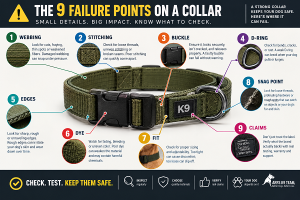
9 Hidden Dangers of Cheap Dog Collars
1. Webbing That Tears or Stretches
Budget collars often use thin, single-layer webbing with no published strength rating. It can fray at the edges, stretch when wet, and loosen over a few months. A collar that fit snugly in week one can slip over your dog’s head by month three.
2. Plastic Buckles That Crack
The buckle is the first thing to go. Thin molded plastic gets brittle in cold, soft in heat, and weak after a few hundred open-and-close cycles. If a plastic buckle is your only connection between a 30 kg dog and a busy road, that’s a bad bet.
3. Stamped or Weakly Welded D-Rings
The D-ring is where your leash actually connects. On cheap collars it’s often thin stamped metal or a ring with a visible gap in the weld. Under a hard pull, it can bend open just enough for the clip to slide out. Quick test: if you can flex it with your fingers, it doesn’t belong on a collar.
4. Weak Stitching
Look at where the webbing folds around the buckle and D-ring. Quality collars use box-stitch or bar-tack patterns (dense, repeated stitching that spreads the load). Cheap ones often use a single thin line of thread. I’ve caught a stitching failure on a pull test before it turned into a problem on a walk. It takes seconds to find and costs nothing to check.
5. Skin Irritation and Hair Loss
Rough edges, harsh dyes, and constant rubbing cause red skin, hot spots, and bald patches. I see it most on short-coated breeds like Boxers and Dobermans, and on dogs with sensitive skin. If your dog scratches at the collar a lot, don’t ignore it.
6. Chemicals and Heavy Metals
This is the danger almost no collar guide mentions. In 2009, the Ecology Center’s HealthyStuff.org project tested hundreds of pet products with an XRF analyzer. Nearly half of the pet collars tested had detectable lead, and 27% were above 300 ppm. That data is old, rules differ by country, and detection doesn’t prove a dog got sick. But dogs chew, lick, and wear their collars daily, and cheap plated hardware and cheap dyes are where problems hide. Pick brands that state their material and, where possible, their safety testing.
7. Fake “Military Grade” Claims and Counterfeit Hardware
“Tactical,” “military grade,” and “Cobra-style” are marketing words, not standards. Real AustriAlpin COBRA buckles are tested and rated. For example, the 25 mm COBRA PRO STYLE has a guaranteed 9 kN straight-pull strength and 18 kN in loop configuration, which is roughly 2,000 lb and 4,000 lb. Lookalikes copy the shape, not the metal or the testing. If a $9 collar claims a genuine COBRA buckle, be suspicious. Genuine buyers can ask for proof of authenticity, and the maker supplies hangtags to show it.
8. Snag and Choke Hazards
A collar can catch on a crate door, fence post, or another dog’s jaw during play. Cheap collars almost never have a release feature. Whole Dog Journal warns that any collar left on an unattended dog can snag and hang it, and that playing dogs can tangle in each other’s collars. A breakaway or quick-release design lowers that risk for dogs that play or crate together.
9. Fit That Drifts
Cheap adjusters slip. If the strap creeps looser, your dog can back out of it. If it creeps tighter, it presses on the throat. Check the fit often, not just on day one.
What the Research Says: Even Good Collars Have Limits
Here’s a point I want every owner to hear, because it changes how you shop.
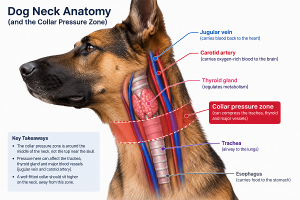
Researchers from Nottingham Trent University and the University of Nottingham tested seven collars and a slip lead on a simulated dog neck. They applied three forces: a firm pull (40 N), a strong pull (70 N), and a jerk (about 141 N). Collars produced pressures from 83 to 832 kPa, and no single collar gave a pressure low enough to be considered safe when pulling. Even padded and wide collars carried injury risk.
What does that mean for you?
- A better collar reduces risk. It doesn’t remove it. Wide, padded collars spread pressure better, so they’re still the smarter buy.
- Pulling is the real problem. A strong, well-built collar keeps your dog attached. It can’t protect the neck from a dog that hauls on the lead.
- Pair the collar with the right tool. For dogs that pull, a well-fitted harness takes the pressure off the neck. I explain what professional handlers look for in my K9 harness guide for maximum control.
- Train the walk. Loose-leash skills protect your dog’s neck more than any piece of gear. If you want a pro handler’s step-by-step approach, my e-book Beyond the Bark covers it.
That’s why I tell owners to buy a quality collar for ID and light control, and to use a harness for walks if the dog pulls.
The Real Cost: Cheap vs. Quality Over Two Years
Let’s do the math most articles skip. These are estimates for an active medium or large dog. Prices vary by country.
| Cheap collar path | Quality collar path | |
|---|---|---|
| Purchase | $5–$8 | $20–$45 |
| Replacements (wear, cracked buckle, stretched strap) | 2–4 per year, about $10–$30/yr | Rarely |
| Skin irritation vet visit (if it happens) | $60–$150 | Unlikely |
| Escape-related emergency (if it happens) | $500–$3,000+ | Much less likely |
| 2-year total, nothing goes wrong | ~$25–$60 | ~$20–$45 |
| 2-year total, one incident | $550–$3,000+ | ~$20–$45 |
Notice what happens. Even in the best case, the cheap path costs about the same or more. In the worst case, it costs far more. You’re not buying a fancier collar. You’re buying out of a risk.
When a Cheap Collar Is Actually Fine
I won’t tell you every low-priced collar is dangerous. Some cases are fine:
- Fast-growing puppies. They outgrow a collar in weeks. Buy a lightweight, soft, inexpensive one and upgrade at 6–8 months.
- Tiny dogs on a harness. If the collar only carries a tag, you don’t need heavy hardware.
- Spare ID collar at home. If it never takes a leash, strength matters less. Quality still matters for skin and material safety.
Even then, skip anything with raw edges, a flimsy plastic buckle, or no material information. “Cheap” should mean affordable, not unknown.
How to Spot a Bad Collar Before You Buy
Use this in a store, or on any product page.
The 60-Second Shop Test (in person)
- Squeeze the buckle. It should click firmly and need real pressure to release.
- Flex the D-ring. If it bends or has a visible seam gap, walk away.
- Check the stitching. Look for dense box or bar-tack stitching at stress points.
- Run a finger along the edges. Rolled or finished edges are good. Raw, scratchy edges are not.
- Sniff it. A strong chemical smell is a red flag.
Red Flags in Online Listings
- No material named (only “durable” or “premium”)
- No strength rating or hardware details
- Photos that never show the buckle or D-ring up close
- Review photos showing cracked buckles or frayed edges
- “Genuine COBRA” claims with no brand or authenticity proof
- A price that’s far below every similar collar
Green Flags
- Named material (for example, nylon, full-grain leather, BioThane)
- Metal buckle and welded D-ring
- Clear width, neck sizes, and weight limits
- Return policy and real customer photos
Want to see how I judge a real product? My Stunt Puppy Classic Black Collar review walks through one everyday collar piece by piece.
Match the Collar to Your Dog
The same collar doesn’t suit every dog. Head shape and job matter as much as size.
| Dog type | Best choice | Why |
|---|---|---|
| Sighthounds (Greyhound, Whippet, Saluki) | Wide martingale collar | Narrow heads let them back out of a flat collar |
| Flat-faced breeds (Bulldog, Pug, Boxer) | Wide padded collar for ID, harness for walks | Short airways, so avoid neck pressure |
| Strong working breeds (Malinois, German Shepherd) | Wide (1.5″–2″) collar, metal hardware, harness for work | High pulling force on every hardware part |
| Small dogs | Lightweight collar plus harness | Fragile necks and tracheas |
| Swimmers and hikers | BioThane or coated webbing, reflective stitching | Handles water, mud, and low light |
| Puppies | Lightweight, adjustable, soft lining | Outgrows it fast, so keep it simple |
For working dogs, I use separate collars for separate jobs: a flat ID collar for downtime and a dedicated wide, all-metal-hardware collar for training. That way the everyday collar never takes the strain of high-drive work. If you’re building a full kit, see my list of tactical K9 gear every working dog should have.
Fit, Care, and When to Replace
The Fit Check
Slide fingers flat between collar and neck. Two fingers is the common guide for medium and large dogs, and one finger for small dogs. Veterinary sources vary slightly, so the goal is the same: snug enough that it can’t slip over the head, loose enough that it doesn’t press on the throat. A collar that fits when your dog stands may feel tight when the dog lies down, so check both. Recheck monthly on puppies and any time your dog gains or loses weight.
My 3-Step Pre-Walk Check
- Pull test: grip both sides of the buckle and pull hard in opposite directions.
- Ring check: tug the D-ring and feel for any flex.
- Fit check: slide two fingers flat under the collar.
Total time: about a minute. It’s the same habit I use before a training session.
Replace It Right Away If You See
- Fraying, thinning, or fuzzy webbing
- Loose or unraveling stitches
- A cracked, sticky, or weak-clicking buckle
- Rust on the D-ring or hardware
- A mildew smell that won’t wash out
- Your dog scratching at the collar more than usual
- A collar that slides loose more easily than before
Also check the ID tag. A collar that holds but carries an unreadable tag only solves half the problem. I cover what to engrave in my military dog tag format guide. For an extra layer of security, a GPS tracker helps too. My guide to choosing a dog tracker shows what holds up in daily use.
Collars I’d Point a Friend Toward
Ready to upgrade? These are the kinds of collars I’d buy for a dog I cared about, with real hardware instead of bargain-bin parts. Prices change, so click through to check today’s price and your dog’s size range.
(Affiliate disclosure: I may earn a small commission if you buy through these links, at no extra cost to you. I only recommend gear I’d use myself.)
Joytale Heavy Duty Dog Collar with Handle: Military-style nylon, strong metal buckle, padded interior, and a built-in handle for control in traffic or tight spaces. A solid pick for strong or energetic dogs and everyday training. 👉 Check price on Amazon
A4DOG Tactical Dog Collar (Adjustable Nylon): High-strength nylon with a heavy-duty metal buckle and an adjustable fit that suits dogs who pull or change size. A good value upgrade from a flimsy pet-store collar. 👉 Check price on Amazon
PetSafe KeepSafe Break-Away Collar: A breakaway buckle that releases if the collar snags, then snaps back together for reuse. It’s a smart add-on for dogs that crate or play together. Use it as a safety layer, not a replacement for a strong walking collar. 👉 Check price on Amazon
My advice: if you’ve been using a $5 collar on a medium or large dog, don’t wait for it to fail. Replace it this week, and measure your dog’s neck first so you pick the right size.
Why You Can Trust This Guide
I’m Cpl. Rofiat Muritala, a Nigerian Army military working dog instructor and handler with more than 14 years at the Nigerian Army Dog Centre. My training covers advanced obedience, K9 patrol, and explosive detection. I represented the Nigerian Army Dog Centre at NADCEL 2026, where I led demonstrations in obedience, detection, agility, and tactical movement. I check collars and hardware by hand every day, because in my work the cost of being wrong isn’t a return label. It’s a dog loose in traffic.
Where I cite research, I link or name the source below. Where I’m sharing handler experience, I say so. This article isn’t veterinary advice, so talk to your vet if your dog shows coughing, gagging, or neck pain.
FAQs About Cheap Dog Collars and Dog Collar Safety
Are cheap dog collars safe for large dogs?
Usually not, unless you can verify the hardware. Large dogs create high peak forces when they lunge or bolt. Choose a wide collar with a metal buckle, welded D-ring, and dense stitching, ideally from a brand that states its materials.
How often should I replace my dog’s collar?
Inspect it monthly, and replace it every 6–12 months as a baseline. Replace it right away if you see fraying, a cracked buckle, rust, or loose stitching. Active and working dogs wear collars out faster.
Is a harness safer than a collar?
For dogs that pull, yes. The Nottingham research found that no collar tested kept neck pressure low during pulling. A harness spreads force across the chest. Keep a collar for ID tags.
Should my dog wear a collar all day?
Many owners do, and a collar with ID helps a lost dog get home. Remove it, or use a breakaway, when your dog is crated, left alone, or playing roughly with other dogs, since snagging is a real risk.
What’s the best collar material: nylon, leather, or BioThane?
All three can be safe if the build quality is good. Nylon is light and affordable. Full-grain leather is durable and comfortable but needs care and doesn’t like staying wet. BioThane suits swimmers and muddy dogs. The real risk is the cheapest, unverified version of any of them.
Bottom Line: Treat the Collar Like a Seatbelt
A dog collar is load-bearing equipment, not decoration. Here’s the short version:
- Cheap collars fail at the webbing, stitching, buckle, or D-ring, often when your dog pulls hardest.
- Unknown dyes and plated metal add a chemical risk that few owners think about.
- A quality collar costs about the same or less over two years and removes a preventable risk.
- Even the best collar can’t make pulling safe, so use a harness for pullers and train a loose-leash walk.
- Run the 60-second check before walks, and replace worn gear right away.
Your next step: measure your dog’s neck, pick one of the collars above (or any collar that passes the checklist), and retire the old one this week. Your dog will never thank you, but they’ll never get the chance to need it.
📬 Want more handler-tested gear and training advice? Join our weekly articles roundup at arfsk9team.com.ng/newsletter.
Sources and further reading
- Carter, Roshier & McNally (2020), Canine collars: an investigation of collar type and the forces applied to a simulated neck model, Veterinary Record: https://irep.ntu.ac.uk/id/eprint/39713
- Nottingham Trent University news release (2020): https://www.ntu.ac.uk/about-us/news/news-articles/2020/05/collars-risk-causing-neck-injuries-in-dogs,-study-shows
- AustriAlpin COBRA PRO STYLE datasheet: https://www.austrialpin.at/en/service/data-sheet/pdf/fy25kfv-cobrar-pro-style-aluminium/
- Ecology Center / HealthyStuff.org pet-product testing (2009), summarized by Kinship: https://kinship.com/dog-health/beware-lead-and-toxic-dog-toys
- Whole Dog Journal, “Avoid These Common Collar Dangers”: https://www.whole-dog-journal.com/?p=635105
- PetMD, “5 Ways Collars Can Harm Your Dog”: https://www.petmd.com/dog/care/5-ways-collars-can-harm-your-dog
- Weiss, Slater & Lord (2012), lost-pet frequency survey

Her work centres on obedience, detection, protection and operational readiness. She favours proven methods built on repetition, consistency and real-world conditioning, so that both dogs and handlers are prepared for high-pressure tasks.
Rofiat represented the Nigerian Army Dog Centre at the Nigerian Army Day Celebration (NADCEL) 2026, where she led demonstrations in obedience, explosive detection, agility and tactical movement. Through articles, training content and documentaries, she shares field-based insight into how structured training, clear communication and trust between handler and dog affect performance and reliability.
She is the author of Beyond the Bark: Inside a Pro Handler's Playbook for Raising the Ideal Dog, a practical guide that helps dog owners and handlers apply professional training principles in everyday situations.
- How to Enter the COBA National Dog Championship - October 20, 2026
- K9 Advantix Dosage Chart & Safety Guide for Dogs - October 19, 2026
- How to Set Up & Use Bousnic Dog Training Collar - October 18, 2026