12 Small Dog Types: Best Breeds by Personality & Size
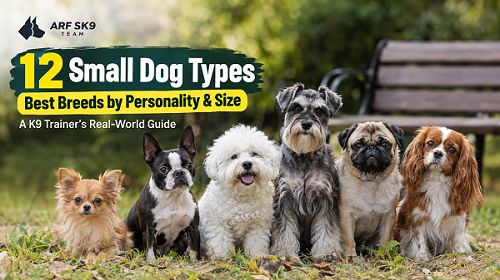
The best small dog breeds for most households are the Cavalier King Charles Spaniel (gentle, family-friendly), the French Bulldog (low-energy apartment companion), the Miniature Schnauzer (alert, trainable watchdog type), and the Bichon Frise (hypoallergenic and social). The “right” small breed depends less on cuteness and more on matching energy level, trainability, and bark tendency to your actual daily life, which is exactly what this guide breaks down, breed by breed.
Table of Contents
- Why “Small Dog” Doesn’t Mean “Simple Dog”
- How We Chose These 12 Breeds
- The 12 Best Small Dog Breeds by Personality & Size
- Small Dog Comparison Table
- How to Match a Small Breed to Your Lifestyle
- What Small Dogs Really Cost (2026 Numbers)
- Training Small Dogs: A Working-Dog Trainer’s Perspective
- Health & Safety Considerations Most Articles Skip
- FAQs
- Final Thoughts
Why “Small Dog” Doesn’t Mean “Simple Dog”
Here’s something I’ve seen trip up new owners over and over again in nearly a decade of working with dogs professionally: people assume a small dog is automatically an easy dog. Low maintenance. Low effort. Something you can more or less set and forget.
That’s just not true, and honestly, it’s the number one reason small dogs end up back in shelters or rescues within their first year. A Chihuahua that never learned bite inhibition is just as much of a liability at the dog park as an untrained Rottweiler, it’s just easier to physically pick up and remove from the situation, which is exactly why the bad habit never gets fixed. If you’re in the puppy stage right now, our guide on how to stop puppy biting fast applies just as much to a 4-lb Chihuahua as it does to a 90-lb Rottweiler.
So here’s what you’ll actually get in this guide, and where it goes further than most “top small dog breeds” lists you’ve probably already scrolled through:
- Real weight ranges and lifespans, not vague “small to medium” descriptions
- Trainability and bark tendency, broken down from actual working-dog training experience, not just AKC breed standard copy
- What each breed costs to actually own over its lifetime, using 2025-2026 data, not decade-old averages
- Which of these breeds can double as a legitimate alert or watchdog, since a lot of small dog guides completely ignore this, even though several toy and small breeds were originally bred for exactly that job
- A lifestyle-matching framework so you’re picking a dog that fits your week, not just a photo that made you go “aww”
If you’re weighing a small dog against a larger breed for security or family protection reasons, it’s worth reading our breakdown on the best dogs for security and family first, small dogs can alert, but very few can physically deter, and that distinction matters.
How We Chose These 12 Breeds
This article was put together by the team at ARF SK9, where we train working, protection, and companion dogs for clients across multiple countries. We pulled breed data from the American Kennel Club (AKC), The Kennel Club (UK), and veterinary and behavior sources, and cross-checked it against what we’ve actually observed handling small breeds in obedience and socialization classes over the years. Where a stat or study is cited, we’ve linked the source.
We didn’t just rank breeds by cuteness or popularity. Each of the 12 breeds below had to check at least three of these boxes:
- Adult weight typically under 30 lbs (13.6 kg)
- A well-documented, distinct personality type (not just “friendly”)
- Established AKC or Kennel Club recognition, so health and temperament data actually exists
- A realistic fit for at least one common household situation , apartment living, families with kids, first-time owners, or active singles.
The 12 Best Small Dog Breeds by Personality & Size
1. Cavalier King Charles Spaniel — The Gentle All-Rounder
- Weight: 13-18 lbs
- Height: 12-13 inches
- Lifespan: 12-15 years
- Personality: Affectionate, eager to please, adaptable
Named after King Charles II of England, who reportedly kept several in his court and even at meetings of state, this breed has been bred for companionship for centuries and it shows. Cavaliers genuinely don’t do well alone for long stretches; they’re what I’d call a “velcro breed.” Great with kids, other dogs, and even cats, but not the pick if your household is empty nine hours a day.
Watch for: Mitral valve disease is unfortunately common in the breed, affecting a large share of Cavaliers by middle age. A reputable breeder should provide cardiac clearances for both parents.
2. French Bulldog — The Low-Energy City Dog
- Weight: 16-28 lbs
- Height: 11-13 inches
- Lifespan: 10-12 years
- Personality: Playful, easygoing, people-oriented
The French Bulldog has held the AKC’s #1 most-registered-breed spot in the United States for four years running as of the 2025 rankings, overtaking the Labrador Retriever’s 31-year reign at the top. That’s not a small shift, it reflects how well this breed fits modern city living: minimal exercise needs, doesn’t bark excessively, and thrives in small apartments.
Watch for: As a brachycephalic (flat-faced) breed, Frenchies can’t regulate heat well and are poor swimmers. Many airlines restrict or ban them from cargo transport because of breathing-related flight risks. If you live somewhere hot and humid, including much of West Africa or the southern US, factor in the cost of a well-ventilated or air-conditioned space.
3. Dachshund — The Bold Little Hunter
- Weight: 16-32 lbs (standard), 11 lbs or under (miniature)
- Height: 8-9 inches (standard)
- Lifespan: 12-16 years
- Personality: Curious, stubborn, surprisingly brave
Dachshunds jumped from the #6 to the #5 most popular breed in America in the AKC’s 2025 rankings, bumping the Poodle out of the top five for the first time in years. Originally bred in Germany to hunt badgers underground (the name literally translates to “badger dog”), they’ve kept every ounce of that tenacity, which is why they’re notoriously difficult to recall off a scent trail once they’re locked on.
Watch for: That long spine is a real vulnerability. Intervertebral disc disease affects roughly 1 in 4 Dachshunds during their lifetime, according to veterinary orthopedic research, largely because of their unusual body proportions. Skip the stairs and the couch-jumping if you can help it.
4. Pug — The Comedian
- Weight: 14-18 lbs
- Height: 10-13 inches
- Lifespan: 12-15 years
- Personality: Charming, mischievous, social
Pugs trace back over 2,000 years to Chinese imperial courts, where they were so valued that soldiers reportedly guarded them. Today they’re basically professional comedians, dramatic, food-motivated, and happiest glued to your side. They train reasonably well for treats but have zero interest in obedience for obedience’s sake, so keep sessions short and rewarding.
Watch for: Similar brachycephalic concerns to the French Bulldog, plus a tendency to gain weight fast if you’re not careful with portions.
5. Boston Terrier — The American Gentleman
- Weight: 12-25 lbs
- Height: 15-17 inches
- Lifespan: 11-13 years
- Personality: Friendly, intelligent, occasionally stubborn
Developed in Boston in the late 1800s, this is one of the few breeds actually created in the United States. Bostons are sharp and pick up commands fast, but they’re also known for a streak of independence that can frustrate first-time trainers who expect instant compliance. Short daily walks plus a bit of mental stimulation, puzzle feeders, short training games, keep them content.
6. Shih Tzu — The Palace Companion
- Weight: 9-16 lbs
- Height: 9-10.5 inches
- Lifespan: 10-18 years
- Personality: Outgoing, affectionate, calm
Bred specifically for Chinese royalty as lap companions (the name translates roughly to “lion dog”), Shih Tzus are one of the most consistently even-tempered small breeds around kids and strangers alike. The trade-off is grooming: that long double coat mats quickly without brushing every 2-3 days, and most owners end up on a 6-8 week professional grooming schedule.
7. Yorkshire Terrier — The Feisty Featherweight
- Weight: Up to 7 lbs
- Height: 7-8 inches
- Lifespan: 13-16 years
- Personality: Bold, affectionate, feisty
Yorkies were originally bred in 19th-century England’s textile mills to hunt rats, a working-class, working-dog job, despite how they’re marketed today as luxury lapdogs. That ratting instinct is still very much alive, which is why Yorkies tend to bark at anything that moves and have a surprisingly loud voice for their size. That trait is actually useful: several of our clients keep Yorkies specifically as an early-warning alert dog inside larger properties, paired with a bigger breed for the actual deterrent.
8. Chihuahua — The Pocket Powerhouse
- Weight: Up to 6 lbs
- Height: 5-8 inches
- Lifespan: 14-16 years (one of the longest-lived breeds)
- Personality: Confident, sassy, deeply loyal to one person
Named after the Mexican state of Chihuahua, where the breed was first documented by Western travelers, this is the smallest dog breed in the world by weight and it doesn’t act like it. Chihuahuas famously bond intensely with one specific person and can become wary or even snappy with everyone else if not socialized early. This is the textbook case of “small dog syndrome”: since owners rarely correct a 4-lb dog’s pushy behavior the way they would a 40-lb dog’s, bad habits calcify fast. Start structured socialization by 8-10 weeks old.
9. Miniature Schnauzer — The Alert Watchdog
- Weight: 11-20 lbs
- Height: 12-14 inches
- Lifespan: 12-15 years
- Personality: Alert, intelligent, spirited
If you want a small dog that actually functions as a real watchdog, this is arguably the strongest pick on this list. Mini Schnauzers were bred in Germany to guard farms and hunt vermin, and that alertness never got bred out. They notice everything, footsteps outside, a car door, a delivery and they’ll tell you about it immediately. Highly trainable and food-motivated, they pick up obedience work faster than most breeds on this list, which is why we recommend them often to clients who want a low-maintenance “second set of ears” alongside kids or an older dog.
10. Bichon Frise — The Hypoallergenic Charmer
- Weight: 12-18 lbs
- Height: 9.5-11.5 inches
- Lifespan: 14-15 years
- Personality: Cheerful, adaptable, people-pleasing
Descended from Mediterranean water dogs and popularized in French royal courts in the 1500s, Bichons are genuinely one of the easiest small breeds to live with. They’re eager to please, train well, and their curly low-shedding coat makes them one of the more allergy-friendly options, though “hypoallergenic” is never a 100% guarantee with any breed, since allergens come from dander and saliva, not just fur.
11. Jack Russell Terrier — The Athlete
- Weight: 13-17 lbs
- Height: 10-15 inches
- Lifespan: 13-16 years
- Personality: Bold, high-energy, relentlessly smart
Don’t let the size fool you, Jack Russells were bred in 19th-century England to keep pace with foxhounds during hunts, and they still have the engine of a working dog stuffed into a small frame. This is not a couch-companion breed. Without at least 45-60 minutes of real exercise daily plus mental work, Jack Russells become destructive and vocal out of sheer boredom. They’re brilliant, but that intelligence needs an outlet.
12. Pomeranian — The Fluffy Extrovert
- Weight: 3-7 lbs
- Height: 6-7 inches
- Lifespan: 12-16 years
- Personality: Confident, curious, surprisingly bold
Descended from larger Arctic sled-type dogs (the Spitz family) and shrunk down through selective breeding in Pomerania, this breed somehow kept the confidence of its much larger ancestors. Poms are famously unaware of their own size, which means they’ll happily challenge dogs many times their weight, a trait that needs careful management, not encouragement.
Small Dog Comparison Table
| Breed | Weight | Energy | Trainability | Best For |
|---|---|---|---|---|
| Cavalier King Charles Spaniel | 13-18 lbs | Low-Moderate | High | Families, companionship |
| French Bulldog | 16-28 lbs | Low | Moderate | Apartments, first-time owners |
| Dachshund | 11-32 lbs | Moderate | Moderate | Active singles, experienced owners |
| Pug | 14-18 lbs | Low-Moderate | Moderate | Families, seniors |
| Boston Terrier | 12-25 lbs | Moderate | High | Active urban owners |
| Shih Tzu | 9-16 lbs | Low | Moderate | Families with kids |
| Yorkshire Terrier | Up to 7 lbs | Moderate | Moderate | Alert/companion combo |
| Chihuahua | Up to 6 lbs | Moderate | Moderate | Single-person households |
| Miniature Schnauzer | 11-20 lbs | Moderate-High | Very High | Watchdog + family combo |
| Bichon Frise | 12-18 lbs | Moderate | High | Allergy-sensitive households |
| Jack Russell Terrier | 13-17 lbs | Very High | Very High | Active, experienced owners |
| Pomeranian | 3-7 lbs | Moderate | Moderate | Companionship, apartment life |
How to Match a Small Breed to Your Lifestyle
Most small dog articles stop at “here are 12 cute breeds.” But the question that actually matters is: which one fits your week? Ask yourself these four things before you fall in love with a photo.
- How many hours is your home empty on a typical weekday? Cavaliers, Pugs, and Shih Tzus struggle badly with long solo stretches. Chihuahuas and Frenchies tolerate it a bit better.
- Do you have young kids or frequent visitors? Bichons, Cavaliers, and Boston Terriers handle chaos and new faces well. Chihuahuas and Pomeranians, without early socialization, often don’t.
- Do you want a dog that actually alerts you to visitors? Miniature Schnauzers and Yorkies are the strongest picks here. Pugs and Shih Tzus are the quietest.
- How much daily exercise can you realistically commit to? Jack Russells and Dachshunds need real outlets. French Bulldogs and Pugs are content with short walks.
If your honest answers point toward wanting a genuinely protective presence rather than just an alert bark, a small breed likely isn’t the right fit for that specific job, see the security and family breeds guide linked above for options built for that role.
What Small Dogs Really Cost (2026 Numbers)
This is the section most breed guides skip entirely, and it’s where a lot of new owners get blindsided.
Average Lifetime Cost of Owning a Small Dog
According to Synchrony’s 2025 Pet Lifetime of Care Study, lifetime dog ownership costs now range from $22,125 to $60,602, up more than 11% since 2022 and nearly 8 out of 10 pet owners underestimate this number going in. A separate 2025 industry survey from Rover pegged the average lifetime cost for a 10-year-old dog at roughly $34,550, factoring in the sharp recent rises in grooming supplies, treats, and veterinary fees. (If you’re reading this outside the US, our breakdown of what a dog really costs to own in Nigeria is a useful side-by-side for how these numbers translate to a different market.)
Small breeds generally sit on the lower end of that range, smaller dogs eat less, need smaller medications, and (with exceptions like the Cavalier and Frenchie) tend to have fewer chronic conditions than giant breeds. But don’t assume “small” automatically means “cheap.”
Where the Money Actually Goes
- Grooming-heavy breeds (Shih Tzu, Bichon Frise, Yorkshire Terrier) typically run $50-$90 per professional grooming session every 4-8 weeks. If grooming cost is a dealbreaker for you, our list of low-maintenance dog breeds with basic grooming needs is worth a look before you commit to one of the fluffier breeds on this list.
- Brachycephalic breeds (French Bulldog, Pug, Boston Terrier) tend to carry higher lifetime vet bills due to breathing, eye, and skin fold issues
- Initial acquisition cost from a reputable breeder for these 12 breeds generally ranges from $1,500-$4,000+, depending on breed, lineage, and country
- Pet insurance now averages around $313/year nationally, and increasingly owners are budgeting for it upfront rather than treating it as optional
Bottom line: budget for the dog you’re actually getting, not just the sticker price of the puppy.
Training Small Dogs: A Working-Dog Trainer’s Perspective
I’ll be straight with you: small dog training gets taken less seriously than it should, and it shows in the number of adult small dogs we see with fear-based reactivity, resource guarding, or leash aggression that started as “cute” puppy behavior nobody corrected.
Four Rules We Give Every Small-Breed Client
- Start socialization by 8-10 weeks, not 6 months. The critical socialization window for puppies closes around 12-16 weeks. Miss it, and you’re managing fear responses for life instead of preventing them.
- Don’t let size decide what gets corrected. If a 60-lb dog jumping on guests is “a problem,” a 6-lb dog doing the same thing is too, just less physically obvious.
- Basic obedience typically takes 8-12 weeks of consistent daily practice to become reliable, regardless of breed size. Miniature Schnauzers and Bichons tend to be on the faster end of that; Chihuahuas and Pomeranians, if socialization was skipped early, often need longer.
- Crate training within the first 2-3 weeks at home prevents a huge share of the separation anxiety we see later in velcro breeds like Cavaliers. Our full walkthrough on how to crate train a puppy covers the exact timeline and common mistakes owners make in week one.
If you’d rather have a structured, step-by-step system to follow at home instead of piecing advice together from blog posts, our complete puppy and small dog training e-book walks through the exact socialization and obedience framework we use with clients, broken into a week-by-week plan.
Health & Safety Considerations Most Articles Skip
Four Risks Most “Best Small Dogs” Roundups Don’t Mention
- Small dogs are less likely to be housetrained successfully. One widely-cited behavioral sample found only 66% of small breeds were fully housetrained, compared to 95% of large breeds, largely because owners are less consistent about correcting accidents from a dog that isn’t causing visible damage.
- Falls and injuries are a real hazard. A jump off a couch or bed that a Labrador shrugs off can fracture a leg in a Chihuahua or Pomeranian. If you’ve got one of the more fragile toy breeds, consider pet stairs early on.
- Dental disease hits small breeds harder. Toy and small breeds are proportionally more prone to periodontal disease because their teeth are often too large for their jaw size, leading to crowding. Daily brushing or dental chews matter more here than with larger dogs.
- Heatstroke risk is elevated in flat-faced breeds. French Bulldogs, Pugs, and Boston Terriers can overheat in conditions a longer-nosed breed would handle fine. Never leave any of these three in a parked car, even briefly, even with windows cracked.
FAQs
What is the friendliest small dog breed?
The Bichon Frise and Cavalier King Charles Spaniel consistently rank among the friendliest small breeds, both bred specifically for companionship and known for getting along well with kids, strangers, and other pets.
Which small dog breed is best for apartments?
French Bulldogs and Pugs are typically the best fit for apartment living thanks to their low exercise needs and minimal barking tendency, though any small breed can adapt to apartment life with sufficient daily activity.
Are small dogs good with kids?
Many are, but it depends heavily on the breed and socialization. Bichon Frises, Cavaliers, and Boston Terriers are generally excellent with children, while Chihuahuas and Pomeranians need careful early socialization and gentle handling since they’re more fragile physically.
Do small dogs live longer than big dogs?
Yes, generally. Small breeds like the Chihuahua often live 14-16 years, while giant breeds average closer to 8-10 years, a well-documented inverse relationship between body size and lifespan across dog breeds.
Can a small dog be a good guard dog?
Small breeds like the Miniature Schnauzer and Yorkshire Terrier make excellent alert dogs, they’ll reliably bark at anything unusual but they lack the size and strength to physically deter an intruder the way a trained protection breed can. Think of them as your alarm system, not your security guard.
Final Thoughts
If there’s one thing to take away from this guide, it’s this: pick based on temperament fit and daily-life logistics, not just how a breed photographs. A Jack Russell in a small apartment with a sedentary owner is a recipe for a destroyed couch and a frustrated dog. A Cavalier left alone for 10 hours a day is a recipe for anxiety-driven behavior problems. Match the dog to your actual life, not your Pinterest board.
Best Small Breed by Use Case
- Best all-around family companion: Cavalier King Charles Spaniel or Bichon Frise
- Best for apartments and first-time owners: French Bulldog
- Best natural watchdog: Miniature Schnauzer
- Best for active owners who want a real workout partner: Jack Russell Terrier
- Best for allergy-sensitive households: Bichon Frise
Whichever breed you choose, start structured socialization early, budget honestly for the lifetime cost (not just the puppy price), and don’t assume small means simple. Do that, and you’ll end up with a small dog that’s genuinely easy to live with, not just easy to carry.

Her work centres on obedience, detection, protection and operational readiness. She favours proven methods built on repetition, consistency and real-world conditioning, so that both dogs and handlers are prepared for high-pressure tasks.
Rofiat represented the Nigerian Army Dog Centre at the Nigerian Army Day Celebration (NADCEL) 2026, where she led demonstrations in obedience, explosive detection, agility and tactical movement. Through articles, training content and documentaries, she shares field-based insight into how structured training, clear communication and trust between handler and dog affect performance and reliability.
She is the author of Beyond the Bark: Inside a Pro Handler's Playbook for Raising the Ideal Dog, a practical guide that helps dog owners and handlers apply professional training principles in everyday situations.
- Bousnic Dog Training Collar Review: Is It Safe? - September 30, 2026
- Gravy Train Dog Food Review: Ingredients & Recalls - September 30, 2026
- How to Spot Fake AKC Registered Dogs: 5 Warning Signs - September 29, 2026