Why Labradors Are the World’s Top Detection & Service Dogs
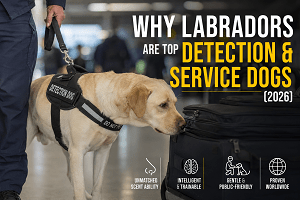
Labrador Retrievers make up roughly 60–70% of guide dogs worldwide and are one of only seven breeds TSA trusts for explosive detection in US airports. They dominate because they combine a food-driven brain that’s easy to train, a nose built for scent work, and a friendly face that never scares the public, a combination almost no other working breed offers in one package.
Table of Contents
- The Numbers: How Much Do Labradors Really Dominate?
- 8 Traits That Make Labradors Built for the Job
- Labrador vs German Shepherd vs Belgian Malinois vs Golden Retriever
- Real-World Case Studies: Labradors on the Job Worldwide
- Training Timeline: How Long Before a Lab Is Operational?
- What a Working Labrador Actually Costs
- Working Labradors vs Pet Labradors: Don’t Confuse the Two
- The Selection Process: Why Most Labradors Never Qualify
- Real Challenges Handlers Don’t Always Talk About
- Trainer’s Take: What I’d Tell Anyone Starting This Journey
- Conclusion & Action Plan
- Frequently Asked Questions
The Numbers: How Much Do Labradors Really Dominate?
Let’s start with the hard data, because this is where most articles on this topic get vague. Here’s what the actual programs report:
| Statistic | Figure | Source/Program |
|---|---|---|
| TSA explosive detection breeds used | 7 (Labrador, German Shepherd, Belgian Malinois, Golden Retriever, GSP, GWP, Vizsla) | TSA National Explosives Detection Canine Program |
| Of TSA’s ~1,200 working dogs, “floppy-eared” breeds (Labs, Goldens, Pointers, Vizslas) | ~80% | TSA / Washington Examiner disclosure |
| TSA canine training graduation rate | ~80–83% | TSA Canine Training Center, San Antonio |
| Cost to train a TSA conventional detection team | ~$33,000 | TSA factsheet |
| Cost to train a TSA passenger-screening team | ~$46,000 | TSA factsheet |
| Labradors in guide dog breeding colonies (varies by school, 50–60%+ typical) | Largest single breed share | Guide Dogs for the Blind, The Seeing Eye, Guide Dogs Australia |
| Guide/service dog program-wide graduation rate | 50–56% (some programs), ~30% (others) | Multiple guide dog schools |
| Drug detection accuracy, Labrador retrievers in UK police trial | 87.7% correct indications, 5.3% false alerts | UK police canine drug detection study |
| Medical detection dogs, cancer detection sensitivity/specificity | Over 90% in peer-reviewed trials | Medical Detection Dogs (UK charity) |
| Odor detection threshold | ~1 part per trillion | Multiple canine olfaction studies |
| Labrador scent receptors | ~300 million (vs. ~5–6 million in humans) | Canine olfaction research |
| Working Labrador height/weight | 21.5–24.5 in (55–62 cm), 55–80 lbs (25–36 kg) | AKC/Kennel Club breed standard |
A few of these numbers deserve context, because they tell a bigger story than a spreadsheet row.
When TSA administrator David Pekoske talked to reporters about the agency’s canine roster, he confirmed something handlers have known for years: passengers relax around floppy-eared dogs. Roughly 80% of TSA’s 1,200 working canines are Labradors, Golden Retrievers, German Shorthaired Pointers, Wirehaired Pointers, or Vizslas, breeds with soft, floppy ears. German Shepherds and Belgian Malinois, with their pricked ears and more intense presence, make up the remaining 20%. That’s a deliberate operational decision, not a coincidence, and it’s one of the clearest data points showing why temperament and public perception matter as much as nose sensitivity.
On the guide dog side, Guide Dogs for the Blind (GDB) in San Rafael, California, states plainly that Labrador Retrievers have proven to have the most success worldwide as guides, and Labradors make up the largest share of GDB’s own breeding colony. The Seeing Eye, America’s oldest guide dog school, founded in 1929, breeds German Shepherds, Labradors, Golden Retrievers, and Lab-Golden crosses specifically for intelligence, good health, moderate size, sound hips, and gentle temperament.
8 Traits That Make Labradors Built for the Job
Labradors weren’t picked for this work by accident. Every trait below traces back to what they were originally bred for: working with a person, not away from them.
1. Bred to Retrieve and Take Direction
Labradors trace back to Newfoundland fishing dogs that hauled nets and retrieved fish that slipped off lines in freezing Atlantic water. That job required a dog that would work in partnership with a human, follow hand direction, and bring things back rather than run off with them. That’s the exact skeleton of modern detection work: search, find, and communicate the find back to the handler instead of acting on it alone. If you want the fuller backstory on how this breed’s working history shapes modern roles, our piece on what makes a dog a “working dog” breaks down how detection, service, military, and SAR roles actually differ.
2. A Brain That’s Never Satisfied
Ask any Lab handler and they’ll tell you the same thing: these dogs are “always begging for something to do.” That restless drive to work is a double-edged sword at home (hello, chewed shoes) but it’s gold in a training kennel. A bored Lab in a family home becomes destructive. A bored Lab in a detection program becomes a liability that loses focus mid-search, which is exactly why working-line breeders select hard against low drive.
3. Food Motivation Speeds Up Everything
Labs are famously food-obsessed, and trainers use that shamelessly. Because a Lab will work for a piece of kibble with the same enthusiasm on day 400 as day one, you get instant, consistent reinforcement the second the dog hits target odor. Compare that to breeds that are more toy- or prey-driven and need a tug session as a reward, food rewards are faster to deliver, easier to standardize across handlers, and don’t interrupt a search sequence.
4. A Face That Doesn’t Scare Anyone
This is the trait competitors rarely give enough weight to, and it’s arguably the single biggest reason Labs beat German Shepherds and Malinois for public-facing roles. A German Shepherd working a checkpoint can visibly spike a nervous flyer’s anxiety. A Labrador does the identical job and most people don’t even clock it as “security”, they just see a friendly dog. The Canadian Border Services Agency specifically uses Labradors in correctional facilities for this reason: they’re less likely to intimidate inmates than a shepherd-type breed would be.
5. They’ll Work for Whoever’s Holding the Leash
Most working breeds bond tightly to one handler and their performance drops when that handler changes. Labradors are the exception, they’ll produce reliable results with a rotating cast of handlers, which matters enormously for large agencies (TSA, border forces, hospital therapy programs) where staffing changes constantly and you can’t afford a dog that only “works” for one person.
6. Emotional Stability Under Pressure
A good detection dog needs to walk into a packed terminal, a construction-noise environment, or a crowd of screaming kids and stay completely task-focused. Labradors score consistently high on environmental soundness testing, they don’t spook, freeze, or shut down the way more sensitive or reactive breeds can. This is tested formally: programs like The Seeing Eye run a mid-training “blindfold test” around 6–8 weeks into formal training specifically to measure how a dog handles pressure and distraction.
7. A Body Built for Public Spaces
At 55–80 lbs and roughly 22–24 inches at the shoulder, a Lab is large enough to brace for mobility support, pull a wheelchair, or physically block a fall but small enough not to dominate a crowded aisle, an airplane cabin, or a hospital elevator. Compare that to an 80–100 lb Rottweiler or a rangy GSD, and you can see why size alone rules a lot of breeds out of public-access work before temperament is even considered.
8. A Nose Backed by Real Science
This is the trait everyone assumes but few explain properly. Dogs have roughly 300 million scent receptors compared to a human’s 5–6 million, and trained detection dogs can pick up concentrations as low as one part per trillion, researchers compare that to smelling a single teaspoon of sugar dissolved in two Olympic-sized swimming pools. But raw nose power isn’t the whole story. Medical Detection Dogs, a UK charity, has published peer-reviewed results showing trained dogs hitting over 90% sensitivity and specificity detecting certain cancers from scent samples alone and during COVID-19 trials, their top-performing dogs hit up to 94.3% sensitivity, beating the accuracy threshold the WHO recommended for diagnostic tests at the time. That kind of accuracy doesn’t come from the nose alone, it comes from imprinting protocols, repetition, and handler teamwork layered on top of biology. We go deeper into the mechanics of this in the science behind explosive detection accuracy.
Labrador vs German Shepherd vs Belgian Malinois vs Golden Retriever
This is probably the most common question I field from people building or joining a K9 program: “Why not just use a Shepherd or a Malinois for everything?” Short answer, different jobs need different dogs, and picking the wrong breed for the role is one of the most expensive mistakes a program can make.
| Trait | Labrador | German Shepherd | Belgian Malinois | Golden Retriever |
|---|---|---|---|---|
| Best-suited role | Detection, service, therapy, medical alert | Patrol, protection, dual-purpose K9 | High-intensity military/tactical work | Service, therapy, guide work |
| Public presence | Non-threatening, approachable | Can intimidate the public | Very intense, not public-facing | Extremely non-threatening |
| Drive type | Food/work drive, biddable | Prey and defense drive | Extremely high prey drive | Food/work drive, biddable |
| Handler flexibility | Works well with multiple handlers | Usually bonds to one handler | Usually bonds to one handler | Works well with multiple handlers |
| Energy management | High but manageable with daily work | Very high, needs a job | Extremely high, needs intense work | High but manageable |
| Coat/shedding | Moderate-heavy shedding | Heavy shedding | Moderate shedding | Heavy shedding |
| Typical working lifespan | 8–10 years active service | 8–10 years active service | 6–9 years (intense wear) | 8–10 years active service |
| Not ideal for | Bite work, patrol, suspect apprehension | Ultra-public-friendly roles | Family/public settings, first-time handlers | Protection work of any kind |
When each breed makes sense
Choose a Labrador or Golden Retriever when: the dog will work in public (airports, hospitals, schools, courthouses), you need narcotics/explosives/medical-alert detection, multiple handlers will rotate through the role, or you’re placing a service dog with a family.
Choose a German Shepherd when: you need a dual-purpose K9 that can detect and apprehend, you’re running patrol or protection work, or you need a dog capable of independent decision-making under a single dedicated handler.
Choose a Belgian Malinois when: you need the highest possible drive and speed for tactical or military work, and you have an experienced handler who can manage that intensity, Malinois are not a good fit for first-time handlers or public-facing roles.
If protection and family security are more your concern than detection work, our roundup of top guard and protection breeds for family safety covers where Shepherds, Malinois, and other protection breeds genuinely outperform a Lab.
Real-World Case Studies: Labradors on the Job Worldwide
Numbers on a spreadsheet only tell you so much. Here’s where Labradors are actually doing the work, with named programs and verified figures.
TSA National Explosives Detection Canine Program (USA)
TSA runs its Canine Training Center at Joint Base San Antonio-Lackland, a $12 million, 25,000-square-foot facility with 17 mock environments including airport gates, baggage claim, light rail cars, and aircraft interiors. About 325 dogs graduate annually, with roughly 80–83% completing the program. TSA also runs its own Labrador breeding program at Lackland, modeled directly on Australia’s Customs Service breeding program, with foster families raising puppies locally before formal training begins.
One story that still comes up in handler circles: Sirius, a yellow Labrador working explosives detection for the Port Authority Police at the World Trade Center, was killed in the line of duty on September 11, 2001, the only police canine fatality that day. It’s a sober reminder of how seriously these “friendly” dogs are actually taken in high-stakes security work.
Australian Border Force (ABF)
The ABF has run its own Labrador breeding program since 1993, selecting specifically for high drive, steady temperament, and adaptability to harsh environments. Narcotics detection makes up roughly 60% of all ABF detector dog operational tasks, and Labradors remain the primary breed for the role.
Guide Dog Schools Worldwide
Labradors dominate the guide dog world across every major program: Guide Dogs for the Blind (US), The Seeing Eye (US), Leader Dogs for the Blind (US), Guide Dogs Australia, and Guide Dogs UK all breed and place Labradors as their largest single-breed cohort, often alongside Golden Retrievers and Lab-Golden crosses. Leader Dogs for the Blind, for example, reports roughly 450+ puppies born into its breeding program in a typical year, almost entirely Labradors, Goldens, their crosses, and German Shepherds.
Medical Detection Dogs (UK Charity)
Founded in 2008, this Buckinghamshire-based charity trains two categories of dogs: Bio Detection Dogs, which sniff cancer, Parkinson’s, and infection markers from lab samples, and Medical Alert Assistance Dogs, which live with patients and alert to conditions like Type 1 diabetes, Addison’s disease, and severe allergies in real time. Their published trial data shows detection accuracy for certain cancers exceeding 90% sensitivity and specificity, numbers that stack up favorably against some lab-based diagnostic tools.
UK Police Canine Drug Detection
A published study comparing 68 Labrador Retrievers against 61 German Shepherds in operational drug detection found Labradors returned 87.7% correct indications with only a 5.3% false-alert rate, a strong showing against a breed traditionally associated with police work.
Training Timeline: How Long Before a Lab Is Operational?
Timelines vary a lot depending on the role, so here’s the realistic breakdown by job type.
Full public-access service dog: 18–24 months
- Months 0–6 — Foundation & Socialization: basic obedience, exposure to varied environments, positive-reinforcement groundwork.
- Months 6–12 — Task Introduction: handler-specific tasks introduced, impulse control drilled around distractions.
- Months 12–18 — Advanced Task Work: reliability testing in complex, real-world settings.
- Months 18–24 — Public Access Testing: formal evaluation against public-access standards before certification.
Scent/explosives detection specifically: 8–16 weeks
TSA’s conventional detection course runs about 11 weeks; its passenger-screening course runs 16 weeks because the dog also has to be comfortable detecting odor on a moving person in a security lane, which is a very different skill from searching static cargo. Dedicated scent-imprinting programs elsewhere often run 2–3 months, with the dog living full-time with the trainer during that window.
Guide dog training: roughly 4–6 months formal training, on top of a year of puppy-raising
Most guide dog schools place a puppy with a volunteer raiser family from about 8 weeks old to around 14–18 months, then bring the dog back for 4 months of formal training with a sighted instructor before pairing with a client.
Best age to start foundational training
Most programs start basic obedience and socialization at 8–12 weeks. Labradors are physically mature by around 2 years old, but many don’t mentally settle until closer to 3, which is exactly why working roles typically don’t deploy a dog fully until 18–24 months of age at the earliest.
The graduation-rate reality check
Numbers vary a lot by program and by how “graduation” gets defined. TSA reports roughly 80–83% of its canines graduate. Some guide dog schools report 50–56% graduation. Older, frequently-cited service dog industry figures put failure as high as 70% across less selective programs. The honest takeaway: the more rigorous and Labrador-specific the breeding program, the higher the graduation rate, which is exactly why organizations like GDB, ABF, and TSA all run in-house Labrador breeding colonies instead of relying purely on outside pet-bred litters.
What a Working Labrador Actually Costs
Numbers here vary hugely by country and program, so let’s break it down by category.
Professional program-trained dogs: $25,000–$50,000
Fully trained assistance and detection dogs from established organizations typically run $25,000–$35,000, occasionally up to $50,000 for highly specialized skill sets. TSA’s own published figures put a conventional detection team (dog + handler training) at about $33,000, and a passenger-screening team at about $46,000. Most nonprofit guide dog schools don’t charge recipients this amount directly, they absorb the cost through donations, which is why waiting lists for guide dogs commonly run a year or more.
Self-training with a certified trainer: $3,000–$10,000
If you already own a suitable working-line Lab and hire a certified positive-reinforcement trainer to guide the process, total costs typically land between $3,000 and $10,000, depending on task complexity and how long training takes.
Professional trainer hourly rates: $150–$250/hour
Independent trainer time is usually billed hourly, and total cost is a function of how many specific tasks you’re teaching and how quickly the dog picks them up.
Why programs still bet on Labs financially
Because Labs work reliably with rotating handlers and have comparatively lower washout rates when bred from proven working lines, agencies get more operational years out of the same training investment. That’s the actual financial logic behind why TSA, ABF, and most guide dog schools keep circling back to this one breed instead of diversifying entirely.
Working Labradors vs Pet Labradors: Don’t Confuse the Two
This trips up a lot of people shopping for a “Labrador” without realizing there are two very different dogs wearing the same breed name.
| Trait | Working-Line Labrador | Show/Pet-Line Labrador |
|---|---|---|
| Energy level | Very high, needs daily purposeful work | Moderate, manageable in a normal home |
| Build | Leaner, more athletic | Stockier, “blockier” head and frame |
| Focus | Intense task focus | More generally affectionate, less driven |
| Trainability for high-level work | Excellent, bred for it | Good for basic obedience, harder for advanced work |
| Off-leash reliability | Requires experienced handling | Generally easier for average owners |
| Living situation | Often kenneled, worked daily | Typically a house pet |
If you’re buying a puppy specifically to raise into detection or service work, you need to be shopping working-line breeders, not the show-ring or backyard-bred litters most pet owners buy from. Our breed deep-dive on what makes Labradors exceptional service and detection dogs walks through how to spot the difference when you’re evaluating a litter. And regardless of which line you go with, that high working energy has to go somewhere, our guide on how often to exercise a working dog covers what “enough exercise” actually looks like for a driven Lab, because a 20-minute walk isn’t going to cut it.
The Selection Process: Why Most Labradors Never Qualify
Here’s the part that surprises people outside the industry: being a Labrador doesn’t automatically make a dog eligible for detection or service work. Selection is brutal, and it starts before the puppy is even weaned.
What programs actually screen for
- Comfortable and confident in unfamiliar environments
- Recovers quickly if startled, doesn’t freeze or shut down
- Persistent when searching for a target odor, doesn’t give up easily
- Tolerant of loud noise, crowds, and novel objects
- Neutral or friendly toward strangers and other dogs
- No history of fear-based or aggressive behavior
- Sound hips, elbows, and eyes on veterinary screening
Typical formal requirements (detection roles)
- Weight in the 40–75 lb range
- Age 10 months–3 years at intake
- High food drive combined with independence (able to work without constant handler cueing)
- Strong nerve stability under environmental pressure
Why so many wash out
Programs report dogs get released from training for a fairly consistent set of reasons: hereditary or orthopedic issues discovered during screening, low persistence on scent work, fear responses to novel stimuli, or resource-guarding and reactivity issues that surface under pressure. This is precisely why breeding programs like GDB’s and The Seeing Eye’s now track genomic and behavioral data across generations, a 2024 study analyzing 844 Labradors from The Seeing Eye found certain dental and health traits had strong enough predictive value (AUROC scores of 0.79–0.87) to actively guide future breeding decisions, moving guide dog breeding closer to the kind of data-driven selection used in livestock genetics for decades.
Real Challenges Handlers Don’t Always Talk About
Labradors aren’t a flawless breed, and pretending otherwise does a disservice to anyone considering one for working purposes.
- Adolescent chaos (8–18 months): This is the stretch where even well-bred working Labs test every ounce of patience a handler has. It’s normal, and it’s temporary, but programs lose dogs during this window if handlers misread normal adolescent pushback as a training failure.
- Energy that has to go somewhere: An under-exercised working-line Lab doesn’t just get restless, it gets destructive, mouthy, and hard to focus. Daily structured work isn’t optional for this breed.
- Food drive cuts both ways: The same food motivation that makes training fast can also make it harder to work a Lab reliably in food-scented environments (kitchens, food courts, farmers markets) without extra proofing.
- Off-leash impulse control: That retrieving instinct is strong, and a Lab with a nose down on an interesting scent trail can blow off a recall faster than people expect from such an “obedient” breed.
- Not built for protection: If the goal is a dog that can physically intimidate or intervene against a threat, a Labrador is the wrong tool. That’s not a flaw, it’s just not what the breed was built for.
Trainer’s Take: What I’d Tell Anyone Starting This Journey
If there’s one thing years around working dogs teaches you, it’s that breed reputation only gets you halfway there. I’ve watched well-bred working Labs sail through evaluations that washed out supposedly “easier” breeds, and I’ve watched pet-line Labs from backyard breeders struggle with basic focus exercises that a working-line puppy picks up in a single session. The breed name on the paperwork matters far less than the line, the early socialization, and the specific temperament testing a puppy goes through before eight weeks old.
If you’re serious about evaluating a dog properly, whether you’re raising a working prospect, a protection dog, or just want to understand what professional handlers actually look for beyond “is it friendly”, that evaluation mindset is exactly what I break down in my book, Beyond the Bark: Inside a Pro Handler’s Playbook for Raising the Ideal Dog. It covers the same drive testing, nerve strength evaluation, and trainability assessment methods programs like the ones above use, adapted so an everyday owner or aspiring handler can actually apply them.
Conclusion & Action Plan
Labradors didn’t earn their spot at the top of detection and service work through popularity alone. They earned it because a Newfoundland fishing dog’s genetics happened to produce exactly what modern institutions need: a biddable, food-motivated, emotionally stable dog with a world-class nose and a face that puts the public at ease. That’s a rare combination, and it’s why TSA, border forces on three continents, guide dog schools worldwide, and medical detection charities keep coming back to the same breed decade after decade.
Key takeaways:
- Labradors make up the largest single breed in most major guide dog and detection programs worldwide, and roughly 80% of TSA’s working dogs are floppy-eared breeds like Labs precisely because they don’t scare the public.
- Their edge comes from a specific trait stack: food motivation, multi-handler flexibility, environmental stability, and a nose that hits over 90% sensitivity in medical detection trials.
- Labs win detection, service, therapy, and medical-alert roles; German Shepherds and Malinois win protection, patrol, and dual-purpose K9 work.
- Training runs 8–16 weeks for pure scent detection, 4–6 months formal for guide work, and 18–24 months for full public-access service certification.
- Costs range from $3,000–$10,000 for self-training with a certified trainer up to $25,000–$50,000 for a fully program-trained dog.
- Graduation rates vary from roughly 50% to over 80% depending on how selective and Labrador-specific the breeding program is.
- Working-line and pet-line Labradors are genuinely different dogs, don’t buy a show-line puppy expecting working-dog performance.
- Selection is rigorous: hip/elbow/eye health, nerve stability, persistence, and food drive all get formally tested before a dog is accepted into a program.
If you’re considering a working Labrador:
- Source a puppy from a working-line breeder, not a show-ring or casual backyard breeder
- Begin structured socialization and basic obedience at 8–12 weeks
- Budget realistically, $3,000–$10,000 for self-training, $25,000+ for a program-trained dog
- Plan for 8 weeks to 24 months of training depending on the specific role
- Commit to daily structured exercise and mental work, this isn’t a low-maintenance breed
- Lean into the temperament instead of fighting it, the “too friendly for protection work” trait is exactly what makes this breed unbeatable everywhere else
Frequently Asked Questions
1. Why are Labradors used as sniffer dogs more than other breeds?
Labradors combine an exceptional nose (around 300 million scent receptors, able to detect concentrations near one part per trillion) with food-driven trainability and a temperament that doesn’t intimidate the public. That combination is why they’re one of only seven breeds in TSA’s explosives detection program and the primary breed in Australian Border Force narcotics detection since 1993.
2. Are Labradors smarter than German Shepherds?
Neither is “smarter”, they’re intelligent in different, job-specific ways. Labradors excel at obedience-based, food-motivated learning suited to detection and service tasks. German Shepherds excel at independent problem-solving suited to patrol and protection work, where a dog sometimes needs to make judgment calls without a handler’s cue. Pick the intelligence type that fits the job, not the breed with the better reputation.
3. What makes a Labrador suitable for service work?
Formal selection criteria include a stable, food-driven temperament; comfort in novel environments; resilience if startled; persistence during search tasks; tolerance of crowds and noise; and no history of fear-based or aggressive behavior. Physically, most detection programs require a weight of roughly 40–75 lbs and an intake age between 10 months and 3 years, alongside clean hip, elbow, and eye screenings.
4. Do working Labradors behave differently from pet Labradors?
Yes, significantly. Working-line Labs are leaner, higher-energy, and more intensely task-focused than show or pet-line Labs, which tend to be calmer and more generally affectionate but often harder to train for advanced work. If you want a working-capable dog, you need to source from working lines specifically, the breed name alone doesn’t guarantee working temperament.
5. Can any Labrador become a detection dog?
No. Even within working lines, most programs report meaningful washout rates, some as low as roughly 17-20% at highly selective agencies like TSA, and considerably higher at less selective programs. Dogs get released for hereditary health issues, low persistence on scent tasks, fear responses, or reactivity that surfaces under pressure. That’s exactly why leading programs run their own dedicated Labrador breeding colonies instead of relying on general pet-bred litters.
Have a question about raising or evaluating a working-line Labrador that this guide didn’t cover? Drop it in the comments, I read every one.

Her work centres on obedience, detection, protection and operational readiness. She favours proven methods built on repetition, consistency and real-world conditioning, so that both dogs and handlers are prepared for high-pressure tasks.
Rofiat represented the Nigerian Army Dog Centre at the Nigerian Army Day Celebration (NADCEL) 2026, where she led demonstrations in obedience, explosive detection, agility and tactical movement. Through articles, training content and documentaries, she shares field-based insight into how structured training, clear communication and trust between handler and dog affect performance and reliability.
She is the author of Beyond the Bark: Inside a Pro Handler's Playbook for Raising the Ideal Dog, a practical guide that helps dog owners and handlers apply professional training principles in everyday situations.
- Bousnic Dog Training Collar Review: Is It Safe? - September 30, 2026
- Gravy Train Dog Food Review: Ingredients & Recalls - September 30, 2026
- How to Spot Fake AKC Registered Dogs: 5 Warning Signs - September 29, 2026